

Read More


Recognized for AI Excellence at 2026 Globee® Awards - Read More

Maitray Gadhavi

Australian businesses are spending more on software than ever. Yet KPMG's 2026 survey of 270+ Australian business leaders ranked 'getting value from digital transformations' as their second-biggest challenge.
This problem rarely stems from technology. It stems from the partner. Whoever builds your software decides whether it fits the way your business actually runs or becomes one more tool your team works around. That makes selecting the right software development partner the decision that matters most. The right custom software development company in Australia is the one understands your industry’s rules, explains trade-offs in plain English, and puts code ownership in writing.
Here are the top Australian custom software development companies you can choose from, based on the end goal you are seeking:
| Company & Base | Core Strengths | Best Fit |
|---|---|---|
| Radixweb Melbourne Delivery Centre in Ahmedabad, India | Custom software, AI, legacy modernisation, dedicated teams | Regulated industries with long-term roadmaps. |
| WorkingMouse/Moonward Brisbane | Legacy modernisation, model-driven delivery | Government and enterprise programs |
| Appello Software Sydney | Custom software, CRM, ERP, mobile | Mid-sized, operations-heavy businesses |
| StepInsight Sydney | Web platforms, API integrations, mapping apps | SMBs with one workflow problems |
| EB Pearls Sydney | iOS, Android, Flutter, MVPs | Founders launching customer-facing apps |
| PixelForce Adelaide | Mobile and web apps, UX, data engineering | Health, fitness and consumer products |
Custom software development in Australia starts around AUD 25,000 for a focused tool and reaches AUD 150,000+ for enterprise platforms. What protects that money is the partner you pick. So, choose a software development company in Australia that explains trade-offs plainly, reviews every line of AI-generated code, and signs over the IP in writing. Businesses planning custom software in Australia can compare Radixweb, WorkingMouse, Appello Software, StepInsight, EB Pearls and PixelForce for fit and scope.
There are thousands of off-the-shelf solutions already available in the market. Yet, people look at custom software development, because generic software don't fit their unique needs. Especially for Australian businesses, off-the-shelf software fail because most SaaS products are built for a global average customer, not for local workplace rules, industry regulations and government systems.
Generic tools tend to break down in the same places:
Cost pressure makes the fit problem worse.
Many popular tools bill in US dollars, so a weaker Australian dollar raises the invoice without a single new feature. Custom software reverses that equation. The difference between an off-the-shelf software and custom software is that the latter is a system around your processes, you own it, and your staff stops re-keying data between tabs. The real decision is which partner can deliver it without the usual risks, and that's the point where most owners start comparing software development companies on fit rather than on price alone.
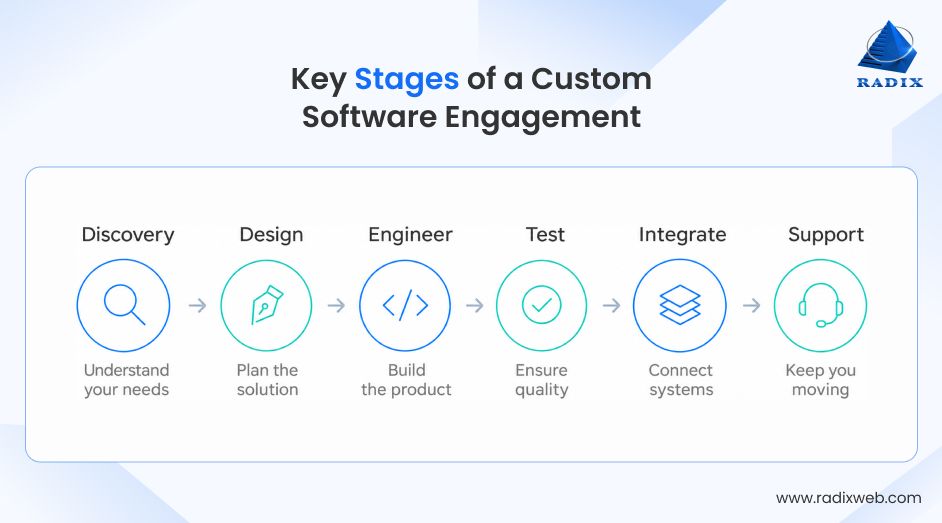
Custom software development companies in Australia design, build and maintain software made for one business's processes, data and compliance obligations, instead of selling the same product to every customer. They usually handle discovery, design, engineering, testing, integration and long-term support through onshore, offshore or hybrid teams.
A typical engagement with a custom software company covers:
It helps to see how a custom software company differs from the other options most owners consider first.
| Option | What you get | Best for | Watch out for |
|---|---|---|---|
| SaaS subscription | A ready-made product used by thousands of businesses | Standard needs such as email or basic accounting | Per-seat price rises, no control over the roadmap |
| Freelancer | One developer working on a defined task | Small, well-scoped jobs | Single point of failure, limited testing and support |
| Local agency | A design-led team in your city | Websites and marketing-led apps | Higher hourly rates, varied engineering depth |
| Custom software company | A full team covering discovery to support | Core business systems and new products | Needs a clear brief and active involvement from you |
The right choice depends on how central the software is to your operations. If it runs the core of your business, a dedicated custom software partner usually pays for itself.
The demand for custom software development in Australia is also driven by compliance obligations like the wage theft laws, ransomware payment reporting, Support at Home, AML/CTF tranche 2, Payday Super and the 10 December 2026 automated decision-making disclosure.
Each one changes what your systems must record, calculate or report.
| Date | Change | Who it affects | What your software must do |
|---|---|---|---|
| 1 Jan 2025 | Intentional wage underpayment becomes a criminal offence | All employers | Apply modern award rules correctly in rostering and payroll |
| 30 May 2025 (enforced from 1 Jan 2026) | Ransomware payment reporting within 72 hours | Businesses with turnover above $3M | Log incidents and support fast reporting |
| 1 Nov 2025 | Support at Home replaces Home Care Packages | In-home aged care providers | Handle new budgets, invoicing and claims |
| 1 Jul 2026 | AML/CTF tranche 2 obligations begin | Lawyers, accountants, conveyancers, real estate | Run customer due diligence, keep records, report |
| 1 Jul 2026 | Payday Super starts | All employers | Feed accurate pay data to payroll every pay run |
| 10 Dec 2026 | Automated decision-making disclosure | Entities covered by the Privacy Act | Record where automated decisions affect people |
| Dec 2026 | Federal agencies automate Peppol e-invoicing | Government suppliers | Send and receive e-invoices |
Past dates still matter because regulators are now enforcing them. Here's how to turn compliance requirements into a roadmap:
The 10 December automated decision-making rule is the next one to plan around.
The top custom software development companies in Australia for 2027 are Radixweb, WorkingMouse, Appello Software, StepInsight, EB Pearls and PixelForce. Each fits a different business need, from regulated-industry modernisation to mobile MVPs.
A genuine software development company in Australia has a verifiable local presence, such as a local office or registered business, contracts under Australian law and builds software that meets local privacy, workplace and industry rules. Every firm below meets that test.
Each of the companies we have mentioned below also passed four important checks:
The firms are grouped by the job each does best rather than ranked on awards.
Radixweb is the best fit for dedicated teams, modernisation, and AI in regulated industries, combining custom software experience since 2000 with a Melbourne office and a large engineering centre in India. That hybrid structure gives clients local contact and senior architecture expertise while keeping build costs below Sydney day rates.
Location: Suite 411, 343 Little Collins Street, Melbourne, with a delivery centre in Ahmedabad
Team: 650+ engineers
Services: Custom software, AI and machine learning, legacy and cloud modernisation, mobile apps, dedicated teams
Australian industries served: Automotive, fintech, HR tech, insurance and healthcare
Credentials: ISO 27001, ISO 9001 and SOC 2 certified; Microsoft Gold Partner
In mid-2026, Radixweb's sales leadership met Australian clients and partners in person across Sydney, Melbourne, Brisbane, Perth and Adelaide to discuss legacy modernisation, cloud migration and practical AI adoption.
Also, Radixweb's custom software development services start with a discovery phase and we stay on after launch as a dedicated squad.
Best for: businesses replacing or modernizing older systems, adding AI to existing software, or planning a multi-year product roadmap with one partner.
WorkingMouse is best for government and legacy modernisation work, with fully onshore Brisbane teams and a published delivery method it calls the Way of Working.
Location: Milton, Brisbane
Delivery model: fully onshore teams
Services: custom software, enterprise app modernisation, web and mobile development
Notable clients: Queensland Health, Transport and Main Roads and the Department of Defence, per its capability statement
Approach: Builds on the Codebots model-driven platform, which reuses tested components to lower risk on larger programs
Best for: public sector projects, onshore-only requirements and structured modernisation programs.
Appello Software is best for CRM, ERP and operations systems, with a Sydney-headquartered team that builds the platforms businesses run on day to day.
Location: George Street, Sydney
Services: Custom software, mobile apps, CRM and ERP implementations, API integrations
Industries: healthcare, manufacturing, property and financial services
Commercial model: bills against weekly milestones, so you pay for completed work
Time zones: Its Clutch profile lists support across Australian, Central European and UK hours
Best for: Mid-sized businesses replacing a patchwork of operations tools with one connected system.
StepInsight is best for workflow platforms and integrations, suiting owners who need one specific process fixed rather than a sprawling transformation program.
Location: York Street, Sydney
Services: custom web platforms, API integrations, geospatial and mapping applications
Recent reviewed work: A food safety management platform, a custom learning management system and a land surveying web app on Google Cloud
Client feedback: reviewers praise its ability to turn ideas from people without software backgrounds into working products
Best for: SMBs that need one well-built system to replace a manual process.
EB Pearls is best for mobile-first products and MVPs, having built iOS, Android and Flutter apps for founders and businesses since 2004.
Location: Surry Hills, Sydney, with teams in London and Kathmandu
Services: iOS, Android and Flutter apps, custom software, UX and UI design
Entry point: Its Clutch profile lists a minimum project size of $5,000+
Reviewed work: Ranges from small career apps to $200,000+ Flutter platforms, including work for a logistics real estate company
Best for: Customer-facing apps and early product validation on a startup budget.
PixelForce is best for health, fitness and consumer apps, with an onshore Adelaide team and a strong track record in wellness products.
Location: Kent Town, Adelaide
Industry focus: Healthcare and medical clients make up about 40% of its work, per its directory profile
Notable clients: Flinders University and the South Australian Government
Services: discovery, UX design, backend development, testing and data engineering
Best for: health and wellness founders who want an onshore product team.
No single firm wins every scenario, so match the firm to the job before comparing quotes:
| If you need to... | Consider Working With: |
|---|---|
| Modernize a legacy system and add AI under strict compliance | Radixweb |
| Deliver a government or onshore-only program | WorkingMouse |
| Replace scattered operations tools with one CRM or ERP | Appello Software |
| Fix one specific workflow with a focused build | StepInsight |
| Launch a customer-facing mobile app or MVP | EB Pearls |
| Build a health, fitness or consumer app | PixelForce |
Custom development delivers the biggest returns in situations such as these:
Replacing subscription sprawl with one system you own often costs less over five years than paying for overlapping tools, and it stops USD price rises flowing straight into your margin. Signs you've reached this point:
Scaling past spreadsheets and manual workarounds with automation usually costs less than hiring admin staff just to move data between systems. Typical candidates are order entry, invoicing, scheduling and reporting.
Custom software helps when preparing a business for sale or succession because documented, system-driven processes are easier for a buyer or successor to value and take over.
VistaPrint's 2026 research found nearly one in three small business owners plan to retire within five years, yet only 16% have a documented succession plan. That gap leaves many businesses dependent on knowledge that lives only in the owner's head.
Replacing and modernizing insecure or outdated legacy systems reduces cyber risk, because systems that can no longer be patched are a growing liability. The Australian Signals Directorate's 2024-25 data puts the average self-reported cost of cybercrime at $56,600 per report for small businesses and $97,200 for medium businesses.
Recovering from a failed project or a developer who kept the code starts with a code audit and an honest call on whether to stabilize or rebuild. The audit usually checks:
Account control is often the first problem to fix, and the contract terms covered further down prevent a repeat.
Custom software isn't the right fit for every business or situation. However, the situations above are clear signs you need tailored software development to deliver better business value.
The custom software development services Australian businesses need most are web applications, mobile apps, internal business systems, integrations with local platforms, AI features, legacy modernisation, MVP development and ongoing support, each shaped by local privacy, workplace and industry rules.
| Service | What it solves | Australian requirements to build in |
|---|---|---|
| Web applications and portals | Clients and staff need online access to data and tasks | Onshore data hosting, accessibility, ABN and GST handling |
| Mobile apps | Work happens away from a desk | Offline mode for regional coverage, local payment methods |
| Internal business systems | Spreadsheets and email run core operations | Modern award rules, STP Phase 2 and Payday Super data, WHS registers |
| System integrations | Data is re-keyed between tools | Xero, MYOB, Peppol, Services Australia, NDIS, PEXA |
| AI features | Staff spend hours reading, sorting or drafting | Automated decision-making disclosure, onshore data handling |
| Legacy modernisation | An old system is slow, insecure or unsupported | Notifiable Data Breaches scheme, ransomware reporting, minimal downtime |
| MVP development | A new product idea needs testing | R&D Tax Incentive records, testing with local users |
| Maintenance and support | Software needs to stay secure and current | Privacy Act security duties, incident response plans |
Web applications and customer portals are browser-based systems that let clients, suppliers or staff log in, upload documents and track progress without calling your office. Building a web solution is the same anywhere, but a portal used by Australian clients also has to handle local requirements such as:
Getting custom mobile apps developed gives field staff and customers iOS and Android access to your business, and many are built cross-platform with Flutter or React Native to keep one codebase. Where Australian projects differ is in the conditions the app must work under:
Internal business systems and workflow automation replace spreadsheets, email chains and manual double-handling with one system built around your process. The highest-value builds embed Australian workplace rules:
Integrating two or more systems connects the platforms your business already relies on, so data moves between them without re-keying. The usual connections are Xero and MYOB for accounting, Peppol for e-invoicing, Services Australia and NDIS systems for care providers, PEXA for e-conveyancing, and Australia Post or StarTrack for shipping.
A good integration layer also lets you replace one tool later without rebuilding everything around it.
Building smart AI features and mapping automations helps read, sort and draft work using your own data, while a person still approves the final decision.
For Australian businesses, two local issues shape the AI architecture design: entities covered by the Privacy Act must disclose significant automated decisions from 10 December 2026, and many clients expect their data to stay onshore, which limits the AI models and hosting regions you can use.
Modernizing a business application rebuilds or migrates an aging system to the cloud while the business keeps running. Many mid-market firms still rely on on-premise servers, old desktop software or custom databases built a decade or more ago. Moving them in stages lowers risk under the Notifiable Data Breaches scheme and the ransomware reporting rules for businesses over $3 million turnover.
Developing a minimum viable product produces a lean first version of a new product that tests the idea with real users before full investment. Founders often plan MVP work so that genuinely experimental activities are documented for an R&D Tax Incentive claim, and so the results can support future grant applications.
Software maintenance and ongoing support cover security patches, operating system updates, bug fixes and new features after launch. Because the Privacy Act requires reasonable technical and organisational steps to protect personal information, your support agreement should include patching timelines, backup testing and an incident response plan.
Most projects combine two or three of these services, such as an internal system, its integrations with Xero or payroll, and a mobile app for field staff.
Demand for custom software development services in Australia is the strongest where local regulation, award rules, distance or remote operations make generic software a poor fit. The top industries include:
Aged care and disability providers need custom software because government funding and quality rules change faster than most off-the-shelf care platforms.
Support at Home replaced Home Care Packages on 1 November 2025 under the new Aged Care Act, changing how providers manage budgets, client contributions and claims through Services Australia. NDIS providers face their own pricing arrangements and NDIS Practice Standards audits.
Common builds include:
Healthcare and allied health practices need custom software that fits Australia's health system, including Medicare and private health fund claiming, My Health Record and strict handling of health information under the Privacy Act. Overseas practice software often misses local claiming rules or specialty workflows.
Typical healthcare software development includes building systems that support:
Legal, accounting, real estate and conveyancing firms need custom software to meet new AML/CTF duties alongside existing trust accounting rules. AUSTRAC's tranche 2 reforms brought these professions under AML/CTF obligations from 1 July 2026, and most practice software was never built for customer due diligence, record-keeping and reporting.
Common builds include:
Construction, trades and field services businesses need mobile-first custom software because work spans many sites and each state sets its own licencing, payment and safety rules.
Security of Payment laws, state licencing such as Queensland's QBCC regime, and WHS duties all generate paperwork that generic job apps handle poorly, while infrastructure pipelines such as the Brisbane 2032 Olympic projects keep adding volume.
Typical systems include:
Mining, resources and energy operations across Western Australia, Queensland and the Northern Territory need custom software that works offline at remote sites, manages fly-in fly-out workforces and connects to equipment data.
Projects often include:
Agriculture and agtech businesses need custom tools that cope with patchy rural connectivity and national livestock traceability rules. Under the national sheep and goat eID rollout, sheep and farmed goats born from 1 January 2025 need NLIS electronic tags before leaving their property of birth, and from 1 January 2027 all of them need tags before leaving any property.
Common builds include:
Logistics, transport and supply chain businesses need custom software built for Australia's long distances and, in the states where it applies, the Heavy Vehicle National Law, whose Chain of Responsibility duties extend safety obligations to everyone who controls a transport task.
Typical projects include:
Hospitality, retail and franchise businesses need custom software mainly for award-compliant rostering and multi-site control. The Hospitality Industry (General) Award and the General Retail Industry Award set penalty rates and allowances that change by time and day, and intentional underpayment has been a criminal offence since 1 January 2025. Franchise networks must also meet the Franchising Code of Conduct.
Common builds include:
Custom software for financial services and fintech is important because regulators expect strong operational controls and audit trails. APRA's CPS 230 operational risk standard has applied to banks, insurers and super funds since 1 July 2025, extending oversight to the service providers they rely on, while lenders and advisers also work within ASIC and AML/CTF rules.
Common builds include:
If your sector appears here, ask vendors for a project they built under the same rules you face, ideally for a client in your state.
The integrations a custom software partner should deliver in Australia include Xero, MYOB, Single Touch Payroll, Peppol, Services Australia and NDIS systems, identity verification and local payment gateways. Expect a capable firm to have delivered most of these:
| Integration | Why it matters | Who needs it most |
|---|---|---|
| Xero and MYOB | Invoices, payments and reconciliations flow automatically | Almost every SME |
| Single Touch Payroll and Payday Super-ready payroll | Pay and super data must reach the ATO and funds every pay run | Any business with employees |
| Peppol e-invoicing | Faster payment from government and large customers | Government suppliers |
| Services Australia and NDIS systems | Claims and funding data stay accurate | Aged care and disability providers |
| Identity verification services | Customer due diligence for AML/CTF | Lawyers, accountants, real estate, conveyancers |
| Local payment gateways and bank feeds | Local payment methods and reconciliation | Retail, hospitality, subscription businesses |
Ask for one live example of each integration your project needs, and who maintains it when the other platform changes. Also, make sure you consider the specifics related to integrating new software with existing systems.
AI has changed custom software development, especially for non-technical businesses, by making expert-led builds faster and more affordable. The same tools have also tempted owners to build it themselves, and the risks of that rarely show until something breaks. For anyone choosing a software development company in 2027, how that company uses AI now matters as much as its technology stack.
Here's how AI has impacted software development:
Experienced engineers who use AI deliver custom software faster and at lower cost, because AI handles routine coding, testing and documentation while they focus on architecture and business logic.
Google's 2025 DORA research, drawn from nearly 5,000 technology professionals, found 90% now use AI at work and more than 80% say it has raised their productivity. In well-run teams, AI-assisted software development speeds up work such as:
The same research describes AI as an amplifier of a team's existing strengths and weaknesses. The speed gains depend on who holds the tools and how carefully they review the output.
Building business software yourself with AI tools puts your business at risk because AI-generated code often contains security flaws and incorrect business logic that non-technical owners can't detect.
Veracode's 2025 testing of more than 100 AI models found AI-generated code introduced security vulnerabilities in 45% of coding tasks. Code that runs isn't the same as code that's safe to put in front of clients. Owners who build alone with AI tools usually hit four problems:
Those failures carry Privacy Act, Fair Work and cyber reporting consequences, so the cost of getting it wrong is higher than a broken feature.
Combining your domain knowledge with a partner's engineering and AI expertise is the model that works: you explain how the business runs, and engineers use AI for speed while applying human judgment where it counts.
| You bring | Your development partner brings |
|---|---|
| How the work really flows, step by step | Architecture that scales and stays secure |
| The rules and exceptions your industry follows | Engineers who use AI and review every output |
| Real users who can test each release | Automated testing and security checks |
| Decisions on priorities and budget | Clear estimates, demos and documentation |
Ask every shortlisted firm where AI sits in its delivery process and who reviews the output before it reaches production.
Custom AI built around how your business uses your own data, rules and workflows, so it handles specific tasks such as reading forms or drafting quotes instead of offering generic chat.
The National AI Centre reported that 44% of Australian SMEs had adopted AI by February 2026, while more than half of non-adopters still see AI as irrelevant to their business. That view usually comes from generic chatbots, not from AI built into real workflows.
Custom AI works inside your own systems, using your data and your rules:
| Industry | AI use case | Human checkpoint |
|---|---|---|
| Aged care | Flags incomplete or inconsistent care notes | Care manager reviews flagged notes |
| Healthcare | Extracts details from referral letters into intake records | Practice staff confirm before booking |
| Conveyancing | Pre-fills identity and risk checks from documents | Conveyancer approves the risk rating |
| Construction | Drafts quotes from past jobs and current material costs | Estimator signs off the final price |
| Logistics | Predicts delivery delays from route and weather data | Dispatcher decides on rerouting |
AI development for existing business systems helps add these features without rebuilding everything. If the AI shapes decisions about people, design it for the 10 December disclosure rules so every automated decision is recorded and explainable.
Custom software development in Australia typically costs AUD 25,000 to AUD 150,000 or more, depending on scope, integrations and compliance needs. The ranges below reflect typical 2027 cost for custom software development services, and the factors that follow explain where your project is likely to land.
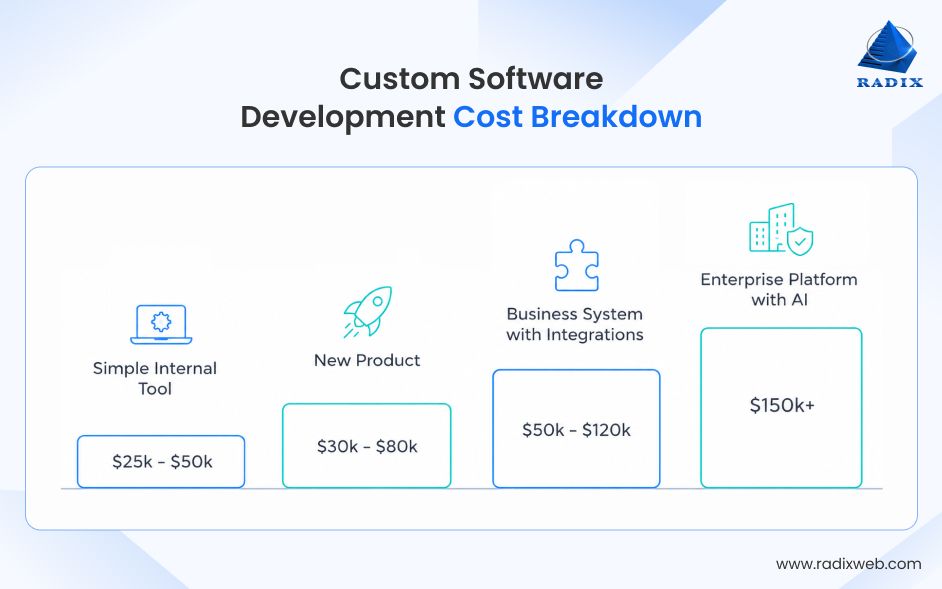
| Project type | Typical range (AUD) | Typical timeline | What you usually get |
|---|---|---|---|
| Simple internal tool or workflow app | $25,000 to $50,000 | 6 to 12 weeks | One core workflow, a few user roles, basic reporting |
| MVP for a new product | $30,000 to $80,000 | 8 to 12 weeks | Core features to test with real users |
| Business system with several integrations | $50,000 to $120,000 | 3 to 6 months | Multiple workflows, accounting and payroll links |
| Enterprise platform with AI or complex compliance | $150,000+ | 6 to 12+ months | Many modules, audit trails, AI features, high security |
App-heavy projects follow similar bands, and our breakdown of mobile app development costs in Australia shows how individual features move the price.
The biggest drivers of custom software price are the number of integrations, compliance requirements, user roles, offline capability, AI features and design complexity.
| Factor | Why it adds cost | How to control it |
|---|---|---|
| Integrations | Each connection needs building, testing and maintaining | Start with the two or three that save the most time |
| Compliance | Audit trails, data residency and access controls take extra work | Define exactly which rules apply during discovery |
| User roles | More roles mean more screens and permissions | Launch with essential roles, add others later |
| Offline capability | Syncing data safely is complex | Limit offline mode to the tasks that truly need it |
| AI features | Training data, testing and human review add time | Pilot one AI feature before expanding |
| Design complexity | Custom interactions take longer than standard patterns | Use proven design components where possible |
Hidden costs to budget for are the setup and running costs that custom software quotes often leave out. Ask about each of these:
Tax benefits, grants and government support can reduce the real cost of a custom software build. Check eligibility with your accountant at scoping, because records must be kept as the work happens.
| Program | What it offers | Who qualifies | Watch out for |
|---|---|---|---|
| Software development pool | Development costs deducted over five years | Businesses developing in-house software | Deductions start in year two |
| R&D Tax Incentive | 43.5% refundable offset | Companies with turnover under $20M doing genuinely experimental work | Routine software builds don't qualify |
| Industry Growth Program | Matched grants for commercialization projects | Innovative SMEs in priority sectors | Currently paused to new applications |
| Digital Solutions program | Low-cost one-on-one digital advice | Businesses with fewer than 20 staff | Advice only, not funding for the build |
Used together, these programs can make a well-scoped project noticeably cheaper than its headline quote.
Over five years, custom software often costs less than a SaaS stack for growing teams, because subscription costs rise with headcount while custom software costs rise only with new features.
Here's an illustrative comparison for a 40-person team. It assumes an average SaaS spend of AUD 150 per user per month, and annual maintenance of 15 to 20% of the build cost, a common rule of thumb.
| Cost item | SaaS stack | Custom build |
|---|---|---|
| Upfront cost | None | AUD 120,000 |
| Yearly cost | AUD 72,000 | AUD 18,000 to 24,000 maintenance |
| Five-year total | AUD 360,000 before price rises | Roughly AUD 210,000 to 240,000 |
| Ownership | None; you rent access | You own the software |
| Price control | Set by the vendor, often in USD | Set by your own roadmap |
Real numbers vary with team size and tool mix, so run the same comparison using your own subscription invoices.
Onshore software development in Australia typically costs AUD 80 to 250 an hour depending on seniority. Working with an offshore development team costs well below local rates and hybrid partners sit somewhere in between.
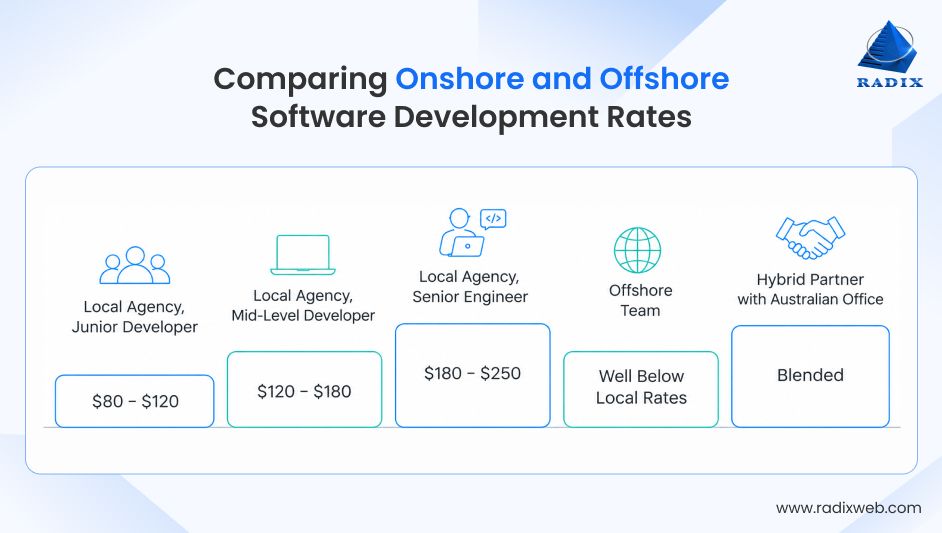
| Team type | Typical hourly rate (AUD) | Strengths | Trade-offs |
|---|---|---|---|
| Local agency, junior developer | $80 to $120 | Same time zone, local contracts | Highest cost per hour |
| Local agency, mid-level developer | $120 to $180 | Strong communication | Budget stretches less far |
| Local agency, senior engineer | $180 to $250 | Deep expertise on hand | Premium pricing |
| Offshore team | Well below local rates | Lowest cost, large talent pool | Less time-zone overlap, accountability can blur |
| Hybrid partner with Australian office | Blended | Local contact with offshore value | Check how work is split between locations |
An offshore development partner with hybrid capabilities offers the best of both worlds by offering local accountability and offshore value in the same contract, which suits many mid-sized businesses.
A standard custom software development process has five stages: discovery, design, development and testing, launch, and ongoing support, with a focused MVP typically taking eight to twelve weeks. A clear process protects non-technical buyers more than any contract clause.
| Stage | Typical duration | Key deliverables | Your role |
|---|---|---|---|
| Discovery and scoping | 2 to 4 weeks | Scope, feature list, technical plan, estimate | Explain processes and priorities |
| Design and prototyping | 2 to 6 weeks | Wireframes, clickable prototype | Test with staff and give feedback |
| Development and testing | 8 to 24 weeks | Working software every sprint | Attend demos and approve each sprint |
| Launch and handover | 1 to 2 weeks | Live system, training, documentation | Plan rollout and train staff |
| Ongoing support | Ongoing | Updates, fixes, new features | Review roadmap quarterly |
Note: Design and prototyping is the cheapest stage to change your mind, because moving a button in a prototype costs minutes rather than days.
A software development company is a firm that plans, designs, builds, tests and supports software for its clients, usually charging per project or per dedicated team. For a non-technical owner, the right one explains trade-offs in plain language, shows its process openly and protects your ownership of the code. Use the following checks to find the right company:
The best practical tests, especially for non-technical founders, are questions that reveal how a team thinks, and you don't need to read code to ask them. Ask these questions in your first meetings:
Clear, honest answers matter more than polished slides.
A good development company explains exactly how it uses AI in delivery and checks its output, naming the tools, the review steps and the security testing applied to AI-generated code. Red flags include:
Strong security, privacy and testing capability shows in certifications, data hosting answers and dedicated QA. Look for ISO 27001 or SOC 2 certification, clear answers on where your data is hosted, and dedicated QA staff rather than developers testing their own work. Ask how they handle a security incident and how fast they patch vulnerabilities.
When comparing offshore vs nearshore software development or even onshore development, knowing exactly who builds your software matters more than where they sit. Offshore and hybrid teams work well when you verify these points before signing:
The contract terms that protect your code and data are a written IP assignment, source code and account access, data location, change control and an exit clause, because paying for software doesn't automatically make you the copyright owner. Check for these terms:
| Clause | What good looks like |
|---|---|
| IP assignment | All project code and designs assigned to your business |
| Source code access | Access to the code repository throughout the project |
| Account ownership | Hosting, domain and app store accounts in your name |
| Data location | Where data is stored and who can access it |
| Change requests | How new scope is priced and approved |
| Exit and handover | What the vendor must hand over if the relationship ends |
Small businesses also have ACCC unfair contract terms protections against one-sided standard contracts, and the Australian Small Business and Family Enterprise Ombudsman can help if a dispute arises.
A partner who answers these questions openly is usually the one who'll deliver openly too.
A custom software project readiness checklist covers your priority processes, systems, compliance rules, decision-makers, budget, data needs and success measures. Owners who arrive with these answers get sharper quotes and faster starts:
The right custom software partner turns your business priorities into technology that solves real problems and supports growth. Choose a team that understands your goals, delivers with clarity, and builds for the long term.
Choose the Software Development Company That Fits Your Business, Not the Biggest Name
The compliance calendar isn’t slowing down, and neither are subscription bills. Getting custom software tailor-made for your business now makes sense for far more Australian organisations than it did two years ago, but only with the right partner. Before you contact anyone, turn the readiness checklist into a one-page brief. Then ask each shortlisted firm the same questions on AI review, security, and code ownership.At Radixweb, we have built and modernized complex enterprise software for over 26 years, with a Melbourne office and 650+ engineers behind it. We work across legacy modernisation, AI integration, and cloud migration for Australian clients in healthcare, fintech, insurance, and HR tech. Schedule a consultation with our consultants and get the right strategy first, before a single dollar goes into development.
Ready to brush up on something new? We've got more to read right this way.

