Read More


Recognized for AI Excellence at 2026 Globee® Awards - Read More

Maitray Gadhavi
Development time is one of the first questions in any software project. It drives decisions around cost, resourcing, and when you can expect to see business value. But there's no single answer to how long a software project will take. It depends on several factors like project type, feature complexity, team composition, etc.
With so many variables at play, it's no surprise that global studies suggest that only 2-5% of software projects are completed on time. At Radixweb, we've estimated and delivered (on time!) 4,500+ software projects over the past 26 years. One lesson has remained consistent throughout those engagements: Accurate timelines come from a disciplined estimation process.
In this guide, we explain how software development timelines are estimated, the factors that influence them, and what actually keeps projects on schedule.
Development timelines don't slip because developers write code slowly. They slip because estimates are made before requirements are understood, risks are identified, or complexity is measured. This guide explains how software development is actually estimated, what realistic timelines look like, which estimation methods professionals use, and what separates dependable estimates from optimistic guesses.
| Aspect | Detail |
|---|---|
| What this guide covers? | How software development timelines are estimated, typical project durations, estimation techniques, factors influencing delivery schedules, and practical tips for getting reliable software timeline estimates. |
| Who should read this? | Business owners, CIOs, CTOs, Product Managers, Engineering Leaders, and decision-makers evaluating software development projects or vendor estimates. |
For most custom software projects, the development timeline falls between 3 and 9 months. Below we provide a quick overview of software development timelines:
Timeline based on project complexity:
The type of software you're building also has a significant impact on delivery timelines:
Every software project also progresses through a series of delivery phases, each contributing to the overall timeline
The numbers above provide useful benchmarks. But they're only one part of the story. Let's look at how these estimates are actually built and what influences them in real-world software projects.
Project type is usually the single biggest factor influencing development timelines. A customer portal, AI platform, ERP modernization initiative, and internal workflow application may contain a similar number of features yet require a completely different engineering effort because the underlying technical complexity differs.
The table below provides realistic delivery ranges based on our project experience.
| Project Type / Industry | Typical Timeline | Primary Complexity Driver |
|---|---|---|
| Internal Business Tool | 1–3 months | Workflow implementation |
| Customer Portal | 3–5 months | Authentication, APIs, responsive UX |
| SaaS MVP | 4–8 months | Multi-tenancy and scalability |
| Enterprise SaaS Platform | 9–18 months | Architecture, security, enterprise integrations |
| AI-Powered Application | 4–12 months | Data readiness, model evaluation, AI workflows |
| Legacy System Modernization | 6–18 months | Existing infrastructure, migration complexity |
| ERP Implementation / Modernization | 9–24 months | Business processes, enterprise integrations |
| Healthcare Software | 8–18 months | HIPAA compliance, interoperability, EHR integration |
| FinTech Application | 6–15 months | Security, PCI DSS compliance, payment integrations |
| Insurance Platform | 8–16 months | Policy workflows, claims automation, legacy integration |
| Manufacturing Software | 6–15 months | IoT connectivity, MES/ERP integration, real-time data |
| Retail & eCommerce Platform | 4–10 months | Omnichannel experience, inventory, payment systems |
| Logistics & Supply Chain Platform | 6–15 months | Route optimization, tracking, ERP/WMS integration |
| Education (EdTech) Platform | 4–10 months | LMS features, video delivery, user scalability |
The differences aren't simply about writing more or less code.
For example, integrating AI into an existing application without a full rebuild often takes less time than building an AI-native platform because much of the infrastructure already exists. Similarly, timeline for modernizing a 15-year-old enterprise application is different from modernizing a 3-year-old application because the former needs more dependency analysis and migration planning.
Every project passes through the same lifecycle stages irrespective of the methodology it uses. But each stage contributes differently to the overall timeline. Development consumes the largest share of effort. But the accuracy of the schedule is largely determined during discovery and architecture.
Let's look at where the time actually goes.
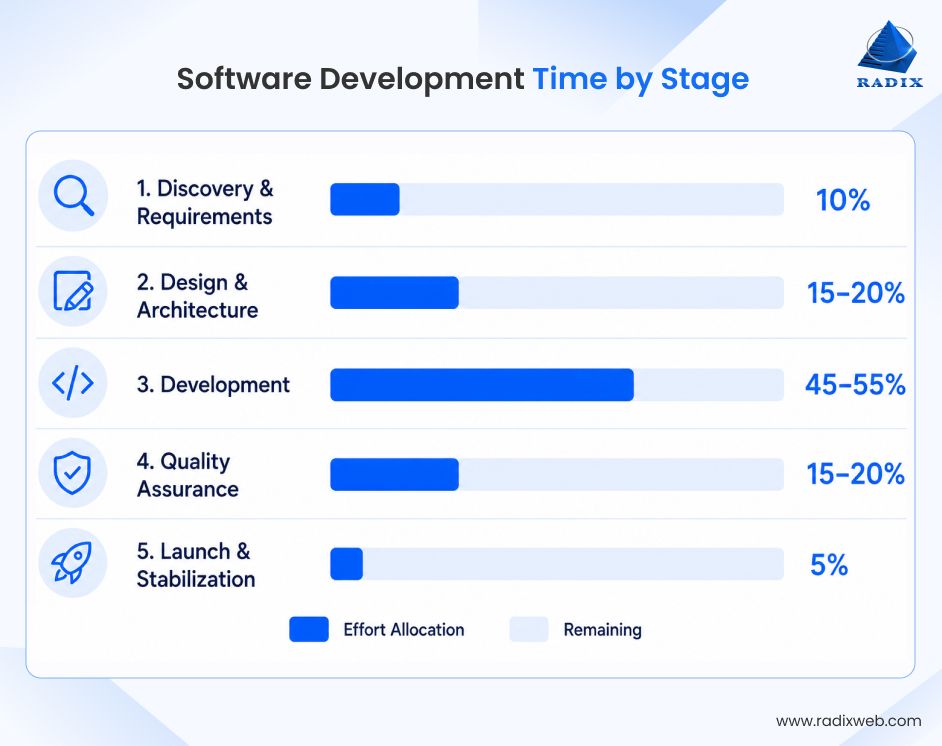
Average timeline: 1–4 weeks (≈10% of total project time)
Every successful software project begins with discovery where business analysts and solution architects define business objectives, user requirements, functional scope, integration needs, and potential risks. The quality of this work directly influences the accuracy of the project estimate.
Average timeline: 2–6 weeks (≈15–20% of total project time)
Once the requirements are finalized, designers create user journeys, wireframes, and interface designs. Solution architects establish the application's technical foundation. Decisions related to technology stack, system architecture, database design, and integrations are made here. Expert-led and well-planned software architecture design ensures the software can scale, perform reliably, and support future enhancements.
Average timeline: 1–6+ months (≈45–55% of total project time)
Development is the longest phase of the software lifecycle. Frontend and backend engineers build application features in iterative releases, supported by code reviews, integration, and continuous testing. Project complexity, third-party integrations, multi-platform support, and AI capabilities can significantly extend this phase.
Important: A proposal that allocates almost all time to coding (and very little to planning or testing!) is usually a warning sign rather than an efficiency gain.
Average timeline: 2–6 weeks (≈15–20% of total project time)
Quality assurance and software testing validates that the software performs as expected before release. This phase includes functional, performance, security, compatibility, and regression testing to identify and resolve defects. Allocating sufficient time for testing reduces production issues and improves overall software quality and reliability.
Average timeline: 1–2 weeks (≈5% of total project time)
The final phase focuses on deploying the project, configuring infrastructure, monitoring performance, and resolving any issues identified after launch. Depending on the project, this stage may also include user onboarding, phased rollouts, app store approvals, or post-release optimization.
There are several methods of estimating a software project timeline. But these estimation methodologies aren't interchangeable. Each technique is suited for a certain stage of the project, depending on the amount of available information.
At Radixweb, we don't rely on a single technique. Instead, we combine multiple estimation methods throughout the software development lifecycle to improve accuracy.
| Project Stage | Recommended Estimation Method |
|---|---|
| Initial Discussion | Analogous Estimation |
| Discovery & Planning | Bottom-Up Estimation |
| High-Risk Features | Three-Point (PERT) Estimation |
| Ongoing Agile Development | Story Points & Team Velocity |
Best for: Early budgeting and feasibility discussions
Analogous estimation compares the proposed software with similar projects delivered in the past. The estimate is adjusted based on differences in scope, complexity, and technology. It is the fastest way to develop an initial timeline and is commonly used before detailed discovery begins. But analogous estimates should be used for initial conversations, not added to contracts as commitments.
ExampleWhen scoping ML platforms that integrate with existing data pipelines, we benchmark against deliveries like our inventory forecasting platform for a UK retail distributor, which was completed in 5 months.
Best for: Detailed planning and delivery commitments
Bottom-up estimation breaks a project into individual implementation tasks before estimating each one separately. The individual estimates are then combined to produce the overall delivery timeline. This step-by-step process requires more planning effort. But when an engineer thinks through every implementation step, hidden dependencies surface before they become schedule explosions.
Any fixed-scope quote worth signing has a bottom-up breakdown underneath it.
ExampleProject: Customer Self-Service PortalFeatures and estimated effort:● User Authentication: 40 hours● Customer Dashboard: 72 hours● CRM Integration: 56 hours● Reporting Module: 48 hours● Testing & QA: 64 hoursTotal Estimated Effort: 280 hours
Best for: High-risk or uncertain implementation tasks
Some software activities have multiple possible outcomes depending on technical complexity or external dependencies. Three-Point Estimation (PERT) accounts for this uncertainty by estimating three scenarios: Optimistic, Most likely, and Pessimistic.
Then a weighted average is calculated instead of relying on a single assumption.
ExampleProject: Integrating a third-party payment gateway into an existing checkout flow.The PERT formula: Estimate = (O + 4M + P) / 6● Optimistic (O): 24 hours. Documentation accurate, sandbox matches production, no edge cases.● Most likely (M): 40 hours. Normal friction: a webhook quirk, one undocumented field, retesting.● Pessimistic (P): 80 hours. Sandbox and production diverge, compliance review, refund-flow rework.Estimate = (24 + 160 + 80) / 6 = 44 hoursThe result lands above the most likely value, and that's the formula working. It pulls the estimate toward the long right tail where software risk actually lives.Run this across every uncertain task in a bottom-up breakdown, add a visible 15–25% project-level buffer, and the final number has a defensible structure instead of hope.
Best for: Long-term Agile product development
Once development begins, Agile teams rarely estimate work in hours. Instead, they estimate the relative effort of each feature using story points and measure how much work the team completes during each sprint. Future timelines are then forecast using actual team performance rather than prediction. That's because velocity is observed reality rather than prediction.
ExampleOur long-running HRTech chatbot engagement was run on exactly this model across 20,000+ hours of iterative delivery. was run on exactly this model across 20,000+ hours of iterative delivery.● Sprint Length: 2 weeks● Average Team Velocity: 40 story points per sprint● Remaining Product Backlog: 200 story pointsEstimated Delivery Timeline: 200 story points ÷ 40 story points per sprint = 5 sprintsEstimated Duration: 10 weeksAs additional sprints are completed, velocity becomes increasingly predictable.
You may also come across estimation techniques such as Function Point Analysis (FPA), COCOMO, and other parametric models. While they remain useful in certain large-scale or highly standardized environments, most modern software engineering teams rely on a combination of analogous estimation, bottom-up estimation, PERT, and Agile velocity because they better reflect today's iterative development practices.
Two software projects that look similar may still have very different delivery timelines. That's because there are several factors that affect the timeline. Here are the key factors and how they impact delivery schedule:
Impact on timeline: High
The is the most dominant driver. Basic tools with few screens and simple backend logic ship in weeks. Projects with advanced functionality, scalability, and integrations extend to a year or more. That's because the latter needs significantly more planning, implementation, and testing.
Impact on timeline: High
Changing requirements are expected. But when unmanaged they lead to timeline overruns. Every addition after development starts also costs more than the same feature scoped upfront, because it forces rework on existing code. The fix isn't freezing the scope forever. Instead, it is attaching a timeline delta to every change request the moment it appears.
Impact on timeline: Medium – High
Reliable timelines depend on having the right people involved from the beginning. A team with skill gaps completes tasks slower and reworks more. So instead of building a team ad hoc, trust dedicated development teams that include solution architects, developers, QA engineers, DevOps specialists, and business analysts. It positively affects schedule reliability, particularly for businesses on a fixed runway.
Impact on timeline: Medium
Projects with many unknowns are naturally harder to estimate. The solution is not to commit to a timeline immediately. Instead, start with a prototype and estimate the full build timeline based on that. We took this route on an enterprise-grade AI-driven language learning platform. We shipped a working prototype in 2 weeks, and beta tested with 50 users. Based on that, we planned and delivered the full 12-month build that cut the client's training costs by 82%. The 2-week prototype bought estimation confidence worth months. We shipped a working prototype in 2 weeks, and beta tested with 50 users. Based on that, we planned and delivered the full 12-month build that cut the client's training costs by 82%. The 2-week prototype bought estimation confidence worth months.
Impact on timeline: Medium – High
Not every delay is within the engineering team's control. Client approvals, third-party integrations, vendor onboarding, infrastructure provisioning, and compliance reviews also affect timelines. Strong estimates identify these dependencies upfront and add suitable buffers for each.
Impact on timeline: Medium
Today, AI affects the software development speed and timeline, and costs in multiple ways. AI-assisted development tools speed up coding, testing, and documentation. This reduces effort, cost, and the time needed for these routine tasks. But AI features need more work around data readiness, model evaluation, and prompt engineering. This increases the overall project timelines. An accurate timeline factors in both these aspects of AI and automation.
The more thoroughly these factors are evaluated, the more reliable the timeline becomes.
Most software projects don't exceed their timelines because engineers underestimate coding effort. They exceed timelines because the estimate was built before the project itself was fully understood.
In practice, we've found that estimation errors usually originate long before development begins. The most common causes include:
Initial discussions rarely capture every workflow, edge case, integration, or reporting requirement. As those emerge, implementation effort increases.
Legacy systems, undocumented APIs, security constraints, and data migration challenges often remain invisible until architects begin technical discovery.
Development teams don't control vendor approvals, client feedback cycles, App Store reviews, compliance audits, or third-party API provisioning. These delays affect schedules even when engineering progresses as planned.
Perhaps the biggest mistake is expecting precise delivery dates before discovery has even started. A realistic estimate evolves through multiple stages of confidence. The first estimate informs budgeting. The final estimate guides delivery. That's why mature engineering teams continuously refine estimates rather than defending the very first number they produced.
The good news is that most of these mistakes are preventable when estimation is treated as an evolving engineering process rather than a one-time prediction.
The process of timeline estimation is what separates dependable estimates from optimistic guesses. Here's what you should do to get trustworthy estimates
If a vendor offers precise timelines before discovery, it is a red flag. Early estimates should be presented as realistic ranges with clear assumptions. Later, as requirements become clearer, firm milestone-level commitments become possible.
A single delivery timeline reveals little about how the estimate was created. Ask for a breakdown of major workstreams, milestones, dependencies, and effort estimates.
Every software project encounters uncertainty. So, if you see no buffer, it means it's hidden inside padded tasks, or absent. Experienced teams always include a defined contingency buffer (15–25%) for unforeseen challenges.
Engineering-led estimates identify architectural complexity, technical dependencies, and implementation risks. That's why they are more reliable than only sales-led estimates.
One of the most valuable questions you can ask a vendor is, "How closely did your previous estimates match actual delivery?" Teams that track this have an improving process. Teams that can't answer this, never get better at estimations. This holds true regardless of the software development methodology being used for development.
We carried out an analysis of 100+ projects to see how our estimations compared with delivery. The insights now help us build more realistic software cost and timeline estimates. Explore the complete analysis to see the findings.

Build Your Software on a Timeline You Can Trust
Accurate software estimation isn't about predicting a final delivery date. It's about creating enough clarity to make confident business decisions before development begins. Having delivered 4,500+ projects over the past 26 years, we've noticed that the strongest project plans begin with realistic ranges. That lays the foundation for successful, scalable custom software development for enterprises.That's why, at Radixweb, software cost and timeline estimates are part of our engineering process. Over the years, we've refined our estimation approach to balance business priorities with technical reality. Instead of relying on broad industry averages, we evaluate architecture, dependencies, integrations, and delivery risks before recommending timelines. So, no matter what type of software initiative you're planning, schedule a 1-on-1 consultation with us first. Let's build timelines that you can trust.
Ready to brush up on something new? We've got more to read right this way.