Read More


Recognized for AI Excellence at 2026 Globee® Awards - Read More

Pratik Mistry
Deloitte expects AI to lift productivity across the software development life cycle by 30% to 35%. Plenty of boards have read that as a license to halve their budgets. In practice, development hours shrink while total spend rarely does, once integrations, compliance and scale enter the picture.
That gap between what a quote says and what a project finally costs is where most budget conflicts begin. A number on a proposal is only as reliable as the scope behind it.
Most business software builds land between $50,000 and $250,000, and enterprise platforms go well past $500,000. Scope, integrations, compliance, and team model decide where a project sits in that range. Developing custom software tailored to business workflows typically costs more than configuring off-the-shelf tools. Maintenance then adds 15% to 20% of build cost every year.
Software development costs between $50,000 and $250,000 for most builds, with enterprise platforms exceeding $500,000. Industry, region, team model, complexity, integrations and compliance drive the range, while maintenance adds 15% to 20% yearly. Offshore partners cost 40% to 60% less than US teams. Clear scope, MVP-first delivery and the right pricing model keep budgets predictable. AI features add $15,000 to $250,000 on top, depending on the capability.
| Aspect | Details |
|---|---|
| What does this guide cover? | Average software costs by industry, region, project size and team type, plus pricing models, cost factors, hidden expenses, estimation process and practical strategies to reduce spending, with working USD ranges for each. |
| Who should read this guide? | CTOs, product heads and business owners planning a custom software build who need defensible budget ranges before approaching vendors or presenting numbers internally. |

Before a single sprint starts, you are paying for decisions. Scope, architecture, and the team that has to carry both. Those early choices lock in most of the final invoice, long before coding hours show up on it.
A quote that looks light usually prices build hours alone. The work it skips decides whether the software survives against real users, and teams that understand how development methodologies shape delivery, tend to catch that gap before signing.
A realistic budget for software development covers five things beyond code:
A lower quote rarely means a lower total. More often, part of this list has been moved to a later invoice.
Most business software lands between $50,000 and $250,000, and enterprise platforms cross $500,000. That range is the average software development cost for a custom build in 2027, with industry-specific compliance pushing it up.
The gap between a $50,000 build and a $250,000 one is rarely developer rates. It comes down to scope, integrations and regulatory load. Anyone asking, how much does it cost to develop custom software, get a range, not a figure, because a retail catalog app and a claims-processing platform share a category but not a bill.
The table below shows indicative ranges for mid-complexity builds with web and mobile components: -
| Industry | Typical range (USD) | What pushes it higher |
|---|---|---|
| FinTech | $80,000 to $400,000+ | Payments, KYC, fraud controls, audit trails |
| HRTech | $40,000 to $200,000 | Payroll logic, multi-country compliance |
| EdTech | $35,000 to $180,000 | Content delivery, assessments, live sessions |
| Retail & eCommerce | $30,000 to $250,000 | Catalog scale, inventory sync, checkout load |
| LegalTech | $50,000 to $220,000 | Document automation, access control, e-discovery |
| Manufacturing | $70,000 to $350,000 | ERP and shop-floor integration, IoT data |
| Healthcare | $75,000 to $400,000 | HIPAA, EHR interoperability, clinical workflows |
| CleanTech | $60,000 to $300,000 | Sensor data, energy analytics, reporting rules |
| InsurTech | $80,000 to $350,000 | Policy engines, underwriting rules, core system links |
| Travel & Hospitality | $40,000 to $250,000 | Booking engines, global distribution system. and channel integrations |
| Software & Hi-Tech | $60,000 to $500,000 | Multi-tenancy, API platforms, scale targets |
| Automotive | $90,000 to $450,000 | Embedded systems, telematics, safety standards |
| Logistics | $50,000 to $250,000+ | Real-time carrier API integrations, route optimization, IoT device connectivity, warehouse system sync |
| Real Estate | $50,000 to $200,000+ | MLS integration, document management, e-signature, property data APIs |
Regulated sectors sit at the top of nearly every range. Compliance is engineering work, and it gets priced like engineering work.
A comparable mid-size project costs roughly $40,000 to $100,000 in India and $150,000 to $300,000 in the US. Timelines stay within a month or two of each other, so rates drive the gap, not speed.
| Region | Hourly rate (USD) | Average Cost | Typical timeline |
|---|---|---|---|
| United States | $100 to $200 | $150,000 to $300,000 | 6 to 9 months |
| India | $25 to $50 | $40,000 to $100,000 | 5 to 8 months |
| Europe | $50 to $120 | $80,000 to $180,000 | 6 to 8 months |
| United Kingdom | $80 to $150 | $120,000 to $250,000 | 6 to 9 months |
| Australia | $90 to $160 | $130,000 to $260,000 | 6 to 9 months |
Hourly rate is one line of the software development budget. Time-zone overlap, review cycles and the seniority mix decide how many hours a feature takes, so two vendors at the same rate can deliver very different totals.
The rate gap is still large on identical hours. A 1,000-hour project costs $150,000 at $150 an hour with a US team and $45,000 at $45 an hour with an experienced team in India, a 70% difference. The gap narrows for AI-native and specialist work, where talent depth matters more than geography.
Buyers reviewing how leading development vendors compare globally should normalize quotes by delivered scope, not by rate. For fixed-scope work, an offshore delivery team usually cuts spend by 40% to 60% against US rates; provided governance is set up properly.
Lower rates only save money when requirements are written down, and a named owner approves them.
Small builds run $20,000 to $60,000, mid-size products $60,000 to $150,000, and enterprise-grade platforms $150,000 to $500,000 or more. Size here means modules, integrations and user load, not company headcount.
Software application type moves the number too. These ranges cover common builds:
| Software Application type | Cost (USD) | Timeline |
|---|---|---|
| Simple web application (internal tool) | $25,000 to $60,000 | 2 to 4 months |
| Mobile app (iOS or Android) | $30,000 to $80,000 | 3 to 5 months |
| Cross-platform mobile app | $50,000 to $130,000 | 4 to 7 months |
| SaaS platform (multi-tenant) | $80,000 to $250,000 | 5 to 10 months |
| eCommerce platform (custom, not Shopify) | $60,000 to $200,000 | 4 to 8 months |
| Enterprise software (multi-team, multi-department) | $150,000 to $600,000 | 8 to 18 months |
| AI-native application (LLM, RAG, agentic) | $100,000 to $500,000 | 6 to 14 months |
| Healthcare platform (HIPAA-compliant) | $75,000 to $300,000+ | 6 to 18 months |
| FinTech platform (PCI-DSS, SOX) | $90,000 to $400,000+ | 8 to 20 months |
| Logistics platform (real-time tracking, routing) | $50,000 to $250,000+ | 5 to 14 months |
Decisions at the top tier lean heavily on architecture, and custom software choices CTOs make at scale, decide how far the budget stretches. Most overruns start when a project is sized as small and behaves like a mid-size one by 3rd month.
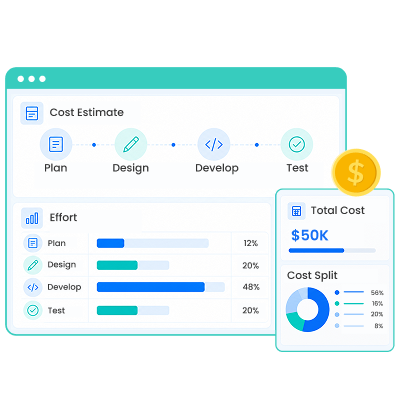
Development takes 40% to 55% of a typical budget. Discovery and design together take 30% to 40%, and that is where cost accuracy gets set.
| Stage | % of budget | What happens here | On a $150,000 project |
|---|---|---|---|
| Discovery | 10% to 15% | Requirements, architecture planning, technical feasibility | $15,000 to $22,500 |
| Design | 20% to 25% | UI/UX design, wireframes, prototypes, design system | $30,000 to $37,500 |
| Development | 40% to 55% | Coding, backend infrastructure, API integrations | $60,000 to $82,500 |
| Testing | 15% to 20% | QA, bug fixing, performance and security testing, user Acceptance Testing | $22,500 to $30,000 |
| Deployment | 5% to 10% | Launch, app store submission, CI/CD setup, monitoring | $7,500 to $15,000 |
Projects that compress discovery and design to start coding sooner usually overrun in development, when the undefined requirements surface. Testing is not an optional scope either. A quote that prices development hours alone leave QA for someone else to fund.
Custom software development costs follow five inputs. Project goals, software type, audience, feature scope, and design depth. Together they place most builds between $50,000 and $250,000, with enterprise platforms past $500,000. Pin these down first and the estimate stops moving.
A revenue-generating product needs billing, analytics, and uptime commitments. An internal efficiency tool does not. The goal sets the quality bar and the budget: an internal tool typically costs $25,000 to $60,000, while a revenue-generating SaaS product runs $80,000 to $250,000.
A simple web app costs $25,000 to $60,000, a native mobile app $30,000 to $80,000 and a cross-platform build $50,000 to $130,000. Multi-tenant SaaS typically adds 25% to 35% over a single tenant build for tenancy, billing and admin tooling, which puts a full platform at $80,000 to $250,000.
Five hundred internal users and five hundred thousand customers need different performance, accessibility, localization, and support models. An internal tool for a few hundred users sits near $25,000 to $60,000, while a customer-facing platform at scale moves into the $150,000 to $500,000+ range.
Dependency matters more than count. One feature touching payments, permissions and reporting costs more than five standalone ones. A standard API such as a payment gateway adds $3,000 to $10,000, while a legacy or ERP connection adds $15,000 to $40,000 or more.
Template-led interfaces and research-led design systems sit at opposite ends of the budget, at $5,000 to $15,000 and $20,000 to $60,000 respectively. Design depth also drives how much prototyping, usability testing, and revision work happens before development starts.
Choosing the right development approach for scope changes how risk and rework get priced. Loosely scoped projects see 10% to 25% growth from mid-build changes, so estimates carry a 10% to 20% buffer on uncertain scope.

A US-based team costs $150,000 to $300,000 for a mid-size build, while an India-based partner costs $50,000 to $120,000. Team model changes the number more than technology choice does.
| Team model | Estimated cost, mid-size build (USD) | Best for |
|---|---|---|
| Local development team, US | $150,000 to $300,000 | Close collaboration, regulated work |
| In-house developers, US | $200,000 to $350,000 (year one, fully loaded) | Core products with long roadmaps |
| Freelance developers | $40,000 to $120,000 | Small, well-defined tasks |
| Offshore development company, India | $50,000 to $120,000 | Full cycle builds on a tight budget |
| Nearshore development company | $90,000 to $180,000 | Teams needing time-zone overlap |
| Hybrid (US product owner, offshore engineering) | $70,000 to $150,000 | Product-led companies scaling delivery |
A local development company means US-based engineers, one legal framework and working hours that overlap fully with yours. Mid-size builds cost $150,000 to $300,000, driven by US rates of $100 to $200 an hour. Regulated buyers in healthcare and finance often accept the premium because audits, data residency and contract enforcement stay domestic.
Working with US-based software engineering partners having onshore delivery teams also shortens feedback loops, since workshops and demos happen within the same business day.
Pros
Cons
An in-house team means salaried engineers who work only on your product. Year-one cost reaches $200,000 to $350,000 for a team of four to six once salary, benefits, equipment and management time are loaded in. The model fits core products with a multi-year roadmap, where retained knowledge compounds.
Companies building software from scratch can start by structuring an in-house engineering team before the first hire.
Salary alone understates the in-house number. The fully burdened comparison looks different:
| Cost component | In-house team | Outsourced team |
|---|---|---|
| Annual salary (mid-senior developer, US) | $120,000 to $150,000 | $0 |
| Benefits and employer taxes (+30%) | $36,000 to $45,000 | $0 |
| Recruitment fee (15% to 25% of salary) | $18,000 to $37,500 | $0 |
| Equipment, licenses, tools | $10,000 to $15,000 | $0 |
| Training and professional development | $5,000 to $8,000 | $0 |
| Management overhead | $12,000 to $18,000 | Included in partner rate |
| Ramp time (3 months at reduced productivity) | $30,000 to $37,500 | Minimal (days to weeks) |
| Fully burdened annual cost | $231,000 to $311,000 | $54,000 to $90,000 (at Indian rates) |
The fully burdened cost of one US in-house mid-senior developer ($231,000 to $311,000 a year) exceeds the annual cost of a fully managed outsourced team delivering equivalent output.
Pros
Cons
Freelancers suit narrow, well-defined tasks such as a feature build, a migration script, or a design sprint. A mid-size project built entirely on freelancers costs $40,000 to $120,000, but the real total depends on how much coordination the buyer carries. Without a lead engineer, someone inside the business ends up acting as product owner, architect, and QA reviewer.
Pros
Cons
An offshore partner in India supplies a complete delivery unit. Engineers, QA, designers, DevOps and project manager under one contract. Mid-size builds cost $40,000 to $120,000, the lowest rate for a full team at comparable seniority.
The model works best when requirements are documented, and one person on the client side owns decisions. Teams new to the model can review how offshore engagement models work before shortlisting vendors.
Pros
Cons
Nearshore firms in Eastern Europe or Latin America sit between onshore and offshore on both cost and overlap. Mid-size builds run from $90,000 to $180,000. The model suits teams that run daily standups and want most of the working day shared with their engineers.
Pros
Cons
A hybrid model keeps product ownership, architecture and stakeholder management onshore while an offshore team handles engineering and QA. Costs land at $70,000 to $150,000 for a mid-size build. It suits product-led companies that want business context close to decisions but cannot afford a fully onshore team.
Pros
Cons
The cheapest model on paper is rarely the cheapest after rework; delays and management time are also counted.

Fixed price suits defined scope, time and material suits evolving scope, and a dedicated team suits long-running products. Select by how stable your requirements are, not by which looks cheapest.
Software development pricing typically follows one of four structures: -
Remember That- Mismatched pricing models cause more friction than high rates do. A fixed price on unstable scope guarantees a dispute.
Eight factors move the number. Complexity, platform scope, design depth, tech stack, integrations, security and compliance, team model and timeline. Complexity, integration, and compliance account for most of the variance.
The factors affecting software development cost are well documented. The software development cost drivers that catch buyers off guard are usually integrations and compliance, which look small in a requirements document and large in a sprint plan.
Complexity is the sum of features, business rules, and workflow depth. A login screen is cheap; role-based approvals with audit trails are not. Cost scales with the number of decisions the software has to make, not the number of screens.
| Complexity | Typical scope | Cost (USD) |
|---|---|---|
| Simple | Single role, standard data entry, one platform | $20,000 to $50,000 |
| Moderate | Multiple roles, workflows, two to four integrations | $50,000 to $120,000 |
| High | Complex rules, high data volume, many integrations | $120,000 to $300,000+ |
Each added platform (web, iOS or Android) adds $15,000 to $60,000. Cross-platform frameworks reduce duplicated logic, but platform-specific testing and app store compliance still take real effort.
Template-led interfaces cost $5,000 to $15,000. Research-led design with usability testing and a design system runs $20,000 to $60,000. Heavily used internal tools usually earn that spend back through lower training and support load.
A monolith is cheaper to build; microservices add roughly 20% to 30% upfront and pay off when modules need to scale independently. Niche stacks also raise hourly rates because the talent pool is smaller. Weighing stack options for your product type early keeps those rates in check.
Every integration adds authentication, data mapping and error handling, so system integration across business platforms takes more sprint time than a requirements document suggests. Poorly documented APIs push any of these toward the top of their range.
| Integration type | Examples | Cost (USD) |
|---|---|---|
| Standard APIs | Payment gateways, email, maps | $3,000 to $10,000 |
| Business systems | CRM, HRIS, accounting | $8,000 to $25,000 |
| Legacy and ERP | SAP, Oracle, mainframe | $15,000 to $40,000+ |
Compliance is engineering work; access controls, encryption, logging and audit preparation. The scope of the framework decides the bill.
| Requirement | Typical added cost (USD) |
|---|---|
| GDPR readiness | $10,000 to $30,000 |
| HIPAA | $15,000 to $50,000 |
| SOC 2 readiness | $20,000 to $60,000 |
| PCI-DSS | $20,000 to $80,000 |
Location and experience mix create a 30% to 60% variance for the same scope. Senior-heavy teams cost more per hour but usually finish faster with fewer defects, while junior-heavy teams look cheaper until rework starts.
Compressed schedules need parallel workstreams and more senior engineers, which adds a 15% to 30% premium. Teams that begin with realistic estimates of build duration rarely pay that premium by default. Moving a deadline by four weeks often saves more than any rate of negotiation.
AI-assisted coding trims hours on boilerplate and testing. It does little for discovery, architecture, or compliance, so expect savings in implementation rather than across the whole invoice. Treat the table as a pricing map. Each row is a negotiation point, and each one can be scoped down on purpose.
AI features add $15,000 to $250,000 to a build, and the model API is rarely the expensive part. Data preparation takes 40% to 50% of AI feature effort, so budget it explicitly or it arrives as a change order.
| AI capability | Added cost (USD) | Added timeline |
|---|---|---|
| LLM chatbot (foundation model + RAG) | $15,000 to $60,000 | 3 to 8 weeks |
| Semantic / AI-powered search | $10,000 to $40,000 | 2 to 6 weeks |
| AI workflow automation | $25,000 to $100,000 | 4 to 10 weeks |
| Predictive analytics on existing data | $30,000 to $120,000 | 6 to 14 weeks |
| AI agent (multi-tool, agentic workflow) | $40,000 to $150,000 | 6 to 14 weeks |
| Computer vision (image/video analysis) | $50,000 to $200,000 | 8 to 16 weeks |
| Voice AI (speech recognition, assistant) | $35,000 to $130,000 | 6 to 12 weeks |
| Custom LLM fine-tuning | $60,000 to $250,000 | 8 to 20 weeks |
| MCP server / AI integration layer | $15,000 to $50,000 | 2 to 6 weeks |
Most 2027 projects include at least one AI component, so price it as its own line item. Teams that assess data readiness before committing scope, and use pre-trained foundation models instead of custom training, are the ones that stay inside these ranges.
The costs that surprise buyers sit outside the build quote; maintenance at 15% to 20% of build cost every year, cloud and licensing fees, integration rework and technical debt. Budget for them from day one.
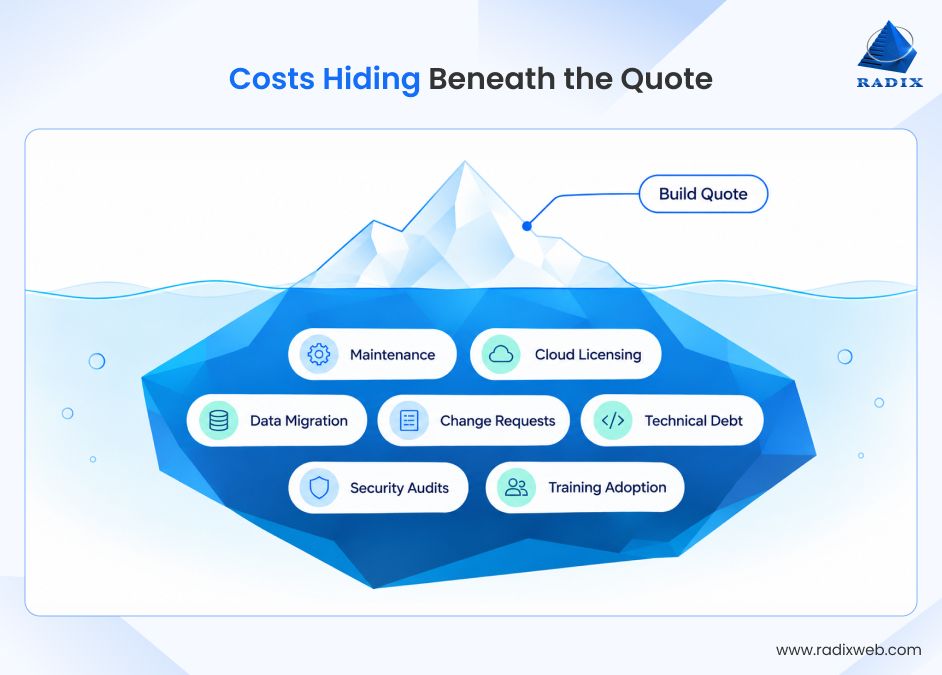
Hidden software development costs usually show up in these places:
Ongoing maintenance support for live software covering bug fixes, security patches, and dependency updates runs 15% to 20% of the original build annually. Skipping them compounds quickly, because unpatched dependencies are a common source of security incidents and emergency fixes.
Hosting, monitoring, third-party APIs and tool licenses range from a few hundred to several thousand dollars monthly. Usage-based pricing grows with adoption, so a successful launch can raise this line faster than expected.
Moving legacy data cleanly typically adds $10,000 to $50,000, depending on volume and quality. Most of the effort goes into cleaning duplicates, mapping fields and validating records, not into the transfer itself, which is why engineering support for legacy data matters.
Loosely scoped projects see 10% to 25% growth from mid-build changes. A change control process with a named approver keeps small additions from turning into a second project.
Shortcuts taken to hit a date get repaid with interest, usually as slower releases and longer bug-fix cycles. Teams engineering software for long-term maintainability pays far less of it.
Annual penetration tests and compliance audits cost $5,000 to $30,000 each cycle. Regulated industries should also plan for remediation work after findings, which is billed separately. Early and secure software development habits that shrink audit findings keep that bill smaller.
Rolling software out to staff takes time, documentation, and support capacity. Low adoption is expensive in its own way, since a tool nobody uses delivers none of the savings it was built for.
Buyers who plan for these upfront compare vendors on the full cost of ownership, not the launch invoice.
At Radixweb, we estimate the cost from scratch. Features are split into various activities, such as tasks into hours, and hours priced by team, mix with a risk buffer on top. The output is a range tied to scope, not a single figure.
Across projects, effort tends to split roughly 65% development, 15% project management, 13% quality assurance, and 7% UI/UX design. That distribution is the baseline against which each estimate gets checked.
Clients comparing multiple proposals should run each vendor through a checklist to vet development partners before signing, alongside the estimate. An estimate built this way can be defended line by line, which is what makes it useful in a budget review.
Teams that want to reduce software development cost should cut scope early and validate before scaling. Trimming QA or architecture to save money only moves the bill to month twelve.
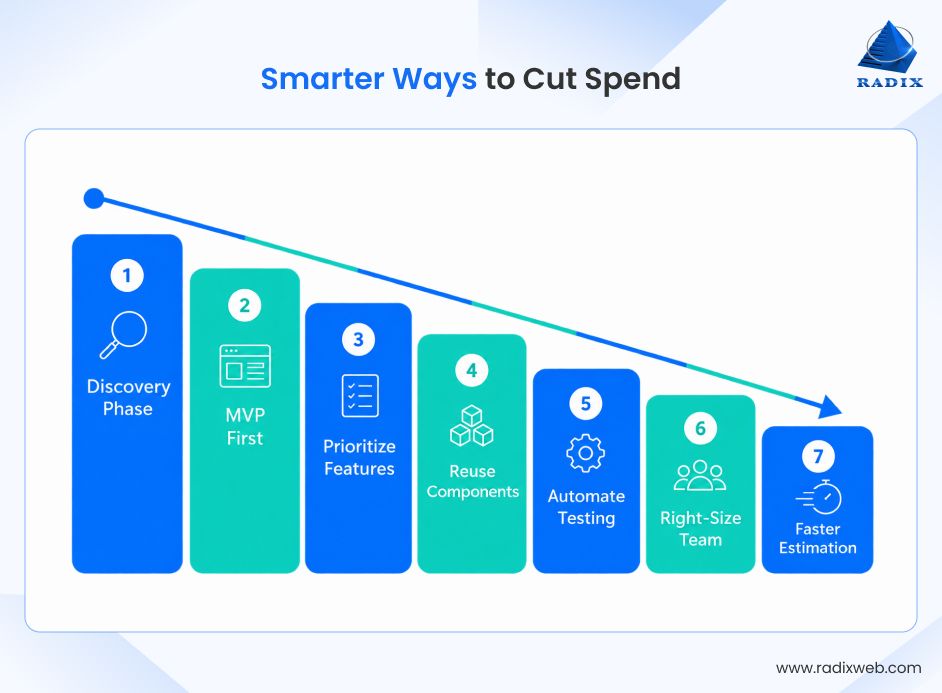
Two to four weeks of structured scoping removes the assumptions that cause the largest overruns. Teams new to the process can first walk through how software development stages connect to scope each phase.
Release the core workflow, learn from real usage, and fund the next phase from evidence. Teams validating AI features also avoid rebuilding later by planning the move from AI prototype to production at scale early.
Rank features as must-have, should-have, and later. Most products launch well with about 60% of the first wish list, and usage data decides what earns a place in the next release.
Open-source libraries, managed cloud services and existing design systems save weeks of build effort. Authentication, payments and notifications are rarely worth building from scratch.
Defects caught during development cost a fraction of those found after release. Automated regression suites and CI pipelines also keep later releases fast as the codebase grows.
For peak workloads, adding vetted developers to existing teams beats permanent headcount. Capacity scales down once the peak passes, so payroll does not stay fixed.
Share a written brief, user stories, and integration list before the first call. Reference estimates from similar past builds cut estimation time by days, not hours.
Savings come from decisions made early. A leaner scope, a clear brief and the right team model will outperform any late-stage discount.
Match your situation to a realistic starting range before you request quotes.
| If your situation is: | Realistic budget | Right approach |
|---|---|---|
| Startup validating an idea | $25,000 to $60,000 | MVP with one core feature, offshore team, pre-built components |
| Growing SaaS adding AI or integrations | $60,000 to $200,000 | Modular build, foundation model AI, phased feature delivery |
| Mid-market replacing a legacy system | $150,000 to $500,000 | Discovery phase first, hybrid team model, phased migration |
| Enterprise with compliance requirements | $300,000 to $1,500,000+ | Architecture review, compliance-first design, dedicated team |
| Company adding AI to existing software | $15,000 to $300,000 | Integration pattern selection, data assessment before scoping |
Build the Software Budget Around Your Scope with Radixweb
Software pricing comes down to clarity, industry demands, team model, and how well-hidden costs are planned for. Ranges help with early budgeting, but the number that holds up in a boardroom comes from a scoped estimate, a pricing model matched to requirement stability and a risk buffer sized to real uncertainty. Most overruns trace back to unclear project scope and software consulting that locks requirements early typically remove that risk upfront.At Radixweb, we bring 26+ years of engineering experience across FinTech, healthcare, manufacturing and 30+ industries to every estimate. Each estimate is built bottom-up from tasks, hours and team mix, then stress-tested with a risk buffer, so the figure survives delivery. Book a free strategy session with our team and share your requirements to get a cost range ready for budget approval.
Ready to brush up on something new? We've got more to read right this way.