Read More


Recognized for AI Excellence at 2026 Globee® Awards - Read More

Pratik Mistry

Why You Should Read This Article: Instead of depending on widely held notions like “offshore is cheaper” or “freelancers are flexible,” we’ll break down how software developer hourly rates vary by country and experience, how outsourcing and offshore software development cost structures differ from in‑house hiring, and how the monthly cost to hire dedicated developers or a dedicated software development team can change depending on your scope, timeline, and level of control.
On a global scale, the cost to hire a software developer ranges from $20 to $150+ per hour, with specialized roles such as AI engineers and cloud architects commanding even higher rates.
But what makes this cost so nuanced is that the same headline “software developer hourly rate” can conceal vastly different realities depending on where that developer sits in the world, which tech stack they specialize in, and how deeply they are integrated into your product lifecycle.
For example, a junior developer in one region might cost you less per hour but carry hidden costs like higher bug rates and more management overhead. But a senior offshore developer can compress timelines, reduce rework, and ultimately lower total project cost even if the hourly number looks higher.
In the same way, an outsourcing hiring model for software development might make sense for a short-term feature build but can become expensive and rigid when you shift into longterm product ownership.
The nuance deepens when you factor salaries with the total cost of ownership - recruitment fees, onboarding ramp‑up, benefits, tools, infrastructure, management bandwidth, and the risk of turnover.
Read on to get a full breakdown of software developer costs across regions, experience levels, hiring models, and more, along with frameworks to estimate budgets and reduce unnecessary spend.

“How much does it cost to hire a software developer?” in 2026 is a combination of three intertwined business questions:
A single hourly rate is not the answer decision‑makers look for, as it’s but a spectrum of options - in‑house, remote, freelance, offshore, and outsourcing. Each has its own cost structure, risk profile, and fit for your product stage, budget, and growth strategy.
TL; DR: salary and rate ranges by model and geography
At a high level, here’s what you can expect when hiring software developers and estimating the cost of executing a software project, before you even add your company‑specific overhead and tools:
In‑house developers (US / Western Europe)
Remote developers (global, contract‑based)
Offshore / nearshore developers (Asia, Eastern Europe, Latin America)
Dedicated software development teams
There's been a steady increase in the cost of hiring software developers over the past few years. The surge is sharply driven by structural imbalances in supply, demand, and rising technology requirements.
Software developer rates can vary based on a combination of experience level, talent attributes, market conditions, and engagement structure. Their hourly rate can range anywhere from $20 to $150+ globally, but that spread exists for specific, explainable reasons.
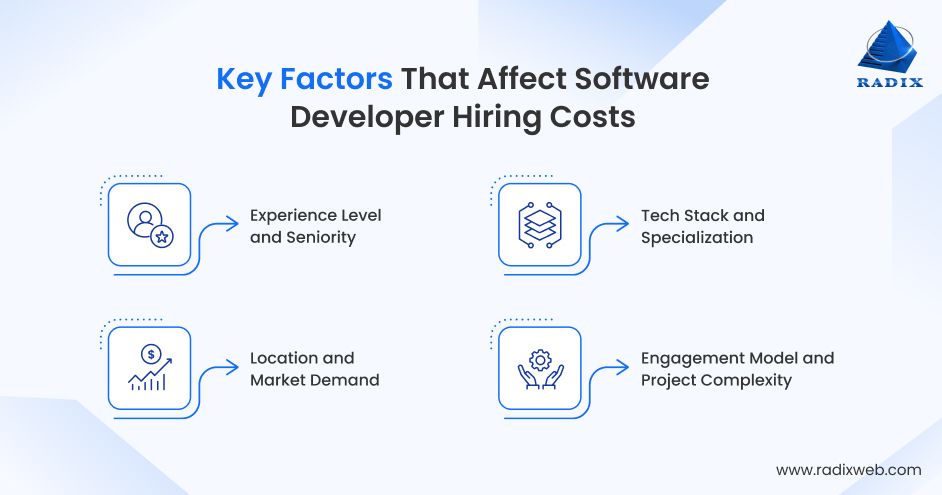
One of the most direct drivers of software developer rates is the level of experience and technical ownership expected from the role.
The choice of technology has an impact on software developer hourly rates. Not all skills are priced equally in the market.
For example, AI and cloud engineers can command rates that are 30–70% higher than generalist developers. This gap is expected to widen as enterprises continue investing in AI-led systems.
Geographical factors like local salary benchmarks, cost of living, and talent availability play an important role in determining software developer cost per hour.
However, remote work has reshaped this dynamic. Companies now compete globally for the same talent, which is gradually narrowing regional price gaps, especially for senior and niche skill sets.
The way you hire is just as important as who you hire. Engagement models directly influence the rate of developers.
Then there’s project complexity. A simple CRUD application will need less experienced resources, but enterprise-grade platforms demand senior talent and higher rates.
In 2025–2026, hiring models span a wide range: from roughly India ≈ $20–$60/hour for mid‑level offshore developers to US ≈ $80–$150/hour (or more) for comparable mid‑ to senior‑level in‑house engineers.
In‑house teams offer the highest control and alignment but also the highest loaded cost.
However, the total cost extends beyond salary, including hiring cycles, infrastructure, onboarding time, and attrition risk.
Freelancers have lower upfront commitment but increased variability in quality and continuity.
However, these rates exclude project management, compliance, and long‑term maintenance, which you must absorb as hidden costs.
Offshore developers are one of the most cost‑efficient options for steady‑state delivery. At scale, one offshore developer often costs $3,000–$12,000 per month, depending on region and seniority.
In India and other Asian hubs, 2025–2026 offshore rates commonly fall in the:
Dedicated offshore teams in Asia typically cost $8,000–$18,000 per month for 2–4 developers, while Eastern European teams often run $15,000–$28,000/month for the same size.
US‑based dedicated‑team alternatives can push $25,000–$50,000/month or more for a small squad but provide easier time‑zone alignment and control.

Geography plays a decisive role in shaping software developer rates, with differences of up to 3–5x between regions. For most organizations, the optimal approach is to combine cost-efficient regions such as India or Southeast Asia to achieve both quality and scalability.
| Country/Region | Typical Hourly Range | Best Fit |
|---|---|---|
| India | $20–$50/hour | Cost-efficient offshore development, long-term product builds |
| USA | $80–$150+/hour | High-control, local collaboration, senior in-house roles |
| Eastern Europe | $30–$70/hour | Complex engineering, strong technical depth |
| Latin America | $25–$65/hour | Nearshore teams, North American time-zone overlap |
| Southeast Asia | $20–$45/hour | Budget-friendly offshore development and scaling |
Take a detailed look at the software developer hourly rate by country:
The cost to hire offshore software developers in India is typically around $20–$50/hour, with junior talent lower and senior or niche specialists higher.
India is one of the most reliable regions for offshore software development for its cost-efficiency in 2025–2026.
For many mid- to senior-level roles, rates often fall around $80–$150+/hour. The USA-based developer rate is usually the highest in this comparison because of labor costs, stronger salary benchmarks, and higher overhead.
The hiring cost of software developers in Eastern Europe commonly sits around $30–$70/hour. Senior engineers and specialized cloud, AI, or DevOps talent, of course, charge more.
The average cost for outsourced software developers in Latin America generally ranges from $25–$65/hour, with country, language fluency, and seniority affecting the final price.
The developer hiring rate in Southeast Asia commonly falls between $20–$45/hour. This region offers a combination of factors that make outsourcing an attractive option for enterprises, such as competitive pricing and a large talent pool.
Hourly rates differ significantly between junior, mid‑level, senior, and lead/architect roles, even when they work in the same country or stack. For accurate budgeting, it is important to align the software developer hourly rate with the level of expertise required rather than optimizing for the lowest upfront cost.
Junior developers typically have 0–2 years of experience and perform supervised tasks.
They offer cost advantages but require guidance, which can increase overall delivery time if not managed well.
Mid-level developers generally have 2–5 years of experience and can work independently on moderately complex features.
This tier often provides the best balance between cost and productivity, which is why it’s a common choice for scaling teams.
Senior developers bring 5–10+ years of experience and are responsible for complex problem-solving, architecture decisions, and code quality.
Although the end-to-end cost to build high-value software products by a senior developer is higher, senior developers reduce long-term costs by minimizing rework and building stable systems.
Lead developers and software architects operate at a strategic level and oversee system architecture, technology decisions, and cross-team alignment.
This level represents the highest software developer rates due to the impact these roles have on overall product success and risk mitigation.
Hidden costs related to recruitment, setup, and churn can easily add 30–50% or more to the total cost of hiring and retaining a developer, especially for in‑house and remote teams.

By combining offshore or dedicated‑team usage, hybrid delivery, thoughtful role‑mixing, and smarter hiring and onboarding, you can meaningfully reduce both your hourly rate and your total cost‑of‑ownership to hire software developers without compromising product quality or speed.
What Should You Be Careful About When Cutting Development Costs?
Lowering your software development cost should not mean optimizing for the lowest hourly rate. A cheaper developer or delivery model can become more expensive if it introduces rework, communication gaps, security issues, compliance challenges, or additional management overhead. The right approach is to look at the overall value and total cost of delivery, including technical expertise, reliability, communication, domain familiarity, and long-term support.Location is one factor where this becomes particularly relevant here. For example, businesses serving the US market may need development teams that understand local customer expectations, business practices, data requirements, and regulatory considerations. Working with a technology partner with hands-on US-focused development expertise can help account for these factors while still taking advantage of globally distributed engineering talent.
Here are four practical, 2025-2026‑aligned strategies you can apply whether you’re in‑house, remote, or outsourcing‑heavy:
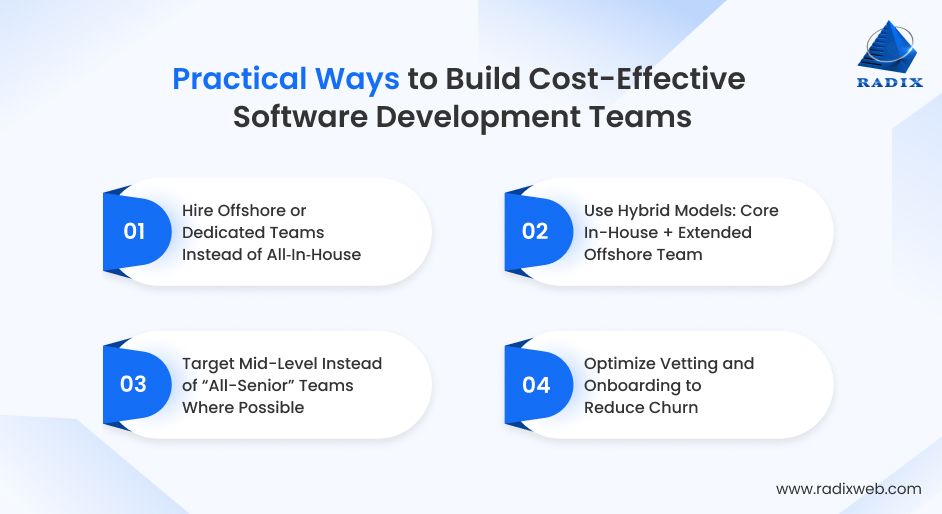
Offshore and dedicated‑team models can cut your hourly and monthly costs since you shift the burden of infrastructure, tools, and operations to the provider. For many mid‑level roles in India and other hubs, you can tap into $20-$50/hour talent, versus the fully loaded $80–$150+/hour for comparable in‑house developers in the US or Western Europe.
The monthly cost to hire a dedicated software development team is also predictable, so you know your engineering spends in advance and rule out the possibilities of any hiring spikes and churn.
Create a hybrid model where you keep a small core product, security, and leadership team in‑house and extend that team with offshore or dedicated developers. Core assets such as IP, architectural decisions, and product roadmap remain under your control, even as you leverage lower-cost development capacity.
This approach to building a software development team is especially effective for mid market companies that want close collaboration without the full salary and overhead of a large local team.
Every task doesn’t need a senior architect or principal engineer. You can staff routine feature work, bug fixes, and well‑scoped modules with trusted mid‑level developers and reserve senior profiles for high‑complexity, high‑risk parts of the product.
This will lower your hourly cost to hire remote software developers without sacrificing stability. Mid‑level engineers often deliver 80-90% of day‑to‑day work at a significantly lower cost than senior‑only squads.
Poor hiring and weak onboarding directly inflate software developer cost per hour through higher turnover and knowledge loss. Strong vetting procedures like technical screenings and cultural fit checks reduce the chance of mis‑hires.
With tech‑sector turnover often running 15–25% per year, even modest improvements in retention can save tens of thousands per developer over a few years by avoiding repeat recruitment, onboarding, and ramp‑up cycles.
By combining offshore or dedicated‑team usage, hybrid delivery, thoughtful role‑mixing, and smarter hiring and onboarding, you can meaningfully reduce both your hourly rate and your total cost‑of‑ownership to hire software developers—without compromising product quality or speed.
AI has begun to influence the cost to hire custom software developers for enterprise projects, but the impact is uneven based on roles and regions.
You can treat software project cost estimation like a simple “calculator” - define the work, estimate hours, apply the right rate, and then add a realistic buffer. This framework works irrespective of your hiring model.
A well‑defined scope gives you a solid base for your cost estimate. Start by outlining what features and modules you need built, including:
Break each feature into smaller tasks and assign approximate hours per task based on complexity. For example:
Add these up to get your total estimated hours for the project.
Decide your team composition (junior, mid‑level, senior) and use a blended hourly rate that reflects that mix. For example:
If your blended rate is $50/hour and your project is estimated at 400 hours, your base cost is $20,000.
This is your “core development cost” before hidden factors.
Account for uncertainty, scope tweaks, and rework by adding a 20–30% buffer to your base cost. That turns $20,000 into a realistic range of $24,000–$26,000.

Outsourcing to an offshore team is a smart financial move when you want to move fast, stay lean, and keep your engineering spend predictable. Collaborating with skilled software developers from offshore hubs, apart from lowering hourly rates, changes the cost structure from fixed overhead to quantifiable delivery.
This approach to hiring makes the most sense when:
Your Next Step to Hire Experienced Software Developer
Radixweb, with 26+ years of experience of custom software engineering, fits naturally into this model by offering ready‑to‑deploy offshore teams staffed with mid‑level and senior engineers who have extensive experience in AI‑assisted workflows, DevOps and cloud‑native stacks, and modern delivery practices.With 2025–2026 benchmark rates in offshore hubs often landing around $20–$60/hour for mid‑level developers, you can access an ISO and SOC 2-certified talent bench at a fraction of the fully loaded cost of many in‑house teams. Ownership of architecture and product strategy remains entirely with your team.If you’re ready to see how a well-qualified offshore team can match your budget and ambition, explore our engagement models and delivery approach. Once you’re ready to discuss your project in detail, you can reach out to us to share your requirements and request a customized cost estimate and team plan.
Ready to brush up on something new? We've got more to read right this way.