Read More


Recognized for AI Excellence at 2026 Globee® Awards - Read More

Nihar Raval
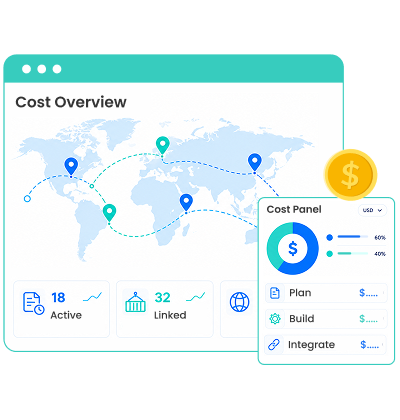
The maritime industry is investing heavily in digital transformation, with global maritime software spending projected to exceed $20 billion by 2026 as shipping companies modernize vessel operations, port coordination, and logistics systems. But the cost variability is staggering.
Maritime software development projects range from $50,000 for simple tracking systems to $500,000+ for enterprise platforms. The problem isn't just the price tag. It's that most companies don't understand why a development project costs what it does.
Stakeholders approve budgets based on optimistic maritime software development estimates, then watch projects bloat as regulatory compliance layers, hardware integration complexities, and legacy system friction emerge midstream. So, ultimately, developing custom software and platforms within budget comes down to understanding cost drivers, what's included in the quote, and what isn't.
Maritime software development costs for low, medium, and high-complexity projects range from $50k to $500k+, depending on the solution type, features, integrations, and overall development scope. A basic vessel tracking system runs $50k–$120k; mid-level fleet management platforms range from $120k–$250k; enterprise systems with multi-port coordination exceed $250k–$500k+. Budget 15–25% of initial development annually for maintenance and regulatory updates. ROI typically hits 18–24 months through fuel savings, labor reduction, and compliance efficiency. Real costs depend on your regulatory scope, vessel types, port integrations, and team model, not just developer headcount.
| Aspect | Detail |
|---|---|
| What does this guide cover? | Maritime software cost breakdown by component, project type, team model, and hidden expenses. Realistic 2026 price ranges, ROI timelines, pricing models, and estimation framework. Maintenance costs, integration expenses, and risk mitigation strategies |
| Who should read this guide? | Shipping company CTOs and tech leads evaluating maritime software investments. Port authorities and logistics platforms planning digital transformation. Procurement and finance leaders building business cases for maritime technology projects. Enterprise operations teams managing digital modernization |

| Cost Type | Cost Range (2026) |
|---|---|
| Basic vessel tracking system | $50k–$120k |
| Mid-complexity fleet management | $120k–$250k |
| Enterprise multi-vessel platform with compliance | $250k–$500k+ |
| Port operations software | $100k–$300k |
| Real-time analytics dashboard | $40k–$100k |
| Compliance & documentation system | $60k–$150k |
| Annual maintenance (15–25% of dev cost) | $12k–$125k/year |
| Harbor/port integration layer | $8k–$20k per port |
| Hardware/sensor compatibility testing | $15k–$35k |
| Team rates (onshore backend dev) | $120–$200/hour |
| Team rates (nearshore backend dev) | $50–$90/hour |
| Team rates (offshore backend dev) | $25–$50/hour |
Maritime software isn't a typical business application. It operates at the intersection of three cost drivers that can push budgets higher than those of land-based systems: regulatory complexity, hardware integration, and operational unreliability. So, understanding the what, why, and how of maritime software development is important.
Here are the key maritime-specific factors that drive development costs:
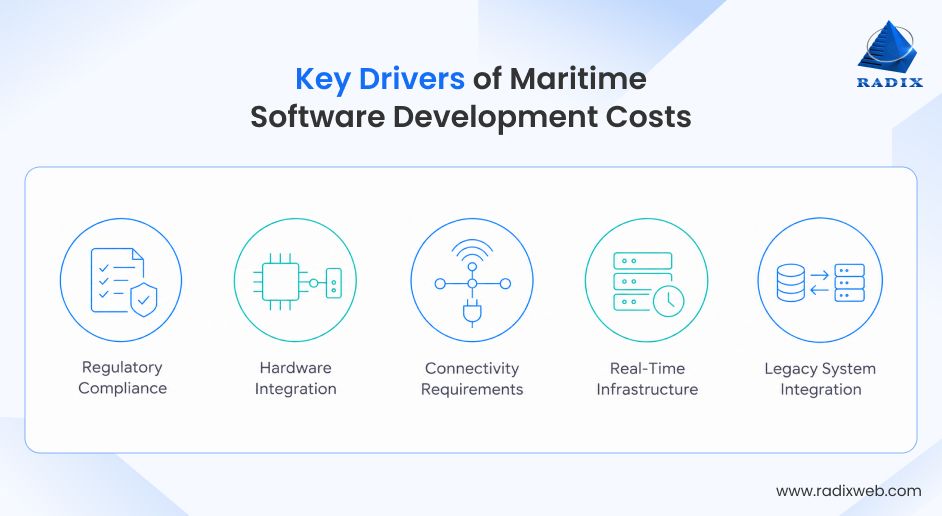
SOLAS (Safety of Life at Sea), ISM Code (International Safety Management), port authority requirements, and emerging IMO 2030 regulations force compliance logic into every feature.
A maritime compliance specialist costs $150–$200/hour and isn't optional because port authorities won't accept systems built by teams that don't understand maritime law. So, the compliance layer alone adds $20,000–$50,000 to development budgets.
Vessels use different GPS systems, AIS (Automatic Identification System) protocols, IoT sensors, and weather monitoring equipment. Testing across five different vessel types with incompatible sensor configurations isn't a minor QA task; it's architectural. Each vessel type requires custom integration work, testing, and debugging. Budget $15,000–$35,000 just for hardware compatibility validation.
Offshore vessels lose internet connectivity for hours or days. Coastal operations pass through zones with patchy satellite coverage. Software must work offline, queue transactions reliably, sync when connectivity returns, and never lose mission-critical data. This offline-first architecture costs more than assuming always-on internet, and it's non-negotiable for maritime operations.
Vessel tracking, fuel monitoring, safety alerts, and port coordination can't tolerate lag or failures. Infrastructure for real-time maritime systems costs more than typical web applications because failure has consequences like delays cost money and missed safety windows create liability.
Most maritime companies run decades-old port booking systems, crew management databases, and vessel logistic platforms built on proprietary architectures. Integration isn't clean REST API calls. It's custom data mapping, workarounds for undocumented behavior, and vendor support that moves slowly. Each legacy maritime software integration costs $8,000–$25,000.
These aren't theoretical concerns or edge cases, but the daily realities of developing tailored software solutions for maritime businesses that force costs up. Once you understand what factors affect maritime software development cost it becomes easier to budget right and prevent surprises later on.
Maritime software costs go beyond core development. Integration, compliance, testing, and infrastructure can each take a significant share of the budget, depending on the project's complexity and operating environment.
Here's how your maritime software development budget is distributed across different functions:
| Phase | % of Cost | What Is Covered |
|---|---|---|
| Core Platform Development | 30–40% | Backend, frontend, APIs, databases, real-time data pipelines, dashboards, mobile interfaces, authentication, and reporting |
| Regulatory & Compliance | 20–30% | ISM and SOLAS requirements, electronic records, audit trails, port documentation, and compliance-focused architecture |
| Hardware & Sensor Integration | 10–20% | GPS, AIS, IoT devices, vessel sensors, offline sync, hardware compatibility, and vendor-specific adapters |
| Testing & QA | 10–15% | Connectivity failures, hardware compatibility, data integrity, regulatory validation, and maritime-specific edge cases |
| Deployment, Infrastructure & Support | 8–15% | Cloud or hybrid infrastructure, redundancy, disaster recovery, monitoring, backups, CI/CD, and post-launch support |
These percentages shift based on project scope. A compliance-heavy port system skews toward regulatory costs (40%+ of budget). A simple analytics dashboard skews toward platform development (60%+ of budget).
The breakdown matters because it shows where your money is actually going and where cost variation comes from.
Here's how much does it costs to build maritime software, broken down by complexity level.
Typical scope: Vessel tracking dashboard with AIS integration, basic GPS monitoring, simple fuel consumption reporting, and email alerts.
Team structure: 1 frontend developer, 1 backend developer, 1 QA engineer (no dedicated compliance specialist, using compliance templates instead).
| What's included | What's not included |
|---|---|
| Basic SOLAS compliance checklist, standard integration (2–3 APIs maximum), offline capability for single-vessel scenarios, and cloud hosting. | Custom port integration, advanced analytics, multi-vessel fleet logic, and custom hardware integration. |
Why this price point: Minimal compliance work (using pre-built modules), straightforward architecture, limited integrations, smaller team, shorter timeline.
Typical scope: Fleet management system with crew scheduling, fuel monitoring, maintenance tracking, port scheduling, multi-vessel coordination, and compliance reporting.
Team structure: 2 frontend developers, 2 backend developers, 1 DevOps engineer, 1 compliance specialist, 1 QA engineer (7 people total).
| What's included | What's not included |
|---|---|
| Moderate compliance requirements (ISM Code + port-specific rules), 3–4 third-party integrations, offline capability with sync mechanisms, basic analytics dashboard, API for third-party access. | Enterprise-scale multi-port coordination, AI-driven predictive analytics, heavy legacy system integration, custom hardware design. |
Why this price point: Full compliance specialist on team, moderate integrations, multi-tenancy basics, comprehensive testing, structured DevOps.
Typical scope: Enterprise platform for multi-vessel fleets, multi-port coordination, real-time analytics, AI-driven predictive maintenance, custom hardware integration, and regulatory reporting across multiple flag states.
Team structure: 4–5 backend developers, 3–4 frontend developers, 1–2 DevOps engineers, 2 compliance specialists, 2 QA engineers, 1 solutions architect (14–16 people total).
| What's included | What's not included |
|---|---|
| Full regulatory compliance across multiple jurisdictions, 5+ integrations with legacy systems, advanced offline-first architecture, ML/AI for fuel optimization and maintenance prediction, disaster recovery, multi-region redundancy. | Custom hardware development (only software integration). |
Why this price point: Large specialized team, significant compliance complexity, heavy integration work, advanced technical requirements, long timeline, enterprise-grade operations.
Important context: These ranges assume a nearshore or onshore team. Offshore teams (India, Southeast Asia) cost 40–60% less per hour. Most companies find hybrid (nearshore + onshore for compliance) hits the best cost-to-quality ratio.
Not all maritime software costs the same. Project type has a direct impact on maritime software costs because each system has different integration, compliance, and data requirements.
Maritime software development cost estimates based on the type of project:
| Project Type | Cost | Timeline |
|---|---|---|
| Fleet Management System | $120K–$300K | 5–7 months |
| Port Operations Software | $100K–$300K | 4–6 months |
| Crew Management Platform | $80K–$200K | 3–5 months |
| Real-Time Analytics Dashboard | $40K–$150K | 2–4 months |
| Compliance & Documentation System | $60K–$150K | 3–5 months |
These ranges are indicative. The final cost depends on integrations, vessel coverage, compliance requirements, data volume, and the level of customization required. Also, budget 15–20% of ongoing maintenance specifically for regulatory updates.
The cost of developing a software solution is the one-time upfront cost. But that's not all. There is also the cost of software maintenance, which is the long-term, ongoing cost. And in maritime, it's higher than most industries expect because regulations change constantly, and integrations break unpredictably.
In the maritime industry, regulatory updates happen constantly. IMO 2030 requirements, port authority rule changes, flag state compliance updates, all force code changes. So for a fleet management software development project that costs $200,000 budget $30,000 - $50,000 annually for maintenance and compliance updates
What's included: Bug fixes, security patches, regulatory compliance updates, minor feature improvements, infrastructure monitoring, performance optimization.
What's excluded: Major platform rewrites or significant new features (those are change orders).
Maritime systems don't play often nicely with each other. Integrating any new application to an existing system requires custom mapping, testing, and documentation work. There's no plug-and-play in maritime. Here's what some common integrations cost:
That's only part of the story. Maintenance costs compound if you ignore them early. A company that treats maintenance as "we'll figure it out later" ends up paying 30–50% more when regulatory compliance falls behind, and integrations start breaking. So, plan for 15–25% annually from day one because it's cheaper than emergency fixes.
If you are looking to engage a dedicated development team for building your maritime software, the cost relies heavily on team composition, expertise, location, and project complexity. Understanding maritime software development team rates helps estimate budgets more accurately before development begins.
| Role | Onshore | Nearshore | Offshore |
|---|---|---|---|
| Frontend Developer | $120–$160/hour | $50–$80/hour | $25–$40/hour |
| Backend Developer | $130–$180/hour | $55–$90/hour | $30–$50/hour |
| DevOps/Infrastructure | $140–$200/hour | $60–$100/hour | $35–$55/hour |
| QA/Testing Specialist | $80–$120/hour | $35–$60/hour | $15–$30/hour |
| Compliance Specialist | $150–$200/hour | $70–$120/hour | $40–$70/hour |
| Project Manager | $100–$150/hour | $45–$75/hour | $25–$40/hour |
Why maritime specialists cost more:
Not every developer knows maritime regulations or how vessel systems work. Hiring someone who understands both software engineering and maritime operations costs premium rates.
A compliance specialist who doesn't understand ISM Code costs you audit failures and potential fines. That's not a cost-optimization area.
Maritime software failures can mean vessel delays, safety issues, or regulatory violations. Companies pay more for developers who understand the stakes and the domain.
So, the right budget needs to account for domain expertise, compliance, integrations, infrastructure, testing, and ongoing support. Start by comparing hourly rates to hire software developers, but then also look at factors like experience, industry-specific expertise, and onboarding costs, if any.
Budget estimates that look reasonable often don't account for the curveballs maritime throws. Here's what surprises people mid-project.
IMO 2030 deadlines, new port authority rules, flag state updates can happen during development.
Cost impact: $8,000–$25,000 per major change, or 10–15% of project timeline delayed.
Different vessel types use incompatible GPS/AIS systems. You discover this during testing, not planning.
Cost impact: $15,000–$35,000 to build compatibility layers not in the original estimate.
Old port systems, ancient crew databases, scattered spreadsheets. Cleaning and mapping this data is slow, manual, error-prone.
Cost impact: $10,000–$30,000, often adding 3–4 weeks to timeline.
Crew resistance to new systems is real. Training on new software, especially for non-technical crews, takes time and money.
Cost impact: $5,000–$15,000 for training materials, workshops, onsite support.
Port APIs don't work as documented. Vendor support is slow or nonexistent. Third-party systems have quirks nobody warned you about.
Cost impact: $10,000–$25,000 in custom workarounds and extended timelines.
Real-time telemetry from 50+ vessels eats bandwidth differently than capacity planning predicted. Cloud costs balloon.
Cost impact: $5,000–$15,000 in infrastructure redesign and optimization.
Maritime industry increasingly requires ISO 27001, SOC 2, or port authority security certifications.
Cost impact: $8,000–$20,000 for initial certification, then $2,000–$5,000 annually.
A realistic maritime software development budget should account for these variables from the start. Building contingency into the plan and budgeting 20-30% extra gives your team room to handle unexpected integration work, compliance changes, infrastructure needs, and user adoption without compromising the core product or delaying launch.
The pricing model you choose when getting a maritime software solution developed affects more than how you pay. It also determines how much flexibility you have when requirements change, how predictable your budget remains, and who carries the risk of unexpected work.
Here are the main types of models you can choose from:
A fixed-price model works best when the project scope, features, integrations, and delivery requirements are clearly defined upfront. You agree on a fixed cost with the development partner before work begins, making it easier to plan the initial budget and track spending throughout the project. However, changes outside the agreed scope can lead to additional costs and change orders.
With a time-and-materials model, you pay based on the actual hours worked at agreed rates. This gives your team more flexibility to adjust features, integrations, and requirements as the project evolves. It can be useful for complex maritime systems where the difficulty of legacy integrations or regulatory requirements may not be fully known at the start. The tradeoff is that the final project cost is less predictable.
A hybrid model combines a defined project scope and upfront development cost with an ongoing retainer for maintenance, compliance updates, integrations, and enhancements. This approach can work well for maritime systems that require continuous updates after launch. It provides greater budget visibility for ongoing work while allowing the software to evolve as operational and regulatory requirements change.
| Fixed-Price | T&M | Hybrid |
|---|---|---|
| High predictability | Low predictability | Medium predictability |
| Low flexibility | High flexibility | Medium flexibility |
| Vendor bears risk | Client bears risk | Shared risk |
| Best for well-defined scope | Best for evolving requirements | Best for ongoing systems with compliance needs |
In maritime, the hybrid model usually wins. It lets you keep the scope fixed for the core platform and use the time-and-materials model for the compliance of unknowns. It costs more upfront than pure T&M but surprises you less than the fixed-price model.
Maritime software almost always generates ROI, but not where you expect. Here's where the maritime software development ROI comes from:
Real-time monitoring and route optimization can reduce fuel consumption by 5–15%. A 50-vessel fleet burning 1,000 tons/year at $600/ton leads to $600,000 annual fuel cost. A 10% reduction is $60,000/year saved. A $180,000 platform cost pays back in 3 years and continues saving after.
Automation of crew scheduling, maintenance tracking, documentation reduces manual admin work by 20–40%. It also allows crew teams to spend more time on operational priorities rather than repetitive administrative tasks.
Fines for non-compliance start at $50,000 and climb fast. Audit time and manual documentation take 200+ hours/year per company. At $75/hour labor cost, that's $15,000/year of admin overhead. Automation cuts this by 50–70% results in $7,500–$10,500/year saved.
Better coordination and electronic documentation reduce wait time by 2–6 hours per port call. For 100 port calls/year, even 3 hours saved at $1,000/hour cost results in annual savings of $300,000.
Identifying equipment failures before they happen prevents downtime. A single unplanned vessel downtime costs $50,000–$150,000 in lost revenue. Preventing 2–3 major breakdowns/year pays for $100,000 software quickly.
Realistic Payback Timeline:
These numbers make it clear that maritime software pays for itself. The important question isn't simply how quickly the software pays for itself. It's whether the system targets the operational costs that matter most to your business. So, before development begins, identify the measurable costs the software is expected to reduce and establish baseline metrics. This gives you a clearer way to evaluate the investment after launch and determine whether the software is delivering the operational value your business expected.

Take the First Step towards Maritime Software Development
Cost is an important part of any maritime software decision, but the estimate itself is only the starting point. Instead of fixating on a single number, start by understanding how that number is built: the project scope, integrations, compliance requirements, team composition, infrastructure, testing, and ongoing support. Start by consulting experts who can explain the software development process, how costs are estimated and what are the key considerations to be vary of. Armed with this information, you can evaluate estimates more realistically.With two and a half decades of software engineering experience and expertise in maritime technology, Radixweb can help you turn those variables into a practical development plan. Schedule a consultation with our team to get a custom estimate that covers the expected cost, timeline, deliverables, and development roadmap, so you have the context behind the number and a clearer path from planning to implementation.
Ready to brush up on something new? We've got more to read right this way.