Read More


Recognized for AI Excellence at 2026 Globee® Awards - Read More

Dhaval Dave

Unplanned downtime costs companies an estimated $50 billion annually in the US alone. That sounds too much, right? But consider this: A manufacturing plant producing $2 million per day stops. Within 60 seconds, the company loses $2,000. Within an hour, $120,000. Also, an average manufacturing downtime is about 238 minutes per incident. The worst part? In most cases, the equipment had been warning everyone for days. But nobody was listening. Predictive maintenance AI promises to cut the annual losses by 40-50%. But 60% of predictive maintenance projects fail within the first 12 months.
The gap isn't between companies that have AI and those that don't. It's between those who built the right foundation before deploying AI and those that don't. At Radixweb, we've worked with 10+ businesses across industries to implement predictive maintenance systems. We've seen what works and what doesn't. Based on our hands-on experience, below we share what does it really takes to reduce unplanned downtimes.
More than two thirds of predictive maintenance AI projects fail. All because organizations jump to modeling before building the foundation. Clean data pipelines, historical failure records, decision rules, and a team that understands and trusts the system are the prerequisites for successful predictive maintenance of AI. More importantly, success isn't about deployment alone. It's about treating it as an ongoing operation with continuous retraining and feedback loops that keep predictions accurate over time.
| Aspect | Detail |
|---|---|
| What this guide covers? | The infrastructure requirements for predictive maintenance AI, the difference between pilot projects and production deployments, data pipeline fundamentals, model selection and retraining, and organizational capabilities needed for long-term success. |
| Who should read this? | Operations leaders, Manufacturing Directors, Engineering Managers, Plant Managers, and anyone responsible for uptime, maintenance costs, and production reliability. |
Predictive maintenance is the practice of monitoring equipment health to identify early signs of failure and performing maintenance only when the data indicates it is needed. The use of real operating data to determine when intervention is actually required results in:
Preventive maintenance, on the other hand, follows fixed schedules regardless of equipment condition.
Artificial intelligence takes predictive maintenance far beyond traditional condition monitoring. Instead of relying on simple thresholds or predefined rules, AI analyzes thousands of sensor readings. It also tracks maintenance records, operating conditions, and historical failures to identify patterns. It continuously learns from new data and improves prediction accuracy over time. Most importantly, AI predictive maintenance estimates not only when a machine is likely to fail but also how confident the prediction is, making custom AI development for enterprise-scale applications especially valuable where maintenance decisions directly affect production uptime.
This changes predictive maintenance from a reactive to an intelligent decision support system. Maintenance teams gain earlier warnings, clearer priorities, and better visibility into equipment health. With that the teams can reduces unplanned downtime, optimize maintenance schedules, improve spare parts planning, and make more informed ops decisions.
Predictive maintenance sounds simple at the board level. But it is extraordinarily complex in practice. The 60% first-year failure rate isn't because the AI doesn't work. It fails because organizations underestimate what's required to make AI actually useful in operations.
We've assessed dozens of predictive maintenance projects across manufacturing, utilities, logistics, and oil & gas. The failed projects all share common patterns:
Most organizations don't have structured sensor data. They have IoT devices, SCADA systems, and historian databases. But these systems were never designed to work together. Sensor readings are stored in different formats across different systems with different time intervals, different precision levels, and different quality standards. A predictive model trained on such data, the models learns inconsistency instead of pattern. The result isn't better predictions, but wrong decisions, made with confidence. Reliable data integration for diverse systems is the step 1 to a properly functional predictive maintenance system
Companies often acquire pre-built predictive maintenance models from vendors. Off-the-shelf models trained on generic equipment data simply don't work on your specific equipment, in your specific environment, under your specific operating conditions. The model predicts when a generic pump is likely to fail. Your pump runs differently.
Once deployed, these models need continuous retraining as your equipment ages, operating patterns shift, and maintenance practices evolve. Most organizations don't have the processes to do this. The model degrades over time and nobody notices until predictions become unreliable.
Predictive maintenance AI changes how maintenance operates. Instead of preventive maintenance on a schedule, maintenance becomes responsive to AI recommendations. But operators, maintenance managers, and plant leadership often distrust AI predictions. When the model says equipment will fail in 3 days but the equipment has run fine for the past 5 years, it's difficult to pull the unit offline for maintenance.
Worse, there's no clarity on who owns the outcomes of the predictions made by the AI system. Is it the AI team's responsibility if a prediction is wrong? The operations team's for not acting on it? The vendor's for providing a faulty model? Without clear ownership, accountability evaporates. When something goes wrong nobody takes responsibility for fixing it.
Predictive maintenance ROI should be straightforward: savings from prevented downtime minus the cost of implementing the system. But it rarely works out that way. Organizations implement predictive maintenance, reduce downtime by 25%, but then realize that running maintenance more frequently also increases maintenance labor costs, spare parts inventory, and engineering overhead. The best outcome is real but not the slam-dunk that was promised at the project kickoff.
These four issues, technology failures but implementation failures, are why most predictive maintenance projects never get the 'successful' tag.
A predictive maintenance AI project for 20 critical assets with existing sensors, clean maintenance data, and a modern CMMS typically costs $75,000-$150,000 and takes 3-4 months to reach production. Now compare that with another project using the same AI models, but deployed across a legacy manufacturing plant where sensor data is fragmented, SCADA systems are decades old, and historical failure records need to be cleaned and connected. That project can easily cost $400,000-$800,000 and take 8-12 months to go live.
The difference isn't just the AI model or the absolute cost of developing the AI system. It's the environment where the AI has to operate. Predictive maintenance succeeds only when it can access reliable equipment data, integrate with operational systems, and fit into existing maintenance workflows. The more complex those systems are, the larger the investment required.
| Project Scenario | Typical Timeline | Estimated Cost (USD) |
|---|---|---|
| Pilot deployment for 10-20 critical assets with existing sensors and structured maintenance history | 3-4 months | $75,000-$150,000 |
| Single production facility with real-time monitoring, custom AI models, and CMMS integration | 6-8 months | $180,000-$400,000 |
| Legacy manufacturing plant requiring additional sensors, SCADA integration, historian modernization, and custom dashboards | 8-12 months | $400,000-$800,000 |
| Enterprise deployment across multiple plants with centralized monitoring, MLOps, governance, and continuous model retraining | 12-18 months | $800,000-$2M+ |
Several factors influence where your project falls within these ranges:
So, when you get a cost estimate or timeline from a vendor rather than focusing on a headline cost or timeline, focus on how the estimate was built, what work it includes, and the operational outcomes it is expected to deliver. That tells you far more about the project's value than the number alone.

Before deploying predictive maintenance AI, your organization needs four things in place. Call them the predictive maintenance readiness dimensions.
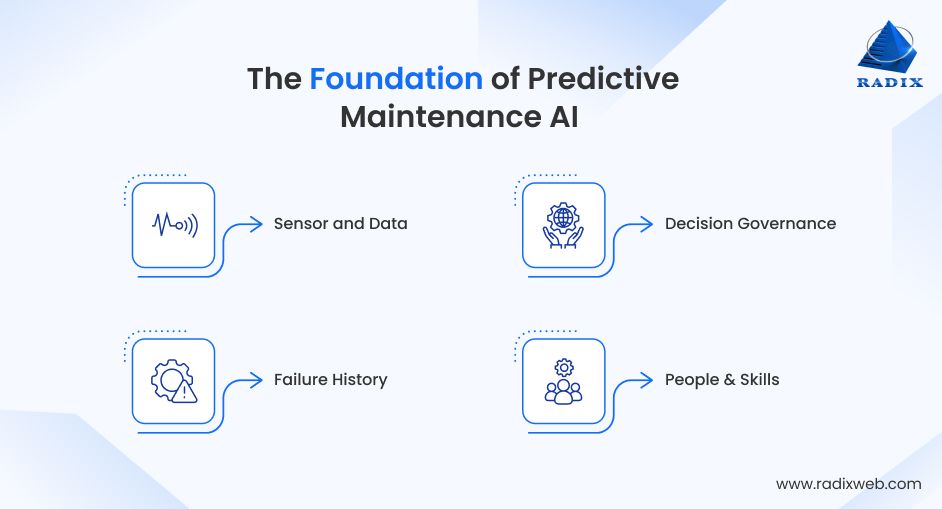
Your sensors must be collecting the right data, at the right frequency, with the right quality. This sounds obvious. It's surprisingly difficult to get right.
For predictive maintenance to work, you need sensors that measure the parameters that actually precede equipment failure. For rotating equipment, this means vibration data (typically 5-20 kHz sampling rate), temperature (at equipment housings and bearing points), acoustic emissions (for detecting bearing degradation), and power signatures (changes in current draw can signal mechanical problems). For compressors and pumps, pressure, flow rate, and efficiency metrics matter.
Each sensor type requires different sampling rates and precision levels. Vibration data needs high frequency sampling but lower precision. Temperature data needs lower frequency but higher accuracy. When these are collected through different IoT platforms, historian databases, and SCADA systems, integrating them becomes a data engineering challenge.
Before you select a model or hire data engineers for data filtering or processing, you need a data pipeline: automated extraction from sensors, standardization across systems, real-time aggregation, and storage in a format that an ML model can actually use. Most organizations skip this step. They deploy the model and then struggle with data quality issues for 18 months.
Machine learning models need to learn from the past to predict the future. That means you need historical data about past equipment failures, not just that equipment failed, but why it failed, how long it took to manifest, what sensors showed as warning signs, and what interventions worked.
Many organizations don't have this in structured form. Maintenance logs are scattered across spreadsheets, work orders are in a CMMS (Computerized Maintenance Management System) that wasn't designed for data analysis, and critical information about failure root causes lives in the heads of senior technicians who are retiring.
Without clean failure data, you're training models on a dataset that's too small and too noisy. The model can't learn genuine patterns because the signal-to-noise ratio is terrible.
Many organizations start predictive maintenance with 6-12 months of historical data. The models may be less accurate initially, but they improve rapidly once they start seeing real failures in production. Start with what you have, validate on recent data, and plan to retrain as more data accumulates. The worst approach is waiting for perfect historical data before starting.
Predictive maintenance creates a new decision point in your operations. When the AI model flags equipment as likely to fail, who decides what to do?
This needs explicit governance and impactful clarity in decision making. There are also questions to answer, like: When a failure is predicted with 90% confidence, does maintenance automatically schedule work or does it wait for approval from the plant manager? When is a prediction wrong enough to warrant investigation? Who monitors the model's performance? Who gets paged if a prediction fails?
Organizations without this clarity end up with AI recommendations that nobody acts on, or actions taken without understanding the confidence level or the implications. Clear decision rules matter more than model accuracy.
Predictive maintenance AI requires skills that are rare in industrial organizations: data engineering (to build pipelines), ML operations (to monitor and retrain models), and domain expertise in maintenance and equipment behavior.
Most organizations solve this by hiring dedicated software development partners. That's often the right move. But even with external support, someone in your organization needs to own the model, understand its limitations, and make judgment calls about when AI should guide decisions and when human expertise should override it.
Once you have the foundation in place, the architecture question becomes: How do you build a system that can make reliable predictions over time?
The short answer: You don't build one model. You build multiple, specialized models, each predicting different types of failure on different equipment.
Here's how it works:
A single model that predicts 'equipment will fail' is too broad to be useful. Instead, predictive maintenance systems use specialized models: one for bearing failures, one for seal failures, one for thermal issues, one for vibration-based degradation. Each model focuses on the specific physics of a particular failure mode.
This approach is more accurate (each model learns deeper patterns specific to its failure mode) and more actionable (when the bearing failure model triggers, maintenance knows exactly what to inspect).
Real-time predictions alone are dangerous. A single data point showing high vibration might be noise. The same high vibration persisting over 3 days is a signal. A experts guide software architecture design is the one that ingests real-time sensor streams but scores them against historical trends for that specific equipment under those specific operating conditions.
This requires buffering sensor data (not just storing the latest reading, but keeping 30-90 days of historical context), computing time-series features (rate of change, moving averages, anomaly scores), and comparing current behavior against each equipment's unique baseline, not a generic one.
Models should output not just a prediction, but a confidence level. A model saying 'bearing will fail in 7 days with 92% confidence' is fundamentally different from 'bearing might fail with 52% confidence.' The latter should trigger investigation, not action. The former should trigger maintenance.
This requires Bayesian modeling approaches or ensemble methods that can quantify uncertainty, not just point predictions. When you add this decision support layer, predictive AI evolves into prescriptive AI, which yields even stronger, actionable outcomes.
Every prediction that turns out to be wrong (or right) is training data. The architecture needs to capture what actually happened after a prediction, compare it to what the model said would happen, and use that feedback to improve the model for next time.
This is one of the most common reasons of AI failure in production. After deployment, predictions degrade because the model isn't being retrained on new data. Building automated retraining into your architecture is critical.
Here's what an actual predictive maintenance implementation looks like, from assessment to production:
Evaluate data availability, sensor coverage, equipment criticality, and current downtime patterns. Establish what's actually costing the organization in terms of unplanned downtime. Get clear on what 'success' looks like (e.g., 30% reduction in unplanned downtime for critical equipment).
This is where most projects spend way more time than expected. Extract historical data from CMMS, historian databases, and SCADA systems. Clean it. Standardize it. Match failure records to sensor readings. Build the data pipeline that will ingest real-time sensor data going forward. This phase often takes longer than the AI modeling phase.
Once data is ready, train initial models. Validate them on historical data you've set aside. Test predictions against known failures to see if the model would have caught them. This phase moves relatively quickly once data is clean.
Deploy to a limited set of non-critical equipment first. Let the model make predictions but don't automatically act on them. Have maintenance teams review predictions and document whether predictions align with their experience. Capture this feedback and use it to improve the model.
Once confident, expand to production equipment. Start with high-confidence predictions (>85% confidence). Set up monitoring and alerting. Establish escalation procedures.
Monitor model performance. Retrain quarterly with new data. As equipment changes or maintenance practices evolve, update the models. This isn't a one-time project. It's an ongoing system.
Total timeline from assessment to meaningful production results takes a minimum of 6-9 months.
The biggest mistake organizations make is comparing predictive maintenance projects based only on implementation cost or delivery time. A project that costs twice as much isn't necessarily overpriced if it prevents millions of dollars in production losses over its lifetime. The right question isn't "How much will this cost?" It's "What value will this create once it's running?"
A simple way to calculate predictive maintenance ROI is:
ROI = (Annual savings from reduced downtime + maintenance optimization + asset life extension - Annual operating costs) ÷ Total implementation cost × 100
The savings typically come from multiple areas, including:
On the cost side, organizations should include implementation, infrastructure, model maintenance, cloud hosting, and ongoing monitoring, not just the initial development cost.
For example, consider a manufacturing facility that loses $60,000 per hour during unplanned production stoppages and experiences 40 hours of downtime annually, resulting in $2.4 million in annual losses.
If a predictive maintenance program costing $450,000 reduces downtime by 35%, the organization avoids approximately 14 hours of downtime, saving around $840,000 in production losses each year. Even after accounting for ongoing operating costs, the project pays for itself within the first year and continues generating value as the models improve and are deployed across additional assets.
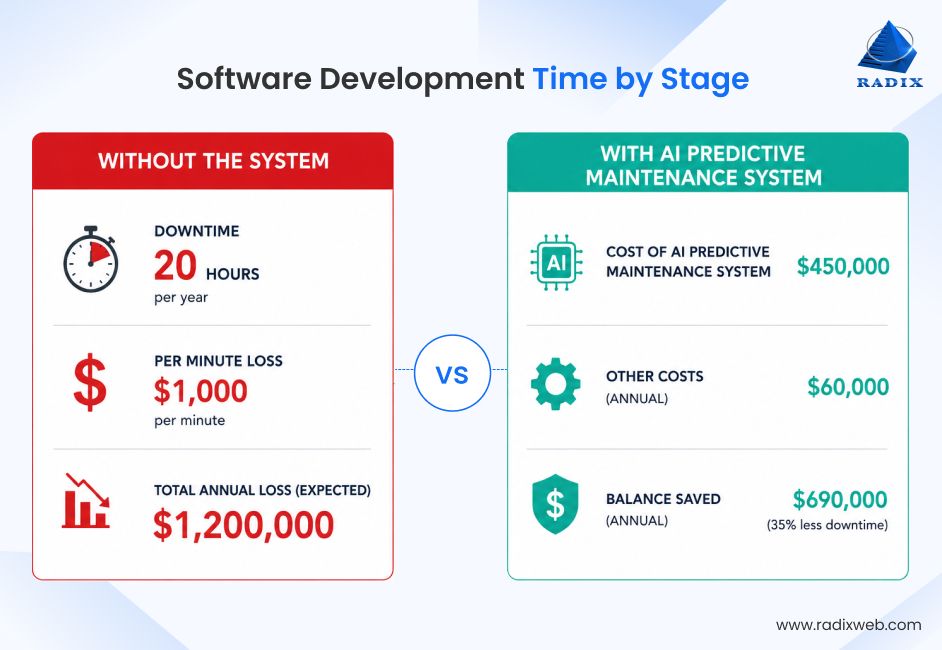
Important: Not every predictive maintenance AI project delivers identical results. ROI depends on equipment criticality, downtime costs, production volumes, maintenance maturity, and how effectively the organization acts on AI recommendations. A highly automated manufacturing plant will usually see a much larger financial impact than a facility where equipment failures have limited operational consequences.

Reducing Unplanned Downtime with AI-Enabled Predictive Maintenance
Unplanned downtime is expensive, but it is also largely preventable. With predictive maintenance AI. But it only works if you've built the foundation first: reliable data, clear decision rules, skilled teams, and realistic timelines. At Radixweb, we have the experience of having supported several organizations build predictive maintenance systems. And we've consistently seen that the organizations that get results are the ones that treated predictive maintenance as a foundation-building effort, not an AI model-deployment project.So the key is to invest in data infrastructure, establish clear governance, and plan for the long term instead of chasing short-term returns. If you're evaluating predictive maintenance AI for your organization, schedule a consultation with our predictive maintenance specialists to assess your readiness, identify the highest-impact failures to target first, and understand what it would take to reduce your unplanned downtime by 30-40% over the next 12 months.
Ready to brush up on something new? We've got more to read right this way.