Read More


Recognized for AI Excellence at 2026 Globee® Awards - Read More

Pratik Mistry

Why this matters in 2026: AI development projects can cost anywhere between $5,000 for small projects to $100,000+ for enterprise solutions. So, how much should you budget for AI implementation? This guide will help you understand the ins and outs of custom AI development costs. Read on to budget confidently, avoid overruns, and make smarter AI investment decisions.
85% of organizations increased their AI budgets in the last 12 months. Yet, only 6% of organizations see AI ROI within 12 months of implementation.
This mismatch makes 2026 AI budgeting tougher… and makes understanding the real cost of AI implementation more critical than ever.
This guide lays out a practical, detailed artificial intelligence cost estimation framework rooted in our hands-on experience of building AI software solutions. If you want to understand how much AI development costs and what actually drives that budget, you’re in the right place.
But if you’re asking, “What is the cost of AI development” and expecting a single number, you’re asking the wrong question. In 2026, there isn’t one fixed price for AI. The real key is understanding how AI costs are structured and using that insight to plan a realistic budget.
Read on and find out.

Before you get started with Artificial Intelligence development, you need to understand how AI development costs are structured. Most businesses initially assume that AI development works like buying a packaged SaaS product.
Choose a plan --> Pay a fixed rate --> Go live
In reality, the cost of AI development doesn’t work like that. Instead, it depends on complexity, technical choices, constraints, and the type of intelligence.
Below are the core drivers that shape the AI software development cost:
The kind of artificial intelligence you are building sets the baseline AI app development cost. A rule-based chatbot and a multimodal generative AI system won’t cost the same. That’s because different types of AI solution require different engineering layers like data pipelines, training loops, model architectures, and evaluation processes. This variation in effort drives drastic variations in costs.
Project scope is one of the biggest factors affecting the cost of developing AI solutions. The number of features, automation level, accuracy targets, integrations, compliance needs, device support, and multilingual or multimodal requirements all add to the effort. Scope often grows as the project unfolds, and even a 10% increase in features can mean weeks of extra engineering and higher costs.
Data sits at the center of AI projects. That’s why AI development costs differ depending on whether you already have structured and labeled data or your data is unstructured and siloed. Manual labeling and the need for building real-time pipelines also contribute to the AI model development cost.
AI model development cost also depends on whether the system is required to work in real-time or use batch processing. Real-time systems used for fraud detection, autonomous systems, and voice assistants, for example, require:
That’s why they cost way more than batch systems, which can use simpler pipelines and less compute.
Higher AI model accuracy isn’t just a number. It is labor and has a cost impact. Achieving 85% accuracy might need 10 iterations. And achieving 95%+ accuracy can take 10× more effort. This affects training cycles, hyperparameter tuning, dataset size, model choice, and compute consumption, which affects costs.
Expert Advice: Organizations in regulated industries especially must budget for higher accuracy thresholds to build trust and meet regulatory requirements.
Overall, artificial intelligence cost estimation ultimately depends on how all these factors come together. If you already have existing systems, you’ll also need to account for AI integration costs. And beyond the initial build, it’s essential to plan for ongoing AI maintenance costs to keep your solution running efficiently.
AI development isn’t a single line item; it is an ecosystem of interconnected services.
Here’s a quick summary of the AI development cost breakdown:
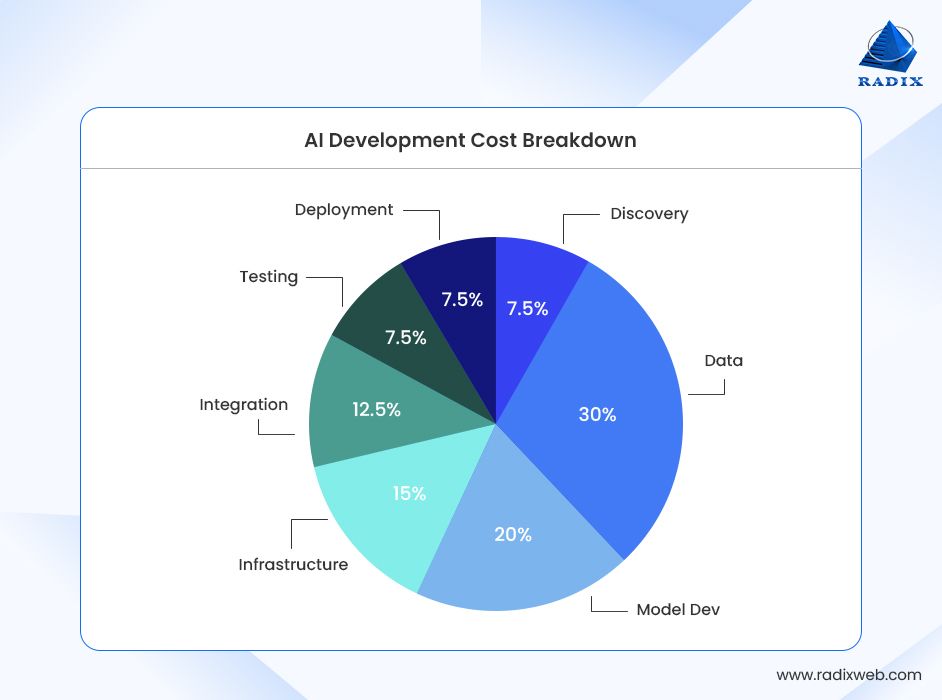
Below is a detailed look at how AI development budgets are typically distributed
(5–10% of the total AI software development cost)
This is the first stage for any AI project and involves understanding business requirements, success metrics, risks, and architecture options. Cutting corners here often leads to higher expenses later.
(20–40% of the total AI software development cost)
Data collection, cleaning, and labeling often account for a major chunk of the total cost of developing AI solutions. This includes pulling data from multiple internal systems, removing inconsistencies, labeling data through human or semi-automated methods, and performing normalization and transformation. When high-quality, clean data is already available, overall costs can drop significantly.
(15–25% of the total AI software development cost)
This covers choosing the right algorithms, building training pipelines, running experiments, and refining the model’s performance. These iterations consume both compute resources and engineering time, making this a substantial investment.
(10–20% of the total AI software development cost)
Compute-intensive AI projects require GPUs, high-memory servers, scalable storage, and cloud resources. As models grow more complex and datasets increase, infrastructure costs rise proportionally.
(10–15% of the total AI software development cost)
Connecting AI systems to existing CRM, ERP, IoT, POS, or legacy platforms often takes more time than most people expect. Each system has unique constraints, and ensuring smooth communication adds significant engineering effort and AI integration cost.
(5–10% of the total AI software development cost)
Testing goes beyond functional checks and includes evaluating model behavior across edge cases, stress scenarios, and real-world conditions. Security and compliance work further becomes important in regulated industries.
(5–10% of the total AI software development cost)
Deployment requires reliable pipelines, versioning, and infrastructure for drift monitoring, logging, and alerting. These systems ensure that the model performs reliably once it’s in production.
AI systems require continual attention. Models must be retrained, updated, and monitored as new data comes in, and business needs evolve. So once your AI project is live, make sure you also budget for this recurring AI maintenance cost that ensures the system remains accurate and relevant over time. The annual maintenance costs usually turn out to be around 10-15% of the total cost of developing AI solutions.

Custom AI development doesn’t have a one-size-fits-all price tag. Costs vary widely because every project has different goals, levels of complexity, and technical requirements. Instead of being driven by model complexity alone, pricing is shaped by:
These factors often overlap, which is why budgets can shift dramatically from one project to another. For example, a computer vision system built for a mid-sized manufacturing operation will have different needs (and costs!) than a small chatbot for customer service. Understanding these dimensions makes it easier to estimate what an AI solution might actually cost in 2026.
Next up is a more comprehensive view of how these factors shape the overall cost of developing AI systems
Different AI solutions have different architectures, data needs, accuracy expectations, and infrastructure demands. This makes “AI solution type” one of the strongest predictors of how much the project will ultimately cost.
Below we have explained the AI development costs some common types of AI projects:
Approximate Cost: $40,000 to $250,000
Conversational AI chatbot development cost depends on whether it is simple rule-based systems or advanced LLM-powered assistants with contextual understanding, workflow automation, and integration with business systems. Costs increase as customization, data training, and real-time performance requirements grow. Also, if the chatbot has to be embedded into legacy systems which have their own quirks, the AI integration cost might be more than usual.
Predictive Analytics Solutions
Approximate Cost: $60,000 to $500,000
Predictive analytics solutions help organizations forecast trends, optimize operations, analyze risks, and support decision-making. The exact cost of predictive analytics solutions depends on the data quality, dataset size, and accuracy and real-time processing needs.
Approximate Cost: $80,000 to $600,000
Computer vision systems analyze images or videos for object detection, recognition, quality inspection, or autonomous navigation. The cost for developing a computer vision system is influenced by the size of the dataset, model complexity, training requirements, and performance demands.
Recommendation Systems
Approximate Cost: $70,000 to $400,000
Recommendation engines deliver personalized experiences by analyzing user behavior, preferences, and interactions. The costs for such systems rises with increase in dataset volume, more real-time recommendations, multi-segment targeting, and advanced hybrid modeling techniques.
Generative AI (Text, Image, Audio, Video)
Approximate Cost: $150,000 to $1,200,000
Generative AI development includes building systems that can create content such as text, images, audio, or video. Multimodal capabilities, model fine-tuning, high-throughput inference, safety measures, and secure enterprise-grade hosting affect the overall cost of Gen AI systems.
Autonomous/Real-Time AI Systems
Approximate Cost: $250,000 to $2,000,000+
Autonomous and real-time AI systems power robotics, drones, vehicles, and industrial automation. These systems often require continuous sensor processing, sub-second decision-making, safety-critical operations, and rigorous testing, which drives higher AI automation costs.
Approximate Cost: $100,000 to $800,000
AI agent development costs depends on the complexity of the agent’s reasoning, multi-step decision-making, integration with business workflows, and learning capabilities. Costs also rise with the need for real-time interaction, multi-agent coordination, and domain-specific customization. Advanced AI agents may require ongoing monitoring and updates which add to the overall AI agent development cost.
Here’s a quick summary of the AI development costs based on the type of solution:
| AI Solution Type | Estimated Cost (USD) |
|---|---|
| Conversational AI / Chatbots | $40,000–$250,000 |
| Predictive Analytics | $60,000–$500,000 |
| Computer Vision | $80,000–$600,000 |
| Recommendation Systems | $70,000–$400,000 |
| Generative AI | $150,000–$1,200,000 |
| Autonomous / Real-Time Systems | $250,000–$2,000,000+ |
| AI agents | $100,000 to $800,000 |
Project scale reflects the breadth, depth, and operational expectations of the AI system. It captures not only “how big” the solution is, but also how sophisticated and production-ready it must be.
Small-Scale Projects
Small-scale AI app development costs usually range between $30,000 to $120,000. These projects focus on solving a single, well-defined problem with minimal data requirements and limited AI integrations. These solutions include simple chatbots, single-feature ML classifiers, rule-based automation, and small predictive models. They usually involve short development cycles, lightweight infrastructure, and straightforward deployment. Small-scale AI pilot projects are the most affordable path to adopting AI for early-stage or low-risk use cases.
Mid-Level Enterprise Solutions
Mid-level enterprise AI solutions generally range from $120,000 to $600,000 and bring together multiple components, richer data pipelines, and deeper enterprise integrations. These projects often require multi-system connectivity, multi-step workflows, monitoring and dashboards, explainability features, hybrid cloud environments, and stronger data engineering foundations.
Examples include medium-scale recommendation engines, enterprise analytics platforms, and computer vision defect detection systems. They support more complex business operations and are typically central to digital transformation efforts.
Large, Production-Grade AI Platforms
Large enterprise-grade AI solutions usually cost between $600,000 and $2,000,000+ and require extensive engineering, infrastructure planning, and enterprise-level reliability. These systems often involve multi-modal or multi-agent architectures, real-time inference, large dataset pipelines, strict SLAs, compliance-driven development, multi-region scalability, and custom infrastructure such as GPU clusters or vector databases.
These platforms often become mission-critical components of the business and require continuous enhancement, monitoring, and support.
Here’s a quick summary of the AI development costs based on scale of the project
| Project Scale | Estimated Cost (USD) |
|---|---|
| Small-Scale AI Projects | $30,000–$120,000 |
| Mid-Level Enterprise Solutions | $120,000–$600,000 |
| Large Enterprise-Grade AI Platforms | $600,000–$2,000,000+ |
Every industry operates under its own constraints, regulations, and data realities. This means that the AI automation cost can be significantly more or less depending on the domain.
Below is a closer look at how much does AI development costs across leading industries in 2026 and how industry specifics affect the AI implementation cost.
Healthcare
Developing AI for healthcare is one of the most expensive undertakings, often landing between $250,000 and $2,000,000. The cost climbs quickly because these systems must satisfy HIPAA compliance, FDA-related expectations, strict data governance rules, and clinical-level accuracy. Healthcare models undergo extensive validation, security hardening, and explainability checks before they can be trusted in real-world environments, which adds considerable engineering and review effort.
Finance
In financial services, AI implementation cost tends to fall in the $200,000 to $1,500,000 range, largely due to the high demand for transparency and auditability. Models must align with AML, KYC, SOX, and other regulatory frameworks, and they often power fraud detection, risk scoring, or real-time transaction analysis. The emphasis on trust, reproducibility, and secure data flow makes finance a regulation-heavy arena where precision and governance directly drive cost.
Retail & E-commerce
AI in retail and e-commerce projects are generally more accessible, with budgets typically ranging from $80,000 to $800,000 depending on scale. These systems usually support personalization, demand forecasting, recommendation engines, or segmentation models. Because retail environments deal with fast-moving customer behavior and heavy traffic spikes, infrastructure considerations (rather than regulations!) often determine how expensive the solution becomes.
Manufacturing
AI in manufacturing often carries a higher engineering burden due to the reliance on computer vision, robotics, and real-time operational feedback. Costs, which usually fall between $120,000 and $1,000,000, are shaped by the need to process high-resolution video streams, meet industrial safety requirements, and integrate smoothly with machinery. The tight coordination between hardware and AI software makes manufacturing uniquely demanding compared to other sectors.
Logistics
The price of AI in logistics solutions can vary widely, typically from $150,000 to $900,000, depending on how complex the operation is. Routing optimization, fleet visibility, IoT-driven monitoring, and predictive modeling all require working with large geospatial datasets and real-time decision engines. Because even small inaccuracies can create costly downstream issues, achieving a high degree of optimization often becomes the main cost driver.
Automotive
Automotive AI stands out as one of the highest-cost categories, especially for autonomous or safety-critical components. AI implementation costs commonly start around $300,000 and can exceed $2,000,000+ for advanced systems. Whether it’s ADAS features, lane detection, sensor fusion, or predictive maintenance, the work requires intensive simulation, real-world testing, and integration with complex sensor suites, all of which demand extensive engineering cycles.
Media & Entertainment
AI project cost in the media and entertainment industry varies based on the type of system being built and generally land between $80,000 and $700,000. AI is used for content recommendation, media enhancement, and increasingly generative content production. Multimodal models for video, audio, and imagery can significantly increase complexity, especially when creative quality, scalability, and turnaround time are critical.
Real Estate
AI in real estate tends to be more budget-friendly than in heavily regulated industries. Typical projects cost $60,000 to $500,000, supporting AI use cases such as property recommendations, market analysis, and predictive pricing. Since the data structures are relatively standardized and compliance overhead is low, costs mainly depend on model depth and the scale of market data being analyzed.
EdTech
EdTech AI solutions often sit between $50,000 and $400,000, but the AI project cost shifts depending on how personalized or real-time the system needs to be. Adaptive learning engines, automated content tagging, live evaluation, and proctoring tools require careful consideration of fairness, explainability, and student privacy. When multilingual or anti-cheating capabilities are added, complexity and price tend to rise.
Here’s a quick summary of the cost of implementing artificial intelligence based on the industry:
| Industry | Estimated Cost Range (USD) |
|---|---|
| Healthcare | $250,000–$2,000,000 |
| Finance | $200,000–$1,500,000 |
| Retail & E-commerce | $80,000–$800,000 |
| Manufacturing | $120,000–$1,000,000 |
| Logistics | $150,000–$900,000 |
| Automotive | $300,000–$2,000,000+ |
| Media & Entertainment | $80,000–$700,000 |
| Real Estate | $60,000–$500,000 |
| EdTech | $50,000–$400,000 |
If you are not sure how much does AI development costs for your industry, it is best to schedule an AI consultation and get an exact quote for your needs.

Beyond industry and solution type, the development model you choose has a major impact on budget, speed, and long-term scalability. Most organizations adopt one of three approaches:
Each path comes with its own cost drivers and operational trade-offs.
Building an in-house team means hiring AI developers, ML engineers, data scientists, MLOps specialists, and product roles. This offers full control but also brings the highest upfront and ongoing expenses. Most teams require at least 5–10 specialists, making this the most expensive model for companies without an existing AI foundation.
| Expense Category | Annual Cost (USD) |
|---|---|
| AI/ML Engineers | $150,000–$350,000 per person |
| Data Scientists | $120,000–$280,000 per person |
| MLOps Engineers | $140,000–$300,000 per person |
| Infrastructure/Tools | $50,000–$600,000 |
| Total Annual Cost | ~$500,000 to $3M+ |
This approach is often ideal for organizations seeking long-term AI ownership and continuous R&D.
Outsourcing your AI project to a dedicated AI software development company provides immediate access to skilled teams, mature workflows, and ready-made frameworks. All without the cost of hiring full-time specialists.
You pay for clearly defined project outcomes instead of maintaining internal talent and infrastructure. This model reduces engineering risk, speeds up delivery, and is widely chosen by companies that want predictable costs and faster execution.
| Project Type | AI Development Cost Range (USD) |
|---|---|
| Small AI solutions | $30,000–$120,000 |
| Mid-level enterprise AI | $120,000–$600,000 |
| Large-scale enterprise AI | $600,000–$2,000,000+ |
Outsourcing to a dedicated AI development partner is best suited for teams that need production-quality AI, access to experts with experience in various AI programming languages, and controlled AI project costs.
No-code and low-code development is useful for quick prototypes and lightweight AI workflows. They offer drag-and-drop tools and pre-built components, allowing non-technical teams to ship smaller features quickly.
However, these platforms become limiting when you need fully customized data pipelines, deep integrations, or fine-tuned models.
| Expense Category | AI platform pricing (USD) |
|---|---|
| Base subscription | $500–$5,000/month |
| Enterprise plan | $50,000–$200,000/year |
| Add-ons | $10,000–$100,000+ |
Using no-code and low-code solutions is best for rapid, low-complexity AI use cases rather than large-scale or custom AI systems. In most cases, as the scale of the system increases, the AI platform pricing grows at a much faster pace, which makes the solution less cost-effective.
When it comes to conversations around AI budgeting, businesses begin on the wrong side. While fixed model development costs is what most business leaders consider, they miss the 80% salient costs staying below the borderline.
The Data Tax: Preparation of data takes up about 60-80% of AI project timelines before the actual development cycle begins. Data cleaning, labelling, and structuring aren’t a project specific task, but rather an ongoing approach where every new data source I verify before models are trained in it.
Infrastructure Bleed: Almost 84% of organizations now quote cloud spending management as their top challenge. A study on cloud wastage remark that AI workloads drive close to 28–35% baseline cloud waste for companies without clear infrastructure governance. My observation says that most teams overbuild for peak load but do not optimize it realistically.
Model Drift & Maintenance: It is a fact that AI models drift in context and behaviour over time as data patterns and user behaviours evolve. They demand expensive monitoring, retraining, and reengineering – something which business leaders must factor in their expense sheets. The annual cost of AI maintenance often goes close to 15-30% of the build cost and higher for enterprise-scale solutions.
The Talent Premium: AI-specific talent demands at least a 67% salary premium over traditional roles. In fact, the average cost of hiring an AI specialist is inching towards $138581 per year in 2026. Businesses should, however, not put a stay order on hiring AI-based profiles, else they would pay a stiff compounding cost of delay later.
The Compliance Overhead: In highly regulated sectors, AI governance compliance, audits, documentation etc. add a substantial overhead. And with regulatory requirements constantly evolving, it’s going to rise further.
What Cost Should You Plan For?
You can roughly assume that AI budgets incur 35-50% of the costs on top of original AI development budgets. Companies need to carefully assess their position on each of these parameters and then determine the final budget.
AI development can be expensive. As an AI solution development partner, we often see organizations hesitate in implementing AI solutions due to high AI app development cost. Plus, there is the fear that the investment won’t match the returns.
However, the need to adopt AI remains urgent.
The solution here is to reduce AI automation costs, without compromising the effectiveness/reliability of the solution. Some key practical strategies that we've seen consistently work for this include:

Pre-trained models can cut development costs by 40–60% depending on the use case. Instead of training from scratch, teams can fine-tune or adapt existing models that already understand language, vision, or patterns at a foundational level. It also allows teams to deliver functional prototypes early in the project.
Open-source AI frameworks (PyTorch, TensorFlow, HuggingFace, LangChain, etc.) have matured enough to power enterprise-grade systems. They reduce licensing costs and allow teams to reuse community-driven building blocks. More importantly, they evolve quickly, meaning companies receive updates and performance improvements at no additional cost.
One of the most effective cost-saving methods is clear scoping through a Minimum Viable Product (MVP) model. Instead of building a large AI system all at once, companies can start with the most essential features and expand gradually. This avoids unnecessary engineering effort, reduces risk, and ensures budgets go toward features that actually deliver value.
A lot of our clients have saved considerable costs by simply getting MVP development services first. Later on, after ROI is seen, these models can be scaled as required.
For industries with scarce or expensive data, synthetic data can dramatically reduce labeling and collection costs. Properly generated synthetic datasets can supplement real data, increase model robustness, and accelerate early-stage development. While synthetic data shouldn’t replace real-world data entirely, it can cut pilot-stage expenses by up to 30%. It’s a practical strategy especially for computer vision, robotics, and simulations.
By choosing smarter development paths, companies can unlock high-quality AI solutions while maintaining full control over cost and value.
Choosing the right AI development partner influences not only your budget but also the quality and reliability of your AI solution. Many businesses assume that the highest-cost vendor ensures quality, but that is not always true. Similarly, going with the lowest bidder may appear cost-efficient, but in reality, often leads to compromises, hidden charges, and rework expenses later on. The right balance comes from understanding what the AI software development company brings to the table, not just what they quote.
Here are some of the key factors to evaluate when selecting an AI development partner:
A good partner can prevent budget overruns, accelerate delivery, and ensure long-term maintainability. On the other hand, a wrong partner can lead to delays, rebuilds, or even project abandonment. So, taking the time to evaluate these factors will save significantly more in the long run.
Making a Smart AI Investment in 2026
AI adoption in 2026 is no longer optional for businesses that expect to remain competitive. Now that you have a detailed understanding of the costs, planning for AI development becomes much more manageable.The next step is simple: start by scheduling a grounded strategy session with our AI development experts at Radixweb. In the strategy session, we understand your specific goals, workflows, data landscape, and technical constraints to provide a precise cost estimate tailored to your needs.This clarity helps you budget realistically, avoid unnecessary risk, and move forward with confidence.
Ready to brush up on something new? We've got more to read right this way.