

Read More


Recognized for AI Excellence at 2026 Globee® Awards - Read More

Mounil Shah

Summary: AI-led analytics is gently reshaping the service approach for industries – from reactive to proactive. In the healthcare industry, AI predictive modelling is helping medical businesses forecast risks, optimize clinical decisioning and deliver tailored preventive care. Today we’ll explore the role of AI in predictive analytics in reducing admissions, improving patient outcomes, real-life use cases, advantages, challenges, and what lies in the future.
Every data point is a story waiting to be told. And businesses that leverage data-driven decisioning in their operations, amplify positive user outcomes. For the healthcare industry, AI predictive analytics is unlocking a brand-new level of efficiency.
Traditional healthcare systems are facing some overwhelming pressure now - huge influx of patient data leading to increased inefficiencies, siloed business functions resulting in operational complications. The latest healthcare technology trends indicate that reactive healthtech models need more than a tech upgrade to deliver quality care while optimizing resource utilization.
Predictive analytics in healthcare, led by transformative AI capabilities, is heralding a new era. One where AI systems are efficiently analyzing both real-time and historical data to forecast challenges, reduce readmissions, and deliver tailored care proactively. A report reveals that:
Let’s explore how real-time data analytics is changing the future of healthcare:
The healthcare industry is at its tilting edge. Healthcare businesses are constantly navigating the challenges of rising patient volumes, chronic disease prevalence, and escalating operational costs. And AI innovations are pivoting deep transformations in patient care.
For healthcare leaders, the consideration isn’t any more if AI can transform care – it rather is about how fast they can harness it correctly to deliver measurable value and real outcomes. At its basis lie how well you leverage futuristic data strategy consultations that can make or break your innovation landscape. Predictive analytics is the cornerstone of next-gen healthcare. It empowers organizations with diverse efficiencies, while maintaining compliance and operational resilience. Your core preference here should be monetizing business data while maintaining market trust.
In a world where patient expectations are evolving constantly and readmissions are under tight scrutiny; we’ll unravel what leadership principles underpin successful adoption and how experts at Radixweb are driving real impact leveraging artificial intelligence for predictive analytics in healthcare.
5 stats right from the market to help you rethink impact and efficiency of AI healthcare analytics solutions:
ML Against Traditional Predictions: +25–55% gain in predictive efficiency
Ever heard of ‘Baltimore Score’?
A study led by JAMA network evaluated 14,062 patients across 16,649 discharges based on this Baltimore score. The study revealed that the mentioned scoring mechanism outperformed traditional readmission scoring by 25% to 55% in prediction accuracy.
Improved Area Under the Curve From 0.66 to 0.83 by ML Predictive Modelling
BMC Health Services Research carried out a survey in Alberta, Canada where ML predictive analytics was applied to admin data which improved AUC (Area Under the Curve) from 0.66 to 0.83 for hospital readmission predictions.
AI-led Early Warning System Helped Reduce Mortality Rates by 35%
An AI-powered nursing insight-led early warning system, CONCERN, has been built by Penn Medicine. It is reportedly reducing hospital stays by 0.5 day, detecting health vulnerabilities and deteriorations almost 42 hours in prior – thus visibly decreasing mortality rates by 35%.
Prescriptive Analytics Reducing Readmissions by 12%
MIT experimented with building a model converging prescriptive and predictive analytics using data generated from 72000 surgeries. It revealed that this model drover closer to 12% reduction in readmissions with pre-op interventions.
AI-Powered Drug Response Predictor: Cancer Type Prediction Accuracy Across 2880
Scientists from NIH have developed an AI scoring system called LORIS. This model is using routine clinical data for forecasting immunotherapy responses. It has demonstrated solid predictive accuracy across 18 types of cancer for 2881 patients.
These stats are sourced directly from global research institutes. They circle a critical truth for decision-makers in healthcare – data-led foresight is the competitive advantage for your business.
AI for Predictive Analytics processes huge datasets at exceptional speed by converging ML algorithms and intelligent modelling. It surpasses traditional analysis by unlocking hidden patterns, delivers sharper insights for higher accuracy which empower healthcare professionals and clinicians make faster, data-powered, informed decisions.
At Radixweb, our data engineers leverage the most advanced AI programming languages and technologies to ensure solution supremacy.
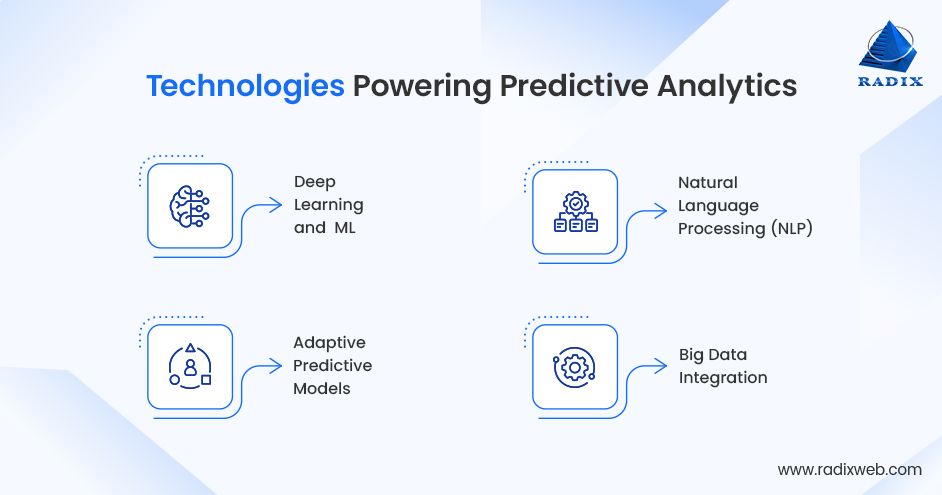
Deep Learning & ML: Continuously learning from new data, ML and Deep Learning forms the backbone of AI predictive analytics in healthcare. They help predictive models constantly refine prediction accuracy as new data emerges.
Natural Language Processing (NLP): Natural Language Processing enhances precision in risk assessments by decoding human cognition from structured and unstructured clinical notes and physician narratives.
Adaptive Predictive Models: Helps generate more realistic and reliable forecasts by dynamically adjusting to evolving patient profiles and real-time data streams.
Big Data Integration: Provides 360-degree view of a patient’s health. It combines EHRs, data from IoT sensors, genomic information for comprehensive insights.
Leveraging these niche technologies for personalized preventative care using AI with the right software partner would help build a powerful tool for healthcare professionals.
I have observed that the striking difference between healthcare businesses that thrive and struggle lies in how well they use their business data. Healthcare I have listed in detail the most crucial applications and benefits of AI-powered predictive analytics:
Risk Prediction for Readmissions: AI-led predictive analytics identifies patients who are at higher potential of getting readmitted within 30 days. This unlocks targeting medical interventions, reducing mortality rates.
Clinical Trial Optimization: Predictive analytics in clinical trials accelerates outcomes and drug development by improving patient selection for trials and forecasting their responses.
Chronic Disease Management: Predictive analytics using AI detects trends to unlock forecasting for disease progression that helps adjusting diagnosis as per patient cases.
Custom Preventive Care Using AI: Predictive data analytics tools in healthcare also assess individual risk profiles to predict disease prognosis to tailor diagnosis and care plans.
Population Health Management: Predictive analytics in healthcare projects also helps care groups identify high-at-risk groups at community level needing immediate intervention and diagnostic care.
Revenue Cycle Management: We have also built solutions that integrate predictive analytics in healthcare revenue cycles. Through these systems, our clients have streamlined insurance claims, progressed with accurate fraud claim detections, and sped up billing accuracies.
Prevention of Overcrowding in Emergency Departments: I have also witnessed predictive AI models work wonders in forecasting patient inflows by assessing patient data. This has helped medical institutions reduce wait times for patients while optimizing staffing distribution.
We’ve discussed several applications of predictive analytics with AI in healthcare. However, implementing predictive ai models also comes with its own set of challenges. Let’s know how you can make AI-led predictive analytics integration risk free for your healthcare systems.
While every modern-day business realizes the potential of leveraging the power of data, very few of them can harness its actual potential. The truth is most businesses pivot AI-led innovations without investing in data management – that’s where the pickle sets in. Here are a few challenges and complexities healthcare organizations face when transforming systems and ways we solve them:
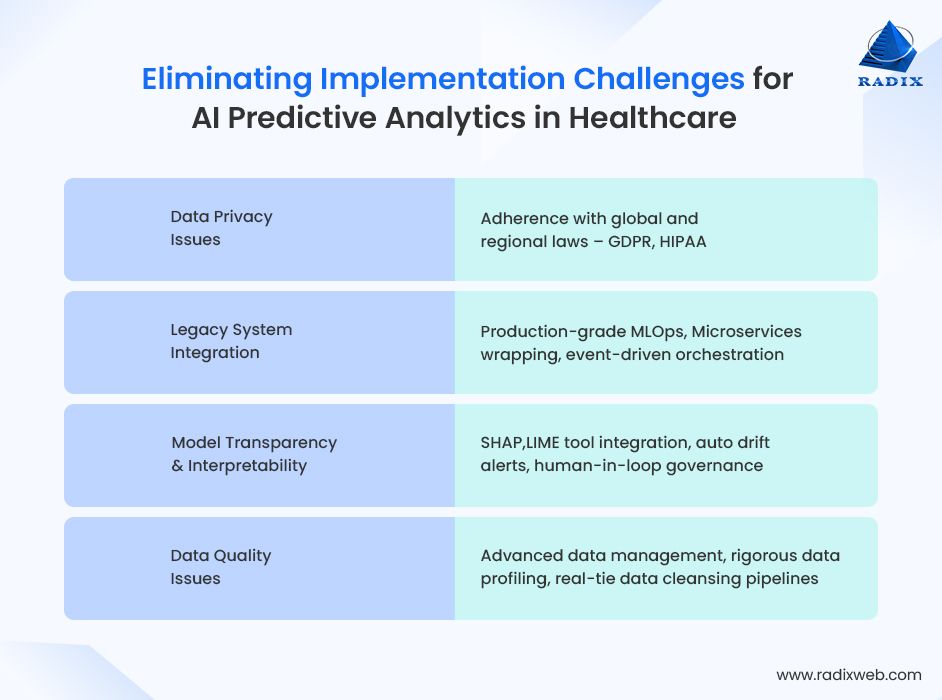
Data Privacy and Compliance: The thumb rule of playing with data lies in observing absolute adherence to world-wide and regional data privacy rules and laws. The healthcare industry in particular, is always under utmost scrutiny by governing bodies because it deals with extremely sensitive patient data.
At Radixweb, our analytics experts prioritize securing your data frontiers by enabling built-in compliance to both universal and regional data rules. From HIPAA, GDPR, PCIDSS, we build healthcare solutions that comply thoroughly and adapt themselves to evolving laws.
Integration with Legacy Systems: Healthcare is one of the most traditional businesses, often relying on traditional methods. It’s also one of the few niche industries that require quick tech evolution even in digital operations. Existing systems that handle crucial business functions can’t be discarded nimbly by most health institutions because any major overhaul often leads to service disruption.
Radixweb’s healthtech experts take the lead in driving smooth, frictionless, risk-free integrations and migrations with context-aware AI modernization. From building schema-aware data pipelines, ELT/ETL, to implementing AES, RBAC for encrypting data ‘at rest’ and HTTPS, SSL, TLS, FTPS encryptions for data ‘in transit’. Our experts also integrate event-driven orchestration, microservices wrapping, production-grade MLOps.
Model Transparency and Interpretability: Healthcare professions require clear explanations of AI-driven models and their predictions to build trust. And this trust signal is missed by most healthcare software providers.
Our standard practice at Radixweb lies in building explainability by design where we implement MLOps pipelines with explainability tools like SHAP, LIME etc. along with three-tier validation checks for business logic. Our experts also build high-end capabilities in monitoring model drift detections with built-in automated drift alerts. We also include human-in-the-loop governance with interpretability layers and domain-specific interpretability for rule-based logic overlays and patient-friendly interpretations.
Data Quality Issues: Predictive analytics thrives on high-quality data. In healthcare, incomplete, inconsistent, or inaccurate data—such as missing lab results, outdated patient histories, or errors in EHR entries—can severely compromise prediction accuracy. Given the complexity of healthcare ecosystems, where data flows from multiple sources (EHRs, IoT devices, imaging systems), ensuring integrity and completeness is a critical challenge.
Addressing these challenges requires robust governance frameworks and advanced data management strategies. Analytics experts at Radixweb implement rigorous data profiling and validation, advanced imputation and error correction and real-time data cleansing pipelines.
“Our mission isn’t just predictive analytics—it’s predictive transformation in healthtech. We equip leaders to foresee, act, and change care pathways in real time. We’re engineers of insight—turning scattered records into strategies for healthier communities”, says Dharmesh Acharya, our COO at Radixweb.
Our approach for improving Preventative Care with Predictive insights focuses on:
Let’s explore details of a few healthcare projects we built that drove significant results for our clients.
Case Study 1: AI + React Nurse Training Platform
Salient Challenge:
A healthcare network needed to upskill over 500 nurses rapidly during COVID‑19, with mobile-friendly, adaptive learning tailored to varied clinical roles and compliance requirements.
Radixweb’s Solution:
Impact:
Enabling nurses to train intelligently, even during crisis—with AI that respects privacy and workflow—that’s healthcare leadership in practice.
You can view details of the project directly here.
Case Study 2: Scaling from AI Prototype to Production ML‑Ops
Client Challenge:
A U.S. hospital consortium developed a predictive model for patient deterioration but stalled at pilot stage due to fragmented data, compliance requirements, and the absence of production-grade deployment.
Radixweb Solution:
Impact:
Pilot promise is just the beginning. Leadership means embedding AI into workflows, not just testing it.
Here are the deets for the project.
When prepping for AI-led innovation, choosing the right software partner with relevant expertise, is very crucial step – one where you must look at your provider’s core competencies.
The scope of AU in healthcare predictive analytics is a widely expanding horizon. The future of predictive analytics in healthcare will see greater adoption of AI-driven predictive analytics, expanding into areas like:
Predictive analytics tools in healthcare is poised become more sophisticated with evolving user demands and the rise of threat landscape - enabling real-time decision support and personalized preventative care using AI.
Closing Words
AI-powered predictive analytics is revolutionizing healthcare by enabling proactive, data-driven decision-making. By embracing predictive healthcare solutions, providers can reduce readmissions, improve patient care, and lead the way toward a future where technology and compassion work hand in hand.However, the trick lies in seamless implementation of AI predictive analytics within traditional infrastructures, without disrupting service flows – all the while maintaining compliance adherence. And that is made possible only with an experienced healthcare solution provider like us who excels in healthcare app development. Our data engineers at Radixweb are always eager to learn about your ideas and build futuristic solutions that change your healthcare game. Connect with us and build solutions that place you ahead of your competition.
Ready to brush up on something new? We've got more to read right this way.