

Read More


Recognized for AI Excellence at 2026 Globee® Awards - Read More

Pratik Mistry

Summary: Data strategy consulting is the process of turning a company’s raw data into a growth engine. It’s not just about moving numbers around. It is the process of building a roadmap that ensures your technical setup, the architecture, the governance, and the data quality actually support your business goals.
Instead of letting data sit idle, data strategy consultants focus on turning raw information into a clear competitive advantage.
Who This Guide Is For
Whether you’re a developer architecting your first pipeline, a product manager needing better metrics, or an enterprise leader steering a massive AI transformation for your organization or business, this guide is built for you.
We have drafted these insights from real-world patterns we see every day in the mid-market and enterprise space. If you are looking to modernize your analytics or prepare your organization for AI at scale, you’ll find the roadmap here.
At its core, Data Strategy Consulting is the bridge between owning data and actually profiting from it. It is a specialized service that helps organizations move from "collecting data for the sake of it" to building a structured, measurable roadmap.
While many people mistake it for just a "tool selection," a actual data strategy focuses on the three pillars of scalability, which are:
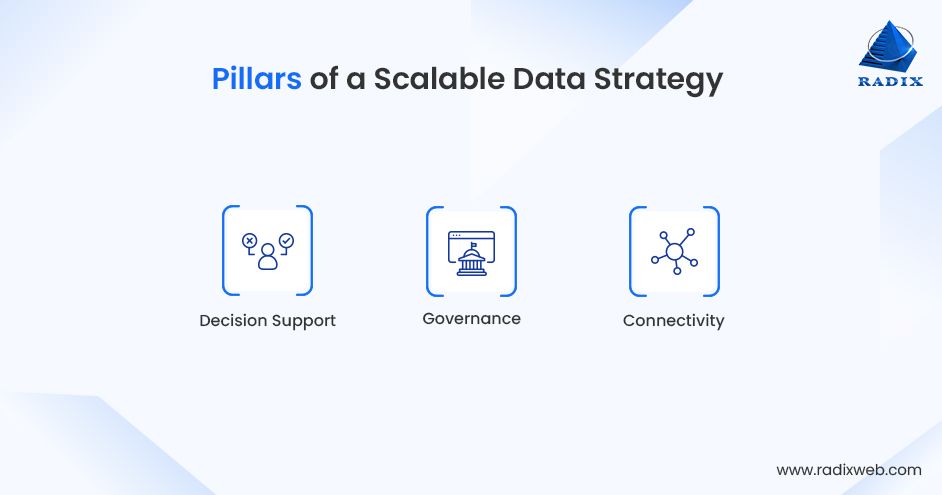
1. Decision Support: How will this data help a human make a faster, better choice?
2. Governance: How do we keep this data clean, secure, and compliant?
3. Connectivity: How do our different systems talk to each other to prevent silos?
A strategy isn't successful until it can clearly answer these four questions:
As per our observations, organizations usually realize they need a data strategy consultant when they hit a complexity wall. This often happens in mid-market or enterprise companies where technology investments are high, but trust in the data is low.
You should consider data strategy consulting when:
If your team is arguing over which report is correct or your AI projects are stalled because the foundation is messy, that is the exact moment a data strategy consultant becomes essential.
Data strategy is essentially an organizational blueprint that regulates what data is collected, how it is managed, who can access it, and how it aligns with core business outcomes. In the age of AI-led innovation, it has emerged as a critical differentiator between data-rich and data-intelligent businesses.
Infrastructure Without Intelligence Is a Core Challenge
Businesses today generate foundational at peak volume and scale. But even with mature cloud platforms and widely accessible AI tools, data reserves don’t translate into actionable decisions. Most often, the reason is absence of a solid data strategy to govern the data infrastructure.
AI Performance Is Directly Related to Data Quality: Most businesses experience a widening AI capability gap in every cycle. Clean, strategically curated, structured and well-governed data assets build effective and bias-less AI models.
Ungoverned Data Now Is Nothing but Liability: Data sovereignty and security laws have made privacy and compliance mandatory and complex.** Poor data governance is longer just an inefficiency but a major catalyst for financial and reputational risk.
Agentic AI Needs a Trusted Data Foundation: With autonomous AI agents evolving into real-time decision-making roles, the need for sound data architecture and governance is immense.** Agentic AI is end-to-end trained on foundational data reserves; solid data architectures and governance guardrails determine how the models behave.
| Without Data Strategy | With Data Strategy |
|---|---|
| Data silos across departments | Unified, accessible data ecosystem |
| Reactive, lagging insights | Predictive, real-time intelligence |
| AI models trained on poor data | High-performance, continuously improving models |
| Compliance exposure | Governed, auditable data flows |
| Technology investment underperforms | Technology investment compounds in value |
A report by Salesforce stated that 76% of B2B consumers and 63% of B2C consumers expect brands to know and understand their unique needs and expectations. A modern data strategy ensures you get clean, governed, actionable data that supports growth, AI adoption, and operational efficiency.
A 2026 data strategy isn't just about storage; it’s about Result-Driven Decision Making. It ensures that when your team (or your AI) asks a question, the answer is instant, accurate, and ethical.

Hiring a data strategy consultant isn't just about outsourcing a task; it’s about buying velocity and certainty. Most organizations try to "DIY" their data journey, only to realize they’ve built a complex system that nobody knows how to use.
A consulting partner shifts your team from a reactive stance (fixing broken reports) to a proactive stance (predicting market shifts). Here are some of the top advantages of hiring a data consultant for your business.

1. Crushing "Time-to-Insight"
In a manual environment, data is like crude oil—it’s useless until refined. A consultant automates that refinement. Instead of your analysts spending 70% of their week just finding data, they spend 100% of their time interpreting it. This leads to faster, more confident pivots.
2. Radical Trust in Decision-Making
The biggest killer of digital transformation is the "Meeting of Conflicting Numbers," where two departments bring different versions of the truth. Consulting establishes a Single Source of Truth (SSOT). When everyone trusts the metrics, the friction in the boardroom disappears.
3. Eliminating the "Redundancy Tax"
Disconnected tools and manual workarounds are expensive. A strategy partner identifies where you are overpaying for software or wasting human hours on tasks that should be automated. We don't just add tools; we often simplify the stack to improve ROI.
4. Governance as an Accelerator (Not a Handbrake)
Most businesses see Governance as a series of "No's." We treat it as the "Yes" that allows you to scale. By setting up access controls and compliance policies upfront, you can give more people access to data safely, without the fear of a security breach or a regulatory fine.
5. AI-Ready Architecture (Building for 2026 and Beyond)
You cannot truly rely on AI when your data foundation is messy. A consultant ensures your architecture is modular and scalable. This prevents technical debt—the costly rework usually required when you decide to launch machine learning or LLM initiatives six months down the line.
6. Predictable Scaling via a Roadmap
Without a roadmap, data projects are just random acts of digital. A structured plan defines your priorities so you aren't trying to do everything at once. It turns a chaotic transformation into a predictable, phase-by-phase evolution that proves its own value as it goes.
A data strategy consultant works across business and technology teams to create a unified roadmap. They don't just hand over a PDF and walk away; they build a operational blueprint that teams can actually execute.
Here is the 5-step breakdown of how a consultant transforms your data ecosystem:
1. Data Landscape Assessment (The Reality Check)
2. Business Alignment (ROI Mapping)
3. Governance and Compliance Design (The Safety Net)
4. Architecture and Platform Strategy (The Foundation)
5. Analytics and AI Enablement (The Payoff)
The modern data strategy framework provides a structured approach to managing data across its entire lifecycle, from discovery and governance to analytics and AI enablement.
This framework provides a structured path to balance the boring but essential governance with the high-impact AI readiness that modern enterprises demand.
The table below outlines the key phases and outcomes of a modern data strategy framework.
| Phase | Objective | Outcome |
|---|---|---|
| Discovery | Understand current data state | Data maturity and gap assessment |
| Alignment | Link data to business goals | Prioritized use cases |
| Design | Define architecture and governance | Scalable data blueprint |
| Implementation | Build pipelines and platforms | Integrated data ecosystem |
| Activation | Enable analytics and AI | Actionable insights |
| Optimization | Measure and improve | Continuous value creation |
For many organizations, this framework is operationalized through a modern data warehouse that centralizes data while supporting analytics, governance, and performance at scale.
We have observed that a well-defined data strategy has a direct impact on revenue, cost efficiency, and decision-making speed. By aligning data initiatives with business objectives, organizations ensure that data investments generate measurable financial and operational returns rather than isolated technical improvements.
A great data strategy should start with business decisions, not datasets; if you aren't solving a core business problem, you're just moving numbers around. — Data Engineering Expert at Radixweb
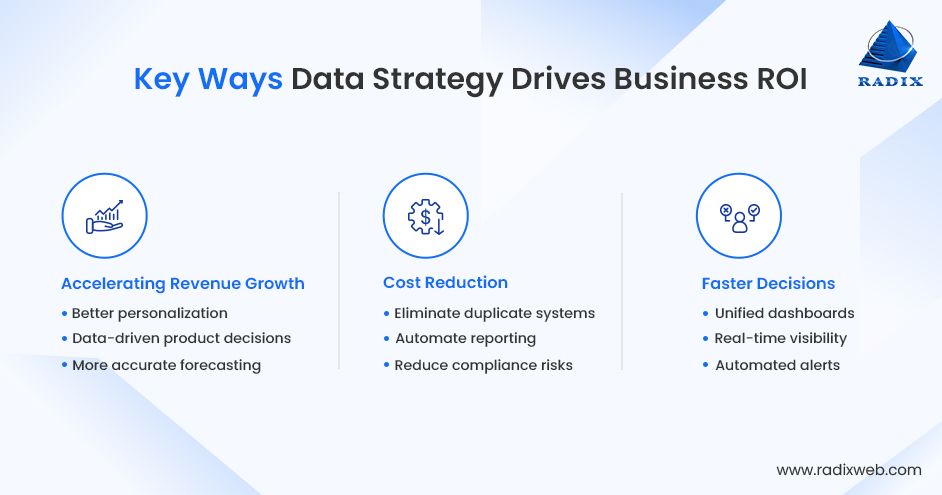
Clean, integrated data acts as a force multiplier for your sales and marketing teams. In practice, this often involves applying specific analytics techniques such as segmentation, trend analysis, and predictive modeling to uncover revenue opportunities earlier. When data is no longer siloed, it directly influences the three primary levers of growth, which are:
Data strategy reduces operational waste by ensuring organizations spend less time managing data and more time using it.
A strong data strategy ensures decision-makers have timely access to trusted insights. This shortens decision cycles and improves responsiveness across the organization.

In modern business, these four terms are often used interchangeably, but they serve very different roles. For readers new to analytics concepts, it helps to understand how data analytics translates raw data into operational and strategic insights across reporting, diagnostics, and forecasting.
Think of them as the layers of a building: you can't have a high-performing penthouse (AI) without a solid foundation (Management) and a structural blueprint (Strategy).
Together, they form the foundation for scalable, insight-driven, and AI-ready decision-making. Let’s understand the core difference between them.
| Area | Focus | Outcome |
|---|---|---|
| Data Strategy | Defines the "why" and "where". It ensures tech spend aligns with business goals. | A prioritized Roadmap for growth. |
| Data Management | Ensures data is reliable, secure, and governed. It’s the essential work of keeping order. | A Trusted Foundation of facts. |
| Data Analytics | Converts raw data into actionable insights. It tells you what happened and why. | Actionable Intelligence for daily decisions. |
| AI & ML | Brings its own intelligence into play to provide user-centric outcomes and predictions. | Predictive Power and automated insights. |
All four must work together for long-term success.
A modern data strategy is not a single initiative or tool. It is a combination of foundational components that must work together to ensure data is trusted, usable, and scalable. When even one of these components is weak, organizations feel it immediately through slow decisions, compliance risk, or stalled analytics and AI efforts.
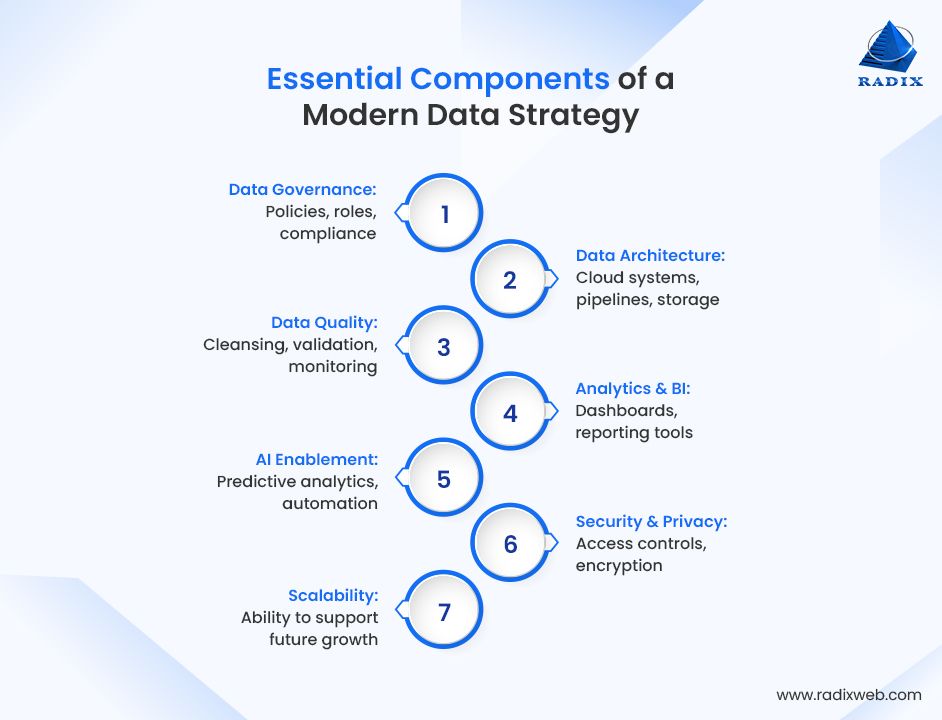
Data governance defines ownership, accountability, and rules around how data is used. Without it, teams create their own versions of the truth, leading to confusion, risk, and inconsistent decisions. Strong & expert data governance provides clarity without slowing teams down.
Data architecture is the backbone of any data strategy. It determines how data moves, where it lives, and how easily it can be accessed. A well-designed architecture prevents bottlenecks today and avoids costly rework as data volumes and use cases grow.
Poor data quality is one of the fastest ways to lose trust in analytics. Cleansing, validation, and monitoring ensure that errors are caught early, before they affect reports, dashboards, or AI models. Reliable insights start with reliable data.
Analytics and BI turn data into visibility. Dashboards and reports help teams understand performance, identify trends, and answer business questions without manual effort. This is often where the value of a data visualization and its strategy become essential to leadership.
AI enablement focuses on preparing data for advanced use cases such as prediction, recommendation, and automation. This requires structured, well-governed data. Without this foundation, AI initiatives struggle to move beyond experimentation.
Security and privacy protect sensitive data while enabling responsible access. Clear controls and encryption help organizations meet regulatory requirements and maintain trust with customers, partners, and regulators.
Scalability ensures the data strategy can grow with the business. As users, data sources, and analytics needs increase, scalable systems prevent constant redesign and support long-term innovation.
Attempting to deploy AI on a fragmented data foundation is like trying to build a skyscraper on a swamp; at Radixweb, we prioritize the foundation first — Data Engineering Expert at Radixweb
Getting started with data strategy requires more than selecting tools or building dashboards. It involves aligning business priorities with technical foundations in a way that scales over time. This six-step approach helps organizations move from fragmented data practices to a structured, execution-ready roadmap.
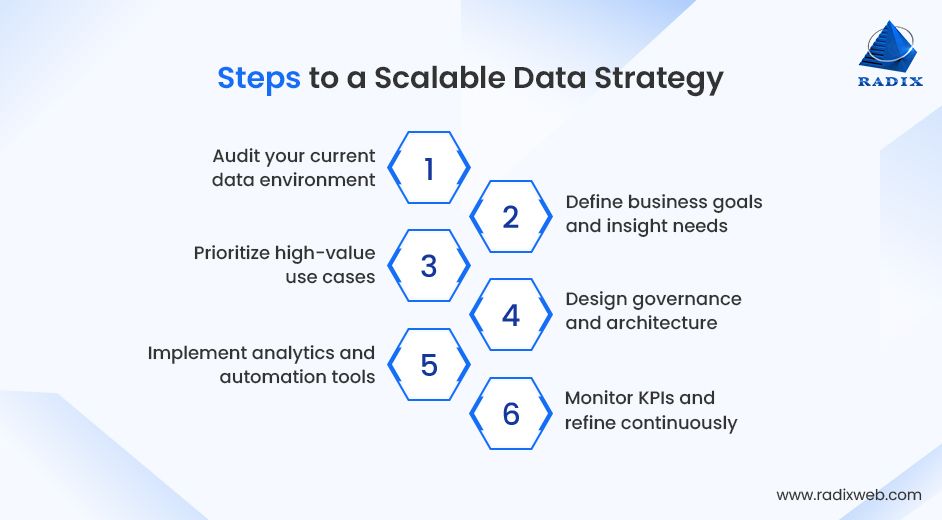
1. Audit your current data environment
Begin by understanding what data you have, where it lives, and how it flows between systems. This step often reveals hidden silos, quality issues, and redundancies that slow decision-making.
2. Define business goals and insight needs
Data strategy should start with decisions, not datasets. Identify the key business questions leaders need answered and the metrics that actually influence outcomes.
3. Prioritize high-value use cases
Not every data initiative delivers equal value. Focus first on use cases that impact revenue, efficiency, risk, or customer experience, rather than trying to fix everything at once.
4. Design governance and architecture
Establish data ownership, access rules, and a scalable architecture that supports current needs while preparing for future growth. This prevents rework as data volumes and users increase.
5. Implement analytics and automation tools
With the foundation in place, enable dashboards, reporting, and automation that deliver insights consistently. This is where the strategy starts producing visible business value. Many organizations also assess whether professional data analytics services can accelerate implementation while avoiding common design and adoption pitfalls.
6. Monitor KPIs and refine continuously
A data strategy is not a one-time project. Track performance, adoption, and outcomes, and refine the approach as business priorities, regulations, and technologies evolve.
Actual numbers change by industry and volume, but typical patterns look like this:
| Business Size | Complexity | Timeline | Expected Outcome |
|---|---|---|---|
| Mid-size company | Moderate | 6–8 weeks | Clean data + BI dashboards |
| Enterprise | High | 3–6 months | Full governance + cloud architecture |
| Legacy-heavy enterprise | Very high | 6–12 months | Modernized data estate + AI readiness |
In consulting-led data strategy engagements, these issues consistently appear regardless of industry, especially in organizations scaling digital products or enterprise systems.
In the 2026 business landscape, data is no longer just a valuable asset it is the literal foundation of your company's intelligence. The most successful organizations don't treat data strategy as a one-time project; they treat it as a permanent capability.
If you are planning to invest in large-scale AI or digital transformation, remember: technology without strategy is just expensive noise. Establishing a data strategy is the most practical first step you can take to ensure your investments in analytics and automation actually scale sustainably.
Where Should You Start?
Don't let "complexity paralysis" stop you. The path to a data-driven culture starts with three simple moves:
The companies that win in the next five years won't be the ones with the most data—they’ll be the ones with the best plan for using it.
Partner with Radixweb to Build Your Data Moat
Navigating the transition from "fragmented data" to "AI-ready insights" is a challenge you don't have to face alone. As a leader in Data Strategy Consulting, Radixweb helps mid-market and enterprise organizations build the operational blueprints needed to turn raw data into a strategic advantage.Whether you need a Data Landscape Assessment to find your gaps or a Modern Data Architecture built for AI, our consultants provide the technical expertise and business alignment to ensure your data initiatives deliver measurable ROI.Ready to scale? Connect with Radixweb’s data experts to start your journey today.
Ready to brush up on something new? We've got more to read right this way.

