Read More


Recognized for AI Excellence at 2026 Globee® Awards - Read More

Pratik Mistry

Summary: With the phenomenal rise in AI-driven innovation, every year hundreds of enterprise-scale AI projects are reportedly launched – from pilots to full scale deployments. However, most of these never reach the market. This blog explores how not to be part of that stat. We’ll discuss enterprise AI strategy, adoption challenges, and proven steps to ensure success from day one.
While investments in AI projects and boardroom pressures for ROI are at a soaring high, businesses leaders are faced with the paradox of modern AI adoption – AI project failure rate remains persistently high. Here’s a recent snapshot: Up-to-the-minute enterprise surveys have pointed out that 70-90% AI pilots never move to production, almost half of PoCs are quietly shelved and 42% organizations report deserting their AI projects mid-way - underlining that AI initiative failures follow quite a pattern, they aren’t isolated.
For business leaders, understanding why AI projects fail is crucial. Because most AI initiatives fail because of poor foundations, weak governance, and lack of goal alignment. Very rarely it’s about the sophistication of AI models.
We’ve built a practical guide on how to implement AI in business, build futuristic strategies that helps you avoid AI implementation pitfalls and fetches real revenue from your AI innovations.

The data is sobering. Business leaders need a direct-from-the-market take to realize the need for avoiding AI failures. A recent MIT study says, 95% AI pilots give zero return on investment, mostly because of unclear value, data issues, and escalating costs. PMI’s analysis places AI project failure in the 70–80% band, while a MIT research cites that 95% of GenAI pilots fail to produce measurable outcomes. On more reason why your Gen AI development needs to be gamed up with futuristic strategies.
And why you must know these stats? Because the consequences of AI failure directly hit your budgets, timelines, and credibility with stakeholders. Recognizing this context helps tech leaders do things differently from day one.
Let’s now examine the core reasons why most AI projects bleed out before moving to the production stage.
Why do AI projects fail in the first place? While every individual AI project can have its own drawback, I have observed these patterns repeat across industries. Here’s what you must investigate:
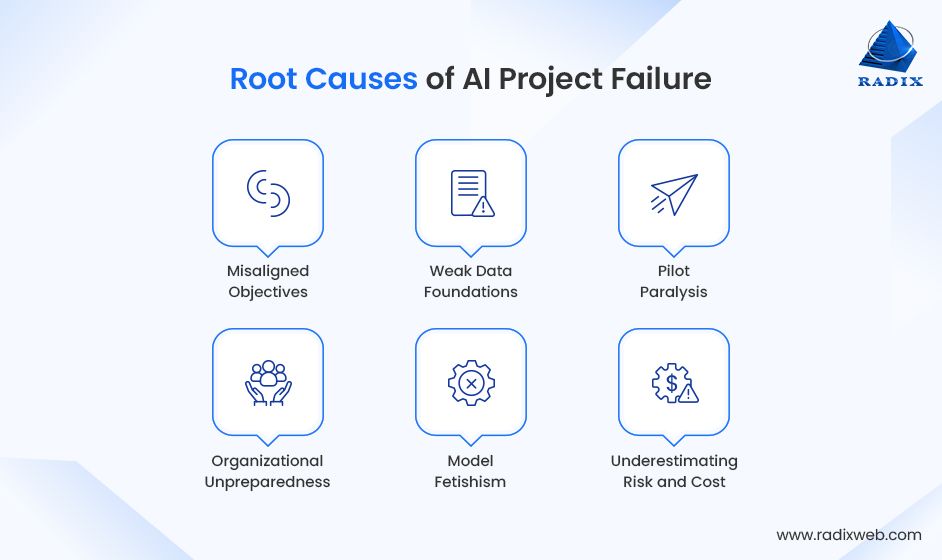
I have observed that the most common AI pitfalls are often strategic and operational mistakes. Algorithm errors are real, but rare. And these challenges are often avoidable with robust discipline.

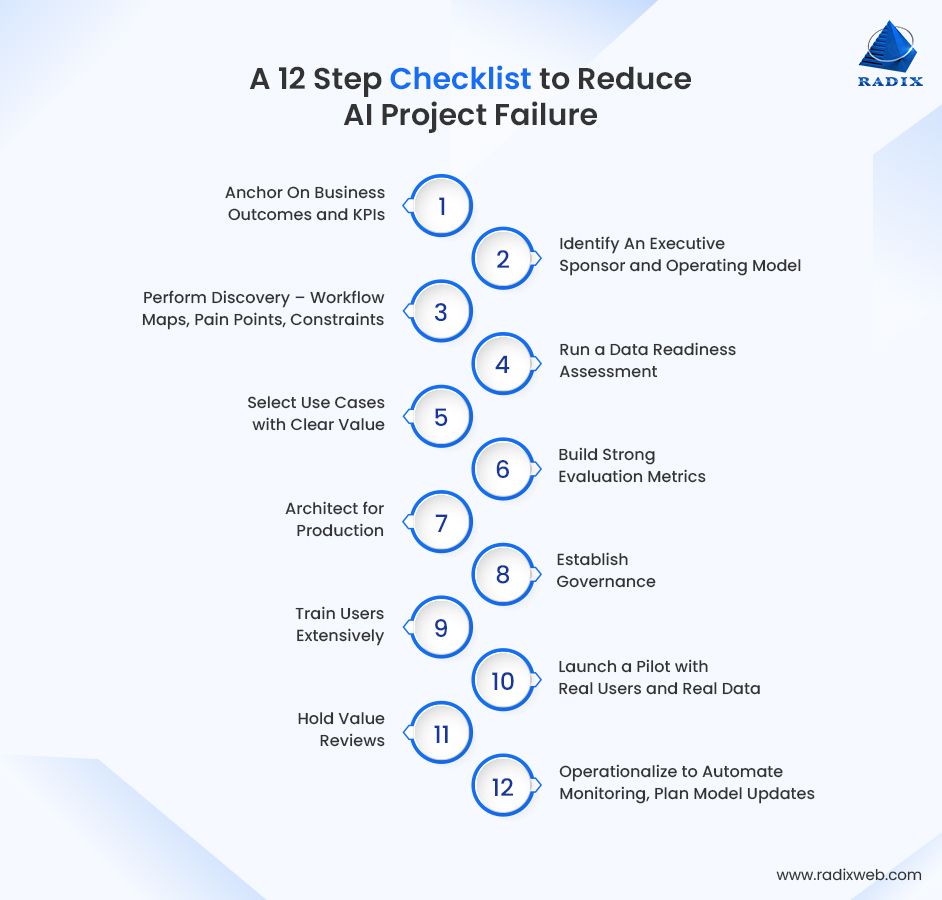
No matter your industry, the nature of your project or the stage of AI capabilities your business has acquired, these are the ground rules if you want to launch a successful AI software.
1. Set Measurable Outcomes:
Tech leaders and CTOs must ask the very basic question before they begin their process automation journey, “How to start an AI project?” And if you choose the top AI development company, the answer will be very one-directional: decide the desired outcome before jumping on to the model of your choice.
You need to clarify the problem statement in the most simplistic way – ‘My solution has a longer response time, I need to reduce the average handling time by 30%’ or ‘My system takes X amount to time to fetch a document and generate an outcome, I need to speed up by at least 40-45%’. This doesn’t just underline your current performance but also puts a benchmark on measuring success. This approach is central to any successful enterprise AI strategy. I am adding this enterprise AI guide if you want to delve deep into AI implementation strategies.
2. Select the Best Use Case:
After establishing your AI project outcome, the next guardrail lies in linking the outcomes to the economics – building a realistic ROI hypothesis. This is another core component of an AI consultation strategy for business; one backed by solid data.
When going through the AI use case selection stage, you must play by the smallest viable scope which touches real data and real users. Use cases with accessible, high-quality data, clear decision pathways, and concrete value helps you avoid high-ambiguity tasks – one of the best take on strategies for preventing AI failures.
3. Building Data Readiness:
Among all the key factors for AI adoption success, data readiness is the most unforgiving. To implement AI in business seamlessly, you need well structured, accurate, governed data with no silos. representative, timely, governed data.
Label, restructure, deduplicate data wisely, detect drifts and anomalies early on, leverage vector databases and RAG systems and establish master data as references of reality for businesses. Put data readiness gates early: no build proceeds until data meets the threshold. It’s one of the steps to ensure AI project success.
4. Design for Production, Not Demos:
When building an AI app, you must transform your production mindset for ‘ship-ready’. Don’t architect just for the demo – it’s one of the pressing reasons why many AI pilots fail at moving to the production. Avoiding AI failure requires deep integration of RBAs, robust encryption, auditability measures and human-in-loop governance for reviewing high-impact outputs.
I’ve also observed that leveraging reusable components and fine-tuning versions for multi-model realities also helps eliminate AI deployment challenges.
5. Embed Security, Risk Determination and Trust by Design:
Trust determines adoption of AI projects. So, you must bake in safety from day one. Embed measures for content filtering, PII redaction, brand guardrails, build role-aware retrieval and robust change logs. Also integrate early legal and privacy reviews to avoid late-stage blockages. You should also establish clear policies for data residency, model updates, vendor changes, and incident response.
Define “acceptable use” and “red lines” for AI assistants. Provide a documented escalation path for low-confidence results and a user-visible intervention mechanism. When users know the boundaries, they adopt responsibly reducing AI initiative failures.
6. Normalize AI Adoption with People:
I’ve seen some best-in-class AI projects fail because the teams launched their innovations without preparing people. You cannot win the market if your solution isn’t tested on realistic scenarios. Melt mental blocks with incentivized adoption strategies.
You can have as many demos, but they won’t move the metrics without consistent usage. This is the human half of how to implement AI in business – you need to train people extensively, redesign/ realign workflows, and celebrate evidence-based impact.
7. Prove Value of Investments Continuously
You can’t manage what you don’t measure. Build your KPI stack that connects technical metrics (precision, recall, hallucination rate, latency, cost/query) directly to business outcomes (CSAT, conversion, cycle time, error rate, revenue, cost-to-serve). Also, unlock complete visibility of workflows and dashboards to product, operations, and finance functions.
Set up guardrails for your AI solutions – predefine metrics that pilots need to achieve for moving to the production stage. Embed value reviews at intervals to verify persistence and guard against model regression.
8. Spend Where It Creates Impact:
You must adopt a very practical stance when it comes to determining the financial design in your AI strategy for business. Don’t just budget for the architectural build - account budgets for data improvement, evaluation, security, and change management.
Your budget must include ongoing costs for model updates, monitoring, and retraining. Build capabilities to track cost-to-serve, time-to-resolution, error reduction, and incremental revenue. Don’t go by the hype, instead focus on areas where differentiation truly creates an impact.
9. Establish Clear Governance Rules:
The AI threat landscape is continuously evolving. To combat it, you need a truly cross-functional team which comprises of experts from product, data, security, legal, compliance, and operations teams.
Define decision rights: who approves use cases, sets evaluation standards, monitors risk, and manages incidents. Assign owners for documentation, data lineage, and user training. This operating model prevents bottlenecks and clarifies accountability—a common gap behind AI initiative failures.
10. Communication and Stakeholder Management:
The crux of how to succeed in AI initiatives lies in data-based evidence. Just like your user teams need realistic use cases to eliminate mental blocks, your stakeholders require evidence like user adoption, qualitative feedback, cost curves and risk probabilities. Only then they will be able to weigh quantified outcomes – something you need to build stakeholder trust for unlocking budgets.
11. Push Your AI Project from Pilot to Production: One Master Tip
It’s easier to run a POC, but going from a prototype to shipping a full-scale AI system – that requires tremendous tech capabilities. To cross the pilot to production hurdle, you must plan production on day zero: define authentication, authorization, environment isolation, secrets management, CI/CD for prompts and configurations, disaster recovery, and rollback plans. Pre-define automated quality checks into pipelines, do not rely only on manual approvals.
Treat models and prompts as versioned artifacts. Maintain test sets reflecting real user behavior and edge cases. Keep humans in the loop for high‑risk decisions. This discipline rewires AI deployment challenges significantly.
While each of these patterns relies on strong data, evaluation, and strong AI integration abilities, they have been observed to consistently generate value for businesses. If you apply AI project best practices like repeatable components, standardized metrics, robust security—you’ll be able to scale with confidence.
Radixweb has been taking bold steps in bridging the AI adoption-implementation and impact gap by mindfully integrating enterprise AI strategies – from bringing strategic alignment, implementing robust data practices, and facilitating seamless deployment. Our recent AI projects are proof of successful implementation and stable business value.
Recently, Brunswick, a global consulting firm, needed an AI-powered Meeting Intelligence Platform and our experts engineered a solution using Llama 3 on AWS that transcribed meetings in real time, extracted decisions and action items, and integrated with tools like Asana and Microsoft Teams. This resulted in 3× faster follow-ups, saving over 10 hours weekly and achieving a 97% user satisfaction rate.
In the legal sector, Radixweb implemented AI-based document management for a global law firm, accelerating contract reviews and improving collaboration securely. For HR tech, Radixweb built an AI-powered talent management platform that predicted attrition, identified skill gaps, and cut recruitment costs—all within GDPR-compliant frameworks.
These aren’t just success stories: they are showcases of our holistic approach: aligning AI initiatives with business goals, ensuring data integrity, implementing MLOps best practices, and driving adoption—transforming AI from a risky experiment into a measurable business advantage.

Building Your Roadmap to AI Success
AI success is carefully engineered, not accidental. As a tech leader, you need to start by laying iron-strong foundations in data integrity, governance, and security. Chasing smart models won’t bring you success if you haven’t done the groundwork before. Your AI initiatives directly impact real user workflows; that’s why you need to measure impact relentlessly with dedicated AI experts.And working with a software partner that has driven enterprise AI success across industries, will help you navigate through the challenges better and de-risk your AI implementation process. Work with our experts who are eager to know your AI ideas and turn them into reality, get in touch with us today for transformational AI strategies that go into 2026 and beyond.
Ready to brush up on something new? We've got more to read right this way.