Read More


Recognized for AI Excellence at 2026 Globee® Awards - Read More

Vinit Kariatukaran

According to a Gartner survey, 63% of organizations either do not have, or are unsure if they have, the data management practices needed to support AI. The challenge isn't a lack of data. Most enterprises already have years of customer records, operational data, documents, and transactions spread across CRMs, ERPs, data warehouses, and legacy systems. The real question is whether that data is actually ready for AI.
And that's where many AI projects begin to lose momentum. 60% of AI projects that start without AI-ready data are expected to be abandoned by the end of 2026. But the teams that spend months trying to make every dataset perfect aren't any better off either. They miss the AI implementation window and struggle to go live when it actually matters. Both approaches increase cost, delay delivery, and reduce trust in AI outcomes.
At Radixweb, we've worked with hundreds of organizations building AI solutions, and data readiness was a part of the AI groundwork we laid for them. Below, we explain what clean data for AI actually means and how you can ensure data readiness.
Quick Summary: Clean data for AI doesn't mean perfect data. It means data that's fit for your specific business problem, with deliberate trade-offs you understand and can defend. Most organizations waste months chasing 100% completeness when 75% clean is often sufficient. The difference between success and failure isn't data perfection. It's knowing what "good enough" means for your use case and treating data quality as a continuous discipline, not a one-time project.
| Aspect | Detail |
|---|---|
| What this guide covers? | What clean data actually means for AI, the five dimensions of AI-ready data, common enterprise data problems that break projects, framework for cleaning data iteratively, how to monitor data quality after deployment |
| Who should read this? | CTOs, data engineering leaders, AI project managers, and business decision-makers planning or scaling AI initiatives who are stuck waiting for perfect data or unsure how to prioritize data cleaning work. |

Our proprietary AI Failure Report revealed that 1 in 5 AI failures can be traced back to data issues. That's because AI doesn't fix your data, it just inherits it. If your customer database has duplicates, your model learns from duplicates. If your transaction history has inconsistencies, your predictions inherit those inconsistencies. If your labels are wrong, your model optimizes toward the wrong outcomes.
More importantly, higher-capacity models don't fix noise. They memorize it. In one study, when test sets were seeded with just 6% additional label errors, larger models like NasNet started underperforming simpler models like ResNet-18. The complex model learned the noisy distribution so well that it actually performed worse on clean data. This is the reverse of what you'd expect. But it's what happens when you treat data as static and models as the variable.
Should You Delay AI Until Your Data Is Perfect?The simple answer: No.Perfect data doesn't exist. If you wait for it, you'll be waiting forever. The other extreme (deploying AI on garbage data) is also wrong. But the solution isn't to wait for perfection. It's to define what data is 'clean and good enough' to start with.
Here's where most organizations get confused.
Teams talk about "clean data" as if it's a binary state. Either the data is clean or it's dirty. But that's not how it works. "Clean" is not absolute. It's contextual.
A dataset with 85% completeness might be too dirty for a financial risk model. That same completeness level is perfectly fine for a customer churn prediction system. A missing customer email address matters in one context and doesn't matter in another.
The confusion happens because people confuse traditional data cleaning with AI-ready data.
Traditional data cleaning removes problems. It
This approach assumes data quality is a checklist. Complete the checklist, and you're done.
AI-ready data is different. It's not about removing problems. It's about understanding them and handling them deliberately. It
The difference isn't subtle. It determines whether you'll ship in three months or nine months. It determines whether your model stays reliable or gradually degrades after launch.

If traditional data quality tells you whether data is usable, AI data readiness tells you whether it's learnable, trustworthy, and sustainable throughout the model's lifecycle.
At Radixweb, we assess data readiness across eight dimensions before building AI systems. Together, these dimensions help identify where data supports reliable AI and where it introduces hidden risks that affect model performance, deployment speed, and long-term accuracy.
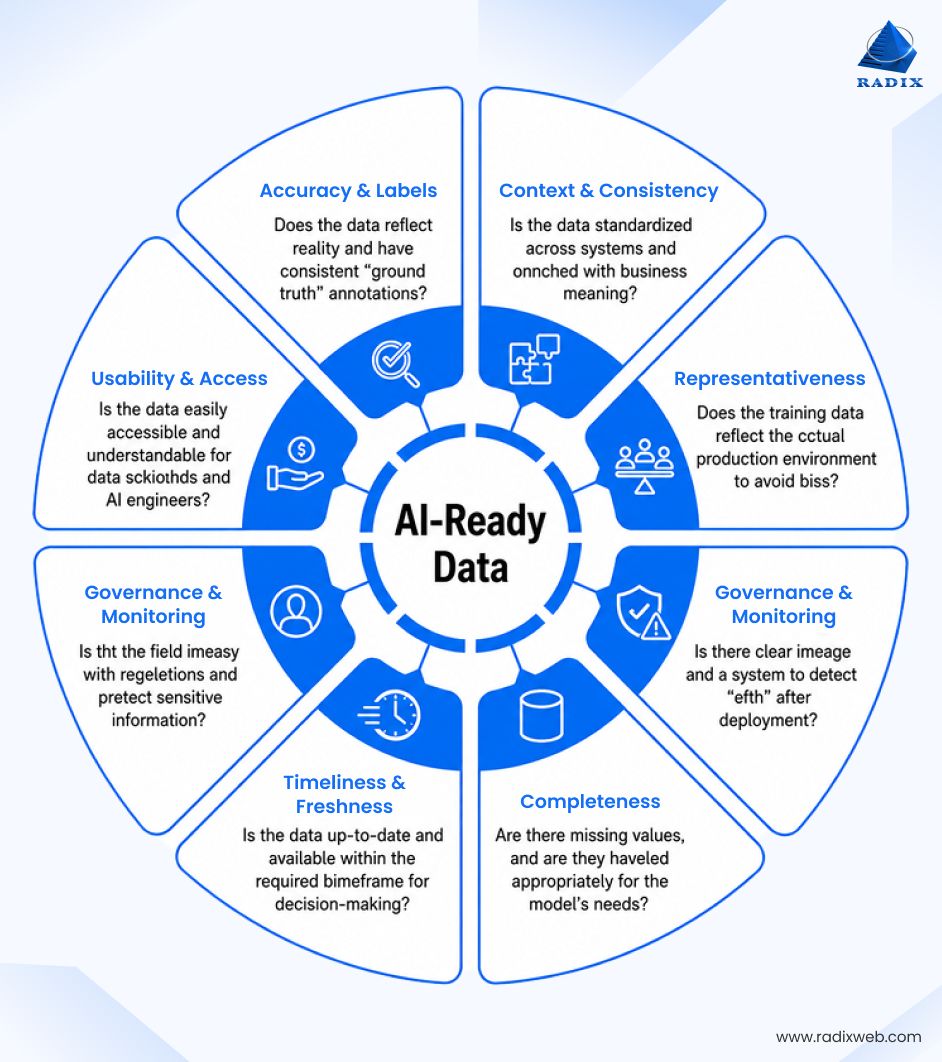
Accuracy answers a simple question: Does the data reflect reality?
Customer ages, transaction amounts, equipment readings, and timestamps should represent actual events. But AI projects rarely require 100% perfect accuracy. Instead, they require a personalized, enterprise-centric data strategy that offers visibility into where errors exist and how to handle them.
For example, a few incorrect customer names may have little impact on a recommendation engine. The same error rate in financial transactions or medical records could significantly affect predictions.
Accuracy includes:
For supervised learning, accuracy also extends to labels. Data engineering companies working with enterprise clients use techniques like confident learning to help identify potentially mislabeled training examples using model predictions, allowing teams to focus human review where it matters most.
Completeness measures whether enough information exists for the model to learn meaningful patterns.
The important word is enough.
Different AI applications require different levels of completeness. A credit risk model may need nearly complete financial information, while a demand forecasting model can often tolerate missing demographic attributes.
Instead of pursuing 100% completeness, define acceptable thresholds for each business-critical feature.
Assess completeness by evaluating:
Missing completely at random can often be handled with imputation. Missing not at random usually requires investigation because the absence itself may carry predictive value.
Consistency ensures the same information is represented the same way across every system.
A customer stored as "John Smith," "john smith," and "Smith, John" across different databases creates three entities instead of one. Similarly, inconsistent date formats, currencies, units of measurement, or product codes introduce unnecessary complexity that models shouldn't have to learn.
Consistency focuses on:
Unlike traditional data cleaning, AI doesn't always require every duplicate to be removed. The goal is to eliminate inconsistencies that distort learning while preserving information that provides useful signals.
Raw data rarely tells the whole story.
AI models perform better when they understand how information relates to the business problem they're solving.
Without context, a transaction amount, sensor reading, or customer interaction becomes an isolated value. With context, the model understands how it connects to customers, products, time, geography, and business processes.
Important contextual elements include:
Teams that document context early spend significantly less time debugging unexpected model behavior later in development.
For supervised machine learning, labels become the ground truth from which every prediction is learned.
If those labels are inconsistent or incorrect, the model learns the wrong behavior regardless of how clean the underlying data appears.
Evaluate label quality by considering:
Human annotators naturally disagree on ambiguous cases. Identifying these disagreements early improves both model performance and evaluation quality.
Techniques such as confident learning help prioritize examples most likely to contain incorrect labels, making manual review faster and more effective.
A dataset can be technically clean and still produce biased AI.
Representativeness measures whether training data reflects the environment where the model will actually operate.
For example, a healthcare model trained primarily on one patient population may struggle when deployed across different demographics. A fraud model trained only on historical attack patterns may miss entirely new fraud behaviors.
Assess representativeness by examining:
This dimension is often overlooked in traditional data quality programs but has a direct impact on fairness, reliability, and model generalization.
Even high-quality data becomes difficult to trust without clear governance.
Ongoing consultation around data governance establishes accountability, traceability, and compliance throughout the AI lifecycle. It ensures every dataset has defined ownership, and every transformation can be explained.
Strong governance includes:
Good governance also makes debugging easier. When model performance changes, teams can quickly determine whether the cause was new data, updated features, or changes in the model itself.
AI-ready data isn't a one-time achievement.
Customer behavior changes. Products evolve. Regulations on shift. Seasonal trends emerge. Data that was suitable during model training gradually drifts away from production reality.
Continuous monitoring keeps data reliable long after deployment.
Key monitoring practices include:
The most successful AI teams don't treat data preparation as a project milestone. They treat it as an ongoing operational process that evolves alongside the business.
Overall, AI-ready data is more than clean records and standardized formats. It combines technical quality, business context, representative training data, operational governance, and continuous monitoring into a system that keeps AI models accurate, explainable, and reliable throughout their lifecycle.
Most data quality issues often go unnoticed during early AI development, only becoming visible when models produce inconsistent predictions, struggle to generalize, or lose accuracy after deployment. While every organization faces unique data challenges, certain problems appear across industries and use cases.
Understanding these common pitfalls early helps teams prioritize the fixes that have the greatest impact on AI performance, rather than spending months solving issues that contribute little to model quality.
Your company has evolved through acquisitions, organic growth, and department autonomy. Now you have a CRM that doesn't talk to your ERP. Your support system doesn't connect to your transaction database. Your IoT sensors pipe into a data lake that's never been connected to your enterprise systems.
The result is that the same customer now exists with different IDs in different systems. But it's not obvious. There's no system flag saying "these are the same person." You only know because they both have the same email address. Or the same phone number. Or the same postal address. But finding all these duplicates requires entity resolution, which most teams don't have.
The impact: Your churn model trains on support tickets and transaction history separately. It never sees the full customer journey. Model performance stays mediocre because the data it's learning from is fundamentally incomplete.
The fix: Before you build AI, you need to identify which systems hold critical data and create bridges between them. Not a perfect single database. Just connections so you can join the pieces that matter. Also, invest in entity resolution before training. Use fuzzy matching, domain knowledge, and linking algorithms to consolidate records. Such enterprise-scale data migration is unglamorous work, but it's the difference between a model that works and one that doesn't.
You have transaction data. You know what was bought, when, and how much. But you don't know why. What prompted that purchase? Was there a marketing campaign? A competitor's outage? A seasonal shift?
The transaction data is technically complete. But it's missing the context that explains it. Your model has to infer causation from correlation, which is much harder.
The impact: Your forecasting model trains on transaction history alone. It learns seasonal patterns and customer behavior. But it can't incorporate external factors like marketing spend, competitive pricing, or product launches. It's limited to explaining history, not predicting futures shaped by new interventions.
The fix: Enrich your transaction data with contextual features before training. Marketing campaigns, pricing changes, regulatory events, and seasonality. These might be simple flags or complex transformations, but they dramatically improve model relevance.
Your fraud team has been manually reviewing transactions for five years. They mark obvious fraud as "fraud" and everything else as "clean." Simple.
But then you dig in. Some analysts are strict. They flag anything unusual. Others are lenient. They only flag clear fraud. Over five years, the standards have drifted. What your team labels as "fraud" in 2022 is different from what they labeled as "fraud" in 2020.
Now you're training a model on labels that don't have consistent meaning. The model learns the noise in your labeling process, not the actual fraud signal.
The impact: Model performance plateaus. It can't improve because the labels it's learning from are noisy and inconsistent. You've taught it to predict the labeling process, not the actual business outcome.
The fix: Before training, audit label consistency. Have a second annotator label a sample of the same data. If you needed, you can also use LLMs for rapid and reliable data annotation. If agreement is below 80%, you have a problem. Either clarify the labeling standard or acknowledge that some examples are genuinely ambiguous. Then your model can learn that ambiguity too.
Your model was trained on 18 months of historical data. Perfect. You deploy it. It makes decisions. But six months later, the world changed. A new competitor entered your market. Customer preferences shifted. Regulations changed. Your model was optimized for an old distribution.
This is where most teams miss the silent failures. The model keeps running. It keeps making decisions. Nobody's watching the data. Six months later, they notice performance has degraded. But they don't know when it started or why.
The impact: Slowly declining model performance that nobody notices until it's too late. Decisions drifting away from business reality.
The fix: Build continuous ML model monitoring and governance into your production infrastructure. Watch for data distribution shifts. Set up alerts when key metrics change. Plan retraining cycles. This isn't a one-time cleanup. It's an operational discipline.
Resolving these issues improves the quality of your data, but it doesn't automatically make your AI project successful. The next step is to make sure that your data is actually AI ready.

Okay. You've assessed your data. You've identified problems. Now what? Here's how to sequence the work so you don't get stuck in endless preparation.
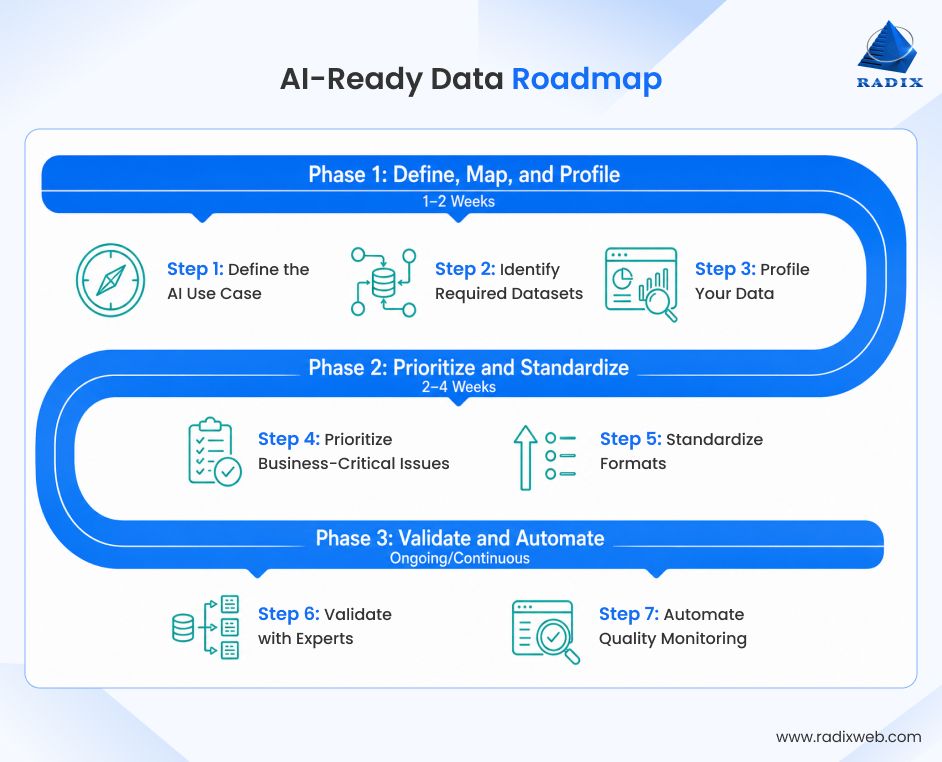
Timeline: 1-2 weeks.
Before you clean anything, know what you're building. 'Improve customer retention' is a a broad goal, but 'Identify customers with >60% churn risk in the next 90 days' is the specific use case that tells you what data matters.
A churn model needs:
A revenue model needs different data entirely. And an operational efficiency model needs yet another set. So, talk to business stakeholders and understand what decision the model will support and get alignment on success metrics.
Timeline: 1 week
Don't audit your entire data warehouse. That's how you end up in endless discovery.
Map backwards from your use case. What systems hold the data you need? Your CRM for customer data. Your transaction database for purchase history. Your support ticketing system for interactions. Identify the 3-5 core data sources. Ignore everything else.
Timeline: 1-2 weeks
Pull a representative sample. Run basic diagnostics by asking the following questions:
This isn't deep analysis but basic inventory, where you're answering: "Do I have enough good data to build a model?" This is actually where most projects should spend more time, not less.
Timeline: 1 week
After you've profiled the data and found the problems, know that you can't fix everything.
Rank issues by impact:
Ensure that you make these decisions with expert data engineers who understand your business needs.
Timeline: 2-3 weeks
This is the tactical part. Your data comes from multiple systems. They don't all format things the same way. This is where you write most of your cleaning scripts for:
Timeline: 1-2 weeks
Don't trust your cleaning blindly. Have domain experts review a sample and ask them the following questions:
Experts catch issues that automated validation misses. This slows you down but saves you from deploying wrong models.
Timeline: 2-3 weeks
Once you know what works, automate it by building a data quality pipeline that runs continuously:
Total Timeline
From start to AI-ready data: 3-4 months for a typical mid-sized project (50,000 to 500,000 records, 20-40 features). This includes profiling, prioritization, cleaning, and automation setup.
The mistake teams make is thinking this should take 2-3 weeks. It doesn't. But it should be parallelized with model development. While you get enterprise data engineering for AI initiatives, your ML engineers should be exploring architecture options and testing with interim datasets. with interim datasets.

Start Building Clean Data for Your AI Project
Clean data a prerequisite to building, integrating, deploying and maintaining artificial intelligence systems successfully. It's the operational discipline that determines model reliability. Whether you're starting your first AI project or scaling an existing one, the way you approach data defines whether you'll be troubleshooting data quality issues in production or running a model that reliably supports business decisions.At Radixweb, we have built, deployed, and maintained AI systems across fintech, healthcare, supply chain, and retail where data quality directly affects business decisions. Our data discipline has helped our clients build models and AI systems that don't just look impressive in demos but are successful in production too. Ready to audit your data and build a realistic cleaning roadmap that actually ships? Schedule a consultation with our data engineers who will assess your data landscape, identify which problems actually matter, prioritize the work that moves the needle, and create a plan that gets you from data discovery to AI-ready.
Ready to brush up on something new? We've got more to read right this way.