Read More


Recognized for AI Excellence at 2026 Globee® Awards - Read More

Pratik Mistry
Most organizations start AI agent initiatives by discussing models, budgets, and timelines. Those conversations matter. But they need to happen after you answer a more important question:
Is the business actually ready to support an AI agent in production?
At Radixweb, we've designed, deployed, and maintained several autonomous agents in the past couple of years. Across these projects, one pattern is consistent: The primary reason why AI initiatives run into trouble isn’t because the model fails. They run into trouble because the organization isn't ready. Data is harder to access than expected. Ownership is unclear. Business processes haven't been adapted. Employees aren't prepared to work alongside the system.
By the time these issues surface, the project is already behind schedule and over budget. The 15-point checklist below will help you decide whether you're ready to proceed, what to fix first if you're not, and what could derail your AI agent project.
AI agents are quickly moving from experimentation to enterprise adoption. Most leadership teams are now under pressure to identify where they fit into the business. But Gartner predicts that over 40% of AI agent projects will fail, not because the technology falls short, but because organizations aren't ready for it. So, before deciding where, when, or how to build an AI agent, ask whether your business is actually prepared.
| Aspect | Detail |
|---|---|
| What this guide covers? | AI agent readiness, the four readiness dimensions, a 15-point checklist, readiness scoring, and practical next steps before AI agent development. |
| Who should read this? | CIOs, CTOs, Product Leaders, AI Leaders, Enterprise Architects, and decision-makers planning AI agent initiatives. |
AI agent readiness is an organization's ability to successfully deploy, operate, monitor, and continuously improve AI agents in production. It means having the right data, systems, people, and business processes in place for an AI agent to make decisions, take actions, and deliver reliable outcomes without creating operational risk.
As AI adoption accelerates, it is easy to assume AI readiness equals AI agent readiness. But that's not true. Most AI initiatives help people work better by generating content, summarizing documents, or answering questions. AI agents go a step further. They don't just assist. They execute workflows, interact with systems, make decisions within guardrails, and complete tasks autonomously.
For example, imagine you're building an autonomous AI chatbot for business needs. The chatbot drafts responses to customer queries, while an employee reviews the draft, makes changes if needed, and sends the reply. That's an AI-assisted workflow.
Now consider an AI agent that retrieves customer information from your CRM, checks order status in your ERP, drafts a personalized response, and updates the support ticket. That's an agentic workflow.
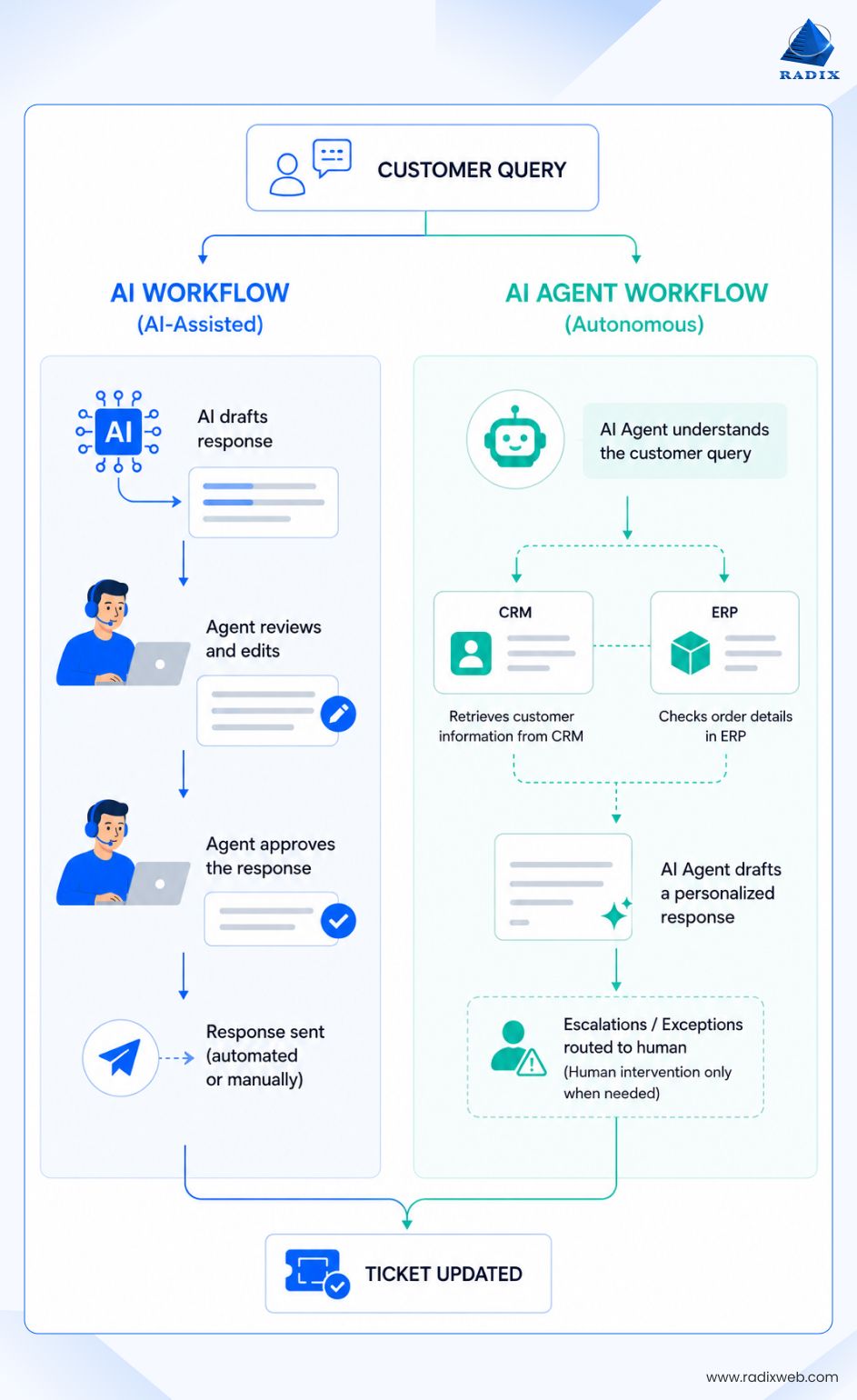
Also Read: The Difference Between Chatbots, LLMs and AI Agents
The difference isn't just technology. It's the level of responsibility. The second scenario requires a much higher level of organizational readiness because AI isn't just generating content but operating within your business.
That's why even if your organization has already assessed its readiness for artificial intelligence use cases, you should still evaluate whether you are specifically ready for AI agents. The technology is different. The operational risks are different. And so is the foundation required.
AI agent readiness isn't a single capability. It depends on your data, technology, people, and business processes working together. This checklist is organized into four readiness categories to help you identify the operational gaps that could delay, derail, or limit the success of your AI agent initiative.
Answer each of the questions below honestly to understand what needs attention before you start building.
AI agents rely on business data to make decisions. If customer records contain duplicates, product information follows different formats across systems, or critical fields are incomplete, the agent will struggle to produce reliable outcomes. Unlike traditional software, AI agents often infer missing context, increasing the likelihood of inaccurate responses or incorrect actions. Before building an agent, make sure the data engineering groundwork for enterprise-grade implementation is laid well.
Look for:
An AI agent cannot operate autonomously if someone has to export spreadsheets before every task. Programmatic access through APIs, databases, or secure services allows agents to retrieve current information whenever decisions need to be made. Manual dependencies reduce reliability and slow down execution. This is often the biggest obstacle when moving from an AI proof of concept to enterprise-scale production.
AI agents should always work from approved and trusted sources of information. If multiple teams maintain different versions of the same dataset or nobody owns data quality, agents may retrieve outdated or conflicting information. Establishing clear ownership, documented source-of-truth systems, and access permissions helps ensure the agent consistently works with authorized business data.
Radixweb InsightOne of the most common issues we uncover during AI readiness assessments is conflicting business data. We've seen organizations maintain multiple "official" customer records across departments, creating inconsistent decisions even before the agent is deployed.
The value of an AI agent depends on how current its information is. If your inventory updates once every 24 hours but the agent makes fulfillment decisions every few minutes, outdated information quickly leads to incorrect actions. Define how frequently your agent needs to make decisions. Then verify that your business data is updated at least as often.
Production AI agents consume significantly more compute than most proof-of-concept deployments. They perform multiple reasoning steps, interact with external services, and often trigger several API calls before completing a task. Your infrastructure should be able to support higher workloads without unacceptable latency, performance degradation, or unexpected operational costs as adoption grows.
Artificial intelligence creates value by interacting and integrating with existing systems such as CRM, ERP, HRMS, ticketing platforms, and internal databases. Stable APIs, documented integrations, and reliable authentication mechanisms are essential. If critical systems lack agent integration capabilities or depend on manual workarounds, the agent will struggle to operate consistently.
Consider evaluating:
Once an AI agent is live, every decision should be observable. Without logging, monitoring, and alerts, problems often remain hidden until customers report them. Good observability allows your team to understand why the agent behaved a certain way, identify recurring issues, and continuously improve performance based on real production data.
Radixweb InsightDuring production deployments, observability often becomes the difference between a manageable issue and a costly outage. Comprehensive logging helps teams identify reasoning failures long before they impact customers.
Successful AI agents rarely remain small. As confidence grows, more teams begin using them, increasing request volume, infrastructure demands, and operating costs. Before deployment, validate that your architecture, integrations, and cost model can support significantly higher adoption without requiring major redesign or creating unsustainable operational expenses.
Using AI tools is different from building and operating AI agents. Someone within the organization should understand concepts such as prompting, retrieval, model limitations, hallucinations, context windows, and agent orchestration. This knowledge helps teams troubleshoot issues, make informed implementation decisions, and improve agent performance over time.
Every production AI agent needs an owner. So, you need to assess if there is a person or team responsible for AI outcomes, monitoring performance, reviewing exceptions, approving improvements, coordinating updates, and deciding when human intervention is required. Shared ownership often leads to delayed decisions and slower incident response.
Successful deployments depend as much on people as technology. Employees need to understand what the agent does, where it fits into their workflows, when they should trust its recommendations, and when they should intervene. Early communication and training significantly improve adoption and reduce resistance.
Before deployment, ensure you have:
AI agents require ongoing refinement. Prompt adjustments, workflow improvements, monitoring, and model updates continue well beyond deployment. Leadership should allocate time, budget, and resources for continuous optimization rather than expecting perfect performance from day one.
AI agents perform best when workflows are standardized and well understood. Decision points, exceptions, approvals, and escalation paths should be documented before automation begins. If employees perform the same task differently across teams, the AI agent has no consistent process to follow.
Document at minimum:
Without measurable success criteria, it becomes difficult to determine whether the AI agent is creating business value. Define a small number of operational and business metrics before implementation so improvements can be measured objectively and future optimizations can be prioritized.
Radixweb InsightThe most successful AI projects we've delivered started with clearly defined business outcomes. Teams that establish measurable KPIs before development make faster implementation decisions and demonstrate ROI much sooner.
Launching an AI agent is the beginning of its lifecycle, not the end. There are many AI agent challenges that arise during or after deployment. There is also the need for a structured process for reviewing performance, capturing user feedback, monitoring failures, and implementing improvements on a regular basis. Organizations that continuously refine their agents consistently achieve higher accuracy, stronger adoption, and better long-term business outcomes.

Here’s how to interpret your results and assess readiness for implementing AI agents:
| Score | Readiness Level | What It Means | Recommended Next Step |
|---|---|---|---|
| 13–15 | Ready to Build | Your organization has the core foundations required to deploy an AI agent successfully. While no implementation is risk-free, you're well-positioned to move forward with a focused use case. | Identify your first AI agent, define success metrics, and plan for continuous monitoring and optimization during the first 90 days. |
| 9–12 | Almost Ready | You have a solid foundation, but a few critical gaps could slow down implementation or reduce the value of your AI agent. | Identify your lowest-scoring readiness category and address those gaps before starting development. Most issues can be resolved with targeted planning over a few weeks. |
| 0–8 | Not Yet Ready | Building an AI agent now is likely to introduce unnecessary operational and implementation risk. Your focus should be on strengthening the fundamentals first. | Treat this checklist as your readiness roadmap. Improve your data, technology, team, and process foundations before investing in AI agent development. |
Important: Don't rely solely on your total score. A single weak area can become a significant implementation risk. For example, scoring 14/15 is far less meaningful if your organization has poor data quality or no ownership for the AI agent. Review your category scores as well. If any category scores below 3, prioritize improving that area before moving forward.
You have the right foundations to move forward with an AI agent. Start with a focused, high-impact use case rather than trying to automate multiple workflows at once. Define success metrics upfront, monitor the first few weeks closely, and plan for continuous improvements after launch.
Your next steps:
Your organization has a solid starting point, but a few gaps could slow down implementation or reduce the value of your AI agent. Focus on improving your weakest readiness category before beginning development.
Your next steps:
Building an AI agent now is likely to create unnecessary risk. Instead of rushing into development, invest time in strengthening your foundations first. The work you do now will significantly improve your chances of a successful deployment later.
Your next steps:

Build the Right Foundation Before You Build the Agent
AI agent success starts long before development begins. Even the most powerful AI model won't fix poor data, disconnected systems, unclear ownership, or broken processes. That's why readiness matters. Use your score to identify your biggest gaps. Then address those gaps before investing in the development of AI agents for your business. A strong foundation gives your AI agent the best chance of succeeding in production.At Radixweb, we've spent 26+ years helping businesses use emerging tech for production-ready systems. In the past year alone, we've delivered agentic AI solutions across 10+ industries including fintech, healthcare, and manufacturing. So if you are exploring AI agents for business, we can help. Schedule a no-cost, no-commitment consultation with our AI specialists to get help in assessing your readiness. Understand where you stand and what's the right next steps for your AI agent initiative.
Ready to brush up on something new? We've got more to read right this way.