
Read More


Recognized for AI Excellence at 2026 Globee® Awards - Read More

Anand Trivedi
Adding the AI Edge to Enterprise Systems: ERP, CRM, and SCM are modern enterprise systems that already run your business. But with AI, they stop recording data and start driving real-time, predictive, and actionable operations. This blog covers the use cases, costs, challenges, and ROI of AI integration in enterprise resource planning, CRM, and SCM systems. Read on to see what you should be doing and how.
85% of organizations have increased their AI budgets over the last 12 months. Yet, AI adoption patterns across industries suggest that only 6% report ROI within 1 year of implementation.
That isn't a capability gap, but an integration problem.
Most enterprises already have ERP, CRM, and SCM systems that hold years of operational data. AI does not replace any of that. It connects to it. When done right, these systems stop being record-keepers and start driving real-time decisions.
The question isn't what AI can do. It is whether AI is wired into the right systems in the right way.
This guide breaks down how AI integration works across all three enterprise system categories.
Let’s dive right in.
Understanding how AI integrates with ERP systems starts with a simple premise: ERP is already data rich. So, the challenge is not finding data. It is making the data usable in real time, predictive, and accessible across functions. The key use cases of AI integration in enterprise resource planning include:
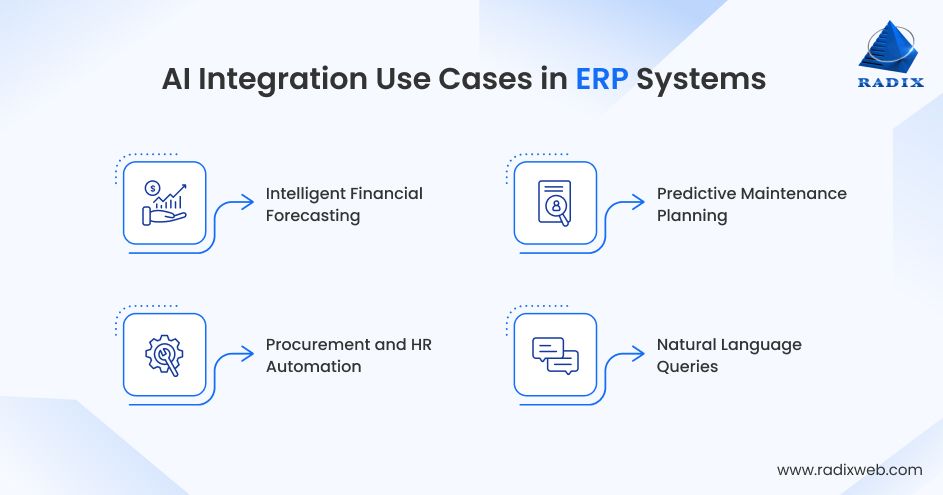
AI models trained on ERP data, cover revenue cycles, cost patterns, and budget variances. It produces rolling forecasts that update continuously rather than quarterly. Finance teams that previously spent weeks on budget cycle can compress that to days.
Manufacturing and operations teams use AI implementation in ERP to anticipate equipment failures before they occur and optimize inventory levels dynamically. The outcome: fewer production challenges stoppages and measurably lower carrying costs.
Routine ERP workflows (purchase order approvals, payroll exceptions, compliance checks!) are strong candidates for intelligent automation of workflows, without platform replacement, while sitting on top of the existing ERP layer. on top of the existing ERP layer.
Executives who needed analyst support to pull ERP reports can now, with the use of NLP-enabled AI ERP, query their systems in plain language. This changes who can act on operational data. When built on solid AI software, these interfaces reach production quality within months.
Several ERP vendors like SAP, Oracle, and Microsoft Dynamics, are embedding AI natively. However, they rarely cover the full scope of AI integration with enterprise systems that organizations need. Purpose-built ERP platforms with integrated AI layers consistently outperform bolt-on features for complex use cases.
CRM systems are good record-keepers but poor decision-makers. Understanding the factors that guide custom CRM software development helps explain why they tell you what happened but not what to do next.
AI integration in CRM changes that by adding a predictive and prescriptive layer on top of it. The most potent use cases of AI integration in CRM systems include:
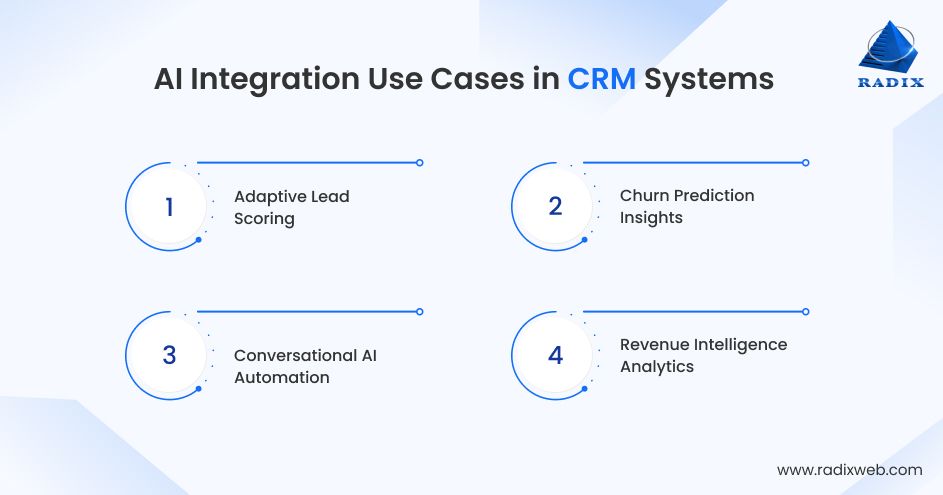
Static lead scoring rules (set once and rarely revisited!) are replaced by models that update continuously based on conversion outcomes. Many teams with AI implementation in CRM report meaningful improvements in pipeline quality within the first few quarters.
AI models that analyze CRM behavioral signals like login frequency, support ticket volume, and contract renewal timing, can flag at-risk accounts weeks before a human would notice. Designing AI-driven software specifically around CRM data for retention use cases has a fast payback period.
From AI assisted email drafting to fully automated follow-up sequences triggered by CRM events, this is where the full range of practical AI applications in customer-facing roles is most visible. Every lead gets a timely, well-crafted response regardless of rep overload.
AI integration in CRM surfaces insights like deal velocity, win/loss pattern analysis, and competitive displacement signals, from pipeline data that required dedicated RevOps analysts. Organizations investing in structured CRM consulting, strategy, and architecture get disproportionate returns when AI is layered on top of a well-organized data foundation
CRM data quality is the ceiling of AI integration impact. That's because AI amplifies patterns in data, including bad ones. So, if your CRM has inconsistent or incorrect records, AI will confidently give wrong predictions. This makes it important to ensure proper data hygiene before integration.
Supply chain disruptions cost the global economy over $4 trillion annually. AI integration in SCM systems helps counter that with capabilities beyond dashboards and alerts. Here's how AI use cases are strengthening supply chain management systems:
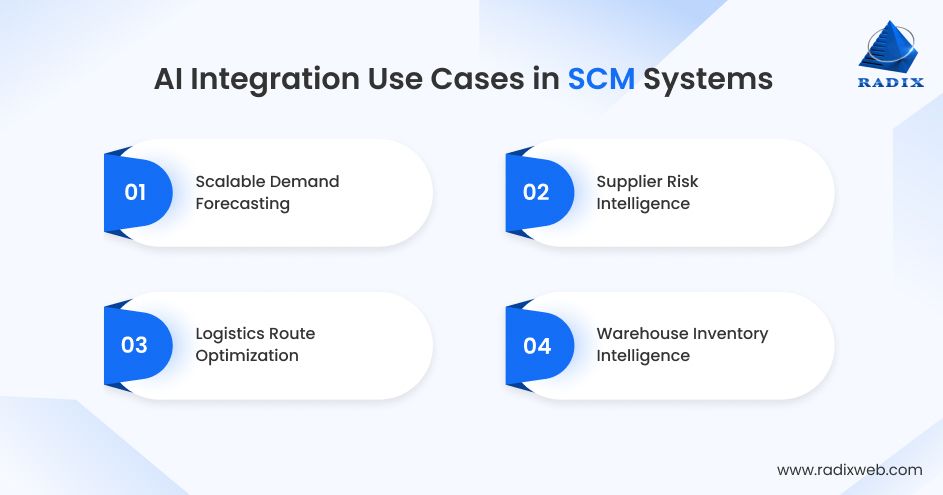
Traditional demand planning relies on historical averages and human judgment. AI in supply chain management systems ingests hundreds of variables producing forecasts that update in near-real time. Accuracy improvements over baseline models run consistently at 20 to 35% in mature deployments.
AI models can monitor supplier financial health, geopolitical exposure, and delivery performance at the same time. They can flag risks before they become disruptions. With that, supply chain software systems built for operational resilience can learn from near misses, not just failures.
AI integration in SCM brings real-time optimization to decisions like route optimization, carrier selection, and last-mile delivery. Earlier these decisions used to be made manually or with rule-based tools. With the application of AI to logistics operations, organizations can drive fuel savings, on-time delivery rates, and customer satisfaction.
Computer vision, RFID feeds, and AI-driven inventory models are replacing periodic stock counts with continuous inventory visibility. In high-SKU environments, AI implementation in ERP, CRM and SCM enables real-time inventory awareness, automatically triggering ERP procurement actions and aligning CRM delivery commitments.
As supply chains grow more complex, intelligence is becoming the defining capability of modern SCM systems. Organizations that embed AI in their supply chain management software are not just building automated, but adaptive and resilient supply chains.
The challenges to integrate AI in ERP, CRM, and SCM systems are real, well-documented, and consistently underestimated by organizations. Whether you are adding a simple AI chatbot to your enterprise system or building an AI agent for your ERP, CRM or SCM system, here are the most pressing challenges that you should be aware of:
Enterprise data rarely lives in one place. ERP, CRM and SCM systems each hold a piece of the operational picture, and they rarely speak the same language. Normalizing data across these environments before it reaches an AI model is the most time-consuming part of most enterprise AI projects.
The majority of AI integration challenges in enterprise software center on legacy infrastructure. If you have older ERP, CRM or SCM systems without REST APIs, data in proprietary formats, and documentation that no longer exists enterprise AI integration will get complicated.
Technology is rarely the hardest part of AI integration. People are. Teams that built their expertise around manual processes, analysts who own reporting workflows, managers who distrust model outputs. These are predictable obstacles. They require change management, not just technical solutions.
Enterprise systems hold sensitive data. AI integration that moves data between systems, exposes it to external models, or stores it in new locations creates a compliance surface that enterprise AI integration services must address explicitly. GDPR, HIPAA, SOC 2: the requirements depend on sector and geography, but they do not disappear because AI is involved.
Organizations that attempt to integrate AI across all enterprise systems at once almost always end up with delayed timelines and diluted outcomes. Understanding the patterns behind stalled AI initiatives is as important as knowing how to start one.
The steps to integrate AI into ERP, CRM, and SCM systems follow a consistent pattern across system types, even though the technical specifics differ. Here is what that process looks like in practice.
Before any AI model is selected or scoped, understand what data exists, where it lives, how clean it is, and what access restrictions apply. This audit defines the ceiling of what AI can achieve. It also reveals where AI data pipelines for enterprise systems must come before model work.
The most common reason enterprise AI initiatives stall or fail outright is that they start with a technology choice rather than a business problem. Define the outcome first. The AI integration process for ERP, CRM, and SCM systems that follows will be more focused, easier to scope, and easier to fund.
Three main paths exist:
The right path depends on your existing stack, your timeline, and the complexity of the use case.
For most enterprise AI projects, the pipeline work, extracting data from ERP, CRM, or SCM systems, normalizing it, and feeding it to the AI layer, accounts for 50 to 60% of the total engineering effort. And as Mr. Pratik Mistry, EVP of Technology Consulting at Radixweb explains, “The projects where AI integration delivers value aren’t the ones that moved fastest. They are the ones where the focus is on data pipelines and processes. As an AI system integration company we have seen this pattern enough times now that it is the first thing we address in any new engagement.”
Start with one system, one use case, one team. Prove the value. Then expand. The progression from an early AI prototype through to full production scale is never a single deployment. It is a series of validated increments. This is where working with experienced AI developers pays off: the ability to phase delivery without losing architectural coherence.
AI models degrade and the business conditions they were trained on change. That’s why governance, covering model monitoring, retraining schedules, and human-in-the-loop checkpoints are not just items on a post-launch checklist. These are design decisions that need to be made before the first model goes live.
Recommended Read: How To Replace Legacy Systems with AI Modernization
Organizations that have taken AI from initial prototype to full production report blended cost reductions of 15 to 30% in AI-enabled processes. However, costs and returns vary by function, use case, and execution maturity.
Here’s a simplified view of what organizations can expect in terms of AI development costs and ROI:
| Cost of integrating AI in ERP | AI Integration ROI |
|---|---|
| ● $80K–$500K+ depending on scale and complexity ● Driven by number of processes automated and customization level ● Influenced by ERP platform (eg, SAP vs mid-market) and integration approach | ● 20–40% reduction in operational costs through automation ● Faster financial cycles and fewer manual errors 12–24 month payback for most implementations |
| Cost of integrating AI in CRM | AI Integration ROI |
|---|---|
| ● $10K–$250K based on native vs custom AI solutions for enterprises ● Influenced by data quality, customer data volume, and workflows ● Platform dependency (Salesforce, HubSpot, or custom CRM) impacts cost | ● 10–30% increase in conversion rates with AI-driven insights ● 15–25% reduction in churn using predictive models ● 6–18 month payback, fastest among enterprise systems |
| Cost of integrating AI in SCM | AI Integration ROI |
|---|---|
| ● $50K–$1M+ depending on supply chain scale and real-time needs ● Driven by data volume, number of nodes, and forecasting complexity ● Higher costs for end-to-end optimization vs point use cases | ● 20–50% improvement in demand forecast accuracy ● 10–30% reduction in inventory carrying costs Increased resilience with fewer disruption losses |
It is clear that the financial case for AI integration outweighs the cost. When you factor in the cost of delaying AI adoption, the ROI becomes even stronger.
So, the key is not just investing in enterprise artificial intelligence but aligning that investment with measurable business outcomes from day one.
Start Integrating AI with Your Enterprise Software Today
AI integration across ERP, CRM, and SCM systems is moving from experimentation to execution. Organizations seeing real impact are not chasing AI for enterprise software for its own sake. Instead, they are starting with clear use cases, aligning data early, and scaling in phases. As enterprise systems evolve into systems of intelligence, the focus will shift from isolated automation to connected, real-time decision-making across functions.At Radixweb, we bring together 26+ years of AI consulting, ML development, and data engineering expertise to deliver practical, outcome-driven integrations across ERP, CRM, and SCM systems. Planning your AI integration journey? Book a 1-on-1 with our experts to explore what a realistic first step looks like for your business.
Ready to brush up on something new? We've got more to read right this way.

