
Read More


Recognized for AI Excellence at 2026 Globee® Awards - Read More

Nihar Raval
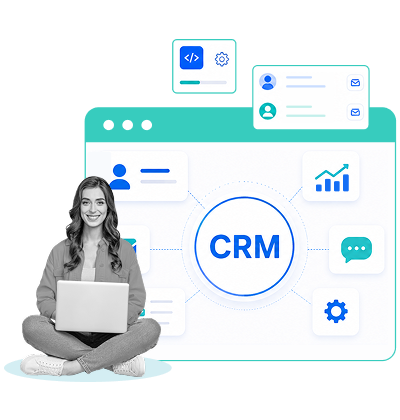
Quick Summary: Most CRM evaluations treat off the shelf versus custom as a yes or no question. However, there is a middle path called deep platform customization, and it fits far more businesses. The question isn't whether to choose Salesforce, HubSpot, Dynamics 365, or a custom CRM. The real decision is determining how much customization your business needs to support its processes, data relationships, and long-term growth goals.
| Aspect | Detail |
|---|---|
| What this guide covers | The three real paths on the CRM build spectrum, where Salesforce, HubSpot, and Dynamics 365 hit their limits. Four conditions that justify custom development, 2026 architecture requirements, and true cost by build path |
| Who should read this | CTOs, VPs of Sales Operations, and Product Leaders deciding whether their CRM needs deeper customization or a full custom build |
A company that has outgrown its CRM rarely says so outright. Instead, the warning signs appear gradually: sales teams start tracking critical information in spreadsheets, feature adoption stalls, and operations teams spend more time working around system limitations than using the platform itself.
This is typically when organizations begin evaluating custom CRM development. The challenge is that many start with the wrong question. The real decision is rarely "off-the-shelf or custom." It's determining where a business falls between platform configuration, deep customization, and a fully custom build. The same mistake appears when companies skip CRM strategy and requirements assessment and select a platform before fully understanding their workflows, data relationships, integration needs, and long-term business objectives.
The reality is that Salesforce, HubSpot, and Dynamics 365 can usually be extended much further than most organizations expect. For many businesses, the answer lies not in replacing the platform but in finding the right level of customization. That's where evaluating when custom CRM development becomes necessary becomes valuable, helping determine the right approach before development begins.

CRM software development focuses on building systems that centralize customer information and improve customer-facing operations. These systems:
It covers three distinct paths. Setting up an off the shelf platform with light configuration. Customizing a platform's data model and workflow engine in real depth. Or building a fully custom system starting from the data layer up.
CRM investments only pay off when they connect back to a measurable business outcome. This is why it matters more to tie CRM investments to measurable outcomes than to chase a longer feature list during evaluation. The decision is which of the three paths closes the gap between what a platform offers natively and what the business's actual workflow, data, and integration needs demand.
This gap is almost never visible at the start of an evaluation. It shows up about six months into using a platform, once specific friction points have piled up enough to be named out loud.
The symptoms tend to show up in places like these:
Treating the CRM build decision as binary is probably the single most common mistake in CRM evaluation. It produces businesses that either overpay for custom development they never needed or spend years fighting a platform that was never going to fit their process in the first place.
The platform's native objects, fields, and workflows get used with barely any modification. It comes with standard contact and opportunity fields, the platform's default pipeline stages and out of the box reporting. This is the right starting point for any business whose sales and service process are not meaningfully different from a generic B2B or B2C company. Cost here is basically the platform's license fee plus a modest setup engagement.
The data model gets extended with custom objects and fields. The workflow engine gets configured around the business's actual process, and custom integrations connect the platform to internal systems through its API. This is the path most businesses genuinely need and yet underuse, often because their first implementation stopped at basic configuration and never went further.
A system built on a custom data model and custom application logic, with no platform license underneath it. This fits a narrower, well-defined set of situations. Although it’s not the automatic answer for every business that outgrew a poorly configured platform.
All of the dominantly used off-the-shelf CRM platforms serve genuinely strong purposes a wide range of business needs. Each one also has a specific point where its architecture stops bending to fit a business's process. Knowing exactly where that point sits is more useful than a generic feature by feature comparison.
Salesforce's data model and workflow engine, including Salesforce Flow and automation capabilities, can encode remarkably complex business logic without writing custom code.
Limitations:
A business running 500 sales reps on Salesforce Enterprise Edition is paying license costs that, past a certain size, start to exceed what an equivalent custom build would cost to operate every year. The exact crossover point moves with edition and negotiated discount, but organizations roughly over 300 to 400 seats on premium editions consistently find it worth modelling the economics against a custom alternative. They ideally do it through custom software built around their own business workflows rather than a generic cost comparison.
The governor limits matter most for businesses running computationally heavy logic on every record save things like real time scoring algorithms or calculations across large sets of related records. Salesforce's per transaction limits on CPU time, SOQL queries, and DML operations are generous for typical business logic and genuinely tight for a narrower set of data heavy use cases.
HubSpot's real strength is the native connection between CRM, marketing automation, and content management, all living inside one data model. That makes it the strongest option for businesses where marketing and sales work off a tightly shared dataset.
Limitations:
HubSpot fits businesses whose main requirement is marketing and sales alignment with moderate process complexity. It stops fitting once sales process complexity becomes the dominant requirement.
Dynamics 365's biggest strength is how deeply it sits inside the Microsoft ecosystem. Organizations already running Microsoft 365, Azure, Teams, Power BI, and the Power Platform can connect customer data, collaboration, reporting, and operations with relatively little integration friction. This makes Dynamics 365 a natural fit for enterprises trying to unify CRM and ERP inside one environment.
Limitations:
At that stage, it is usually worth evaluating custom business applications built around operational workflows rather than continuing to stretch the platform further.
These four conditions are what actually make a ground-up build the financially and operationally sound call instead of one more round of platform customization.
The core business logic is genuinely proprietary and central to how the business competes. This is because the CRM itself has become part of what makes the business operate differently from everyone else. The workflow logic, scoring algorithms, or data relationships that govern how the business manages customer relationships are a real part of that edge. Encoding it inside a third-party platform's data model creates both, a performance ceiling and a long-term dependency on someone else's roadmap decisions.
Data residency or sovereignty requirements that no platform's standard deployment model satisfies. Regulated industries and jurisdictions need customer data to stay inside specific infrastructure boundaries that the major CRM platforms' standard multi-tenant architecture cannot fully guarantee.
Per seat licensing economics that have crossed the point where custom development costs less to run at the business's actual scale. This calls for a real cost model, platform license plus customization cost across a three-to-five-year horizon. This should be weighed against custom build plus maintenance cost over the same window.
Integration depth with proprietary internal systems that goes beyond what any platform's connector ecosystem or API can support without heavy custom middleware. If the customization layer connecting a platform to internal systems gets as large as a custom CRM's core logic, the platform license adds cost without proportional value.
A business that meets one of these four conditions is a legitimate custom CRM candidate. A business that meets none of them and is still considering a custom build is very likely solving a platform configuration problem with a development project.
The baseline expectations for a CRM have shifted noticeably over the past couple of years, regardless of which build path a business chooses.
CRM data models in 2026 need to support AI as a first-class capability, not bolted on afterward. For most organizations this does not mean replacing the CRM entirely. The bigger challenge is usually integrating AI into software already running in production while keeping the underlying customer data structured, accessible, and trustworthy. That means designing fields and relationships around the signals AI models need, engagement scoring inputs, interaction history at a fine enough grain, structured outcome data from past deals.
Every piece of customer data in a 2026 CRM needs a traceable origin and a recorded basis for consent. Not as a compliance afterthought, but as a structural requirement baked into the data model from the beginning. Retrofitting consent tracking onto a CRM that was never built with it is a considerably bigger project than building it in from day one.
The gap between data landing in the CRM and that data triggering a relevant action, a workflow, an alert, an AI generated recommendation, needs to be measured in seconds, not hours.
The CRM's architecture needs to support autonomous agent actions, an AI agent updating a record, kicking off a follow up, escalating a case, with the same audit trail and permission structure that applies to a human user's actions. Most CRM systems built before 2023 were not designed with this in mind at all.
These are architectural requirements, not features to bolt on later. A platform or custom build that treats them as an afterthought will face a much more expensive retrofit than one that treats them as part of the foundation from the start.
Three categories of AI capability now come up in essentially every CRM evaluation, and each one carries a different architectural footprint.
Models trained on historical deal data to score lead quality and predict outcomes. This only works with enough historical data volume and quality inside the CRM to train something meaningful. A common failure mode is a business turning on predictive scoring against two years of inconsistent data entry, and getting predictions no more reliable than a coin flip.
Voice assistants and chat agents that read from and write to CRM records during live customer interactions. Total cost for a first production deployment of this kind typically runs $50,000 to $500,000 depending on the architecture chosen, with integration depth driving cost far more than the voice or language model itself. A working production deployment needs real escalation logic. Sensitive actions like refunds or account changes route to a human for approval instead of executing autonomously, and session context needs to carry over to that human agent so customers are not stuck repeating themselves.
Modern CRM platforms are moving beyond AI-powered recommendations. They increasingly support AI agents that can execute multi-step business processes on their own, updating CRM records, triggering workflows, coordinating actions across connected systems, and interacting with external APIs without requiring manual intervention at every step. Salesforce's Agentforce is one example of this shift, enabling AI agents to perform actions within the CRM environment rather than simply suggesting them to users.
Based on a survey of more than 4,000 sales professionals run in the second half of 2025, the large majority of sales organizations are now using some form of AI in their process, with adoption moving fastest among teams already running agentic tools inside CRM workflows. This category needs the same audit trails, permission structures, and consent tracking mentioned earlier, extended to cover non-human actors, not just people logging in.
Getting the escalation logic and audit trail right here typically calls for production-ready AI agent engineering rather than dropping a chatbot into an existing process and hoping it survives contact with real customers.
The practical takeaway for a 2026 CRM evaluation is that the data quality and architectural readiness of the underlying CRM is what decides whether AI features create value or just generate noise. Businesses evaluating custom development specifically to unlock AI capability should confirm the data foundation is actually sound before treating AI as the main justification for the build.
A CRM's architecture has three layers that decide its capability, performance, and long-term flexibility, whether it is a configured platform or a fully custom build.
Most CRM architectures revolve around how business entities relate to one another.
The further an organization moves from standard CRM relationships, the more important the underlying data architecture becomes.
CRM platforms typically follow one of two integration approaches.
Point-to-point integration is faster to launch but becomes harder to maintain as systems are added. API-first architecture requires more upfront investment but scales far more predictably.
Customer relationship data is, by definition, personal data, which makes every CRM build or customization decision a data privacy architecture decision as well.
Major platforms like Salesforce, HubSpot, and Dynamics 365's enterprise CRM capabilities provide compliance tooling that handles much of this automatically within their data model. A custom CRM build takes on the responsibility of building these capabilities directly, which represents a meaningful portion of development cost for any CRM handling regulated data.
Organizations generally deploy AI in one of two ways.
Embedded AI is easier to implement but limited by the platform vendor's capabilities. External AI services require more integration effort but provide greater flexibility and reduce dependence on a single vendor roadmap.
For a custom CRM build, these decisions are made deliberately instead of being inherited from platform defaults. That flexibility is both the biggest advantage of custom development and one of the primary reasons many organizations treat CRM initiatives as part of a broader effort to build enterprise software ecosystems around the business rather than as a standalone sales tool.
Cost varies far more by which point on the build spectrum a project sits at than by which features get included, because the underlying engineering effort is genuinely different by architecture. Business leaders evaluating CRM investments often underestimate how many variables are involved. This is why it helps to understand the factors that shape typical software development budgets before comparing platform licensing against custom build costs.
| Development Path | Typical Cost Range | Timeline | Primary Cost Driver |
|---|---|---|---|
| Platform implementation, light configuration | $15,000 to $60,000 | 4 to 10 weeks | Data migration, user training, basic workflow setup |
| Deep platform customization | $60,000 to $250,000 | 10 to 24 weeks | Custom object development, workflow logic, integration depth |
| Ground up custom CRM | $150,000 to $600,000+ | 20 to 44 weeks | Full data model design, application logic, integration architecture |
| Custom CRM with AI and agentic capability | $250,000 to $800,000+ | 28 to 52 weeks | Data pipeline for AI features, model integration, agentic governance layer |
Annual maintenance for a deeply customized platform typically runs 15 to 20% of the initial customization cost, covering ongoing configuration changes, integration upkeep, and platform version compatibility work.
For a ground up custom CRM, annual maintenance runs higher, usually 20 to 30% of build cost, because the business has taken on full responsibility for security patching, infrastructure management, and feature development that a platform vendor would otherwise handle.
CRM integrations are often where project budgets drift away from their original estimates. The number of systems being connected matters far less than the complexity of the connections themselves. The number of integrations is not always the biggest challenge. A CRM connected to several modern systems with well-documented APIs can be easier to implement than one connected to a single legacy platform with poor data quality and limited documentation.
The biggest integration cost drivers typically include:
Organizations with customer data spread across multiple systems often need data analytics capabilities that create a consistent view of customer information before CRM integration efforts can succeed.
A CRM project should never be estimated from features alone. A thorough integration audit needs to happen before development estimates are finalized. This must cover connected systems, API maturity, data quality, and transformation requirements.
The comparison that should happen before any build decision is not platform license cost against custom development cost in isolation. It is total cost, platform license plus customization plus integration plus annual maintenance, weighed against total cost of a custom build plus infrastructure plus annual maintenance, modelled across a three-to-five-year horizon at the business's actual or projected user count.
The right evaluation criteria change depending on which point on the build spectrum a project occupies.
Getting the Diagnosis Right Before You Pick a Build Path
The businesses that get the most value from a CRM investment, whether that is platform customization or full custom development, are the ones that diagnosed their actual requirement before committing to a build path.Radixweb's custom CRM development team has delivered CRM platforms and integrations across healthcare, financial services, and enterprise technology, alongside certified platform customization work on HubSpot,Salesforce and Dynamics 365, over 26 years, and much of that track record traces back to software development outcomes defined before the build started.The diagnosis that matters is which specific limitation of the current system is holding the business back, and which of the three build paths resolves that limitation at a cost the business's scale can justify. A platform customization project that targets the real constraint will outperform a custom build that solves a problem the business never actually had. A custom build that addresses a genuine architectural limit that platform customization cannot reach will outperform years of incremental platform workarounds. Consult our CRM development experts before the build path gets decided.
Ready to brush up on something new? We've got more to read right this way.

