Read More


Recognized for AI Excellence at 2026 Globee® Awards - Read More

Maitray Gadhavi

10 Mins Read: Every quarter you ‘wait and see’ AI adoption, you leave money on the table. The cost of not adopting AI exceeds implementation costs in 6-9 months. Mid-market firms give up close to $2.3 M per quarter in inefficiencies and slow pipeline velocity. Inaction isn’t protection, its silent negative cash flow. Don’t fund your competitor’s leads, convert delays into margins today.
TL; DR – Don’t Skip This
● Postponing AI adoption multiplies hidden costs. Inc. 5000 firms can lose ~$2.3M a quarter in inefficiencies and missed revenues● AI-powered businesses accelerate workflows 30-50% faster, netting market shares earlier● As per enterprise adoption benchmarks, cost of delayed AI adoption exceeds cost of implementation in 6-9 months● Cost of manual workflows is 20-40% of employee time, slow executive decisions and exploding operational costs without scope of scaling● Businesses with focused AI pilots report practical ROI in 90 days, justifying value before enterprise-scale rollout
AI-led capabilities matter to businesses more than ever now. And business leaders know it. What they don’t realize is that ‘waiting for the next quarter’ secretly generates invisible costs which keep accumulating when businesses delay AI adoption in industry.
Look closely inside your balance sheets, your workflows, talent pipelines and across customer experiences - you’ll find the cost creeps. The latest artificial intelligence statistics clearly point out that if you’re delaying AI adoption now for its rusty implementation cost, you’ll be shelling out a lot more than now.
By staying where you are, you aren’t protecting your business. You’re actually giving away your competitive advantage in the AI journey.
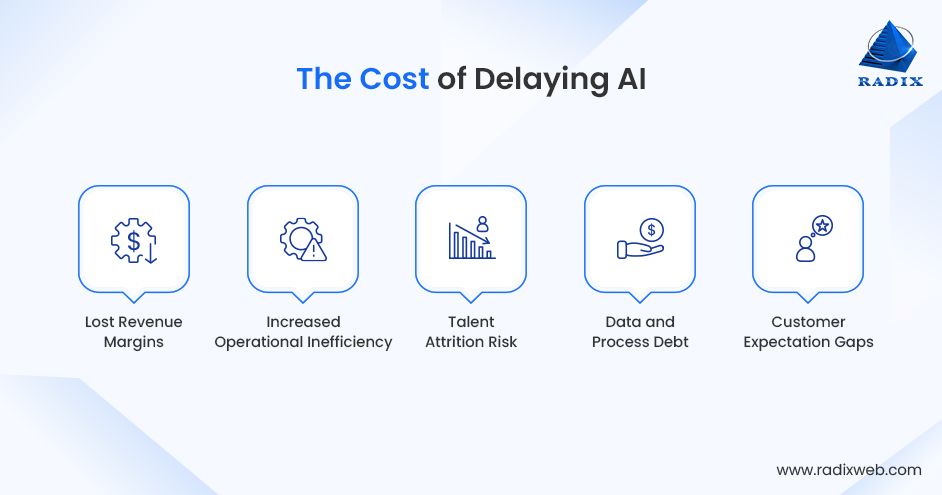
And that compounded interest isn’t what benefits you, it’s what you pay from your margins. While the early adopters accelerate with clean data pipelines, smart automation workflows and efficient operational models, building rich foundational knowledge; you fall behind by months and years of implementation edge in just one-two quarters.
In the age of intelligent automation and scaling at the pace-of-now, waiting for AI to play out favorably for your business is no longer caution – its self-sabotage.
Don’t look at AI delays like a quarter’s time, calculate the expenses you’ll need to bear for catching up. Delaying AI adoption makes you over-reliant on manual processes that:
Investing in AI is costly. Agreed. Strategic implementation can create far more unpredictable costs – from APIs, integrations, architectural redesigns, computing costs, model development and training of resources. Yes, the figures seem upfront and huge. I’d even say AI expenses are tricky because AI spending is often non-linear – token consumption and inference cost management.
However, refusing to implement AI now is a costlier mistake. Imagine the cognitive load on your teams when they are still updating spreadsheets and analyzing numbers when predictive analytics can do the job. You are also paying up for infrastructural costs and human labor in repetitive tasks when intelligent automation can serve the purpose well. Your teams can invest themselves in critical operations or upskilling with AI-driven triage leveraging the most market-relevant AI programming languages, but human routing is keeping them bound to the same routine jobs.
No business is without inefficiencies. However, AI makes these gaps obvious to your perception. We have analyzed multiple business transformations and realized that slow adopters of AI don’t just end up paying more – they move slow and fall back on innovation cycles. Their competitors have moved way ahead, and the gap keeps growing wider every day.
| Without AI | With AI |
|---|---|
| Teams take hours to summarize meetings, feed documents | AI-powered solutions automate pipelines, feed trackers without errors |
| CX stays where it was – slow response time | Automated agents with human-in-loop governance deliver quick responses |
| Data extraction, classification, reporting remains manual | Improved accuracy with automated data landscape and governed processing |
| Latency in decisions, influenced human analysis | Predictive & Prescriptive analytics empowers quick decisioning |
| Human dependency, manual errors - long cycle times | Improved accuracy, managed workloads – reduced dev cycles |
One of the reasons why business leaders stall AI projects is because they fear integration challenges. Our AI implementation process at Radixweb, converges intelligent process automation with strategic AI integration services that helps you cut operational drags without jeopardizing your ongoing operations.
You can be reluctant to experiment with AI, but the best of tech talent knows – the future is where AI is. They don’t want to waste time cleaning data, fighting analytics and building strategies for outdated systems that mostly won’t work.
Businesses that show no indulgence towards investing in AI systems are directly experiencing talent churn over the last two years. In fact, delayed AI adoption is seen to increase frustrations in the talent line, demotivation and ultimately attrition where they eventually choose tech-forward businesses.
If you want to still retain top talent, ask them to help you build AI preparedness, or be ready to let them go. The most tech-first talent lines:
If you want to stay away from the talent-gap challenge, delaying AI could prove as a serious risk to your business.
You accumulate data debts when your business doesn’t know how to clean, classify and process enterprise-scale data sets. And process debts present themselves when you leave outdated legacy workflows function without a touch of modernization. These debts multiply when you delay AI adoption.
Let’s accept it, delayed modernization raises your implementation costs – works the same with AI. When you deploy AI systems on extremely irrelevant architectures, data and process debts compound into:
The time is now – get your AI readiness assessments done with futuristic AI consulting to identify possible bottlenecks in AI adoption. Accelerate process modernization projects to cut down the cost of AI development and implementation.
Your customers access AI at the back of their hands. From chat windows, swift responses, recommendation engines and personalized experiences everything brings resolution in seconds. So, when you still run business functions manually, they take note.
Businesses that leverage AI-powered solutions, experience:
In the age of quick resolutions, slow responses and generic solutions have lost relevance. Your customers won’t wait to talk to your customer execs to solve issues. They expect you to invest in AI agent development to place customer-facing virtual agents that delivers resolutions in seconds.
Let’s talk some hard numbers now. This is what postponing AI adoption does to your business:
On the other hand, businesses that pivot experimenting with AI experience 13% lesser AI waste. Implementing AI for your industry looks difficult? We have broken it down practical advice into digestible bits in this enterprise AI guide.
Let’s give you some industry-specific numbers now.
Delays in AI adoption shows up undeniably when you look at industry-specific numbers. Here I have laid down probable debt structures for industries heavily reliant on automation and how AI-led capabilities spearhead change:
Doesn’t matter which niche you are operating in – manufacturing, healthcare, finance, real estate or supply chains, using AI in industry workflows helps you re-imagine them for the future. While benefits of AI adoption differs in every use case and industry in different ways, the risks of delay are similar across industries – higher cost-to-serve, weak personalization and lost speed.
Our experts have scaled up 50+ pilots to enterprise-scale, production-ready solutions in the previous year. Based on their learnings, we have built a primer on scaling custom AI prototypes to production which delivers realistic fixes for speeding up pilots. Your industry-specific queries solved in minutes!
Now let’s get to the most asked question -
When Should You Adopt AI in Your Industry?
The simplest answer would be:
Ahead of your competitors – and before your customers react to why you haven’t! Most industry research and surveys say that early adopters build resilient operations through solid data moats, fast cycle times, strong profit margins, and retain talent better than non-adopters. Read our guide on building AI software and de-risking the process because waiting longer clearly isn’t going to give you any strategic edge.
I am listing down a simple low-risk plan that would work across industries:
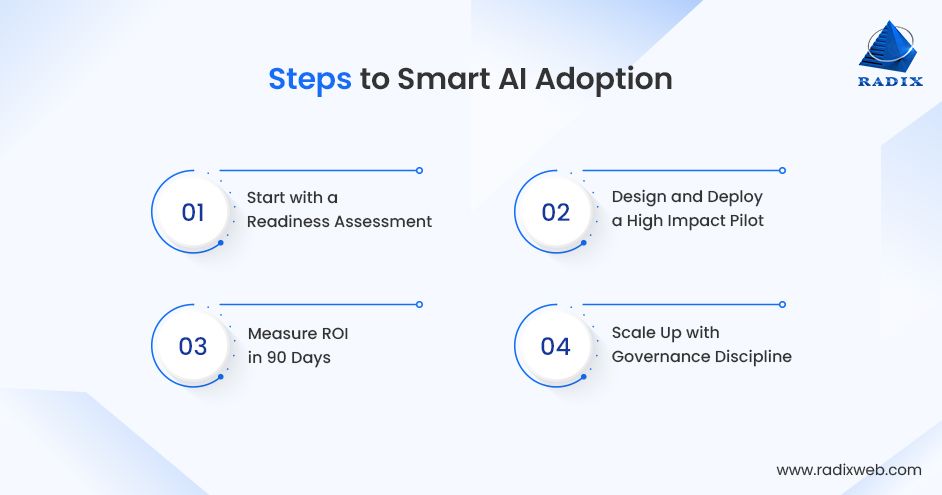
Get tech-first, future-focused AI consulting services that assess the state of your business data and maturity of your processes along with business goals to deliver custom AI adoption blueprints.
Target-test quick wins with:
Build a 90-day KPI and growth tracker. Define smart metrics and target ROI.
Onboard industry trusted artificial intelligence services that prioritize responsible AI with MLOps, drift monitoring and compliance adherence across industries to scale with confidence.
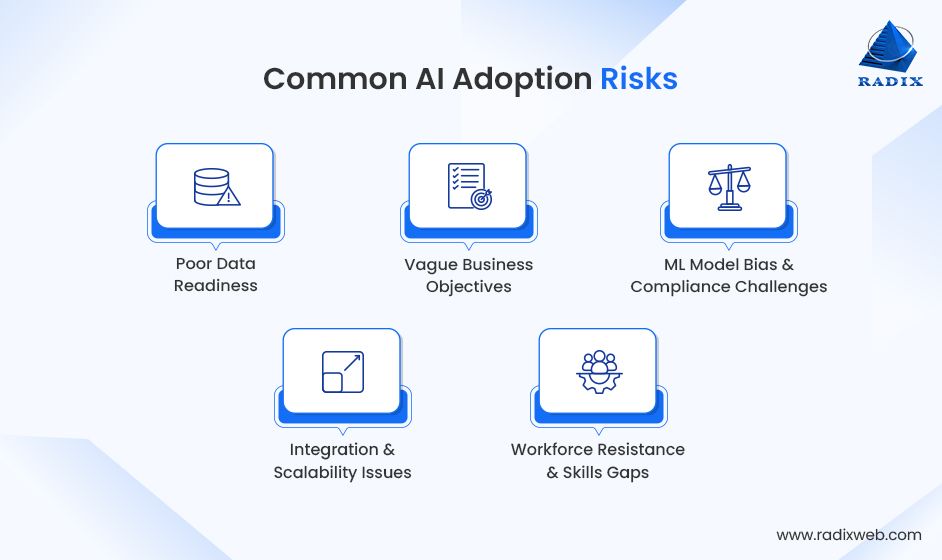
AI adoption brings in massive operational gains and value for a business. However, in the process of operationalizing AI adoption, businesses need to navigate a few challenge landscapes:
AI Isn’t the Real Risk – Inaction Is Killing Your Business
To implement AI or not – cannot be a debate anymore. It’s non-negotiable. You need to understand AI isn’t going to replace your business, however, a competitor using AI very much will.The silent costs of delaying AI adoption: lower revenue, delayed dev cycles, exploding labour costs and worn-down margins, explode without warning signs. Flip the script from ‘falling behind’ to ‘leading the change’. Connect with us to outline your ROI roadmap for AI – we’ll help you build fast and win early.
Ready to brush up on something new? We've got more to read right this way.