Read More


Recognized for AI Excellence at 2026 Globee® Awards - Read More

Nihar Raval
SCM Summed Up: Supply chain disruptions caused by system blind spots cost companies $12 billion per year. The right supply chain management software, however, can help close that gap, but only if you are selecting and implementing it right. In this guide, we break down how SCM software works, which features actually improve operational performance, when off-the-shelf platforms make sense, and when a custom-built system delivers better long-term ROI.
One of our retail and distribution clients was struggling with inaccurate demand planning, frequent stock imbalances across locations, and slow inventory decision-making caused by disconnected operational systems. Their teams had the data. Their systems just couldn’t work together fast enough to make it useful.
That wasn’t an inventory problem. It was a supply chain software problem.
To solve it, we built an ML-powered supply chain management platform with intelligent inventory forecasting capabilities that could adapt to changing demand patterns in real time. The result: forecast error dropped from 28% to under 12%, helping the client significantly reduce excess inventory and prevent recurring stockouts.
That’s just one example of how developing modern supply chain management software creates value. In this guide, we will walk you through what, why, and how of SCM software.
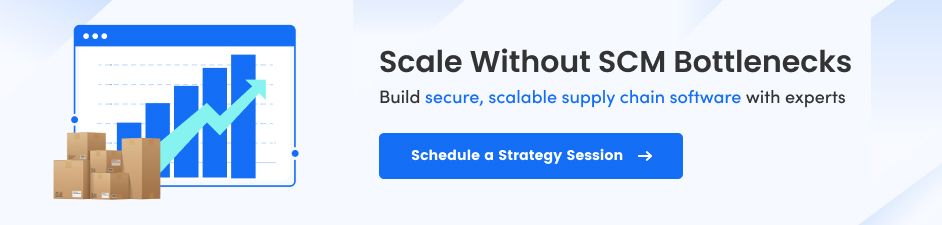
Supply chain management software (SCM software) is a centralized system that helps businesses manage, coordinate, and optimize the entire flow of goods, information, and operations across the supply chain. It covers everything from sourcing raw materials to delivering products to customers. And it connects procurement, inventory, production, warehousing, logistics, suppliers, and order fulfilment into one integrated platform where data updates in real time across every function.
But modern SCM platforms go beyond simple process coordination. Software systems powered by AI, machine learning, and predictive data analytics can:
Ultimately, SCM software eliminates operational blind spots.
Without it, different teams often work with disconnected systems, delayed information, and conflicting data. With it, businesses get a single operational view of the supply chain to track what is happening, identify risks early, and respond faster.
SCM software works by connecting previously siloed data sources, teams, and systems into a single operational layer. The underlying workflow of any supply chain moves across three flows simultaneously:
1. Product flow: the physical movement of goods from supplier through production, warehousing, and on to the customer, including quality checks at each stage.
2. Information flow: the exchange of purchase orders, sales orders, delivery updates, and demand signals between every party in the chain. Every downstream decision depends on the accuracy of this layer.
3. Financial flow: payments, credit terms, invoice processing, and budget tracking tied to procurement and fulfilment activity.
So, when a sales order arrives, the supply chain system checks real-time inventory, triggers fulfilment instructions to the warehouse, updates the supplier portal with revised demand signals, adjusts the demand forecast, and logs the financial transaction, without a manual handoff between teams.
That automation is where the operational value comes from. The businesses that find out about a supplier delay in hours rather than days are not the ones with better supplier relationships. They're the ones whose systems surface that information automatically.
The supply chain spans multiple functions, each with its own complexity. SCM software reflects that. Different tools serve different layers of the operation, and businesses with real operational depth typically need several of them working together.
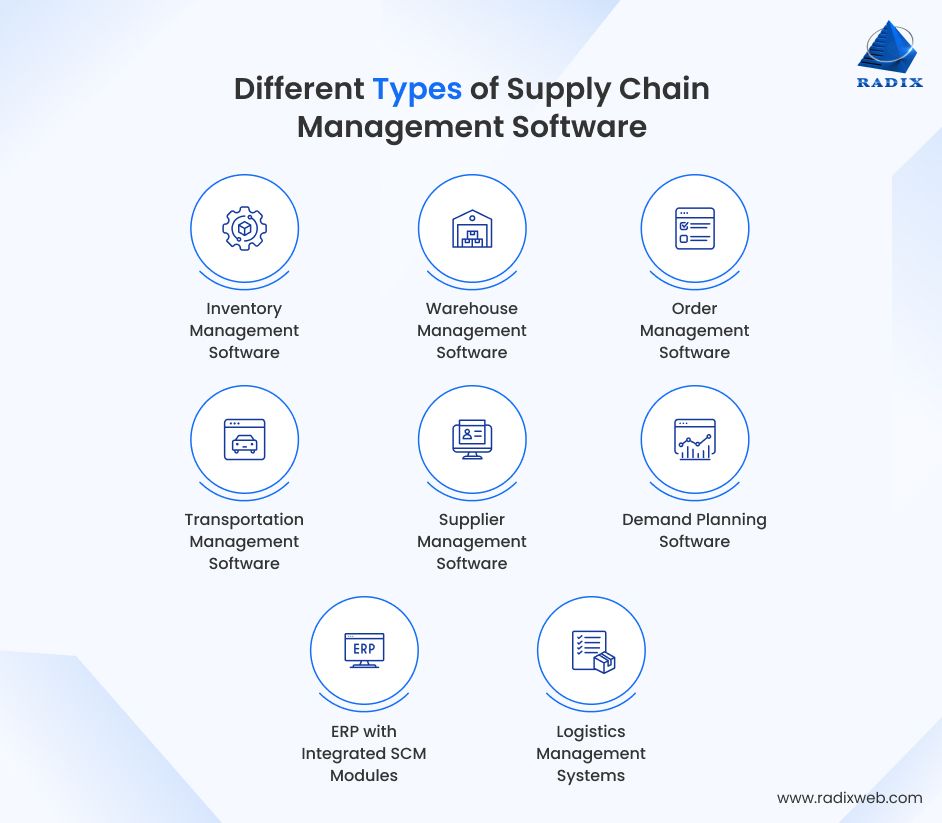
Tracks stock levels, automates reorder triggers, and forecasts demand across every SKU and location. Purpose-built inventory management software prevents both stockouts and excess inventory by accounting for lead time variability and sales velocity, not just historical averages.
Controls all activity inside a distribution center like receiving, put away, picking, packing, and shipping. A warehouse management system gives teams real-time item location data and keeps stock counts accurate without manual cycle counts. For multi-warehouse operations, this is where fulfilment speed is won or lost.
Manages the full lifecycle of every customer order from placement through delivery and post-sale service. An OMS connects front-end sales channels to back-end fulfilment, so orders don't get lost between the platform that takes them and the warehouse that ships them.
Plans, executes, and tracks how goods move between suppliers, facilities, and customers. The benefits of using a transportation management system include cost-optimal routing, consolidated shipments, and delays getting surfaced early enough to reroute or notify customers before the failure lands.
Centralizes all vendor data including contracts, delivery performance, quality records, and pricing history. When it's time to renegotiate terms or qualify a backup supplier, the evidence is already in the system rather than scattered across inboxes.
Forecasts what customers will buy, when, and in what volume, feeding directly into production schedules and procurement cycles. The gap between what businesses produce and what the market wants is one of the most expensive recurring problems in supply chain management.
Large enterprises run supply chain functions inside a broader custom-built enterprise resource planning software that also handles finance, HR, and manufacturing. The advantage is a single source of truth across every business function. The tradeoff is implementation complexity and cost.
A logistics management system combines inventory, order management, transportation, and returns into one platform. For third-party logistics providers and businesses running complex multi-modal distribution, this is usually the right starting architecture.
For most organizations, a single type of supply chain management software cannot handle every operational challenge, which is why most growing businesses eventually combine multiple systems into a connected supply chain ecosystem rather than relying on a single tool.

Whether you are evaluating an off-the-shelf SCM platform or planning a custom-built system, the features below are the ones most likely to impact operational efficiency and long-term scalability.
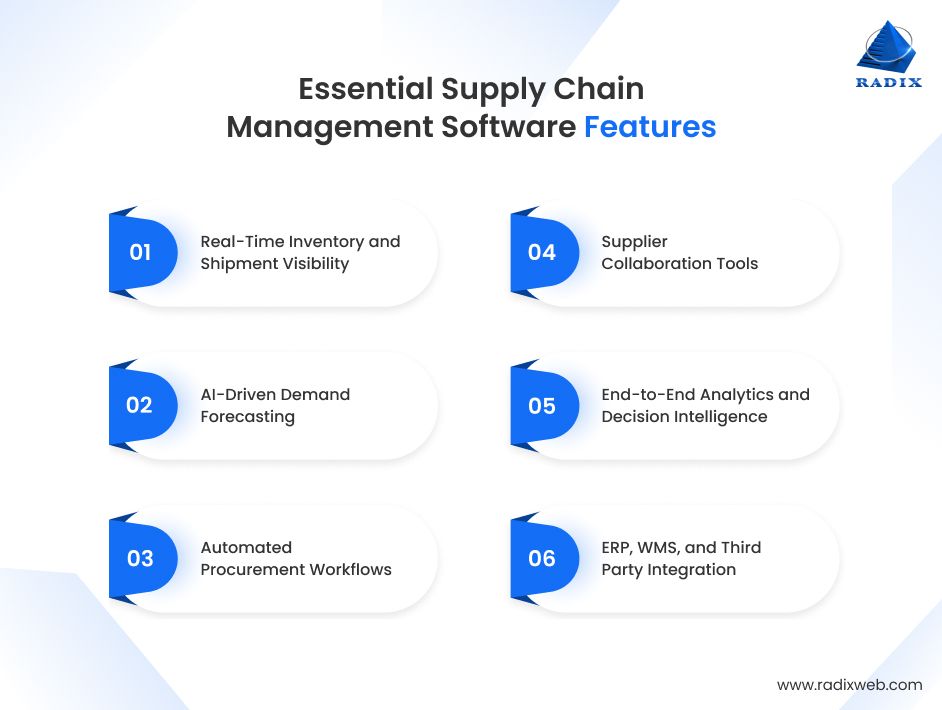
With your SCM software, you should be able to see stock levels, item locations, and shipment status as they happen, not as of yesterday's batch report. Without this, every downstream decision from order promising to production scheduling runs on stale data.
Your SCM software should forecast demand as a range of likely scenarios, not a single static number. Look for platforms that account for seasonality, promotions, supplier lead time fluctuations, and changing buying patterns automatically.
Your SCM platform should automatically trigger purchase orders when stock reaches predefined thresholds, route approvals to the right stakeholders, and send supplier confirmations without manual follow-ups. If replenishment still depends on someone noticing a spreadsheet or sending an email, procurement delays will continue creating stockouts.
Your SCM system should give suppliers a dedicated portal to confirm orders, update delivery timelines, and flag capacity or production issues in real time. Without direct supplier visibility, delays usually surface only after production schedules or customer deliveries are already affected.
Your SCM software should surface operational KPIs across inventory, fulfilment, logistics, and supplier performance in one place, while also helping teams understand what action needs to be taken next. Reporting alone is not enough.
Your SCM software should integrate cleanly with the ERP, warehouse systems, eCommerce platforms, carriers, and other operational tools already in use. Weak integrations create new silos instead of fixing existing ones, forcing teams back into manual reconciliation and duplicate data entry. This is one of the most overlooked risks during SCM selection and one of the hardest problems to fix after implementation.
Though not every business needs all of the SCM software features mentioned above, every conversation with SCM vendors or development partners should cover each one directly.
According to Straits Research, the global supply chain management software market was valued at USD 27.59 billion in 2024 and is projected to reach USD 72.72 billion by 2033 at a CAGR of 11.37%.
That growth reflects how the business case for SCM software is not abstract. It shows up in specific, measurable outcomes and is now a baseline operational requirement, not a competitive differentiator.
Automated procurement, optimized inventory levels, and smarter freight decisions cut the spending that comes from emergency orders, excess stock write-offs, and inefficient routing. Research indicates that early adopters of AI-powered SCM software can reduce inventory levels by up to 35%, which at scale translates directly to freed working capital.
Supply chain disruptions are not occasional events. They're the background condition of operating a global supply chain. Businesses with connected SCM systems find out about a supplier failure or a demand spike in hours. Businesses without them find out when a stockout reaches the customer.
Clear performance records, automated communication, and centralized contract history shift procurement conversations from impressions to evidence. You know which suppliers consistently hit delivery windows. That knowledge is most valuable before a disruption, not after.
Accurate inventory, consistent fulfillment, and on-time delivery are the direct outputs of a well-run supply chain. SCM software makes those outcomes repeatable rather than dependent on individual effort and institutional memory.
Visibility into spending across every supplier relationship makes it possible to enforce buying policies, reduce unplanned purchasing, and surface budget mismatches in time to correct them rather than discovering them at quarter-end.
In our experience building SCM solutions for manufacturers, distributors, and logistics companies across North America and Europe, the pattern holds consistently: the operational improvements rarely come from a single feature. Cost reduction, faster disruption response, supplier accountability, and fulfilment reliability usually improve together once businesses replace disconnected systems and delayed visibility with a centralized, real-time supply chain environment.
Choosing supply chain management software is not just a technology decision. It is an operational decision because the right system is the one that matches how your business actually operates today while supporting the level of scale and complexity you expect in the future. Below are the three key parameters that should guide your choice:
The most common and expensive mistake in SCM software selection is starting with vendor demos before writing a clear problem statement. Businesses that buy platforms because they cover everything routinely end up with systems that do many things poorly rather than one critical thing well.
Before speaking to any vendor, answer two questions: Where does the supply chain break down most often? And what does that failure cost the business in measurable terms?
A manufacturer losing $400,000 a year to stockout-related production delays has a very different requirement than a distributor's bleeding margin on inefficient freight routing. Those answers determine which type of SCM software belongs on the shortlist.
The constant debate between custom-built and off-the-self software solutions continues in the SCM domain too.
Off-the-shelf platforms such as SAP SCM, Oracle SCM Cloud, and NetSuite work well when a business's operations fit standard supply chain workflows. They deploy faster, come with pre-built integrations, and reduce early implementation risk.
The problem arises when the business doesn't fit the platform's assumptions. Most businesses with meaningful supply chain complexity have at least one process that doesn't map cleanly to an off-the-shelf template. When that happens, the platform becomes a constraint.
Here’s a quick comparison between custom and off-the-shelf SCM software:
| Off-the-Shelf SCM Software | Custom SCM Software |
|---|---|
| Faster implementation timelines | Longer initial development cycle |
| Lower upfront investment | Higher upfront investment |
| Standard workflows and features | Built around existing business processes |
| Pre-built integrations available | Integrations tailored to existing systems |
| Easier vendor support and updates | Greater control over roadmap and scalability |
| Best for predictable operational models | Best for complex or highly specialized operations |
| Customization often limited or expensive | Fully adaptable as business needs evolve |
In most cases, off-the-shelf SCM software makes sense when operational complexity is still manageable and the business can comfortably adapt to industry-standard workflows.
Custom SCM software becomes the stronger long-term choice when the business starts adapting its operations around software limitations rather than the other way around.
Important: Custom supply chain software development costs more in the initial build, but over three to five years, the total cost often favors custom once licensing fees, third-party customization costs, and operational inefficiencies are factored in.
The right SCM software depends less on company size alone and more on operational complexity, fulfilment volume, supplier coordination requirements, and how quickly the business is scaling.
Based on the type and scale of your business, here’s when off-the-shelf solutions suffice and when you need to build a custom software solution from scratch:
| Business Type | Off-the-Shelf SCM Is Better When | Custom SCM Makes Sense When |
|---|---|---|
| Startups & Small Businesses | You need fast setup, lower cost, and standard inventory/order management features | Your workflows, fulfilment model, or integrations are becoming too complex for packaged tools |
| Mid-Sized Manufacturers & Distributors | Your operations mostly follow standard supply chain processes | Teams rely on spreadsheets, manual workarounds, or disconnected systems to run operations |
| Enterprises & Complex Operations | You want a stable, scalable platform with standardized workflows | You need deep customization, advanced automation, or support for highly specialized operations |
Practical Insights: At Radixweb, we’ve delivered software solutions to 3000+ global customers over 26 years, and we’ve seen that while off-the-shelf platforms work well for many businesses early on, growing operational complexity often need custom SCM system.
Custom SCM software development typically ranges from $50,000 to $300,000 or more. Four variables determine where a project lands in that range.
A phased SCM system build is usually the right financial approach as it helps solve the most expensive operational problem first, validate ROI early, and expand the platform based on measurable business impact.
Supply chain management software is shifting from passive tracking systems to intelligent operational platforms that can predict issues, automate decisions, and coordinate supply chain activity in real time. The biggest industry changes include:
SCM platforms are moving from reporting problems to resolving them automatically. Modern systems can already forecast demand, detect supply risks, and recommend actions. The next step is agentic AI, where the software can autonomously execute tasks like raising purchase orders, adjusting inventory allocations, rerouting shipments, or updating delivery timelines, without waiting for manual approvals.
Businesses selecting SCM software today should evaluate whether the platform can support AI-driven automation in the future, not just current reporting needs.
Secure, high-performing cloud-based apps and software are becoming the standard because they make it easier to scale operations, connect distributed teams, and keep data synchronized across suppliers, warehouses, logistics providers, and internal departments.
For businesses operating across multiple locations, cloud-based SCM is now less of a technology upgrade and more of an operational requirement for maintaining real-time visibility.
IoT sensors connected to SCM platforms now provide live tracking for inventory movement, shipment location, temperature conditions, and warehouse activity. This gives operations teams real-time visibility instead of relying on delayed status updates.
For industries like manufacturing, pharmaceuticals, food logistics, and cold chain distribution, getting real-time monitoring systems built with IoT implementation is quickly becoming the baseline.

Building a More Resilient and Scalable Supply Chain
Supply chain management software exists to solve one core problem: Delayed and disconnected operational information. When procurement, inventory, warehousing, logistics, and finance teams work from the same real-time system, businesses respond faster, reduce operational waste, and prevent small issues from turning into customer-facing failures.At Radixweb, we help businesses evaluate, implement, customize, and build SCM solutions based on how their operations actually function. Whether you need SCM consulting, off-the-shelf platform implementation, integrations, customization, or fully custom SCM software development, our team can help. If your current systems are creating visibility gaps or operational bottlenecks, schedule a consultation with our team to evaluate the right SCM approach for your business.
Ready to brush up on something new? We've got more to read right this way.