Read More


Recognized for AI Excellence at 2026 Globee® Awards - Read More

Sarrah Pitaliya
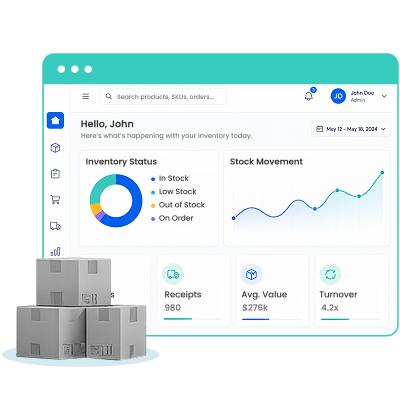
Inventory distortion (overstock, stockouts, and shrinkage) costs businesses $1.77 trillion annually. Most of that loss doesn't come from poor inventory strategy. It comes from software and systems that don't fit business needs.
Spreadsheets break at a certain scale. Generic off-the-shelf tools stop fitting once you add a second warehouse, a new sales channel, or an ERP that doesn't speak the same language. At that point, the inventory management system you're running isn't solving the problem. It's becoming part of it.
The question most businesses face isn't whether they need a system. It is whether the system they have is still the right one or the gap between what it shows and what the operation actually looks like has become too expensive to ignore.
This guide covers what an inventory management system actually does, the features that deliver measurable operational value, the types of systems available, and the clearest signal that your current setup has hit its ceiling.
Inventory management systems help businesses track stock across locations, channels, and supply chains. Features like real-time tracking, automated reordering, forecasting, barcode/RFID scanning, and ERP integration reduce stockouts, overstock, manual reconciliation, and operational delays. As businesses scale, off-the-shelf tools often become limiting. That's when a custom inventory management system delivers better value.
| Aspect | Details |
|---|---|
| What does this guide cover? | What is an inventory management system, key features and types, essential integrations, signs your current system has reached its limits, off-the-shelf vs. custom options, and where inventory systems deliver the strongest ROI. |
| Who should read this guide? | Business owners, operations managers, supply chain leaders, and IT decision-makers evaluating an inventory system |

An inventory management system is software that tracks every movement of stock across your operation. It tracks what you have, where it is, when it needs replenishing, and how it flows from supplier to customer. It replaces the combination of spreadsheets, manual counts, and disconnected tools that most businesses outgrow before they realize it.
A well-implemented system gives operations managers a single source of truth for stock levels across every location, every channel, and every stage of the supply chain. This makes inventory management more than a stock-counting function. It becomes the operational layer connecting inventory activity with purchasing, sales, warehouse operations, finance, and supply chain planning.
The impact of the wrong inventory management system goes beyond workflow friction. Here’s what it really costs to keep running on the wrong inventory management system:
These costs put the fix-versus-continue decision into perspective. The question is not simply, “How much will a better inventory system cost?” It is also, “How much is the current system costing us every year?”
In most cases, building a custom inventory management system ends up costing less than the ongoing impact of operating with a misaligned/inefficient system.
Different inventory systems offer different capabilities. But there are a few core features that are important for almost every growing operation. These are the features that actually move operational performance:
With a real-time inventory tracking system in place, every stock movement (purchase order, sale, warehouse transfer, return, etc.) updates instantly. No end-of-day reconciliation. No discrepancy between what the system shows and what's on the shelf. Without real-time visibility, every other feature in the system is operating on delayed data.
The system calculates reorder thresholds based on lead time, safety stock requirements, and demand. It then triggers purchase orders when thresholds are breached. Buyers stop managing spreadsheet formulas and start managing exceptions. This time saved on routine replenishment goes toward supplier relationships and demand planning.
Operations running across more than one warehouse, distribution center, or sales channel need a single inventory layer that serves them simultaneously. The system should show stock levels by location, enable inter-location transfers, and prevent overselling across channels.
Historical sales patterns combined with factors such as seasonality, promotions, and supplier lead times can produce more context-aware demand forecasts than relying on simple historical averages alone. Accurate forecasting positively impacts both working capital and customer satisfaction.
An inventory management system should integrate with existing business software. This includes ERP, accounting, eCommerce, CRM, warehouse, and procurement systems. Proper ecosystem integration keeps data synced and maintains consistent inventory visibility across operations.
Warehouse staff confirm receipts, pick orders, and update stock records by scanning items. This removes the need for manual updates, improves accuracy, and reduces processing time. Eventually, the gap between physical stock and system records closes.
Every stock movement, adjustment, and override is logged with a timestamp and user ID. Different roles see different data and have different permissions. For regulated industries, this is a compliance requirement. For any business, it's the foundation of accountability in inventory operations.
Important metrics (like inventory turnover rate or carrying cost) are available on live dashboards. This helps operations managers make decisions from current data, not old snapshots.
The right feature set depends on how your inventory operation works today and where it needs to scale next. So, don't focus on building the longest feature list. Instead, include the capabilities that actually improve accuracy, reduce effort, and can be integrated with your existing business systems.
"Not every system serves every business"
There are several different types of inventory management systems that fit different operational needs. The goal is to choose what fits your business, not simply what is trending or what your competitors use.
Here are the key options to choose from:
Perpetual inventory systems track every inventory transaction as it happens, automatically updating stock levels after each sale, receipt, transfer, or adjustment. They give businesses an accurate view of inventory at any point in time. These systems are a strong fit for mid-market and enterprise operations where real-time accuracy matters more than minimizing implementation costs.
Periodic inventory systems update stock levels through scheduled physical counts rather than tracking every transaction continuously. This makes them simpler and less expensive to operate. But inventory accuracy can decline between counts. They are generally better suited to very small businesses with limited SKUs, predictable demand, and low-volume stock movement.
These systems use barcode scanning to update stock records at the point of movement. They are more accurate than manual entry, without the higher implementation cost of RFID. They are a practical standard for most warehouse operations that don't require item-level serialization.
RFID systems use radio-frequency identification for bulk scanning without requiring direct line-of-sight. A reader can count every item in a zone simultaneously, which enables faster inventory processing. Though the implementation cost is higher, it is significantly faster for processing high-volume operations. It is most-used in pharmaceutical, aerospace, and high-value retail environments.
Cloud-based inventory management systems are hosted on remote servers and accessed via browser or app. No on-premise infrastructure required. Updates and maintenance are managed by the vendor, which results in lower upfront cost, faster deployment, accessibility from any location. These benefits are the reason why cloud-based inventory management systems are the default choice for most new implementations.
These systems are installed and maintained on a business’ own local servers. So, the data stays within the business's infrastructure. This results in higher upfront cost and more IT overhead, but it is preferred in industries with strict data residency requirements or where connectivity cannot be assumed.
There is no universally 'best inventory management system'. The most suitable one is the one that matches your needs in terms of inventory volume, operational complexity, integration, cost, and level of control. And in practice, these options are not mutually exclusive either. An inventory management system can combine multiple approaches, such as perpetual tracking with both barcode and RFID scanning, deployed through a cloud or on-premise environment, depending on the operation’s requirements.
So, when you develop a custom software for your enterprise base the decision on how your operation actually works, rather than just building based on features or popularity alone.
A standalone inventory system creates a data island. Its operational value compounds only when it integrates with adjacent systems. The following integrations are essential for developing a connected supply chain management ecosystem
When these systems work together, inventory data becomes more useful across the business. The result is fewer manual handoffs, better visibility, and faster, more informed decisions.
Most businesses don't realize their inventory system has become a limitation on the day it happens. They notice the symptoms first. Here are the signs you need to look out for:
Any one of these signs is worth examining. But if several of these symptoms appear together, it's worth reassessing whether the current system still fits the operation.
Not every business needs to build an inventory management system from scratch. But the opposite is also true: not every business can pick a packaged tool, configure a few settings, and call the problem solved. The right choice between custom and off-the-shelf software depends on how closely existing tools fit your operation and what you need the system to achieve.
Get a custom inventory management system built when:
Choose an off-the-shelf inventory management system when:
In practice, the choice is rarely as simple as “buy” or “build.” Many businesses get the best outcome by starting with an off-the-shelf platform and customizing the areas where standard functionality falls short.
Inventory management delivers the most value where businesses handle high stock volumes, multiple locations, complex fulfillment, or strict traceability requirements. Here are the industries that benefit the most from inventory management systems:
Manufacturers need to track raw materials, work-in-progress, and finished goods as inventory moves through multiple production stages. Integrating inventory management with manufacturing execution and production planning systems helps production teams know what materials are available, what is being consumed, and what needs replenishing, so material shortages do not disrupt production schedules. Integrating inventory with production planning also makes it easier to align purchasing decisions with actual manufacturing demand.
Retailers and eCommerce businesses often manage inventory across physical stores, online storefronts, marketplaces, and multiple fulfillment channels. A connected inventory system keeps stock levels synchronized across these channels, reducing overselling and helping teams manage channel-specific fulfillment, transfers, and returns. The value grows as the number of sales channels and locations increases.
Healthcare and pharmaceutical businesses need inventory systems built around traceability and compliance, not simply stock availability. Lot numbers, expiration dates, serial numbers, and recall information must remain accurate throughout the inventory lifecycle. A healthcare software built with these capabilities helps organizations identify affected products quickly, prevent expired inventory from being distributed, and maintain the records required for regulated operations.
Businesses in the logistics and transportation domain deal with high-volume inventory movement across warehouses, distribution centers, and other nodes in the supply chain. They need detailed, location-level visibility to track stock, monitor order cycle times, measure fill rates, and maintain healthy inventory turnover. Accurate inventory data helps teams respond faster to changes in demand and avoid delays caused by inaccurate stock information.
Food and beverage businesses have additional inventory challenges because products often have limited shelf lives, batch requirements, and specific storage conditions. Inventory systems need to track batches, expiration dates, quantities, and locations accurately while supporting first-expiry-first-out or other rotation strategies. Better inventory tracking helps food and beverage businesses reduce spoilage and waste.
In general, businesses dealing with high volumes, multiple locations, perishable goods, regulatory requirements, or complex fulfillment, benefit the most from inventory management systems that reduce waste while improving accuracy, responsiveness, and control.
Getting the Right System for Your Operation
The inventory management system market ranges from free spreadsheet replacements to enterprise platforms. The right choice depends on where your operation sits today and where it's going in the next three years. If your current system is producing reconciliation work, stockout cycles, or integration headaches that your team has learned to absorb, those are operational costs that compound quietly. An inventory management system built for your actual workflows helps eliminate them.At Radixweb, we have delivered 15+ inventory management software solutions for manufacturing, logistics, healthcare, and retail operations. We also recently delivered an ML-powered platform with advanced inventory forecasting that helped reduce stockouts by 95%. So, whether you're evaluating whether your current system has hit its ceiling or scoping what a purpose-built replacement would require, the right starting point is a conversation with a team that will tell you honestly which direction makes sense for your situation. Discuss your inventory management requirements with our experts and get a no-cost, no-obligation time and cost estimate before you invest.
Ready to brush up on something new? We've got more to read right this way.