Read More


Recognized for AI Excellence at 2026 Globee® Awards - Read More

Maitray Gadhavi
Quick Summary: Most AI applications take anywhere from 4 weeks to 24 months to reach production. But the timeline is rarely determined by coding alone. The biggest variable is data preparation, which typically accounts for 40–50% of total development effort. This guide explains realistic timelines by use case and the factors that actually determine delivery.
| Aspect | Detail |
|---|---|
| What this guide covers? | Timeline ranges by AI use case, six development phases with durations, top delay causes, acceleration strategies, regulated industry premiums, delivery pattern evidence |
| Who should read this? | CTOs, Founders, Product Managers, and Engineering Leaders setting realistic expectations before AI project scope is committed |
| TL;DR in <60 seconds | A focused AI feature integration takes 4 to 12 weeks. An AI-native application takes 4 to 12 months. An enterprise AI platform with custom model training, multi-system integration, and regulated compliance takes 12 to 24 months. Where in those ranges a specific project lands is determined almost entirely by the state of the data before development begins. |
| Read Time | 15 mins |
Nearly half of every AI project's effort (around 40–50%) is spent preparing data, not building AI. Yet most AI timeline estimates barely mention it. Instead, they promise a chatbot in six weeks or an AI app in three months without explaining the assumptions behind those numbers. The reality is that AI projects can take anywhere from 4 weeks for a focused chatbot to 24 months for an enterprise AI platform. And the biggest factor isn't model selection or coding, it's data readiness.
This guide breaks down what an AI development timeline actually includes, why it differs from traditional software development, and realistic delivery timelines for the most common AI use cases based on our experience and industry benchmarks.

An AI development timeline covers the entire journey from discovery and data readiness to model integration, testing, deployment, and production validation.
Traditional software projects schedules and timelines are driven by coding and feature development. But AI projects are heavily influenced by data. Before a model can generate reliable results, teams need to collect, clean, structure, label and connect data to the system. All this is work that has no true equivalent in conventional software development. That's why two AI projects with similar feature sets can have vastly different timelines depending on the state of their data.
AI development timelines vary by use case, but they follow clear delivery patterns. While every project has unique variables, these ranges provide a realistic starting point for planning.
| AI Project Type | Data-Ready | Data Prep Required | Primary Driver |
|---|---|---|---|
| AI chatbot (foundation model + RAG) | 4-8 weeks | 8-14 weeks | Knowledge base quality |
| AI feature integration (single workflow) | 3-8 weeks | 6-14 weeks | System API availability |
| AI MVP (one primary AI function) | 8-14 weeks | 12-22 weeks | Data pipeline complexity |
| Predictive analytics platform | 10-18 weeks | 18-32 weeks | Historical data volume and quality |
| RAG document intelligence | 6-12 weeks | 10-20 weeks | Document quality and volume |
| Agentic AI workflow | 12-20 weeks | 18-30 weeks | Integration depth and tool reliability |
| AI-native application | 4-9 months | 7-14 months | Architecture and integration scope |
| Enterprise AI platform | 9-18 months | 14-24 months | Compliance, integrations, training data |
Estimates based on Radixweb's experience delivering hundreds of AI software projects, combined with industry benchmarks and market research.
For organizations with well-organized documentation, developing and launching a production-ready AI chatbot often takes just 4–8 weeks. The biggest variable here isn't the model but the knowledge base. If documents need to be cleaned, reorganized, or enriched before they can support reliable retrieval, projects can stretch to 8–14 weeks.
AI integration is usually faster than building a new product because the base already exists. Integrating AI into well-documented systems take 3–8 weeks. Legacy architectures with undocumented APIs or tightly coupled business logic can push delivery to 6–14 weeks.
An AI MVP designed to validate a single business use case generally takes 8–14 weeks. This is when production-quality data is already available. If the team must first collect, clean, label, or engineer data, expect the timeline to grow to roughly 12–22 weeks. It is also important to understand here that the time it takes to plan, develop, and ship an MVP cannot be extrapolated to come to a timeline for full-version product development. That’s because a lot of factors that are not included in MVP development are to be taken care of during product development.
Unlike generative AI projects, predictive analytics lives or dies by data quality. With reliable historical datasets, most platforms take 10–18 weeks to build. Organizations dealing with fragmented data, extensive feature engineering, or multiple data sources should plan for 18–32 weeks instead. Proper predictive analytics consulting with experts further helps narrow down the gap between the expected and actual timelines.
A typical RAG implementation takes 6–12 weeks. This is based on the assumption that documents are reasonably structured and searchable. Timelines increase to 10–20 weeks when teams must first normalize large repositories, handle multiple file formats, remove duplicate content, or improve document quality before indexing.
Agentic AI projects involve much more than prompting an LLM. They orchestrate actions across business systems. Designing and implementing Agentic AI workflows can be done within 12–20 weeks. But multi-agent architectures, external tool integrations, and autonomous decision logic often extend development to 18–30 weeks.
When AI sits at the heart of the product (not just as a feature) development typically takes 4–9 months. Larger enterprise-grade AI application development that covers scalable infrastructure, sophisticated user experiences, and numerous integrations can take anywhere from 7–14 months before being production ready.
Enterprise AI platforms are long-term transformation initiatives rather than standalone software projects. Organizations with mature data foundations often reach production in 9–18 months. For deployments spanning multiple business units, those with strict compliance requirements, or enterprise-wide integrations, timelines can extend to 14–24 months
Every AI project - whether you are building an internal copilot, an AI SaaS, or enterprise-grade automations - follows a broadly similar development lifecycle. What changes from one project to another is the effort each phase demands. Understanding where time is actually spent helps set realistic delivery (and cost) expectations. It also makes it easier to find opportunities to accelerate time-to-market.
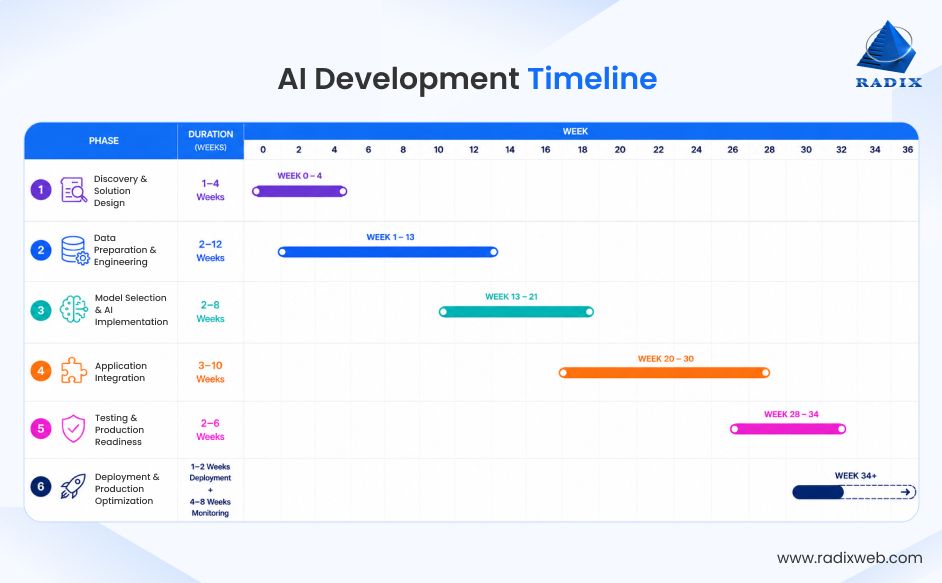
Time: 1–4 Weeks
This phase lays the foundation for the entire project. The team defines business objectives, prioritizes the most impactful AI use cases, maps existing systems, identifies technical dependencies, and evaluates whether the proposed solution is feasible.
One of the most important activities during this phase is assessing data readiness. The goal isn't to clean the data yet. It is just to understand what is available, where, whether it's suitable for AI, and what preparation is needed. Projects that skip this step discover hidden challenges during production, making timelines far less predictable.
Output: Solution architecture, data readiness assessment, project roadmap
Time: 2–12 Weeks
Once the discovery is complete, the focus shifts to preparing the data that will power the AI system. This is often the longest and most variable phase because every AI model is only as good as the data it receives.
The work typically includes consolidating data from multiple sources, removing duplicates, handling missing values, standardizing formats, enriching datasets where required, and building automated pipelines that continuously feed data into the AI application. Organizations with clean, centralized data may complete this phase within a few weeks. Businesses relying on fragmented legacy systems should expect considerably more time.
Output: Clean datasets, data pipelines, standardized data, feature-ready datasets, data quality report
Time: 2-8 Weeks
With the data foundation in place, the next step is selecting the AI model and implementing the intelligence.
For most enterprise use cases, this means configuring and fine-tuning a pre-trained foundation model using domain-specific data and prompts. The objective during this phase is to establish a model that consistently meets the defined performance and business expectations before it's integrated into the application.
Output: Configured AI model, baseline performance metrics, validated AI workflows
Time: 3-10 Weeks
An AI model creates value only when it's connected to the systems employees and customers already use. This phase focuses on integrating the AI capabilities with existing business systems. It can be everyday applications, databases, authentication systems, APIs, workflows, or user interfaces.
Timeline variations are usually driven by the complexity of the existing technology landscape. Modern platforms with well-documented APIs integrate relatively quickly. Integrating AI into existing legacy systems or custom middleware requires additional engineering effort.
Output: Integrated AI services, API connections, AI-enabled user workflows, secure authentication
Time: 2-6 Weeks
Unlike traditional software testing and quality assurance, AI systems cannot be validated with simple pass-or-fail test cases. They must be evaluated across a wide variety of real-world scenarios. This is important to ensure their responses are accurate, reliable, secure, and consistent.
This phase includes functional testing, AI output validation, performance testing, user acceptance testing, and security verification. For regulated industries, it also covers compliance validation, audit readiness, and governance checks.
Output: Tested application, accuracy validation report, performance benchmarks, security & compliance sign-off, UAT approval
Time: 1-2 Weeks for Deployment, Followed by 4-8 Weeks of Monitoring
Deployment marks the beginning of real-world learning, not the end of development. Once the AI software solution is live, production usage reveals edge cases, user behavior patterns, and optimization opportunities.
The initial monitoring period focuses on tracking model performance, improving prompts or workflows, resolving production issues, and ensuring the system continues to meet business expectations as usage grows.
Output: Production deployment, monitoring dashboards, performance insights, model optimization plan, stable production environment
No two AI projects spend exactly the same amount of time in each phase. Some move quickly through data preparation and spend more time on integrations. Others require extensive compliance validation before deployment. What remains consistent is that organizations that invest adequate time and resources during enterprise AI implementation experience fewer delays, lower rework, and far more predictable delivery timelines than those that rush into development
Most AI project delays don't happen because teams underestimate how long it takes to build AI. They happen because seemingly small planning decisions create problems that surface later. Based on our experience and broader industry patterns, we see the same five patterns behind most timeline overruns. The good news? Every one of them is preventable if you know what to look for.
Many teams assume their data is usable because it already exists. The reality often looks very different. There are missing records, inconsistent formats, duplicate entries, and disconnected systems. By the time these issues surface, development is underway and timelines begin to slip.
To avoid it: Conduct data readiness assessment before finalizing scope and timelines.
AI projects naturally uncover new possibilities. A chatbot can answer more questions than expected. A prediction model identifies another valuable use case. Individually these requests seem harmless. Together they can extend delivery by 30–50%.
To avoid it: Lock the MVP scope early and evaluate new ideas in future releases instead of the current sprint.
Connecting AI to existing applications is often where projects slow down. Legacy systems, undocumented APIs, third-party limitations, and unexpected data dependencies rarely become obvious until implementation is underway.
To avoid it: Validate integrations and system dependencies during discovery, not development.
An AI model may perform well in testing but struggle with real queries and production data. Improving accuracy after deployment requires additional tuning, testing, and workflow changes that weren't part of the original estimate.
To avoid it: Test with representative production data and define success criteria before development starts.
In regulated industries, compliance isn't a launch checklist. It influences architecture, integrations, security controls, auditability, and testing from the very beginning. Retrofitting these requirements later almost always means redesigning work that's already complete.
To avoid it: Treat compliance requirements as architectural inputs, not post-development validation.
None of these delays are inevitable. They are planning risks, not technical limitations. Address them early, and your AI project is far more likely to stay on schedule, on budget, and ready for production when expected.
Every business wants a shorter AI development timeline. But most decision makers assume that the way to do that is by reducing scope or skipping engineering work. In practice, the fastest AI projects aren't the ones that cut corners. Instead, they're the ones that eliminate uncertainty before development begins. Here are five practices that help reduce timelines without quality compromises.
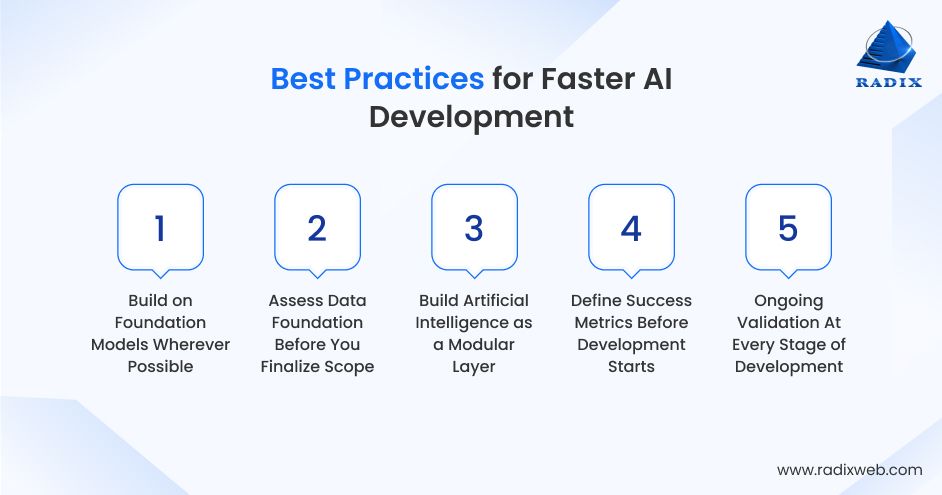
For most businesses, pre-trained foundation models like GPT-4o, Claude, or Gemini are enough. Using these models instead of training a custom model from scratch can reduce timelines by 30–50%. Custom models useful for specialized data, edge deployment, or when economics justify efforts.
Data issues discovered during development are the biggest causes of project overruns. Pre-project data assessment helps identify quality gaps, integrations, and pipeline complexity before timelines are committed. Spending 1–3 weeks on assessment can save months of rework later and help compress timelines.
Treat AI as an independent service rather than embedding it deep within your system. Modular architectures allow AI components to be developed, tested, and rolled back independently and safely, without affecting the core product. This reduces development risk while speeding up delivery.
"Make the AI accurate" isn't a measurable requirement. Define target metrics (response accuracy, latency, hallucination rate, false-positive thresholds) before development begins. Clear acceptance criteria reduce unnecessary iteration. It prevent projects from drifting because no one knows when the AI is "good enough."
Testing AI only before deployment creates expensive surprises. Validate data pipelines, model outputs, integrations, and user workflows throughout development. It helps identify issues while they're still inexpensive and faster to fix. Continuous validation shortens feedback loops and keeps the project moving without last-minute delays.
Faster time-to-market creates value only when your AI solution is reliable enough. So, don't cut essential engineering to get an AI project into production sooner. Instead, adhere to realistic timelines that ensure security, stability, and scalability.

Two AI projects can have the same feature list and use the same programming language for AI development, and still have different timelines just based on the regulatory requirements that shape how the system is designed, integrated, tested, and deployed. In regulated industries, compliance isn't a final review before launch. It becomes part of the architecture from the first sprint. That additional engineering work extends the timeline.
Here's how AI software development timeline varies across three regulated environments:
| Industry | Timeline Extension | What Takes Extra Time | Example Timeline |
|---|---|---|---|
| Healthcare | 30–40% | HIPAA technical safeguards, PHI encryption, role-based access controls, audit logging, Business Associate Agreements (BAAs), security validation, compliance testing | Standard AI MVP: 8–14 weeks HIPAA-compliant AI MVP: 11–20 weeks |
| Financial Services | 40–60% | PCI-DSS controls, SOX audit trails, AI explainability, data lineage, governance, risk validation, compliance testing | Standard AI Platform: 9–18 months Financial AI Platform: 14–29 months |
| Legal | 20–35% | Confidential data protection, document-level permissions, secure retrieval, audit trails, human review workflows, validation of AI-generated outputs | Standard AI Assistant: 10–16 weeks Legal AI Assistant: 12–22 weeks |
The important takeaway here is that these additional weeks are not contingency buffers. They represent real engineering work required to build AI systems that satisfy regulations. Planning for that effort early results in more predictable timelines, lower implementation risk, and far fewer architectural changes once development is underway.
These projects show that AI timelines are driven less by the use case itself and more by data readiness, integration complexity, and model strategy.
Timeline: 8 weeks
Built on an existing HR recruitment platform, this GPT-powered chatbot automated candidate screening and routine recruitment tasks. Because the workflow data was already structured and only a pre-trained foundation model needed domain adaptation, the project moved quickly without custom model training.
Outcome: Automated 70% of operational tasks and improved recruitment turnaround time by 3×.
Timeline: 10 weeks
This Azure-based RAG solution connected to legacy document repositories enables natural language search. While the documents required indexing and vectorization, the repository was already organized and well-defined, significantly reducing preparation time.
Outcome: Achieved 97% query interpretation accuracy while lowering infrastructure costs by 40%.
Timeline: 12 weeks
An AI layer was integrated directly into an existing meeting platform to generate summaries, capture action items, and process transcripts in real time. Since transcripts were created live, there was no historical data backlog to clean or migrate.
Outcome: Reduced follow-up time by 3× and achieved a 97% user satisfaction score.
Despite solving different business problems, all three projects stayed on schedule for the same reasons: data readiness was validated before development began, the implementation built on existing systems, and pre-trained foundation models were used instead of custom model training. These factors consistently have a greater impact on delivery timelines than the AI use case itself.
No vendor can accurately estimate an AI project from a feature list alone. The quality of the estimate depends on the quality of the information available. Before requesting proposals or comparing vendors, answer these three questions.
Data readiness has the biggest impact on AI development timelines. If your data is clean, well-structured, and readily accessible, the project is far more likely to stay within the lower end of the estimated timeline. If you haven't assessed its quality, do that before committing to scope or budgets.
Most business AI applications can be built on foundation models, reducing model development time by 30–50%. Consider a custom model only if your use case has specific technical, regulatory, or performance requirements that pre-trained models cannot satisfy.
If your AI solution will process regulated data (such as healthcare, financial, or personal information) compliance requirements should shape the architecture from day one. Building them in early is faster and cost-effective than redesigning the system later.
These questions won't replace technical discovery. They'll determine whether your project starts with realistic expectations or expensive assumptions.

Build AI on a Timeline That Fits Your Business Goals
AI project timelines become predictable when the right questions are answered before development. Data readiness, integrations, and compliance requirements have the most impact on how long a project takes to complete. And teams that validate these variables upfront are much more likely to launch on time. What’s also important to remember here is that the goal overall, shouldn't be the shortest timeline for developing and launching an artificial intelligence software. It should be a realistic and achievable timeline built around the realities of your business.That's exactly how Radixweb approaches AI delivery. With 26+ years of engineering experience, 4,500+ successful project deliveries, and expertise spanning enterprise AI, data engineering, cloud, and application modernization, we help organizations build AI solutions with realistic timelines and accelerated delivery strategies. Without compromising quality, scalability, or governance. Every engagement starts with a no-cost, tailored development time and cost estimates, based on your specific requirements, not generic industry averages. Planning an AI initiative? Schedule a no-cost, no-obligation consultation to get accurate timeline estimates before you start.
Ready to brush up on something new? We've got more to read right this way.