Read More


Recognized for AI Excellence at 2026 Globee® Awards - Read More

Nihar Raval
The Hard Truth About AI Agents: The real AI agent deployment challenges aren't just slowing down work; they are leaking revenue. This guide covers the most pressing enterprise AI agent deployment challenges across integration, security, compliance, data, cost, and lifecycle management, along with six best practices to deploy with control. Read on.
The global AI agent market is projected to grow from $7.84 billion in 2025 to over $52.62 billion by 2032. That’s a 46.3% CAGR. By the end of 2026, Gartner expects 40% of enterprise applications to be integrated with task-specific AI agents. That’s up from under 5% in 2025.
This speed without foundation is expensive though. Latest data and statistics around artificial intelligence also predict that even though 57% of organizations have adopted AI agents in the past 2 years, over 40% of these projects will be cancelled by the end of 2027. Why? Due to escalating costs, unclear business value, or inadequate risk controls.
Moreover, over 80% of technical teams have agents in testing or production, yet only 14.4% were launched with full security and IT approval. The gap between deployment velocity and deployment readiness is where most enterprises lose.
But this gap can be closed. Yes, the challenges are real, but so are the solutions. Below we walk you through the most pressing challenges and best practices to tackle those.
Here’s a quick summary of the most pressing enterprise AI agent deployment challenges and how you can tackle them.
| Challenge Category | Core Issue | Strategic Response |
|---|---|---|
| 1. Integration & System Complexity | Fragmented systems, legacy incompatibility | Bounded scope, modular integration design |
| 2. Security & Control | Prompt injection, privilege escalation | Zero Trust architecture, session-scoped permissions |
| 3. Compliance & Governance | Regulatory gaps, absent audit trails | Compliance-as-architecture, policy enforcement at build |
| 4. Data Quality & Privacy | Inconsistent data, retention obligations | Data readiness audits, privacy-by-design |
| 5. Scalability & Cost | Token cost overruns, pilot-to-production failures | Full lifecycle cost modeling, MLOps integration |
| 6. Lifecycle Management | Model drift, version control gaps | Continuous monitoring, retraining pipelines |
Let’s discuss these challenges and best practices to mitigate those in detail below.
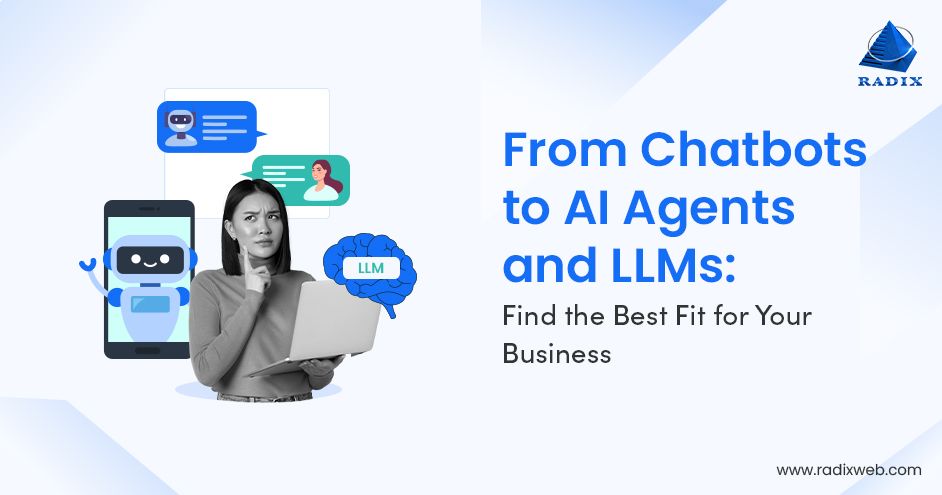
To understand why enterprise AI deployments fail, we first have to clear up a common industry misconception. AI agents, Large Language Models (LLMs), and chatbots are often used interchangeably, but treating them as the same thing is exactly how projects run into trouble.
Once you understand how AI agents differ, it becomes easier to understand the specific challenges in deploying them and ultimately tackling those.
Below we mention enterprise AI agent deployment challenges that aren't edge cases, but patterns that appear consistently across industries and use cases.
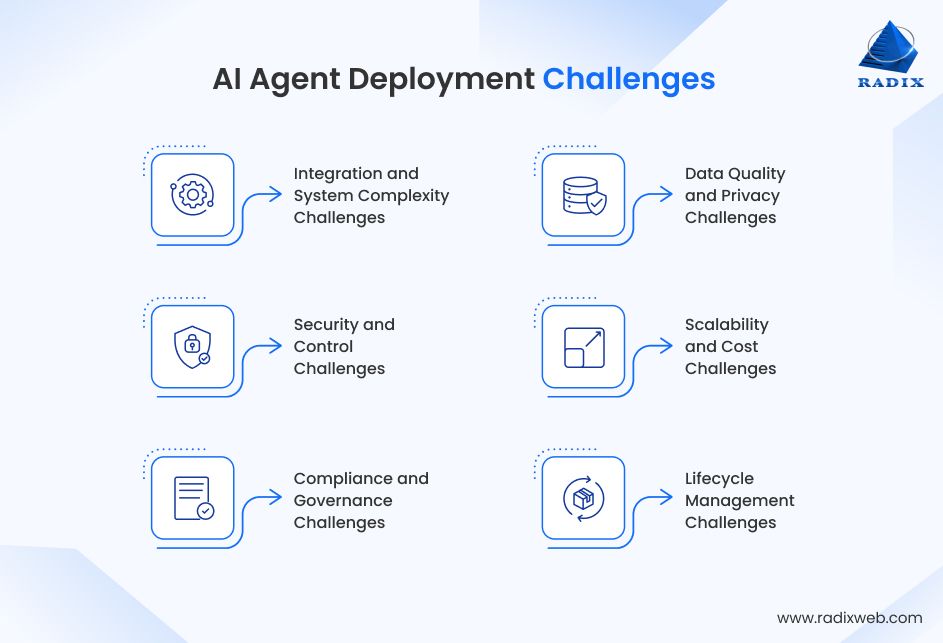
Managing system complexity when developing and deploying AI agents is consistently underestimated at scoping and consistently overrun at build. Enterprises don't run on clean and modern stacks; agents usually have to operate within decades of layered systems.
Most enterprise environments include systems that don't expose clean APIs. There are ERP platforms, proprietary databases, and on-premise infrastructure that predate modern integration standards. Replacing legacy systems with AI-first systems is a long-term play though. In the short term, you need workarounds for the challenges of integrating AI agents into existing systems. That usually means using custom connectors and significant engineering overhead that rarely appears in initial estimates. One incompatible dependency can stall an entire deployment.
When multiple agents coordinate tasks and share state, the orchestration layer becomes a system in itself. Each handoff is a potential failure point. The AI agent integration challenges in multi-agent orchestration are frequently more complex than the individual agent logic, and they're difficult to reproduce and diagnose after the fact.
Tight integration design from the start isn't optional. Without it, system complexity doesn't slow deployment; it puts a stop to it.
The security challenges in AI agent deployment aren't theoretical. Agents operate with real permissions, call real tools, and process untrusted inputs. The attack surface is larger than most security teams initially scope for.
Prompt injection ranked as the top vulnerability on OWASP's 2025 LLM Top 10. When an agent retrieves external content and acts on it, a single injected instruction can cascade through an entire workflow, triggering unintended tool calls or exfiltrating data. The security risk in deploying AI agents is that the attack vector is the agent's core function.
Agents typically get broad access during development and are never scoped before production. This creates significant AI agent deployment security and compliance issues in regulated environments. Compounding this: business units deploying agents outside IT visibility create exposure that only surfaces during an incident or audit.
The only effective response to these security challenges in AI agent deployment is architecture, not monitoring after the fact.
Compliance issues when deploying AI agents are not downstream legal problems. They are upstream architecture decisions. Organizations that treat compliance as a post-deployment audit consistently find themselves rebuilding systems under regulatory pressure.
The EU AI Act's broad enforcement begins August 2026, with fines reaching €35 million or 7% of global turnover. Most enterprises deploying agents today haven't fully mapped their workflows to applicable frameworks. That’s a gap that becomes a liability the moment an audit or incident occurs.
AI agent monitoring and auditing challenges are fundamentally a governance problem. Without complete logs of what an agent decided, what data it accessed, and what actions it took, compliance demonstration is impossible, and incident investigation is guesswork. Building audit infrastructure after the agent is live is significantly more expensive than designing it in from the start.
Compliance built in from the start makes enterprises move faster at scale because they don't have to stop and rebuild.
AI agent data quality challenges and AI agent data privacy challenges are two sides of the same problem. Agents are only as reliable as the data they operate on, and every source they touch creates a privacy obligation.
Agents acting on poor data don't just produce wrong outputs; they take wrong actions at scale. Siloed, inconsistently formatted data creates compounding errors in autonomous workflows. The only way to ensure reliable agent operations is to break the siloes during AI data transformation and avoiding a parallel workstream.
Agents with persistent memory introduce obligations most legal teams haven't fully resolved. Stored embeddings may constitute personal data under GDPR. Without explicit governance on what an agent retains, for how long, and how it can be deleted, memory results in AI agent data privacy challenge and a liability, particularly in healthcare and financial services environments.
AI agent scalability challenges and AI agent deployment cost management failures follow a predictable pattern: the pilot works, the production deployment costs multiples of what was budgeted, and the ROI case collapses.
Multi-step workflows make multiple LLM calls per task. At pilot scale, costs are manageable. At production scale, inference costs can exceed the budget of the entire process being automated. This is one of the primary reasons AI initiatives fail before delivering value.
Scaling an agent reliably requires redundancy, failover logic, and graceful degradation design, none of which can be added after the fact without significant rearchitecting. The AI development cost for production-grade reliability is consistently underestimated when budgets are set at prototype stage.
AI agent lifecycle management challenges emerge after a successful launch. Models drift. Real-world conditions change. Systems for the agent depends on getting updated. Without lifecycle infrastructure, a well-deployed agent degrades silently.
Agent performance degrades as real-world data distribution shifts from what the model was trained on. Without continuous evaluation of pipelines, performance erosion goes undetected until it causes a visible failure. The ML governance disciplines that apply to traditional ML models apply with equal force to agent systems.
When an underlying model is updated by a provider, or a dependent API changes, agent behavior can shift without any change to the agent's own code. Enterprises without version control on agent configurations and prompt templates have no reliable way to isolate what changed or roll back to a known-good state.
Deploying an agent is the beginning of an operational commitment, not the end of a project.
Responsible use of enterprise AI is the key to successful agent deployment. Below, we highlight six practices that, applied together, address the full range of challenges above.
Define the agent's permission scope, decision authority, and escalation paths in the architecture, before deployment. Not improvised in production.
How Radixweb does it: Our AI agent development engagements begin with an autonomy envelope. We set a defined boundary of what the agent is permitted to do and under what conditions. This shapes every subsequent architectural decision.
AI agent deployment best practices for security require Zero Trust applied at the agent level — verify explicitly, use least privilege, assume breach.
How Radixweb does it: When integrating artificial intelligence with existing software and systems, we always include security architecture review as a mandatory project phase. By deploying AI agents securely in enterprise environments, we ensure security is never retrofitted.
Identify applicable regulations, design for them, and build audit controls into the architecture from day one.
How Radixweb does it: Before we discuss your AI agent deployment, we conduct in-depth sessions around data governance where we walk you through AI agent governance best practices. For us, these are actual technical controls, not just policy documents written after deployment.
Agents operating on unvalidated data take wrong actions that can have far reaching impact. A data readiness audit before integration is non-negotiable.
How Radixweb does it: We offer unified and collaborative data, AI, and ML solutions, which helps avoid silos. By involving data teams from the get-go, we ensure AI agent data quality challenges get addressed before they become production incidents.AI agent data quality challenges get addressed before they become production incidents.
Pilot costs are not production costs. Yes, the delaying AI adoption has its own cost today, but so is scaling without a financial model that reflects production reality.
How Radixweb does it: All our engagements around the automation of intelligent agents or business workflows include a cost architecture phase that models full lifecycle expenses, not just build costs.
An agent without monitoring is a system you can't trust, audit, or improve.
How Radixweb does it: We discuss continuous evaluation and rollback capacity for enterprise agent deployments not when things go wrong, but right in the consulting phase of buidling your MLOps strategy. With that, we can solve AI agent monitoring and auditing challenges right at the infrastructure level.

The Foundation Determines the Outcome: Building AI Agents Right
The trajectory for enterprise AI agents is not in question. What is in question is whether organizations build the governance, security, and infrastructure to capitalize on it. Enterprises that treat AI agent deployment risk management strategies as foundational will compound advantages as capabilities advance. Those that don't, will keep cycling through failed pilotsAt Radixweb, we have the architectural and technical experience of developing large-scale and custom enterprise AI solutions. We have also delivered successful AI agents built around security, compliance, and lifecycle management, which helps us understand potential challenges and architect systems around them. So, if you are planning to go agentic, schedule a no-cost consultation with our AI developers and discuss the right next steps.
Ready to brush up on something new? We've got more to read right this way.