Read More


Recognized for AI Excellence at 2026 Globee® Awards - Read More

Dhaval Dave
Your Software Needs to DO, Not Just Assist: AI budgets are climbing. But ROI isn't. Why? Because most businesses are just bolting AI onto software, instead of going agentic. This blog covers the role of AI agents in business software development, what they can and can't do, best practices, and why acting now beats waiting.
AI investment is at an all-time high. According to the latest market data and insights about AI, global enterprise AI spending crossed $200 billion in 2025. Yet most business leaders are not seeing measurable ROI from their AI investments.
The reason is architectural, not aspirational. Most organizations are still implementing AI at the edges. Think: a dashboard that summarizes data, a search bar that's gotten smarter, or a chatbot bolted onto a portal. These are assistance layers that don't change how the software works.
That gap is exactly what AI agents in software development close. An AI agent embedded inside your software doesn't wait for a user to ask it something. It reads inputs from the system, reasons over them, and takes action. Autonomously. But within defined boundaries.
This matters now because your end users’ expectations have shifted from software that ‘assists’ to software that ‘does’. In fact, agentic AI is one of the many trends in the software development landscapes that leaders can no longer afford to treat as a future priority. Read on to see what steps you need to take now.
An AI agent is a software component that perceives inputs from its environment, applies reasoning to decide what to do, and executes an action. All without a human initiating each step. The role of AI agents in software development is not to replace the development process itself. Instead, it acts as autonomous, task-executing modules embedded inside the products being built.
Three things define an AI agent:
The distinction that matters most here is that an embedded AI agent is native to the software. It doesn't sit beside the product, but functions as part of it. That changes how you design for it, how you integrate it, and how you measure its value.
Important: AI agents are often confused with chatbots and even LLMs, but the three differ vastly.
The enterprise use of AI agents in software development is accelerating fastest in industries where high-volume, judgment-adjacent work has historically required large teams. Some of the top use cases across industries include:
| Industry | Key AI Agent Use Cases |
|---|---|
| HR & Talent Acquisition Software | ● Resume screening & candidate scoring ● Automated first-contact emails ● IT provisioning coordination ● Day-one scheduling ● Follow-ups on incomplete paperwork |
| Healthcare Platforms | ● Insurance pre-authorization checks ● Clinical note transcription & structuring ● Patient follow-up scheduling ● Handling unreachable patients ● Workflow coordination across care teams |
| Legal & Compliance Software | ● Contract clause analysis & flagging ● Missing terms detection ● Regulatory change monitoring ● Compliance gap identification ● AI-assisted legal document drafting |
| Financial Services Software | ● Transaction monitoring for fraud ● Loan pre-qualification assessments ● Credit data analysis ● Compliance monitoring ● Regulatory deviation alerts |
| ERP & Supply Chain Systems | ● Inventory stockout prediction ● Automated purchase order generation ● Demand anomaly detection ● Procurement quote comparison ● Pricing anomaly flagging |
| E-Commerce & Retail | ● Customer service query handling ● Returns processing ● Complaint triage ● Multi-warehouse inventory coordination ● Dynamic pricing optimization |
The common thread across all these use cases is that AI agents are not making final decisions in high-stakes scenarios. They are eliminating the work between a trigger and a human decision. As a result, they compress cycle times, reduce error rates, and free people to focus on judgment not administration.

To achieve success with AI agents, the first step is to understand the category of tasks they handle well. Here’s what AI agents are competitive at:
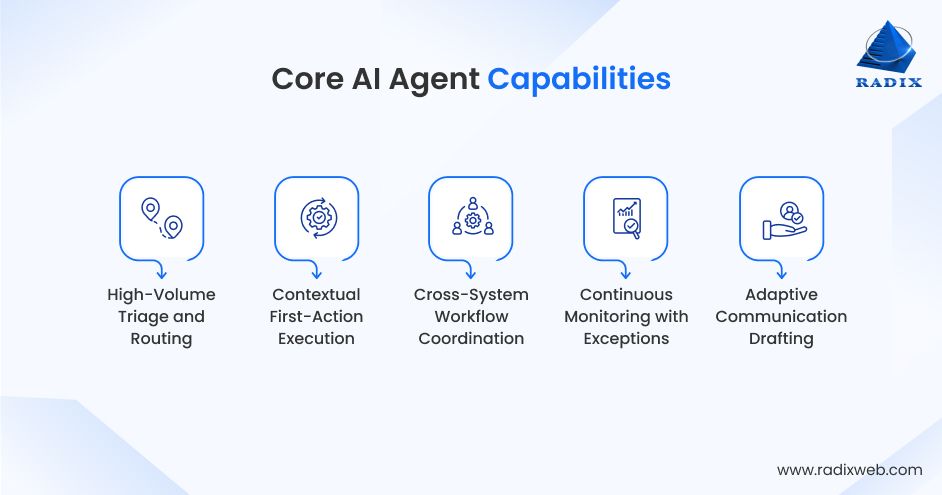
AI agents can process large volumes of inputs against defined criteria and sort them into actionable categories. The intelligence lies in reading unstructured inputs and mapping them to outcomes. This is the foundation of how AI agents help software development teams build products that handle volume without headcount.
An agent can take the first action in a workflow based on context it reads from the system. This is where the benefits of AI-driven process automation services for enterprises compound: the first action is taken before a human has been notified the task exists.
With enterprise-grade generative AI implementation solutions, agents can read from one system and write to another. For example, pull a customer record from a CRM, check inventory, and generate a proposal. These tasks, which required a human to navigate three tools, take seconds with agentic AI software. This is one of the top benefits of using AI agents in business software.
Agents don't need to be triggered. Agentic AI systems understand context, not just conditions. This is the difference between an agent that flags a payment as 'above threshold' and one that flags it as 'inconsistent with this vendor's historical pattern.'
AI agents go way beyond what you get by just developing an AI-powered chatbot. They can draft communications that reflect the system's knowledge of the recipient, the history, and the appropriate register.
With these benefits of AI agents in software development, it is clear that the time to invest is now. But it is also important to understand its limitations.
The reason why AI initiatives often fail is almost never the tech and often the misaligned expectations. Here are some of the limitations of AI agents in software development that you should know about before starting.
An agent operating on incomplete, inconsistent, or poorly structured data will make poor decisions with high confidence. This is a data architecture problem, not a model problem. The challenges of using AI agents in development almost always start here: teams underestimate how much data prep is needed before agents can operate reliably.
Agents perform well in common cases that resemble what the model was trained on. In edge cases, (unusual structures, policy exceptions, or ambiguous situations) agents need to escalate, not guess. Every AI agent architecture for scalable applications needs a well-designed handoff. So, when confidence falls below a threshold, a human gets the task with full context, not a failed action and a log entry.
An AI agent can take a decision but a human needs to own AI decisions. The risks of AI agents in software engineering rise sharply when this boundary blurs. Systems built without a clear human-decision layer create liability exposure and fail on edge cases. Embedded AI agents should be designed to reduce the cost of reaching a decision-ready state, not to replace decision-makers.
Current agents built on LLMs operate within context limits. Workflows that require synthesizing hundreds of documents simultaneously, or agents that need to recall every customer interaction over three years, require deliberate architectural choices like RAG, memory layers, or structured summarization. But this is a solvable problem that needs to be designed for, not assumed.
Integrating artificial intelligence into existing systems includes interactions with legacy codebases, fragmented APIs, inconsistent data schemas, and security constraints that weren't designed with agents in mind. This is one of the core challenges of using AI agents in development in enterprise environments that needs careful planning.
Most best practices for AI agents in development are less about the model and more about the design decisions made before the model is chosen. Here's what drives success when building an enterprise-grade AI system.
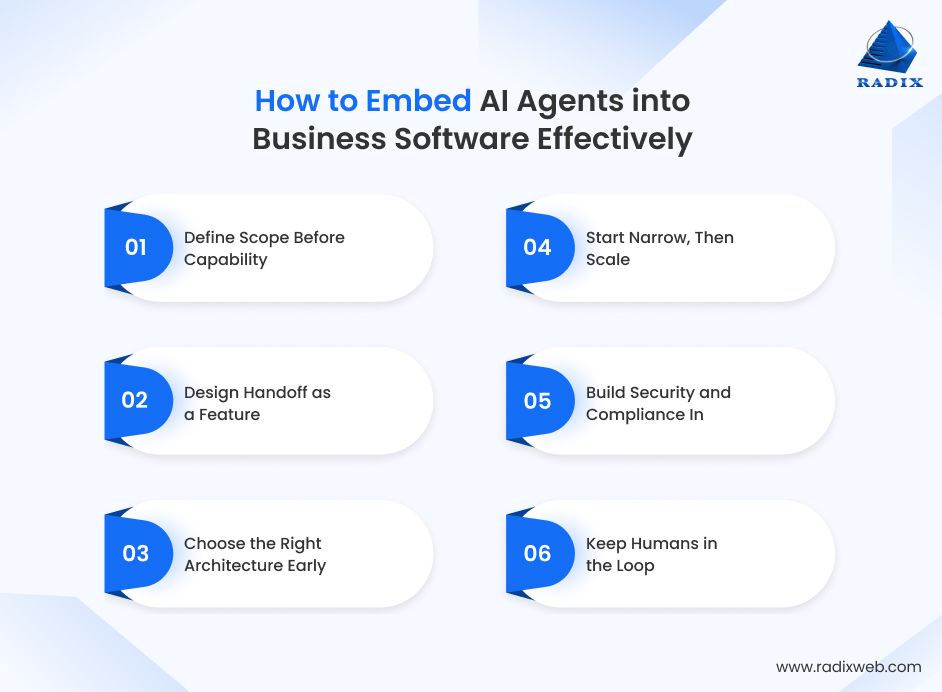
Start with the task, not the technology. Ask yourself questions like:
Starting with a narrow, well-defined scope delivers more reliably and is safer to deploy than a broad agent with fuzzy boundaries.
Every embedded agent needs a designed escalation path. Your system should have ready answers for:
Human-in-the-loop review is not a failure mode but a first-class product feature. The best AI agents for developer productivity and end-user value have human escalation paths as carefully designed as the automation path.
The software development technology stack and AI agent architecture for scalable applications should follow task requirements, not developer familiarity. Whether the agent needs a fine-tuned model, a prompt-engineered LLM, a retrieval-augmented pipeline, or a hybrid setup depends on the workflow. The process of developing a software solution needs to include these decisions early on.
Scaling AI prototypes with custom software development works best when the initial agent is high-frequency and lower-stakes. With that, the value is immediate, the risk is contained, and the production learnings are real. The benefits of AI agents in software development compound faster when you start narrow and expand with evidence.
The risks of AI agents in software engineering multiply significantly when security is treated as a post-launch concern. Security and compliance conversations should happen before the first line of code is written. Agents that access sensitive data need access controls, audit trails, and regulatory compliance requirements baked into the architecture.
This level of foresight doesn’t happen by accident, but comes from structured thinking established early in a successful software development initiative.
The goal is not full autonomy but optimal autonomy. Define explicitly which decisions the agent makes alone, which it makes and logs for review, and which it flags and waits on. AI agents in software development deliver the most durable value when the human-machine boundary is deliberate, documented, and revisited as the agent's performance improves.
Embedding an AI agent in your software comes with a cost. But the cost of delaying the adoption of AI is also concrete and compounding. Every quarter a business waits to embed agents into its software, a competitor with leaner operational costs and faster decision cycles is widening the gap.
The investment in developing an AI agent for business depends on three drivers.
With that, it is clear that building a custom software solution with embedded agents is not a fixed-cost exercise.
A single, narrow agent in a well-defined workflow with clean data can reach production in 8–12 weeks, typically costing $25,000–$80,000.
A multi-agent system with complex integrations and orchestration takes 3–6+ months, with costs ranging from $100,000 to $300,000+ (and higher at enterprise scale).
So don’t ask 'how much does AI agent development cost?' Instead, ask, 'what does this cost relative to the headcount doing this work today, and what does waiting another two quarters cost in competitive positioning?'

Your Next Step: Embedding AI Agents with Radixweb
The window to move from AI experimentation to AI differentiation is narrowing. Businesses that embed agents now are building operational advantages that are harder to replicate later. The enterprise use of AI agents in software development is no longer a forward-looking topic. It is a present-tense execution priority.At Radixweb, we’ve been developing AI agents for businesses across industries. With certified AI/ML engineers, 26+ years of custom software solutions delivery experience, and deep expertise across data, AI, and ML services, our teams cover the full lifecycle. Whether you're integrating AI into existing systems or building an agent-native platform from scratch, our specialized AI developers can deliver the solution you need.Schedule a no-cost consultation with our experts to see how we can help you turn POCs into a system that holds up in production.
Ready to brush up on something new? We've got more to read right this way.