On this page
- Chatbots, LLMs, AI Agents: What they are, How they Work, Advantages, Challenges
- Foundational and Structural Differences of Chatbots, LLMs and AI Agents
- How Should You Choose the Best AI Tool
- LLMs and AI Agents – A Core Technical Comparison
- What Does the Future Hold for Chatbots, LLMs and AI Agents?
- Radixweb Leading the Frontier with Intelligent AI Tools
- Conclusion
13 Mins Read: With a bevy of AI automation tools available in the market, business must have a solid AI implementation strategy in place – one that defines what AI tool works best for their business. While chatbots are designed to handle simple conversations, LLMs deliver intelligent context-aware content, and AI agents automate complex workflows. This guide explores each of these tools, how they work and their best use cases – so that you can make wise choices without over-complicating your strategy.
If you are one of those businesses that thought an AI chatbot could handle all user queries, until it failed its first real query comprehension – you are very likely caught in the AI maze. The market is flooded with conversational AI chatbots, enterprise-scale AI agents and LLMs.
To find out which AI integration works best for your business workflow and delivers performances aligned to your expected outcomes, you must explore them in detail. This piece is crafted with crucial details on what each tool is, where they work best and, most importantly, where they fit into your business. Because these tools, when misimplemented, do not just impact your ROI, they do not just slow you down – your customer satisfaction takes the biggest, direct hit.
Let’s help you choose better –
Understanding the Technologies - Chatbots, AI Agents and LLMs
There’s no one-size-fits-all in artificial intelligence. Although many business leaders put AI agents, chatbots and LLMs in the same bucket, they are foundationally different. And that’s what gives them three distinct personalities.
Succeeding in enterprise-scale AI innovation is a tricky game. However, this guide is equipped with all the insights you need, give it a quick read.
What Are Chatbots: Your First level of Customer Interaction
Conversational AI chatbots are designed to carry out rule-based conversations, they are the first face your customers see. From greeting visitors, to handling basic, routine tasks like call scheduling, verifying order status etc. – they are quick to deliver ground-level information.
How Do Chatbots Work?
AI chatbot development integrates rule-based logic or NLP models for responding to predefined queries.
Why You’ll Need Them?
- Easy to deploy and cost-effective
- First-level automation for basic queries
- Keep customers engaged with swift responses
What’s the Catch?
Chatbots aren’t meant for deep conversations. When it comes to quick fixes, they respond in seconds. But they aren’t meant for in-depth conversations. Cases that require deep comprehension are passed on to human agents.
Real-world example:
A chatbot can help you track your Uber Eats order but if that order doesn't reach your doorstep in time, the chatbot will just respond with generic, templated responses, leading to longer wait times and increased frustration.
Prominent Benefits of Chatbots for Business:
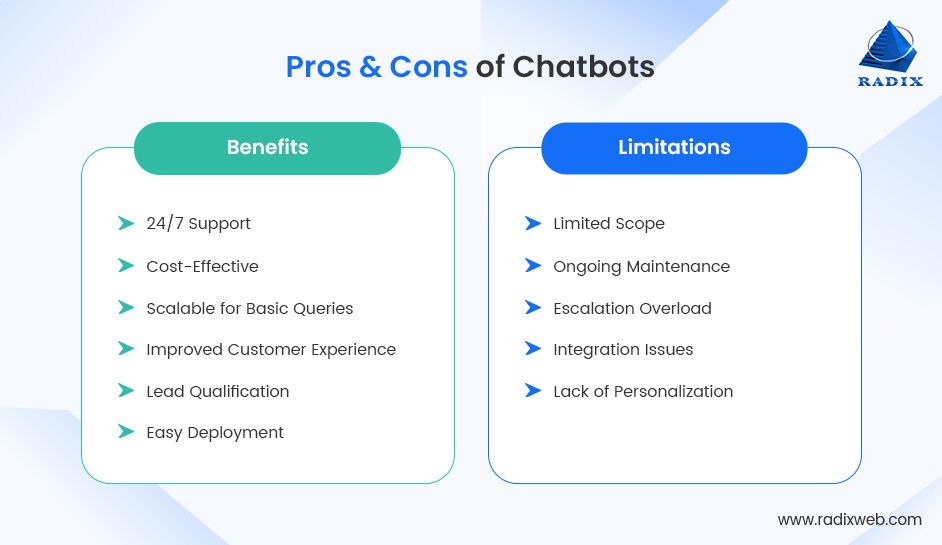
- 24/7 Availability: Round-the-clock support for customer queries.
- Cost-Effective: Reduces comprehensive human involvement and thus, resource costs.
- Scalable for Basic Queries: Handles thousands of interactions simultaneously.
- Improved Customer Experience: Quick responses for basic queries, best-fit to keep users engaged.
- Lead Qualification: Automates initial engagement, connects to human support directly without breaking link in conversation.
- Easy Deployment: Easy and quick implementation on websites and apps.
Crucial Chatbot Challenges:
- Limited Scope: Cannot handle complex queries.
- Ongoing Maintenance: Requires updates for new intents.
- Escalation Overload: Frequent handoffs to human agents.
- Integration Issues: Difficulty in integration with legacy systems.
- Lack of Personalization: Struggles with nuanced conversations.
Most Common Types of Chatbots:
- Rule-Based Chatbots that deliver predefined responses
- Conversational AI Chatbots that leverage NLP and ML for human-like responses
Here are a few common examples of chatbots - Intercom, Drift, WhatsApp bots.
LLMs: The Copywriter Who Never Sleeps
If chatbots are reactive, LLMs are creative.
LLMs (Large Language Models) are advanced AI models trained on massive datasets to understand and generate human-like text. They are the brains behind tools like ChatGPT. They don’t just answer questions—they craft blog posts, write emails, summarize reports, and even generate code.
How Do LLMs Work?
With LLM development your systems can predict text sequences using transformer architectures.
Why You’ll Love Them?
- Understand context and nuance.
- Generate high-quality content at scale.
- Support multiple languages, making global outreach easier.
What’s the Catch?
LLMs aren’t flawless. They work as good as the prompts you provide, otherwise they hallucinate and generate out-of-context responses. They also need strong computing power and cannot act on your behalf.
Real-world example:
You can draft multiple context-aware blog posts, social media content, graphics, images with the right prompts. However, without proper governance, they can bring flawed outputs and cause data-related vulnerabilities.
Prominent Benefits of LLMs
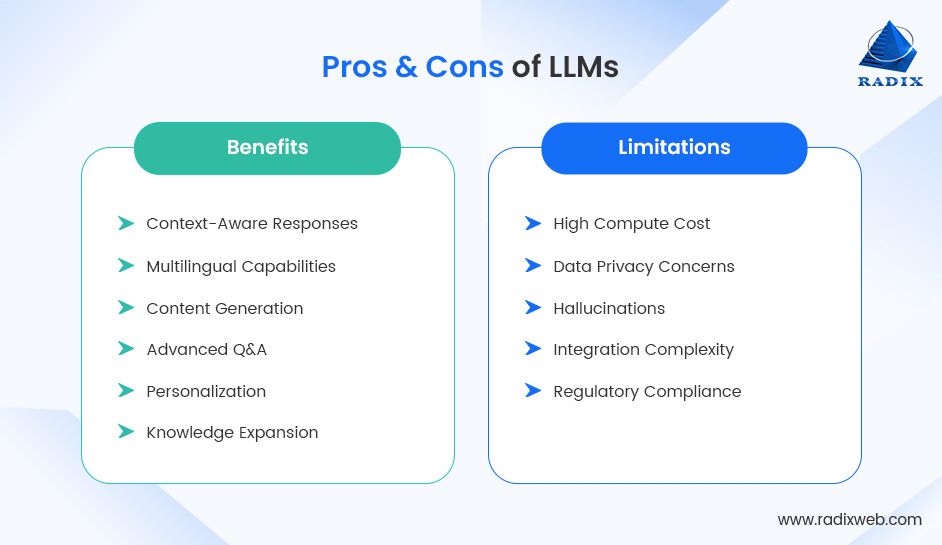
- Context-Aware Responses: Understands and can respond to nuanced queries.
- Multilingual Capabilities: Supports global business expansion.
- Content Generation: Generates thousands of blogs, emails, and reports with right prompts.
- Advanced Q&A: Handles complex user questions.
- Personalization: Learns, adapt and delivers according to user preferences.
- Knowledge Expansion: Can summarize and synthesize large datasets.
Challenges of LLMs
- High Compute Cost: Expensive infrastructure and set-up costs.
- Data Privacy Concerns: Opens your systems to vulnerabilities and sensitive data risks if not governed.
- Hallucinations: Can deliver incorrect or fabricated answers by moving away from actual context, causing model drifts.
- Integration Complexity: Requires APIs and orchestration when integrating with legacy systems.
- Regulatory Compliance: Must align with global data protection laws like GDPR, HIPAA, PIPL, LGPD, DPDP, COPPA.
Most Common Types of LLMs
- Open-Source Models: LLaMA, Falcon.
- Proprietary Models: GPT-4, Claude.
Some common examples of LLMs are GPT-4, Claude, LLaMA.
What are AI Agents: The Automated Doer
AI agents are built to act – not just respond and write. AI agents for enterprise replicate human cognizance and take immediate decisions with real-time data processing. Our experts have developed AI agents that are bound by ground rules, they do not require constant human supervision, can log into business systems, work with CRMs, process invoices etc.
How do AI agents work?
They combine perception, reasoning, and action loops to autonomously complete tasks.
Why you’ll love them?
- Automate entire workflows end-to-end.
- Enable real-time decisions without human intervention.
- Help scale complex enterprise operations.
What’s the catch?
This level of automated decisioning, human cognizance and context-aware actions make them pricey – from setup costs to complex integrations. Also, if your data isn’t clean, structured and prepared, AI agents would absolutely malfunction.
Real-world example:
Your AI agents can automate several business functions without human intervention – from inventory monitoring to forecasting shortages and autonomously dealing with supply chains.
In fact, PWC recently conducted a AI agent survey with 300 senior tech executives, where 66% report measurable productivity gains and 88% plan to increase AI budgets due to agentic AI.
Prominent AI Agents Benefits :
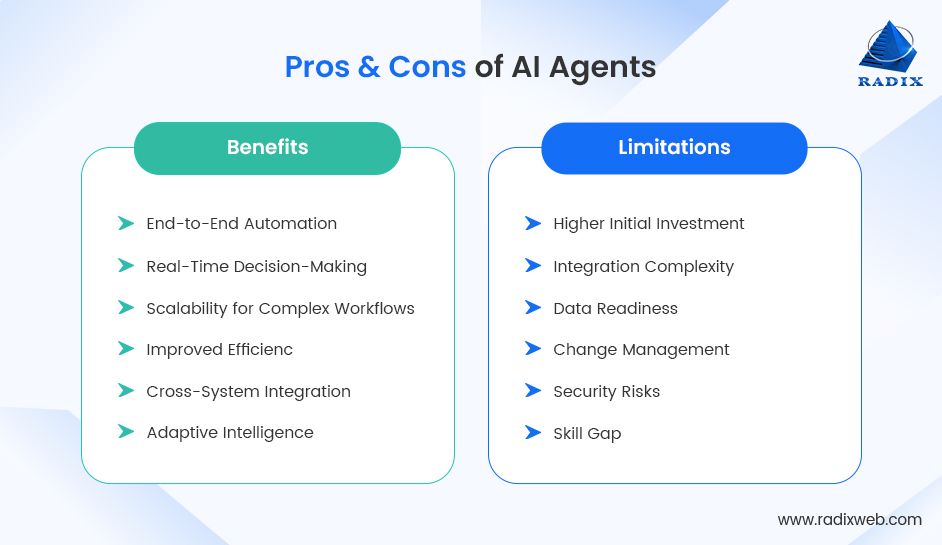
- End-to-End Automation: Executes tasks without human intervention.
- Real-Time Decision-Making: Automates actions based on dynamic data.
- Scalability for Complex Workflows: Easily handles enterprise-level processes.
- Improved Efficiency: Reduces manual intervention and human resource cost.
- Cross-System Integration: Seamlessly integrable across multiple platforms.
- Adaptive Intelligence: Learns and evolves with data, delivering aligned outputs.
Common Challenges of AI Agents:
- Higher Initial Investment: Costly to implement because of data preparedness and integration challenges.
- Integration Complexity: Requires robust infrastructure to scale rapidly.
- Data Readiness: Needs clean, structured data – no data preparedness leads to flawed outcomes.
- Change Management: Faces organizational resistance due to common misconceptions, needs to be implemented transparently with a view to enhance human performance.
- Security Risks: Autonomous actions need strict governance, works best under strong AI audit and monitoring teams.
- Skill Gap: Requires specialized talent for deployment.
Different Types of AI Agents You Can Build:
- Reactive Agents that respond to stimuli.
- Goal-Based Agents that plan actions to achieve objectives.
- Utility-Based Agents that can be optimized for best outcomes.
- Learning Agents that improve performance over time.
The Most Common Examples of AI Agents are AutoGPT, enterprise workflow bots.
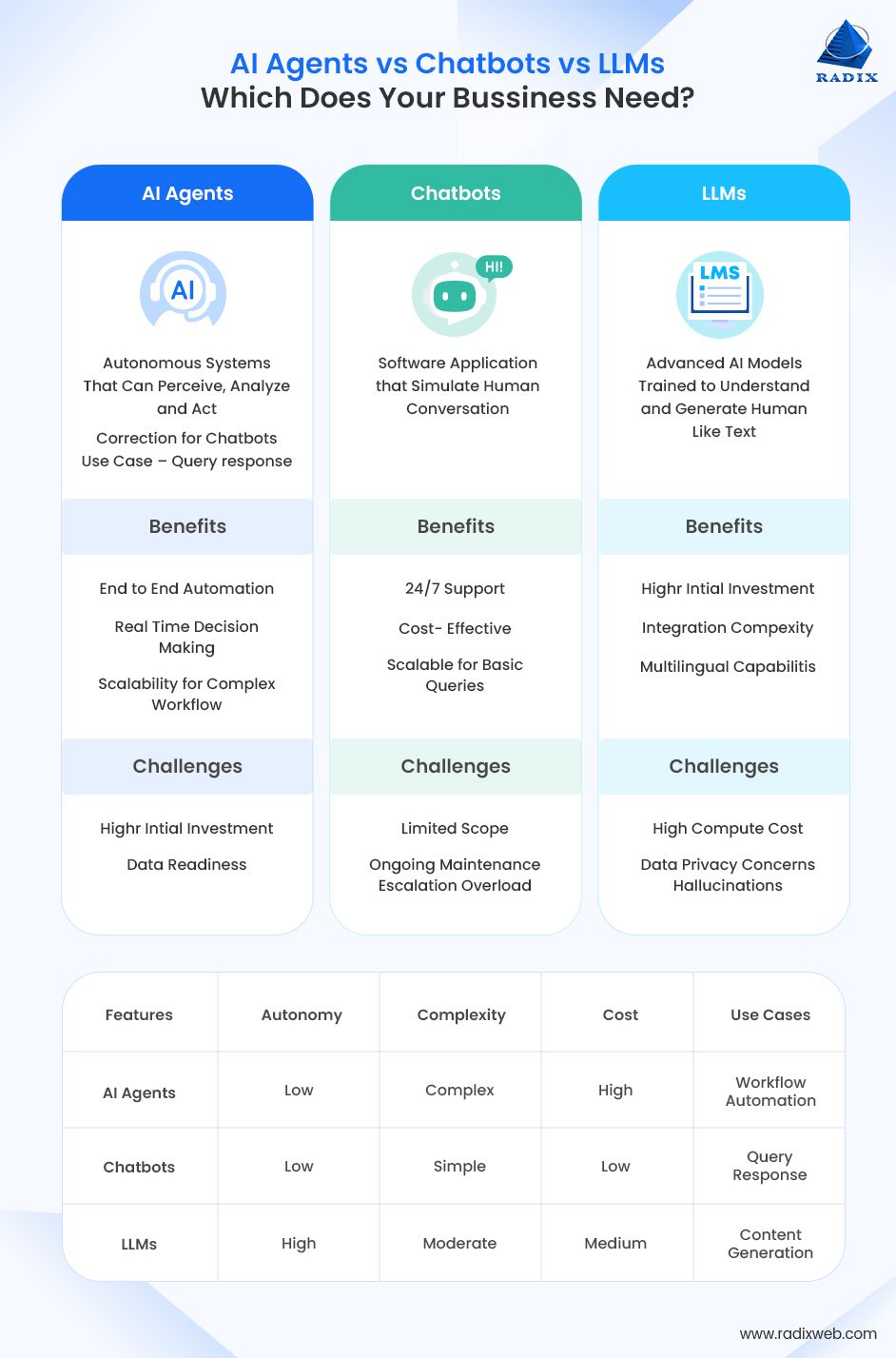
While chatbots are designed to talk, LLMs can think and write. And AI agents are built to act. Each of these autonomous AI tools can play a unique role for your business. But you must know which one or what combination of these tools do you need—and when.
Key Differences: LLMs vs. AI Agents vs. Chatbots
When you choose between chatbots, LLMs, and AI agents is not a matter of preference— rather it’s a strategic decision. One that shapes your operational efficiency and competitiveness for your AI app development initiatives.
Because each of these technologies serve a distinct purpose, and misalignment can lead to wasted investment and operational setbacks. Here’s a clear breakdown of how they differ and where they deliver the most value.
Autonomy: The Degree of Independence
- Chatbots: They operate reactively - requiring specified instructions for every interaction. Chatbots cannot initiate actions on their own.
- LLMs: They generate cognitive, impactful outputs. However, LLMs are highly dependent on good prompting for best execution.
- AI Agents: They can function autonomously without human intervention. AI agents can rapidly analyze data, enable autonomous decisioning and execute operational tasks with ease A certain level of human governance is of course required to supervise these.
Complexity: What Are Their Capabilities?
- Chatbots: These are built for handling extremely basic, straightforward, and repetitive tasks.
- LLMs: They are designed to handle language-driven tasks like content creation, summarization, report generation, and sophisticated multilingual communication.
- AI Agents: Conversational AI agents can tackle enterprise-grade complexity. They automate complex workflows, manage supply chains, and enable real-time decision-making across business systems.
Cost: Investment vs. Impact
- Chatbots: They come with a low-cost entry point for businesses seeking basic automation.
- LLMs: For businesses that need content and knowledge management, LLMs brings significant returns with moderate investments.
- AI Agents: These are meant for businesses which need end-to-end automation and are ready to invest in AI innovation with premium price points. Although AI agents require heavy upfront costs, they bring significant ROI through automation and operational efficiencies.
Use Cases of Chatbots, LLMs and AI Agents: Strategic Application
- Chatbots: Mostly used in customer support, lead qualification, and appointment scheduling.
- LLMs: Leveraged strongly for enhancing marketing content, advanced Q&A, internal knowledge systems.
- AI Agents: They deliver best outcomes in fraud detection, handling dynamic pricing and end-to-end enterprise workflow orchestration.
Scalability: Their Potential for Growth
- Chatbots: Can scale seamlessly for customer-facing interactions but fails in dealing with complexity.
- LLMs: Can adapt and expand for content and knowledge but absolutely lack task execution capabilities.
- AI Agents: Scales frictionlessly across departments and complex processes; ideal for organizations pursuing full-scale digital transformation and AI innovation.
Built-in Intelligence: The Depth of Their Capabilities
- Chatbots: Based on rule-based logic and basic NLP, has minimal capacity to learn and adapt.
- LLMs: Demonstrate advanced language interpretation capabilities and creative content generation. LLMs lack execution abilities.
- AI Agents: Converge cognitive interpretation, active reasoning and autonomous action. They are known to deliver adaptive, enterprise-level intelligence.
Here’s a visual comparison with key differentiation between these AI tools:
| Features | Chatbots | LLMs | AI Agents |
|---|
| Autonomy | Low | Medium | High |
| Complexity | Simple | Moderate | Complex |
| Cost | Low | Medium | High |
| Scalability | Limited | Moderate | Enterprise-wide |
| Use Cases | Basic Support, FAQs | Content and Report Generation | Enterprise-scale Workflow Automation |
The capabilities of these tools are constantly evolving as Microsoft is now leveraging reinforcement learning for training LLMs and AI agents. We have already explained these tech tools in detail, their present advantages, challenges, complexities, and use cases. We’ll guide you how you can choose effectively between these tools.
What Should Organizations Consider When Choosing Between AI Agents, LLMs, and Chatbots?
The recent statistics on artificial intelligence mention that the AI market is poised to grow by 120% year on year. Thus, choosing the right AI tool or technology is crucial - majorly in building capability alignment with your business goals, enhancing infrastructures and building scalability for the future. And not limited to just enhancing features. Only the right AI consulting can arm your business with tools that are suited to your business goals and processes.
This is why you must have a checklist while building the next-gen AI software and integrating the right AI tool for your business:
- Complexity of Workflows: In case your business requires basic support like answering simple user queries, automating routine tasks without critical decision making, chatbots would be sufficient. However, if your business has a complex workflow involving multi-department coordination, various levels of approvals, and rapid business decisioning, AI agents are your best bet.
- Required Level of Autonomy: What level of autonomy your business requires is also a determinant of the tool you should be integrating. Do you need a tool that only responds to user queries? Or do you require AI to generate creative content and intelligent reports? Or is your requirement more for tools that perform independent actions (with due human governance)?
- Level of Organizational Data Readiness: You need to ask yourself a few questions here: Do you have data centralization in your organization? Will you leverage API-led integrations? Does your business have enough security protocols and compliance adherence? Success of both LLMs and AI agents depend on clean and structured data – siloed and unstructured data often lead to model drifts and inaccurate outputs. If that’s what you’re dealing with, keep your expectations low, start with chatbot integrations and then scale advanced AI. I think one of the best approaches for AI innovation is to start with prototypes first, test the market and then scale with custom solutions.
- Real-Time Decisioning Needs: Businesses that need proactive and instant decisioning abilities like dynamic price determining or fraud detection; you need chatbots that act autonomously.
- Budget and ROI: The ground rule for tech innovation is to stretch as per your budget constraints. While chatbots require lower costs for setup, cost for LLMs is mid-scale. However, full-scale AI agents require huge upfront setup costs because they perform end-to-end automation.
- Business System Integration: While LLMs and chatbots can work with API integrations, if you need AI agents, they have a more complex landscape requiring deep integrations with enterprise systems like CRMs, ERPs etc. Also, modern tech stacks facilitate quick deployment for AI agents and LLMs while outdated legacy systems require middleware support. Here’s a realistic guide on transitioning efficiency for legacy systems with AI-led modernization.
- Scalability Goals: When you integrate AI tools, do take stock of your future goals. Is your focus going to be just on enhancing responsiveness and customer engagement or do you want to opt for end-to-end enterprise-wide automation?
When we are talking about the use and efficiency of chatbots, LLMs and AI agents, chatbots are the very first level of AI-led automation. Most leaders are aware of their uses and pitfalls. However, most get confused when it comes to choosing between LLMs and AI agents; this largely affects bridging your AI ambition-impact gap. That’s the knot we’ll untie now:
AI Agents vs. LLMs – A Head-on Comparison
In the landscape of AI evolution, difference between chatbots and ai agents lies distinctly in the ways they deliver efficiency. However, AI Agents and Large Language Models (LLMs) are two distinct yet interconnected paradigms. LLMs work as the foundational technology for generating outputs with natural language understanding. AI Agents add to this capability by adding autonomy, memory, and tool integration to perform complex, goal-driven tasks.
If you want to go beyond simple text processing and build self-learning, adaptive and self-healing systems, you need to get a realistic view - the core technical difference between AI agents and LLMs.
1. Core Architecture
- LLMs (Large Language Models) are built on transformer architectures (e.g., GPT, PaLM), operate as stateless models which treat each prompt independently unless tied with context. They are designed for text generation, understanding, and reasoning.
- AI Agents are composed of LLMs + additional components (memory, tools, environment interaction), use frameworks like LangChain, AutoGen, or OpenAI Agents. They are designed for goal-oriented behavior, not just text generation.
2. Autonomy
- LLMs are reactive. They respond to prompts but do not initiate actions. For long-term planning, LLMs need to be engineered accordingly.
- AI Agents are proactive - they can plan, execute, and adapt tasks over time. They have the ability to retain memory (short-term and long-term) for continuity and can loop through reasoning steps autonomously.
3. Tool Integration
- LLMs cannot directly interact with external systems without wrappers. They are limited to text generation unless integrated via APIs.
- AI Agents are built for intelligent and autonomous tooling - APIs, databases, browsers, code execution. They can orchestrate multiple tools for complex workflows.
4. Reasoning & Planning
- LLMs are strong at pattern recognition and language reasoning. However, they fail at multi-step planning without external scaffolding.
- AI Agents use planning algorithms (e.g., ReAct, Tree-of-Thought, or hierarchical planners). They have the ability to break tasks into sub-goals and execute sequentially.
5. Memory
- LLMs operate on context window only (e.g., 8K–200K tokens). They bear no persistent memory across sessions.
- AI Agents showcase persistent memory via vector databases or custom stores. They can recall past interactions and learn from them.
6. Deployment
- LLMs are typically deployed as API endpoints or embedded in apps for single-shot or chat-based usage.
- AI Agents on the other hand, are built and deployed as autonomous services, bots, or orchestrators which can run continuously and interact with environments.
7. Use Cases
- LLMs work great in single-turn tasks like text summarization, Q&A, content generation, and also help in coding.
- AI Agents are used for dynamic, multi-step tasks like customer support automation, research assistance, workflow automation etc.
If LLMs are the brains, AI agents are the complete system – brain+ memory+ tools+ autonomy.
The Future of Business AI: How Chatbots, LLMs, and AI Agents Are Going to Evolve
Enterprise leaders are facing an existential question now. It's not if AI is going to realign operations. It’s whether organizations are operationalizing AI with enough conviction to stay relevant. Business leaders cannot treat chatbots, LLMs, and AI agents as diverse experiments. For 2030 and beyond, these AI innovations are unified into a centralized intelligence architecture.
Chatbots Won’t Stay Transactional Anymore: The next-gen chatbots will be context-aware and integrate a relationship-intelligent conversational layer that anticipates user needs instead of simply replying to them. With next-gen LLM reasoning and real-time retrieval, these interfaces will enhance continuity across customer lifecycles.
LLMs Are Becoming Repositories of Institutional Knowledge: Large language models are evolving from generic inference engines. With multimodal reasoning, domain-specific fine-tuning and continuous learning will enable next-gen LLMs to interpret market signals with operational data and deliver strategic decisions like human experts.
AI Agents Are Moving AI from Augmentation to Genuine Autonomy: The next-gen AI agents will become multi-agent systems that complete extensive cross-functionality in weeks. These agents will act without human interference; however, governance and accountability will be built-in guardrails.
The new-age AI will be a convergence of chatbots at interference, LLMs at reasoning and agents at the execution layer. These central systems will build the base of autonomous, adaptive operating systems for modern businesses.
How Radixweb is Reshaping the Frontier of Intelligent AI Tools for Businesses?
Our experts at Radixweb are constantly innovating at the edge with AI powered tools, delivering several levels of automation and efficiencies. From basic chatbots to chatbots with NLP integrations, high-performing LLMs and advanced agentic AI.
Recruit.IQ, an Australian HR firm recently built a full-cycle automation web app with us integrating GTP 3.5 AI chatbot that automated about 70% operational tasks, simplified internal workflows and enhanced TATs with 3X speed.
We also built an AI powered document search platform with RAG on Azure for Doyele, O’Keefe & Associated that reduced infrastructure costs by 40% while boost boosting query interpretation accuracy to 97%.
One of our most recent experiments was building an AI meeting assistant and intelligence platform that automated executive decisioning for the global consulting firm Brunswick, It sped up meeting follows up with 3X speed and enhanced 97% user satisfaction score.
Conclusion: Choosing the Right AI Shapes Your Competitive Edge
If you are focused on customer engagement, start with advanced chatbots, whereas if you seek knowledge automation, you’ll benefit from LLM-powered solutions. But if your organizations aims to transform operations and scale decision-making, AI Agents will offer you the most transformational benefits.They crux of making a frictionless decision lies in aligning your AI ambition with real business impact – long-term goals, infrastructural readiness and state of your existing tech stack. We fall in the league of top AI development companies and can help you assess your processes, bring impact alignment with the right tool choice. Tell us your requirements and we’ll build a tailored strategy for your business.