Read More


Recognized for AI Excellence at 2026 Globee® Awards - Read More

Anand Trivedi
A 2026 industry survey found that 35% of maritime firms cite legacy IT systems as the primary barrier to digital transformation, delaying modernization projects by an average of 18 months and contributing to billions in annual operational losses across shipping and port operations. With that, maritime software modernization is no longer a technical either-or choice; it's becoming the operational necessity that separates competitive shipping operations from those bleeding money into workarounds.
Yet modernizing a legacy business application isn't easy, especially for niche industries like maritime. Teams are already stretched, regulations are tightening, and change is disruptive. Success, today, demands more than just new software; it requires deep industry understanding paired with technical expertise to navigate legacy constraints, align stakeholders, and deliver real, measurable gains.
Maritime software modernization connects fragmented legacy systems into a unified, real-time operations backbone. It improves efficiency and cuts operational costs through automation andenables AI-driven decision-making. The exact modernization methodology varies though, as some companies integrate incrementally, while others migrate to cloud platforms. But all methodologies require phased approaches that protect operational continuity. Start with your highest-pain workflow, prove the ROI, then expand systematically.
| Aspect | Details |
|---|---|
| What does this guide cover? | What maritime legacy system modernization means, the real business case behind it, proven maritime software modernization strategies, the unique challenges shipping companies face, and the concrete steps to get started with maritime legacy software modernization |
| Who should read this guide? | Operations directors, IT leaders, and digital transformation executives at shipping companies evaluating how to modernize legacy systems, teams wrestling with disconnected port systems, vessel data siloes, or compliance reporting bottlenecks |
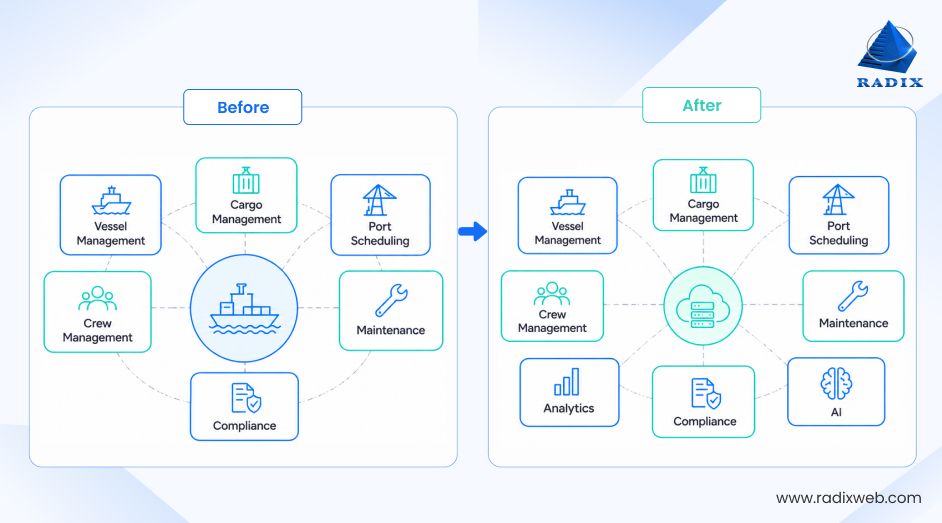
Maritime software modernization connects legacy vessel, port, cargo, and crew systems into a resilient digital foundation for connected, efficient shipping operations. It enables real-time visibility, automation, and compliance across all shipping operations. It's not about ripping out 20-year-old systems overnight. It's about connecting them, extending them, and layering modern capabilities on top until operations can respond to change instead of reacting to crises.
In practice, a shipping company running separate systems for vessel management, cargo tracking, port scheduling, and crew logistics faces constant data synchronization problems. Modernization means these systems talk to each other. With modern, tailored software for the maritime industry, crew updates feed automatically into scheduling. Cargo status flows in real-time to port terminals. Vessel position data triggers predictive maintenance alerts before failures cost thousands in unplanned delays.
That's the destination. The journey is messier.
Despite facing challenges related to legacy maritime systems and knowing the many reasons why modernization is necessary, most maritime organizations are stuck with dated systems, primarily because:
The result: most shipping companies understand the risks of outdated maritime software systems, but the time and cost of modernizing legacy business software keeps them stuck in the legacy vs. legendary software technology debate. The result is sub-optimal operations and manual workarounds that eat up labor and introduce errors.
Modernization isn't a technology project. It's an operational recovery project. When systems are fragmented, you're not just inefficient, you're also bearing the cost of delaying legacy modernization once in the labor cost of workarounds, and also in the revenue lost to delays and missed optimization opportunities.
Here are the key benefits of maritime software modernization:
Port time is dead money. A container ship costs $20,000-40,000 per day to operate. Every extra hour in port is pure loss. Modernized systems eliminate the manual handoffs that cause delays: automated customs documentation, real-time cargo status feeds to terminal operators, and predictive berth scheduling based on actual vessel arrival data. Shipping companies that modernize software solutions have seen port turnaround times drop by 30-40%, freeing up 8-12 additional port calls per year per vessel.
Your current ops team spends 40-60% of their time on data entry and manual reconciliation. Modernizing your business management application can automate this. Cargo updates flow directly from vessel systems to booking databases. Crew documents generate automatically against regulatory templates. Exception handling still requires human judgment—modernization doesn't eliminate that—but routine work disappears. Teams reallocate to higher-value tasks: route optimization, compliance strategy, customer relationship management.
Modern regulatory requirements like IMO 2030 emissions tracking, port state control documentation, and crew certification management, demand real-time data. Legacy systems handle compliance through spreadsheets and manual audits. Software products modernized with the latest tech make compliance automatic: continuous emissions monitoring feeds into reporting dashboards, crew certifications trigger automatic renewal alerts, port documentation generates audit-ready logs. The cost of staying compliant drops, and audit risk vanishes.
You cannot optimize what you cannot see. Modern maritime systems provide live visibility into vessel position, fuel consumption, engine performance, maintenance intervals, and cargo condition. This data feeds into predictive analytics. You know a bearing is about to fail before it fails. You route around storms before they become routing crises. You identify which customer shipments are consistently delayed and adjust planning. This moves shipping from reactive (responding to failures) to proactive (preventing them).
Once systems are connected and modern, AI becomes possible. Not "AI will replace your planners" but "AI will handle the 10,000 micro-decisions your planners don't have time for." Optimal routing based on real-time weather, fuel prices, and port congestion. Predictive maintenance schedules that minimize downtime. Dynamic pricing based on demand and capacity. Anomaly detection that flags unusual cargo handling or equipment stress. These capabilities only exist in modern, industry-specific custom software solutions.
Maritime software modernization is ultimately about building a more efficient, visible, and responsive operation. The right modernization strategy can reduce manual effort, improve compliance, optimize vessel performance, and create the connected data foundation needed for AI-driven decisions.
Once you decide it’s time to modernize a maritime legacy system, you have several ways to move forward. The IT industry commonly uses the 6Rs of legacy modernization: Rehost, Replatform, Refactor, Rebuild, Replace, and Retire.
But these approaches don’t work equally well for every shipping modernization project. A crew management system, vessel tracking platform, and cargo management system can have very different dependencies, operational risks, and modernization requirements. The right approach depends on what the system does, how deeply it is tied to other operations, and how much disruption your business can accommodate.
Here’s a look at the six approaches and when each one works best:
| Strategy | When It's Best |
|---|---|
| Rehost (Lift & Shift) | You have a standalone legacy system (crew management, spare parts tracking) with no critical dependencies and a clear cloud target. Fast, low-risk, proven ROI. |
| Replatform (Lift, Tinker & Shift) | The system is core to operations but can run on modern infrastructure with minor rework. Vessel tracking systems often fall here. |
| Refactor (Re-architect Incrementally) | The system is too interdependent to move intact, but you can't rebuild everything at once. You modernize one module at a time (cargo management, then scheduling, then billing). |
| Rebuild (New from Scratch) | The legacy system is a technical debt black hole with zero documentation and no way to extend it safely. Rare, expensive, but sometimes necessary. |
| Replace (Commercial Off-the-Shelf) | A vendor product exists that covers your workflow better than maintaining legacy code. Maritime ERP systems increasingly fall here. |
| Retire | The system is redundant or obsolete. Shutting it down is the modernization move. |
The key is to decide what to modernize, how to modernize it, and when to make the move based on your system’s operational needs and constraints. The goal is to choose the approach that best fits the system and business, rather than simply choosing what looks easiest or cheapest to implement.
From our experience across multiple legacy modernization implementations, for shipping software solutions, pure Rehost rarely works. That's because maritime systems are deeply integrated. Pure Rebuild, on the other hand, is too risky and expensive. What works best is a blended approach: Retire the truly dead systems, Replace where commercial products fit, Replatform the operational backbone, and Refactor critical integrations piece by piece.
Now, choosing the right modernization approach is only the starting point. Maritime systems operate across vessels, ports, terminals, crews, regulators, and shore-based teams, so the modernization strategy also needs to account for interoperability, data continuity, operational schedules, and regulatory dependencies.
Here are the factors that can determine whether the modernization works in practice:
Instead of replacing legacy systems all at once, APIs create a controlled layer between existing and modern applications. A legacy cargo system, for example, can continue handling core operations while APIs expose the required data and functions to newer platforms, reducing disruption during the transition.
Modern maritime operations depend on data moving reliably across systems rather than being trapped in individual applications. Vessel systems, port platforms, maintenance tools, regulatory databases, and commercial applications should be able to exchange consistent data through a governed architecture that supports real-time visibility and better decisions.
Maritime modernization needs to work around operational realities. Schedule major migrations around planned dry-dock periods, maintenance windows, or lower-activity seasons wherever possible. Breaking the transition into defined phases also gives crews and shore teams time to validate workflows before the next stage.
Running legacy and modern systems in parallel provides a controlled path to cutover. Teams can compare outputs, validate critical workflows, identify data discrepancies, and train users while the existing system remains available. Once the new environment demonstrates operational reliability, teams can retire legacy components progressively.
Modernization can involve more stakeholders than the internal IT team. Port authorities, flag states, classification bodies, technology vendors, and other operational partners may influence requirements or approvals. Bringing them into the planning process early helps account for validation, certification, integration, and compliance requirements before implementation begins.
A maritime modernization program succeeds when the technology transition fits the way ships, ports, crews, and shore operations actually work. That means planning architecture, data, migration windows, testing, stakeholders, and adoption together rather than treating them as separate implementation tasks.
The maritime software modernization process typically follows a phased approach. Start by assessing legacy applications, integrations, data flows, operational dependencies, and compliance requirements. The goal is to identify what needs to change and what can continue operating during the transition.
Here are the key steps:
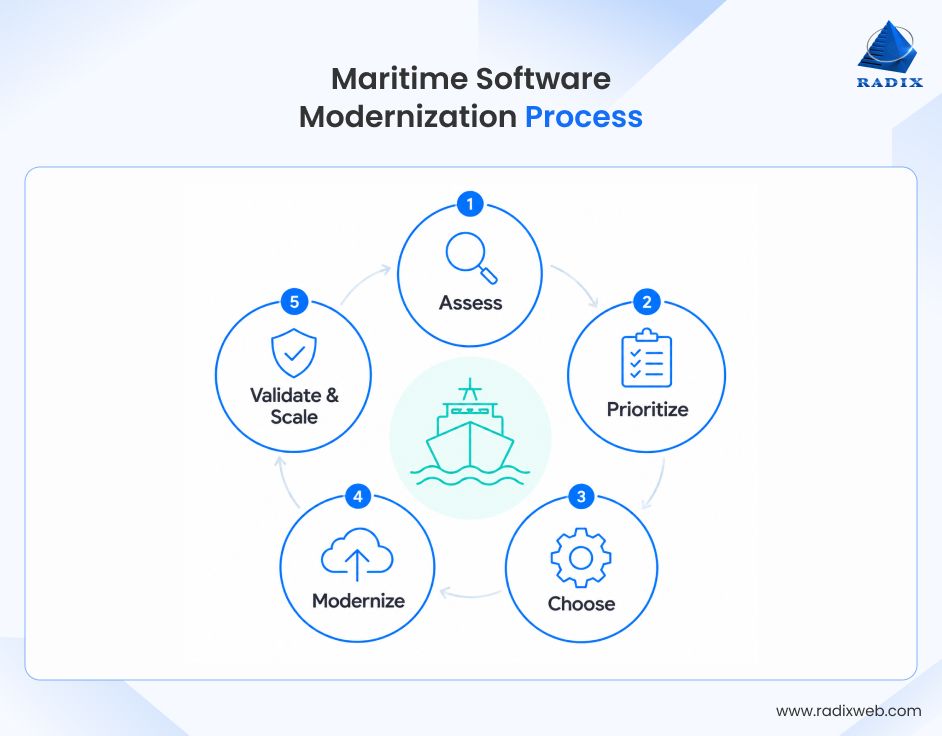
1 Assess: Map legacy systems, technical debt, dependencies, and business-critical workflows.
2 Prioritize: Identify high-impact systems and modernization opportunities based on risk, cost, and operational value.
3 Choose an approach: Decide whether to rehost, replatform, refactor, rebuild, replace, or retire each system.
4 Modernize incrementally: Introduce APIs, cloud infrastructure, modern architecture, and data integration without disrupting live operations.
5 Validate and scale: Test performance, security, compliance, and interoperability before expanding modernization across the fleet.
By following these steps to modernize maritime software, shipping companies can ensure zero-downtime and disruption, while creating a solid foundation for building an enterprise-grade software solution.
Modernizing maritime software is rarely a straightforward technology upgrade. Legacy systems often sit at the heart of vessel, port, cargo, crew, and compliance operations, where downtime or data disruption can have immediate operational consequences. Add fragmented systems, limited connectivity at sea, long asset lifecycles, and regulatory requirements, and conventional modernization approaches quickly become more complicated.
These challenges require modernization strategies built around maritime operating realities. Here are the key challenges to plan for maritime software modernization best practices that help tackle them.
Maritime systems don't operate in a regulatory vacuum. Vessel management systems are certified by flag states (the country where the ship is registered). Port operations are governed by local port authorities. Crew management systems must comply with STCW (Standards of Training, Certification and Watchkeeping) requirements. Change any of these systems, and you're legally required to re-certify before operations resume.
How to tackle it: Build regulatory approval into your project timeline. Start recertification processes before you deploy changes, not after. Partner with a classification society (DNV, Lloyd's Register, ABS) early—they'll guide what changes require re-approval and what doesn't. Budget 4-8 weeks for recertification on every significant system change.
A retailer can take their e-commerce site down for 2 hours on Sunday night for maintenance. A cargo vessel cannot. Vessels are at sea for weeks. They can't wait for a software patch. Ports operate around the clock. They can't pause for a system upgrade.
How to tackle it: Use blue-green deployment patterns where new system versions run in parallel with old ones until validation is complete. Implement automatic failover so that if the new system fails, operations revert to the old system instantly. Test extensively in staging environments that mirror production exactly—including data volumes and system load. Plan maintenance windows around natural operational gaps (arrival in home port, scheduled dry-dock).
A shipping company doesn't operate identical vessels. You have container ships, bulk carriers, tankers, general cargo ships, and vessels acquired through company mergers. Each came with different onboard systems. Gearbox manufacturers, engine suppliers, and navigation equipment vendors all use proprietary protocols. Standardizing across this diversity is a nightmare.
How to tackle it: Don't aim for perfect standardization. Aim for interoperability. Use containerized applications and APIs that abstract away the differences. A vessel's navigation system doesn't need to understand how another vessel's ballast system works—they both need to feed standardized data (position, status, alarms) into a central system. This is a data transformation problem, not a standardization problem.
The cloud is fantastic for shipping operations until your vessel is in the middle of the Pacific Ocean with 64 kbps satellite connectivity. You can't stream terabytes of sensor data to cloud infrastructure in real-time. You can't depend on constant API calls to make onboard decisions.
How to tackle it: Implement edge processing. Critical decision logic (navigation, engine monitoring, cargo management) runs onboard with local data. Non-critical data (analytics, compliance reporting, customer updates) syncs back when connectivity is available. When a vessel returns to port with high-bandwidth connectivity, it uploads accumulated data in bulk. This hybrid model (edge and cloud) is standard for modern maritime systems.
The maritime industry is graying. The engineers who wrote your legacy systems 20 years ago are retiring. The new generation of maritime IT professionals is fluent in cloud and APIs, but they've never touched a maritime system. The institutional knowledge of how these legacy systems actually work is walking out the door.
How to tackle it: Start knowledge capture now. Document current systems with video walkthroughs. Pair retiring engineers with younger staff. Prioritize replacing or modernizing legacy systems before the expertise disappears entirely. Modernization becomes urgent when critical knowledge holders are 18 months from retirement.
Maritime software vendors are often specialized and small. They've built proprietary integrations with other vendors. Switching systems means losing those integrations. Documentation is sparse or exists only in the vendor's head. The vendor might not be interested in helping you migrate away, they make money on maintenance contracts.
How to tackle it: Negotiate modernization clauses into vendor contracts upfront. Make data portability and API access non-negotiable requirements for new systems. Open standards (JSON, REST APIs, open data formats) should be your default demand. When evaluating replacement systems, factor in the cost of data migration and recertification, not just the software license.
Other than navigating these challenges, maritime modernization also needs more than technology expertise. The right legacy modernization partner for your project is almost never a generalist, but a team that understands vessel operations, maritime data, compliance, and live-system constraints. At Radixweb, we have worked with several maritime organizations and modernized their existing software solutions. Recently, we modernized a voyage optimization platform that was over 10 years old. Post modernization, the platform had a stronger compliance foundation and AI capabilities integrated in the system. Moreover, we also ensured a 99.9% uptime during the modernization process.
The Practical First Step Towards Maritime Legacy Software Modernization
Maritime software modernization isn't a flag-it-and-forget-it project. It's a multi-year operational transformation that requires executive commitment, technical expertise, and phased execution. So, the next step is to identify where your biggest operational hurdles, compliance pain points, and cost centers are and start with what can deliver the fastest ROI. Once the approach works, take up legacy software modernization at enterprise scale. And remember, maritime software modernization for shipping companies succeeds when you treat it as a series of smaller, proven wins, not one massive overhaul.At Radixweb, we have spent the last two and a half decades helping maritime businesses navigate exactly this transition. We've guided companies through legacy system modernization in shipping, built maritime software integration platforms that connect disparate systems, and implemented AI-driven maritime software modernization strategies that turn data into competitive advantage. So, if you are looking to start today, schedule a consultation with our maritime modernization experts to assess your current systems.
Ready to brush up on something new? We've got more to read right this way.