
Recognized for AI Excellence at 2026 Globee® Awards - Read More
About the Enterprise
The enterprise is a maritime technology company headquartered in New York City, with a growing international footprint including a new Tokyo office. Its voyage planning and route optimization software helps shipping operators run safer, more profitable, sustainable voyages.

Client Location
USA

Engagement Model
Dedicated Team

Project Duration
10+ Years

Industry
SaaS
Business Goals

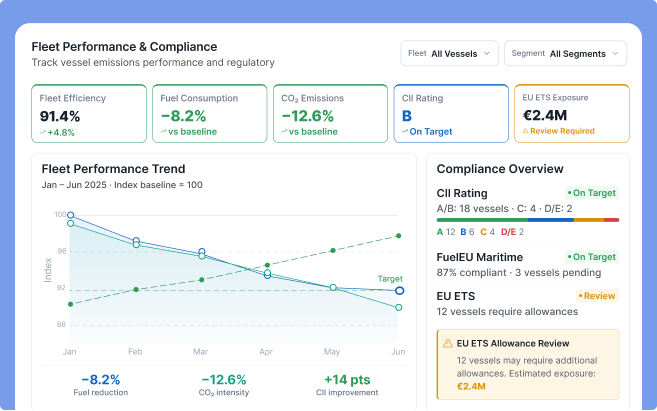
The engagement supports five connected goals through end-to-end application modernization for improved business agility. The enterprise wants to expand into LNG and container ships, beyond its existing dry bulk and tanker base. It aims to lead maritime compliance, covering frameworks like CII, FuelEU, and EU ETS, through a unified dashboard. Operational goals center on reducing costs and improving fuel performance monitoring with an AI-first operating model.
Project Brief

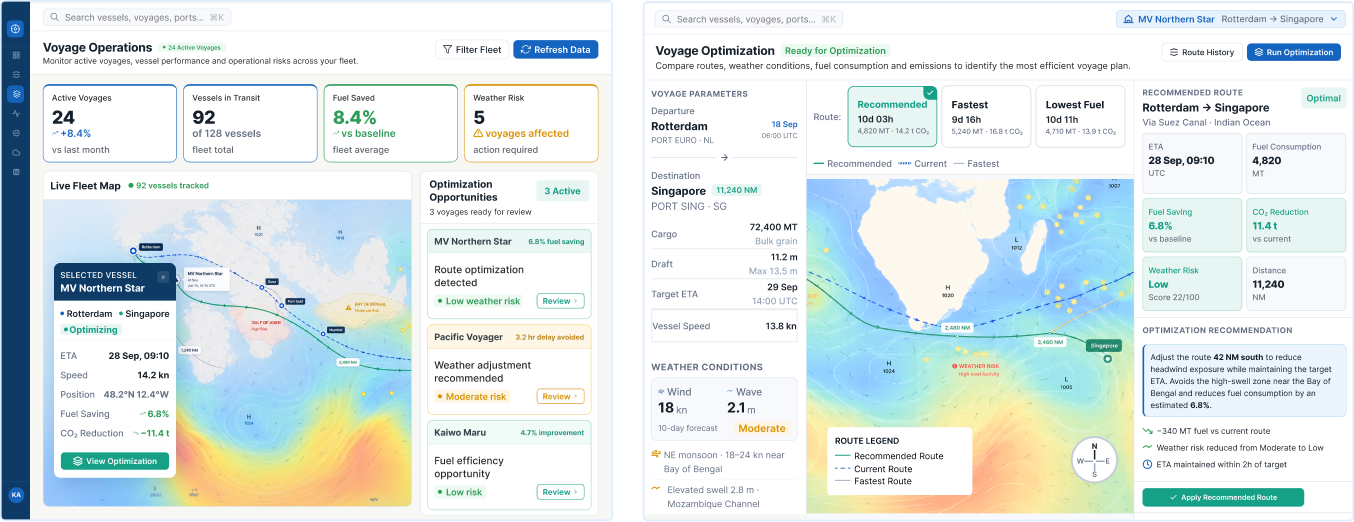
The enterprise runs a vessel performance management software used in the voyage lifecycle, from route optimization to emissions compliance. When Radixweb took over, no formal knowledge transfer or handover documentation existed from the prior development team.
Our dedicated US-based software development team responded with a repository-by-repository audit, debugging build and runtime issues independently to bring the application to a stable state. We also cross-checked existing Confluence material for validation.
Operational data had been scattered across Sedna, PortLog, Veson, and Orbit itself, and the legacy reporting system relied on rigid HTML structures that made version management and fleet onboarding difficult. Vessels also lacked offline capability, and compliance workflows remained largely manual. Our approach to legacy maritime software modernization followed a clear order: stabilize first, understand deeply, document as work progressed.
Client Feedback

This team took over a system with no transition support and still kept things running while we needed them to. The confidence that gave us, watching them debug their way to understanding, mattered more than any handover document would have.
Several endpoints were failing when we started, and fixing them became the fastest way to build real understanding of the platform. That debug-driven approach, paired with constant cross-checking against Confluence, let us reach a stable, running application under live production pressure.

Hetal Dutt
Key Challenges
- Operational data was scattered across disconnected systems, including Sedna for email, PortLog for analytics, and Veson for historical records, with no single source of truth.
- The legacy HTML-based reporting engine used rigid formatting that could not adapt to client-specific needs and made version management genuinely difficult.
- Vessels had no way to draft, review, or submit reports, or run route optimizations, without a constant shore connection.
- Regulatory workflows for emissions and verification reporting remained heavily manual, adding time and risk to compliance-related tasks.
- The project arrived with no formal handover, requiring the team to reverse-engineer the codebase and infrastructure while supporting a live production system.
Solutions Delivered

Full Codebase Audit and Stabilization
With no handover documentation available, our team specializing in marine software development services conducted a repository-by-repository audit across the entire codebase, identifying missing environment variables, broken dependencies, and undocumented services before bringing the application to a stable, running state.

CI/CD Pipeline Design and Implementation
A new CI/CD pipeline was designed and implemented from scratch, giving the team a repeatable, automated path for building, testing, and deploying changes rather than relying on manual, ad hoc release steps.

TMM Module Recovery
The TMM module had stopped functioning correctly before the team's involvement. It was debugged and restored to a stable, fully running state, closing a gap that had been affecting reporting and operational workflows.

Onboarding Tool for Weather Integration
A new onboarding tool incorporating weather-related functionality was initiated as its own project, with high-level analysis and requirements assessment completed as the first phase of a longer delivery roadmap.

Production Support and Issue Resolution
Our team specializing in legacy modernization for mission-critical applications took direct ownership of ongoing production issues, resolving them as they arose and keeping the platform stable for existing customers throughout the transition period and beyond.

Documentation and Confluence Maintenance
Confluence is kept current as changes occur, and documentation covering estimation, tech stack, and resource allocation has been shared with the client, giving them ongoing visibility into project scope and planning.
If your organization has inherited a legacy system, a dedicated engineering team built for exactly this kind of transition can help you stabilize first and scale next.
Technologies Used
React, Redux, and TypeScript
The frontend is built with React and Redux for state management, written in TypeScript throughout, giving the platform's desktop and mobile-facing interfaces a consistent, typed foundation across the voyage lifecycle workflows.
Python (FastAPI) and .NET 7
Backend services run on Python with FastAPI and Pandas for data-heavy processing, alongside .NET 7 for core application logic, with Node.js 18+ supporting additional services across the platform.
PostgreSQL, Redis, and QuestDB
Data storage spans PostgreSQL for relational data, Redis for caching, and QuestDB for time-series workloads, with Dremio and Minio supporting broader data access and object storage needs.
RabbitMQ Messaging
RabbitMQ handles asynchronous messaging between services, letting different parts of the platform communicate and process work without holding up user-facing requests.
Oracle Cloud and Kubernetes
Oracle Cloud serves as the primary infrastructure provider, with AWS as a secondary option, running on Docker and Kubernetes with ArgoCD for GitOps-style deployments and Cloudflare in front for network protection.
GitLab CI/CD and GitHub
CI/CD pipelines run through GitLab, with GitHub used for version control on VCP repositories, and ArgoCD managing continuous deployment into the Kubernetes environment.
AI and LLM Tooling
The AI-powered voyage optimization software’s AI layer draws on OpenAI GPT, Claude, and Gemini through LiteLLM and LangChain, with the MCP protocol, N8N, and CodeRabbit supporting workflow automation and code review.
Playwright, Cypress, and Pytest
Testing runs through Playwright for end-to-end browser automation across Chromium, Firefox, and WebKit using a Page Object Model structure, alongside Cypress and API-level Pytest coverage, with Sentry and Kibana for monitoring.
Vanta, 1Password, and HashiCorp Vault
Security and compliance tooling includes Vanta for continuous ISO 27001 and SOC 2 monitoring, 1Password for human secret management, and HashiCorp Vault supporting broader secrets infrastructure.
Maritime Data Integrations
The platform integrates maritime-specific data sources including Spire for AIS tracking, Lloyd's List, Veson IMOS, DNV Veracity, BV VeriSTAR, We4Sea, SEDNA, and Q88, alongside weather providers Theyr, DTN, and ChartWorld.
Jira, Confluence, and Figma
Project operations run through Jira and Confluence for planning and documentation, Microsoft 365 and Teams for collaboration, Zendesk and HubSpot for customer-facing operations, and Figma with ProductPlan for design and roadmapping.
Business Benefits

Production Stability Without a Handover
Despite inheriting the system with no knowledge transfer, our team brought the application to a stable, running state and kept resolving live production issues throughout, protecting continuity for the enterprise's existing customers.

Faster Development Through AI Tooling
Access to Claude as part of the day-to-day toolkit has measurably accelerated development work, letting the team move through debugging, documentation, and delivery tasks faster than manual processes alone would allow.

Stronger Foundation for Compliance
By treating security documentation and monitoring upgrades as active recommendations rather than afterthoughts, the engagement is building toward tighter alignment with ISO 27001 standards and clearer audit readiness over time.

A Scalable Path for Infrastructure
Migrating non-production environments to managed Kubernetes infrastructure, and reducing dependencies between production and non-production systems, gives the enterprise a cleaner path to scale as workloads and team size grow.
Reach out to Radixweb to start a conversation for your platform's next stage of growth