Read More


Recognized for AI Excellence at 2026 Globee® Awards - Read More

Pratik Mistry

Wait, and You Lose: Based on market data, published research from Gartner, McKinsey, and IBM, and our direct experience maintaining and modernizing legacy systems for enterprise clients over 26 years, here’s how much organizations typically lose if they don't modernize legacy systems: $7M to $10M in cumulative hidden costs. To understand how we arrived at this number and what you can actually do to avoid this cash drain, read on.
There's a comfortable logic to legacy systems. The software works, and your team knows its quirks.
But here's what's true about legacy tech: It ages expensively.
When you look at a single snapshot like this year's maintenance contract, this quarter's developer time spent on workarounds, this month's vendor support bill, the cost of keeping the system alive feels manageable. A legacy system modernization project landing at $1.5–$2M looks enormous by comparison.
But "keeping the lights on" isn't free. It's just expensive in ways that don't show up as a single budget line. Most organizations have never actually added those numbers up.
Finance sees a patch contract.
IT sees overtime.
HR sees recruiting challenges.
The business sees slower feature delivery.
Nobody sees the complete picture, and you continue to bleed budgets. You don’t see any reason to modernize you legacy system.
Below we build a concrete, year-by-year cost model for what happens when businesses delay legacy system modernization. The numbers aren't meant to scare you, they're meant to give IT leaders and CFOs the financial language to have an honest internal conversation about inaction.

Every system has a cost to operate. That's basic infrastructure reality. But legacy systems carry costs that modern systems don't.
The cost of not modernizing is the full financial and operational impact your organization absorbs by continuing to run outdated software instead of updating it. It includes the obvious expenses: maintenance labor that increases every year, vendor support contracts that jump 50–200% when systems reach end-of-life, and hardware refresh costs that keep climbing. But it also includes the costs nobody properly accounts for. Like:
Most organizations undercount their true legacy costs by 40–60% because the real cost is fragmented across budget lines that don't say "legacy system" on them.
The worst part?
Most C-suite executives think about legacy costs as a linear problem. Each year costs a bit more. Eventually it gets expensive.
But that's not how it works.
Technical debt (the accumulated cost of deferred upgrades, workarounds, and unsupported code) grows at approximately 20% annually, if you don't address it. The same compounding applies to your maintenance labor. As the system ages, the number of developers who understand it shrinks and you're paying premiums to find people willing to work on it at all.
So, the cost of waiting is higher than the cost of acting. And every quarter you delay, that gap gets wider.
What follows is a cost projection built from published benchmarks (Accenture, McKinsey, IBM, Stripe). It's calibrated to a representative mid-market organization. Your actual numbers will vary, but the structure of compounding applies to virtually every legacy environment.
Here’s how much it can potentially cost when you don’t modernize your legacy systems
| Cost Category | Year 1 | Year 2 | Year 3 |
|---|---|---|---|
| Maintenance overhead (excess vs modern systems) | $600K–$800K | $720K–$960K | $864K–$1.15M |
| Developer productivity loss (tech debt time) | $600K–$800K | $720K–$960K | $864K–$1.15M |
| Talent premium & retention cost | $150K–$250K | $225K–$375K | $315K–$525K |
| Extended vendor support escalation | $100K–$200K | $180K–$320K | $300K–$500K |
| AI / innovation opportunity cost (accelerating gap) | $250K–$400K | $450K–$700K | $800K–$1.3M |
| Security exposure (risk-weighted) | Elevated | High | Critical |
| Annual hidden cost total (est.) | $1.7M–$2.45M | $2.3M–$3.3M | $3.1M–$4.6M |
| 3-Year Running Total | $1.7M–$2.45M | $4M–$5.75M | $7.1M–$10.35M |
Here’s the baseline scenario for the above cost projection:
Your takeaway from this should be: By Year 2, most organizations have already spent what modernization would have cost. Without gaining any of its benefits.

Let’s understand these costs in detail now
Most organizations in year one aren't alarmed. The system runs with workarounds. But the numbers are already significant:
1. Direct Maintenance Overhead
Most businesses with legacy systems see their IT budgets shrinking. Why? Because industry data shows that upwards of 60% of IT budgets go toward maintaining legacy systems instead of building new capability. On a $5M IT budget, that's $3M just keeping things running, leaving only $2M for innovation, security, and strategic initiatives. For a modernized organization of the same size and complexity, maintenance typically consumes 15–25% of IT resources.
2. Developer Productivity Loss
According to Stripe's Developer Coefficient Report, developers spend 33% of their time on technical debt work like workarounds, patches, integrations, testing. This is the time they could have spent on building features. For a team of 20 developers at $120K fully-loaded cost, that's $792K annually in salary spend that does not contribute to new feature delivery or revenue growth.
3. Security exposure
Older systems lack modern authentication, encryption, and patch capabilities. IBM's Cost of a Data Breach report puts the average breach cost at $4.4 million. Organizations with legacy infrastructure face measurably higher breach costs than those running modern systems. In Year 1, this is a risk exposure on the balance sheet, even if no breach occurs.
Year 1 Total: $1.7M–$2.45M in hidden costs.
This is what inaction costs in year one, distributed invisibly across your budget. Most organizations don't see it as a single number until someone forces the conversation.
Year two is where the patterns that seemed manageable start to become structural.
1. Compounding Technical Debt
At the 20% predicted annual compounding rate, the technical debt your system carried last year is now 20% larger. Every feature request takes longer to scope. Every patch carries higher integration risk. A change to one component now cascades through three or four interdependent systems because the codebase has become tighter, more brittle, more expensive to modify. Your velocity doesn't stay flat. It deteriorates. And the more you wait, the worse it gets because organizations that modernize early see 5X reduction in tech debt as compared to those who put it off for later.
2. Talent Costs Rise Sharply
Developers who understand legacy systems are retiring or moving to organizations running modern stacks. By 2027, the majority of COBOL-era developers, for example, will have exited the workforce. So, by year two, you're either paying significant premiums to retain the talent that knows your system, or you're burning recruiting and training budget to replace it. Either way, the cost line rises sharply. All this while your competitors who modernized their systems with next-gen tech don’t face hiring struggles and pay no retention premiums.
3. Vendor Support Renewal Hits
If your system has passed vendor support's end-of-life date, you now see extended support pricing. Extended support contracts for end-of-life platforms routinely run 50–200% above standard support pricing. Organizations that delayed this conversation often face a sharp, unplanned cost increase mid-budget-cycle.
4. Competitive Gap Widens
Organizations that invested in a modernization plan for their legacy tech when you were in year one are now shipping results. McKinsey research shows that companies modernizing their core applications see up to 40% faster time-to-market and measurable revenue growth within two years. That's not a technology problem. It's a revenue problem.
Year 2 Cumulative Total: $4M–$5.75M
By the end of year two, you've spent what a modernization project would have cost — and you're still running the same legacy system.
1. Maintenance Consumes Your Entire Innovation Budget
By year three, organizations without a modernization path are spending 75–85% of their IT budget just keeping legacy systems operational. On a $5M budget, that leaves $750K–$1.25M for everything else: new development, security improvements, infrastructure, and AI initiatives.
You're no longer running a technology organization. You're running a maintenance shop.
2. AI Exclusion Becomes Competitive Liability
In 2025 and 2026, generative AI, predictive analytics, and intelligent automation moved from experimental to production deployment. Organizations that modernized in 2024–2025 are already seeing double-digit efficiency gains and new revenue streams from AI capabilities. Even a 15–20% efficiency gain on a $2M operational function represents a $300K–$400K annual gap
Legacy architectures can't participate. They weren't designed for real-time data access, API-first integrations, or the clean data pipelines that AI models require. According to McKinsey's 2026 research, companies with fragmented or legacy systems were 30% more likely to experience AI implementation delays.
Your competitors aren't just ahead on features. They're ahead on an entirely new category of tools. That's asymmetric competitive loss expand further when you competitors start updating their existing systems with AI modernization, while you stick to legacy tech. Ultimately, it shows up in your market position.
3. Security Risk Compounds to Critical
Every year without patching and modernization is another year of accumulated vulnerability. 60% of data breaches are linked to unpatched or outdated systems. Organizations running the same legacy stack into year three face breach risk that has compounded alongside the technical debt.
A single breach event costs $4.45M on average. That's more than what a modernization project would have cost to prevent.
Year 3 Cumulative Total: $7.1M–$10.35M over three years
Just remember this number is not counting a breach event or emergency remediation if a system failure forces reactive migration. It also doesn’t factor in regulatory penalties. This is just the steady-state cost of waiting.
On the other hand, the average application modernization project costs $1.5 million and, when executed with the right partner and strategy, delivers 30–50% reductions in operational overheads.
The ROI breakeven point for most modernization projects falls between 18–24 months of modernization completion, well within the window where Year 2 hidden costs begin to exceed that investment.
We've worked with hundreds of organizations in the past few years. Here are the three reasons we hear most often for postponing modernization and why they're not as solid as they sound.
This is technically true. But working and cost-effective are different things.
A system that technically operates while consuming 80% of your IT budget and blocking all AI adoption is working in the narrowest possible sense and not actually serving your business.
Also partly true. There is risk. There is expense.
But this objection compares the known, visible cost of a modernization project against the invisible, distributed costs of inaction. When those hidden costs are properly quantified as in the 3-year model above, the risk calculus reverses. Also, well-implemented modernization projects start yielding ROI within 18-24 months. Staying stuck just compounds the money drain.
This is where compounding matters most.
Next year's technical debt is 20% larger than this year's. Next year's talent pool is smaller. Developers who understand legacy systems are retiring. Next year's vendor support bill is higher. Next year's AI competitors are further ahead. "Next year" isn't a later starting point. It's a more expensive starting point.
So, if any of the above reasons were stopping you from taking the step towards modernizing your legacy tech, don’t let them hold you back anymore. Work with reliable modernization partners who understand the potential pitfalls of legacy system revamp initiatives and make sure you aren’t losing money while contemporaries capture major market share.
So, now that you know why you can't put this off indefinitely, the next question is: How to justify the modernization expense for your system.
Calculate the following 5 key numbers that show actual revenue leak for your business:
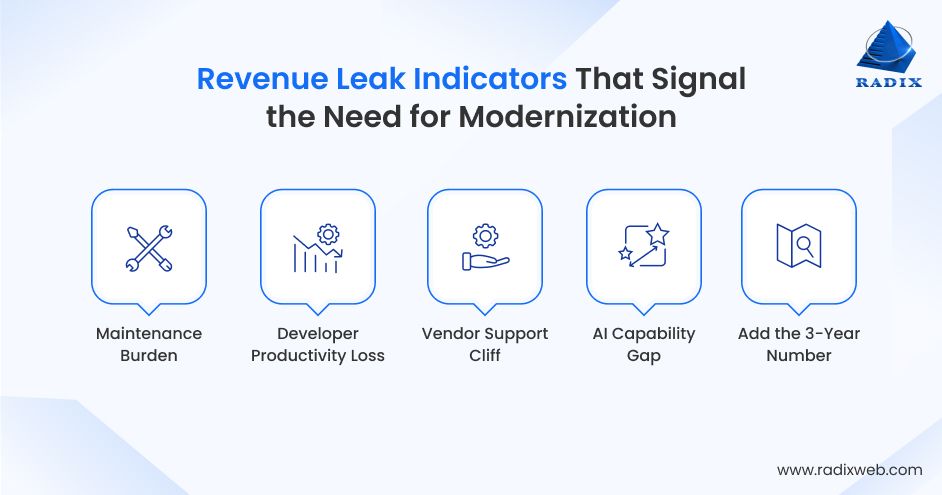
How many engineering hours per week go to keeping the legacy system alive? Multiply by fully-loaded hourly cost ($50–$75/hour for contract labor is standard). Compare that to what a modernized organization of your size typically spends on maintenance.
What percentage of developer time goes to workarounds, patches, and technical debt instead of new features? If you're at the 33% industry average, the cost is significant:
(Number of developers) × (fully-loaded annual cost) × 0.33 = annual lost productive capacity.
What does your current support contract cost? When does it renew?
Get end-of-life support pricing now. The jump is often 100–200%. Most IT budgets don't plan for this shock. Getting the number upfront lets you prepare for it or make the modernization decision before it hits.
What are two or three specific AI capabilities your competitors are deploying that your architecture can't support?
A customer service AI reducing support costs by 20%. A supply chain optimization tool reducing inventory carrying costs by 15%. A compliance automation platform reducing audit labor by 10%. Attach conservative revenue or efficiency estimates to each.
Take these four numbers and project them across three years using the compounding model above.
(Maintenance penalty) + (productivity loss) + (talent premium) + (vendor support escalation) + (AI opportunity cost) = 3-year hidden cost of inaction.
Once that number is visible, the modernization conversation shifts from "can we afford to modernize?" to "can we afford not to?"
The Path Forward: Modernization Done Right
Modernization has risks. But the risks of not modernizing are higher. And organizations that start with clear cost visibility, pick the right partner who understands both technical complexity and business drivers, and execute with a realistic timeline see ROI within 2 years. So, at this point, the question isn’t whether modernization is needed. It’s how to approach it without disrupting your business.At Radixweb, we've been helping clients modernize their legacy applications and outdated systems for more than two decades. We recently helped a health insurance client cut 240+ minutes per case through legacy modernization. With another pharmaceutical marketing company, modernization of on-prem SaaS to cloud-native system increased data processing speed by 65%. These aren't one-off wins. They're patterns we’ve implemented repeatedly across verticals. And we can drive similar results for you. So, don’t wait; schedule a consultation and let our solution architects show you what's possible with your specific systems.The benefits are waiting. The cost of waiting is running. Make sure you're making the right call.
Ready to brush up on something new? We've got more to read right this way.