Read More


Recognized for AI Excellence at 2026 Globee® Awards - Read More

Anand Trivedi
The Cost of Delay: Most enterprise leaders already suspect their legacy systems are a problem. What they consistently underestimate is how much that problem costs every single day. This piece is a direct argument for action. We’ll discuss why AI in custom software modernization has moved from a roadmap item to a survival decision and what a credible path forward actually looks like.
According to Gartner, organizations that are still using legacy IT tools as compared to AI-based solutions experience a 25% drop in efficiency.
This makes one thing very clear: legacy systems already sit as a negative line item in your budget. And in the age of AI, staying on legacy custom software systems is not a minor setback. It is an active disadvantage.
Competitors are already running predictive analytics, intelligent automation, and real-time decisioning on modern stacks. AI in custom software isn't the future anymore. It's the present. And every quarter of delay is a quarter of ground you are handing to someone else.
The signs that your business needs custom software development are often already visible. The question is whether leadership is choosing to see them. In this blog, I will walk you through the what, why, and how of using AI in custom software to replace outdated systems.

For years, 'legacy system' meant slow, hard to maintain, and expensive to support. That definition still applies. But in 2026, it is no longer the primary problem.
Today, a system is legacy the moment it is not AI-first. That is a different and more urgent threshold. A system can be running on modern infrastructure and still be a legacy liability if it was not designed to integrate with machine learning pipelines, real-time data streams, or intelligent automation layers.
This distinction matters enormously for enterprise decision-making. Many organizations have done 'modernization' work in the last five years. This included cloud migrations, framework upgrades, API wrappers on old systems and led organizations to believe they are current. But they are not.
What they have done is extend the lifespan of architecture that was still designed for a world where software executed instructions. AI in custom software requires architecture designed for a world where software learns, adapts, and decides.
In fact, nearly one-third of enterprises report that a significant portion of their legacy custom software systems cannot support AI workloads at all. That is not a future risk, it is a current capability gap that compounds with every AI initiative a competitor runs while you're still retrofitting.
The emerging shifts shaping custom software development make this concrete: the gap between organizations that have embedded AI-first design into their software infrastructure and those that haven't is not closing, it is widening. And the further behind an organization falls, the more expensive and disruptive the eventual catch-up becomes.
Standard software modernization (re-platforming, re-hosting, re-factoring) makes existing systems faster, more stable, or cheaper to run. Useful. But not transformative.
AI in custom software modernization does two things standard modernization cannot:
So, when you build a truly AI-first software, the output is a system designed to learn, adapt, and improve in production, not just a cleaner version of what you had.
That is why the distinction between bespoke application development and off-the-shelf solutions matters: AI capability cannot be bolted onto a generic platform. It has to be designed in.
Here are the five benefits that make the case:
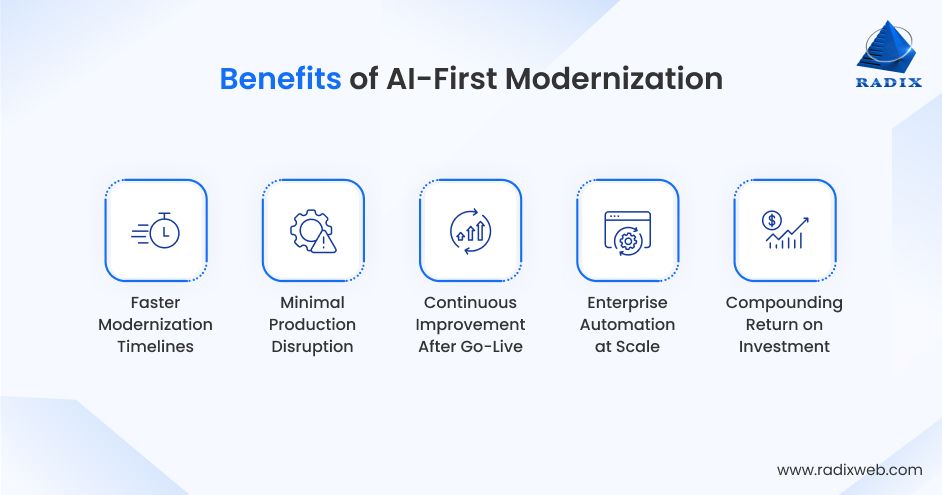
AI-assisted tools scan millions of lines of undocumented code, map dependencies, and generate architecture documentation in days. That alone changes the risk profile of modernizing legacy systems with AI where discovery work traditionally consumed a quarter of the project timeline.
AI in software modernization identifies what to reuse, what to refactor, and what to replace. It then sequences the work to minimize production disruption. Manual assessment is slower, costlier, and misses more.
AI-powered custom software solutions are built with feedback loops and adaptive learning in the architecture. Standard modernization produces a better system. AI modernization produces a system that gets better over time.
Enterprise automation with AI custom software enables workflow intelligence that rule-based automation cannot. It includes predictive routing, anomaly detection, and dynamic decision support. With the AI use cases available to enterprises this transition offers unmatched benefits over traditionally modernized systems.
AI modernization of legacy systems delivers operational efficiency now, plus the platform for capabilities that don't yet exist at modernization time. The the long-term ROI advantages of custom software are most visible here.
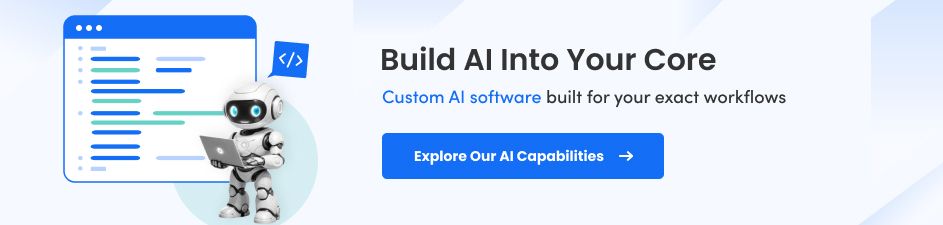
No two enterprise software modernization programs look identical. But the sequence of decisions that separates programs that succeed from those that stall is consistent. Here is how to think about it.
The most common reason modernization projects fail is that they begin with technology before resolving the foundational questions that technology cannot answer. Before a line of migration code is written, these four things must be settled:
1. Assess current systems and identify gaps
Map what you have, what it costs to maintain, what it cannot do, and what capabilities it is blocking. This is not a technical audit, but a business impact assessment.
2. Define business goals for modernization
What does the modernized system need to enable that the current system cannot
Articulate this in one sentence, with stakeholder alignment behind it. 'Our systems are slow' is not a goal. 'Enable real-time customer decisioning across all product lines by Q3' is.
3. Balance between upgrading, integrating, or fully replacing
Not everything in a legacy custom software system needs to be replaced. Identifying what to retain, what to refactor, and what to rebuild is a strategic decision that has a direct bearing on cost, timeline, and risk.
4. Choose the right development partner
Internal teams are rarely the right answer — not because of capability, but because of bandwidth and pattern recognition. A partner who has run comparable custom software modernization programs brings risk intelligence that cannot be built from a standing start. Options range from full outsourcing software development to onshore or offshore companies to hiring dedicated software developers in-house who embed directly into the program.
If these four questions have clear answers with organizational alignment behind them, you are ready to begin.
The first and most underinvested phase of any legacy system modernization project. AI-assisted tools scan codebases, map dependencies, and surface integration points that are not documented anywhere, which, in most legacy environments, is most of them.
This is where AI in custom software modernization diverges most sharply from traditional approaches. Architecture is not designed to replicate existing functionality more efficiently. It is designed for the capabilities the business needs over the next decade. Make sure you are also optimizing your tech stacks in custom software development to get the most outcome from your investment.
It is easy to think that one day you can stop using your old system and just switch to the new one. But the approach that works in practice is that you migrate in phases, running new and legacy systems in parallel until each component is validated in production.
This minimizes disruption and allows for course correction without catastrophic rollback risk.
The following table shows how to prioritize migration sequencing based on business impact and technical risk:
| Component Type | Migration Priority | Recommended Approach |
|---|---|---|
| Core transaction systems | High — migrate early | Full rebuild with AI-first architecture |
| Reporting & analytics layer | High — migrate early | Replace with real-time data pipelines |
| Integration middleware | Medium — parallel operation | Refactor with API-first design |
| Internal admin tools | Lower — migrate last | Reuse or low-code replacement |
| End-of-life vendor systems | Urgent — decommission fast | Replace immediately, no refactor |
The most durable return from enterprise automation with AI custom software comes from what the modernized system can do, not just from what it no longer costs to maintain. AI in custom software capability is designed in at the architecture stage, not added at the end. This includes:
For organizations building this for the first time, the custom software development guide for CTOs is the right architectural reference.
Legacy systems are disproportionately vulnerable to breach. AI modernization of legacy systems is the opportunity to rebuild security posture from the ground up, not just patch it. This means implementing identity and access management, encryption standards, and audit logging that meet current compliance requirements, not the requirements that existed when the original system was built. For enterprises in regulated industries, this step alone often justifies the modernization investment.
Technically correct modernization that no one adopts is a failed modernization. Change management (including training, communication, workflow redesign) is not a soft consideration. It is a delivery risk that has ended more enterprise software modernization programs than technical failure. Plan for it with the same rigor as the technical phases.
Modern custom software development for enterprises does not end at go-live. The modernized platform is instrumented for monitoring, performance tracking, and model retraining. This transforms the system from a fixed asset into a compounding one and one that continuously aligns to the business problems it is solving.
Most failed custom software modernization projects end up that way for predictable reasons. None of them are technical. Here are the three that appear most consistently and what to do instead.
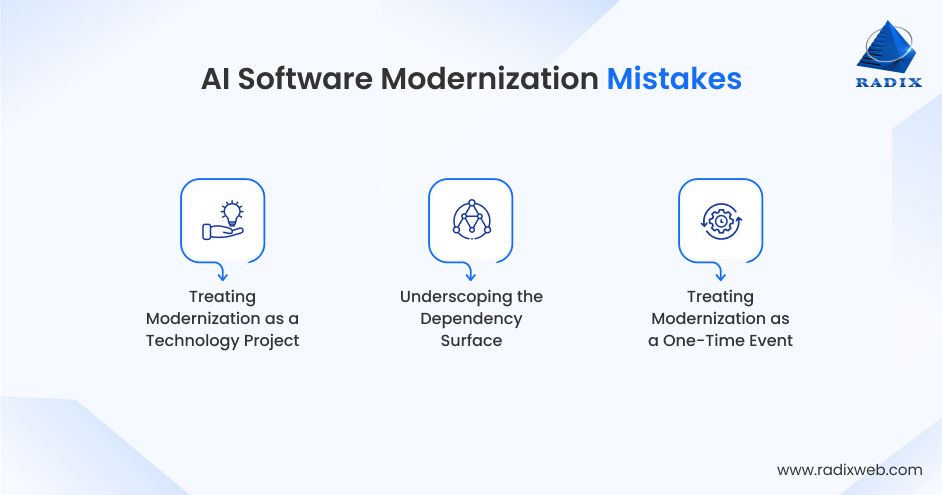
The technical work in AI in software modernization is tractable. The harder work is aligning stakeholders on what the modernized system needs to enable, who owns AI outcomes in enterprises, and what success looks like. Organizations that begin with a technology vendor conversation before completing a business case almost always produce modernized systems that are better than what they replaced, but still not what the business actually needed.
How to overcome it:
Legacy custom software systems accumulate integrations, workarounds, and dependencies over years, none of which is documented. Organizations that do not invest in thorough discovery before the migration begins routinely find that scope expands by two to three times the original estimate. This is where understanding your software development costs upfront is not just useful, it is the difference between a program that delivers and one that stalls mid-execution.
How to overcome it: Treat the discovery and dependency mapping phase as a non-negotiable investment, not a cost to minimize. AI-assisted code analysis tools have made this faster than it used to be, but it still requires time, access, and attention before a line of migration code is written.
The organizations that get the most from modernizing legacy systems with AI do not treat it as a project with an end date. They treat it as a continuous commitment to keeping software infrastructure aligned with business capability requirements. Organizations that declare 'modernization complete' and return to a maintenance mindset typically find themselves back in the same position in five to seven years, facing the same conversation at higher cost.
How to overcome it: Build the continuous improvement infrastructure from Step 7. The case for custom software over packaged solutions is most compelling precisely here: custom systems can be continuously evolved in ways that packaged platforms structurally cannot.
Kickstart AI Modernization with Radixweb
AI modernization of legacy systems is not a theoretical discussion anymore. The costs of outdated systems are real, measurable, and accruing daily. The organizations that lead the next five years will be those that made the transition from legacy custom software systems to AI-powered custom software solutions before the gap became permanent.Radixweb's custom software development services powered by AI capabilities are built for exactly this: replacing what no longer works with systems designed for the decade ahead. Whether you need a full enterprise software modernization, targeted AI in custom software capability, or an honest assessment of where you are before committing to a direction, the starting point is a no-cost consultation. Schedule a consultation today to see what AI in custom software modernization can actually do for your specific system, your specific constraints, and your specific business goals. for your specific system, your specific constraints, and your specific business goals.
Ready to brush up on something new? We've got more to read right this way.