Read More


Recognized for AI Excellence at 2026 Globee® Awards - Read More

Nihar Raval
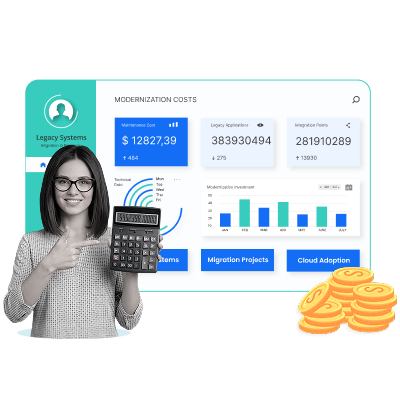
Quick Summary: Most modernization budgets are approved at the low end and overspent by Q3. But here's what legacy modernization actually costs in 2026, by approach and system type. Plus, why the gap between approved budget and actual spend exists before the project even starts.
Most enterprise modernization budgets go through the same failure pattern. Finance asks for a single number. Engineering gives a range. The board approves the lower end. That compromise is convenient. But it is rarely realistic. 12 months later, the same team is back requesting a budget supplement.
The gap isn't technical. It's structural. The most important reasons for modernization and the most impactful business cases are built around the visible cost of the project rather than the complete cost picture: the hidden line items, the approach-specific cost drivers, and the cost of the status quo that the modernization investment is being compared against.
This guide covers what legacy modernization actually costs in 2026, broken down by approach, system complexity, industry, and team structure. More importantly, it covers how to build a budget that survives contact with reality.
Legacy modernization cost is the total investment required to transition an aging application, system, or technology stack to a modern architecture that meets current performance, security, scalability, and integration requirements.
It includes:
The legacy modernization cost range published most often, $50,000 to $2 million or more, is accurate but not useful without understanding everything that goes into building a successful modernization strategy and what determines where a specific project lands. That determination is the primary purpose of a pre-project assessment.
Before building a modernization budget, the correct comparison baseline is what the current state actually costs. Most enterprises undercount this number because the cost is distributed across budget lines that no single function owns.
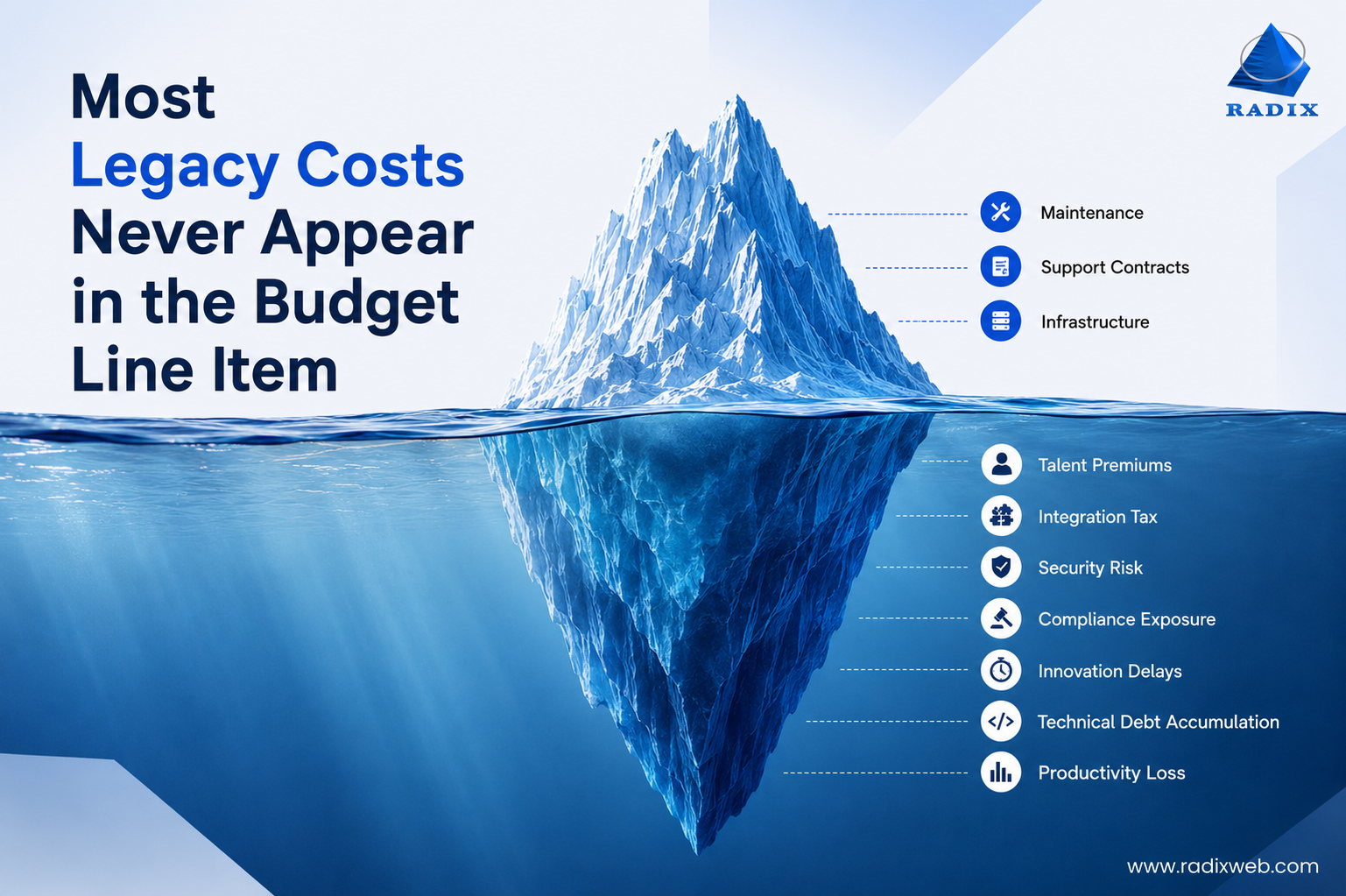
Industry data from Gartner and Deloitte consistently shows enterprises allocate 60 to 80 percent of their IT budget to maintaining legacy systems. That's the visible fraction. The complete cost of a legacy estate includes:
Direct maintenance
License renewals, infrastructure hosting, vendor extended support fees, and the engineering time spent on patches and fixes rather than product development. For enterprises running 10 to 15 legacy applications, direct maintenance alone runs $400,000 to $800,000 annually before any other cost enters the picture.
Talent premiums
COBOL developers, RPG programmers, and engineers with deep knowledge of legacy platforms command significant salary premiums in 2026 because the talent pool is contracting. Recruiting for these roles takes longer and costs more than recruiting for modern stack equivalents. When a key legacy system maintainer leaves, the knowledge gap is expensive to fill.
Integration tax
Every modern tool a business adopts (analytics platforms, AI tools, SaaS applications) must integrate with the legacy system. That integration requires custom middleware, ongoing maintenance, and a dedicated engineering resource to manage the connectors when either side updates. This cost accumulates invisibly across departments.
Breach and compliance exposure
Unpatched legacy systems with known vulnerabilities carry a risk cost that doesn't appear in the IT budget until it materializes. The IBM Cost of a Data Breach Report 2024 found the average cost of a data breach is $4.88 million globally, with figures significantly higher in regulated industries. Running systems past their security patch support window is not cost-neutral. It's deferred risk liability.
We have mapped the 3-year cost of not modernizing legacy applications here.
Overall, the organizations that delay legacy modernization are not saving money, but compounding a liability they haven't yet measured.
There are several methods or approaches to legacy system modernization. Each of these approaches carry fundamentally different cost profiles. Choosing the wrong approach for a system's complexity is the most common source of the budget overrun pattern.
| Approach | What It Involves | Typical Cost Range | Best For |
|---|---|---|---|
| Rehost (lift-and-shift) | Move to cloud with no code changes | $50,000 to $200,000 | Systems that just need infrastructure modernization |
| Replatform | Minor optimizations during cloud move | $100,000 to $500,000 | Systems that need some modernization without full rearchitecture |
| Refactor | Code improvements without architecture change | $150,000 to $600,000 | Systems with good architecture but poor code quality |
| Rearchitect | Redesign architecture, retain core logic | $300,000 to $1,500,000 | Monoliths that need microservices or API decomposition |
| Rebuild | Rewrite from scratch on modern stack | $500,000 to $3,000,000+ | Systems where legacy code is unworkable |
| Replace | Retire and adopt commercial or custom replacement | $100,000 to $2,000,000+ | Systems where off-the-shelf alternatives exist |
These ranges assume a mid-size enterprise system with 5 to 20 integrations and a team of 6 to 12 engineers. Add 30 to 50 percent for systems with undocumented architecture, high integration complexity, or regulated data handling requirements.
The approach selection mistake that drives most overruns: Organizations underestimate system complexity during the initial assessment and choose a lower-cost approach (replatform or refactor) for a system that actually requires rearchitecting or rebuilding. The discovery of that mismatch happens mid-project, when scope expansion is most expensive.
System complexity, regulatory requirements, and data volume vary significantly by industry. These cost ranges reflect those differences.
Core banking modernization is among the most expensive enterprise technology programs undertaken. Core banking platform modernization runs $12 million to $50 million per platform for large institutions.
Loan origination, payments, and treasury systems sit between $4 million and $15 million each. The cost drivers are regulatory compliance validation at each phase, the volume of downstream systems that depend on core banking data, and the near-zero tolerance for operational disruption during the transition.
Mid-size financial services organizations (regional banks, insurance carriers, fintech scale-ups) face more bounded costs: $500,000 to $3 million for a single system modernization with standard compliance requirements.
Modernizing legacy systems in healthcare, EHR and patient management system costs between $500,000 to $5 million depending on patient record volume, integration complexity, and whether HIPAA compliance validation is required at each migration phase. The cost driver specific to healthcare is the parallel running period: maintaining both legacy and modern systems simultaneously during the transition window until all patient data is validated in the new system.
Legacy system modernization transforming retail software like POS, OMS, and inventory management systems runs $300,000 to $2 million for a mid-size multi-location retailer. The cost drivers are the number of store locations (each requiring deployment and staff training), the number of fulfilment models (ship-from-store and BOPIS add OMS complexity), and the peak trading blackout calendar that constrains when migration windows are available.
ERP modernization or replacement runs $1 million to $10 million for mid-size enterprises. The range is wide because ERP scope varies dramatically. A manufacturer modernizing a single production planning module sits at the low end. A full ERP migration touching finance, HR, supply chain, and operations sits at the high end.
Understanding these industry-specific nuances is exactly what allows engineering and finance teams to co-author a business case that aligns baseline risk with actual deployment complexity.

When technical leaders plan a legacy application modernization, they often focus heavily on architecture diagrams and stack selection. The most significant variable on the balance sheet, however, is entirely human: because software transformation remains fundamentally labor-intensive, your engineering framework and geographic footprint will ultimately dictate between 60% and 80% of the total program budget.
A typical mid-size modernization project team includes: a solution architect, 3 to 5 senior developers, 1 to 2 QA engineers, a project manager, a data migration specialist, and a business analyst. For a project running 9 to 12 months, that team represents 60 to 80 percent of total project cost.
| Role | Onshore (US/UK) Rate Range | Offshore (India) Rate Range via Radixweb | Estimated Cost Reduction |
|---|---|---|---|
| Solution Architect | $200–$350/hr | $60–$100/hr | ~70% |
| Senior Developer | $150–$250/hr | $40–$75/hr | ~72% |
| Project Manager | $120–$200/hr | $35–$65/hr | ~67% |
| QA Engineer | $100–$175/hr | $20–$55/hr | ~68% |
How much does it cost to modernize a legacy application with India vs. US teams?For a 12-month project requiring a team of 8, the labor cost difference is substantial. An equivalent US-based team running at blended rates of $175 per hour costs approximately $2.9 million in labor. The same team through Radixweb's India delivery model runs $700,000 to $900,000. The 60 to 70 percent cost reduction is the primary reason enterprise organizations use outsourcing partners in India for modernization projects while retaining onshore architecture and product ownership.The cost reduction does not come at a delivery quality cost when the partner has an established delivery framework for the system type and industry context being modernized. But it does come with coordination overhead. So, time zone alignment, communication protocols, and onboarding investment should be factored into the total project budget.
The visible line items in a modernization budget are design, development, testing, and deployment. More often than not, they remain within estimated cost ranges. But the hidden line items are what causes the gap between approved budget and actual spend. Here are the top reasons why legacy modernization cost overruns are common:
Legacy systems accumulate undocumented functionality over years. Custom business rules, workarounds, and integrations built by engineers who have since left the organization rarely appear in any specification document. Discovery of these dependencies during the project adds scope. Though AI-assisted code analysis has reduced discovery phase costs by approximately 20 percent compared to 2023 and 2024 projects, it has not eliminated discovery overruns entirely.
Data migration in enterprise systems is almost always more complex than the initial estimate. Legacy databases accumulate duplicate records, inconsistent formats, orphaned relationships, and data that was never cleaned because the legacy system tolerated it. The new system doesn't. Data preparation and validation typically runs 15%-25% of total project cost in enterprise modernization programs.
Every system connected to the legacy application needs to be either updated to connect to the new system or rebuilt. Legacy integration is often undocumented. The number of integrations discovered during the project regularly exceeds the number documented during assessment by 30%-50% in our work with enterprise clients. Each undocumented integration is a scope addition.
For mission-critical systems, the legacy and modern environments run simultaneously during the transition period. That dual infrastructure cost (compute, storage, licensing) is often not included in the initial project budget. For large systems running in parallel for 3 to 6 months, this cost adds $50,000 to $200,000 depending on system scale.
New systems require trained users. Training costs for enterprise software replacement range from $500-$2,000 per user depending on system complexity and training format. For a 500-user organization, that's $250,000 to $1,000,000 in training investment alone. Organizations that budget for technology and forget to budget for the humans using it consistently report slower adoption and higher post-launch support costs.
A modernization budget without a contingency line is not a real budget. Standard contingency for enterprise modernization is 15 to 20 percent of total project cost. Organizations that present a zero-contingency budget to the board are presenting a budget that will require a mid-project supplement.
The structural breakdown of an enterprise modernization budget rarely fails because of a calculation error. It fails because the initial presentation encourages finance teams and board members to mistake a best-case estimate for a definitive project cap.
Finance leaders ask for a single number because that's what fits in a budget line.
Engineering leaders give a range because the correct number is genuinely variable before the assessment is complete.
The board picks the lower end because it's the number that fits the available budget.
None of these behaviors are irrational in isolation. Together, they produce a budget that runs out before the project is done.
But the structure that gets approved and stays approved, so:
Frame the comparison correctly: Present the modernization investment against the total cost of the status quo, not against zero. If the current legacy estate costs $800,000 annually in maintenance, talent premiums, and integration tax, a $1.2 million modernization investment with a 36-month payback period is a different decision than a $1.2 million expense line with no comparison baseline.
Use a phase-gate budget structure: Instead of requesting the full project budget upfront, structure the budget in phases with defined gates: Phase 1 assessment ($50,000 to $150,000) produces an architecture assessment and refined cost estimate. Phase 2 modernization runs against the refined estimate from Phase 1. This approach gives the board a bounded initial commitment and a decision point based on real project data before the full investment is approved. It's the structure that most consistently gets full modernization budgets approved in our experience working with enterprise clients.
Include all line items explicitly: Present discovery contingency, data migration, integration rewiring, parallel running infrastructure, training, and post-launch support as named line items, not embedded in the development estimate. Boards that see hidden costs emerge mid-project lose confidence in the delivery team. Boards that see them named upfront treat them as responsible planning.
State the risk cost of the alternative: A modernization business case that doesn't quantify the risk cost of staying on the legacy system is incomplete. Breach exposure, compliance risk, talent retention risk, and competitive displacement are all quantifiable. Include them.
For enterprises needing to build this case, we include a pre-project assessment before actually modernizing your enterprises’ legacy systems. This assessment produces the architecture analysis and cost estimate a Phase 1 gate requires.
AI-assisted development tools changed how legacy modernization happens. The cost equation in impacted two meaningful ways in 2024 and 2025, and the impact is carrying into 2026.
First, AI code analysis tools reduced the discovery phase timeline significantly. Understanding what legacy code does, mapping undocumented integrations, and generating initial architecture documentation are all tasks where AI tooling produces results in days that previously took weeks. Mobisoft's 2026 analysis puts the cost reduction from AI tooling in discovery and translation phases at approximately 21 percent compared to 2023 project benchmarks.
Second, AI-assisted code generation accelerates development on standard components like authentication layers, API wrappers, data transformation logic, and test scaffolding. For a rebuild or rearchitecture project, this reduces the labor hours on mechanical work and shifts engineering time toward the complex, judgment-dependent work that AI tooling doesn't address.
What AI tooling does not change, however, is the cost of data migration, integration validation, parallel running infrastructure, staff training, and the contingency budget for undocumented dependencies.
The discovery cost reduction is real. The overall project cost reduction is more modest than vendor marketing suggests.
Payback timing depends on the ratio of current legacy maintenance cost to modernization investment. The math is cleaner than most business cases make it.
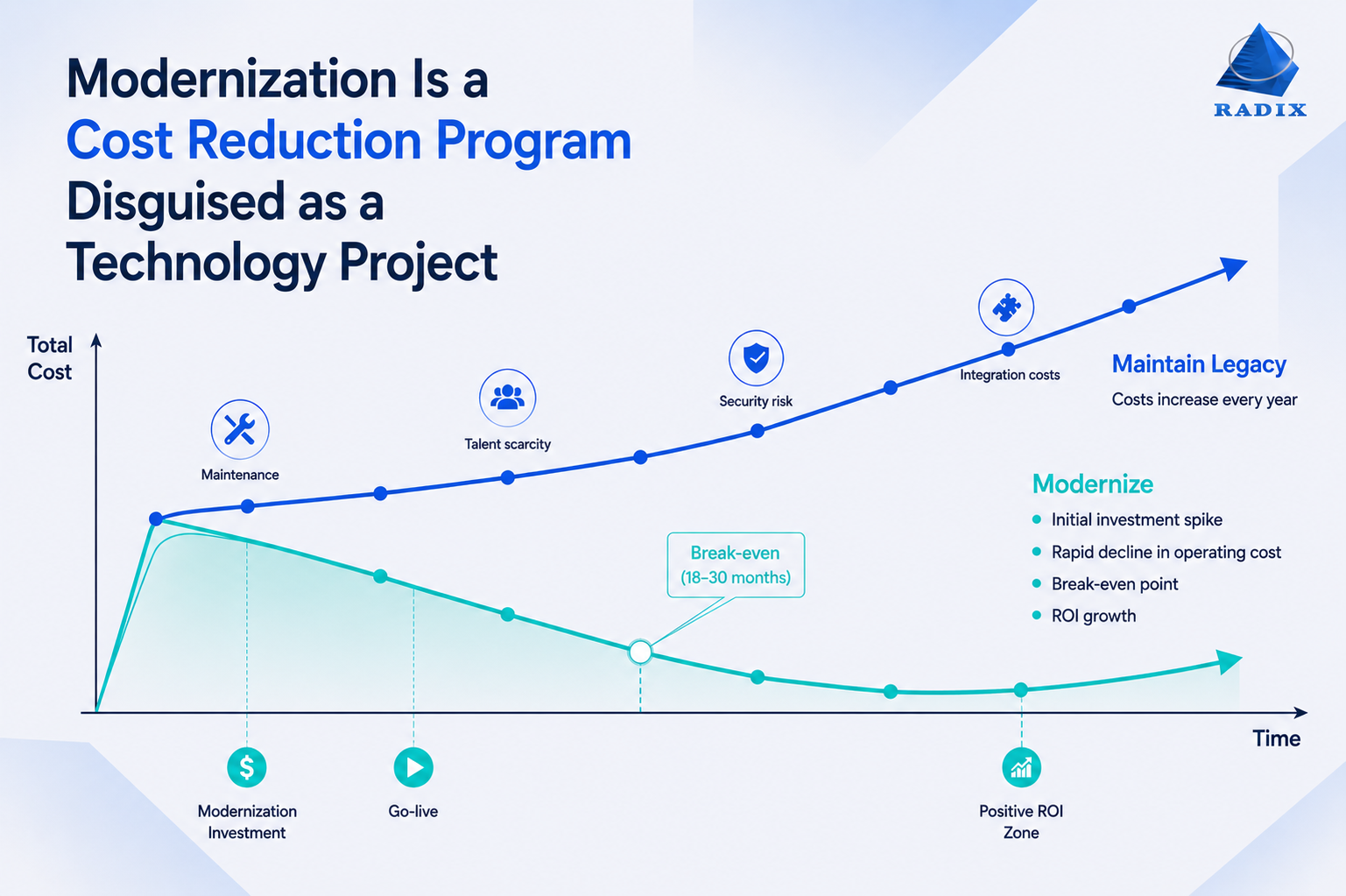
For a mid-size enterprise spending $600,000 annually on legacy maintenance (direct maintenance, talent premiums, integration overhead) and investing $1.2 million in modernization, the payback period is approximately 24 months from go-live, assuming maintenance costs drop by 70 percent post-modernization. Most mid-market organizations see payback between 18 and 30 months.
For larger enterprises with higher legacy maintenance costs, payback can arrive sooner in absolute terms even with higher modernization investment: a company spending $2.7 million annually on legacy maintenance that invests $3.5 million in modernization reaches payback in approximately 18 months.
The payback timeline shortens significantly when the modernization enables revenue-generating capabilities the legacy system blocked: real-time analytics, AI integrations, modern API connectivity, or new product features that couldn't be built on the legacy stack.
These benefits are harder to model in the business case but are often the actual reason modernization generates higher returns on investment beyond the maintenance cost reduction.
Budget Right and Build Your Modernization Roadmap Today
The organizations that complete modernization programs on budget are not the ones that got luckier with their systems. They're the ones that built the budget correctly from the start: with a pre-project assessment, a phase-gate structure, all hidden line items named, and the status quo cost as the comparison baseline.The number the board approves should be the number the project needs. Closing that gap is a business case problem before it's a delivery problem.That’s why at Radixweb, before we get started with application modernization services, we offer a bounded assessment phase that produces the architecture analysis and refined cost estimate required to build a budget that survives. If you are struggling with legacy systems and want to explore the possibilities that modernization can unlock, schedule a one-on-one consultation with our modernization specialists to scope an assessment before committing to a project budget.
Ready to brush up on something new? We've got more to read right this way.