

Read More


Recognized for AI Excellence at 2026 Globee® Awards - Read More

Anand Trivedi

The Quick Answer: Software modernization timelines aren't just driven by the age of a system. The complexity that the system has accumulated over time has a far-reaching impact. A well-maintained 3-to-5-year-old system can often be modernized in 5 to 8 months. A 10-to-15-year-old system typically takes 12 to 24 months due to undocumented integrations and hidden business logic. Read on to learn what drives these timelines and how to estimate them more accurately.
A couple of years ago, a California-based health insurance wanted us to modernize their contact center system. The system was last updated in 2012. For that project, our first task wasn't migration, but archaeology. We mapped what a system actually did versus what anyone thought it did. The full engagement ran 14 months with a 6-person team and helped cut 240-plus minutes per case.
But that discovery phase added weeks to the timeline before modernization started.
A 3-year-old system on a documented architecture with active institutional knowledge does not have this problem. The discovery phase is short. The execution phases can be estimated with real confidence before work begins. That same 14-month timeline on a 3-year-old system of equivalent scope would more likely run 6 to 8 months.
Over the past 26 years, we have refactored, rebuilt, and modernized 500+ projects and here’s what it has taught us:
System age determines almost everything else about a software modernization timeline
In this guide we walk you through what realistic modernization timeline planning looks like.

The need for AI-first features and changing customer expectations make it important to modernize legacy systems. The cost of delaying legacy modernization today far exceeds the actual cost of modernization.
But before any migration work begins, you need answers to four questions:
That’s what the discovery phase is for.
For a 3-year-old system, these questions take days to weeks. The codebase is recent. The architecture has some documentation. At least some of the people who built it are still reachable. The discovery phase in such projects is just a confirmation exercise.
For a 15-year-old system, the same questions can take months.
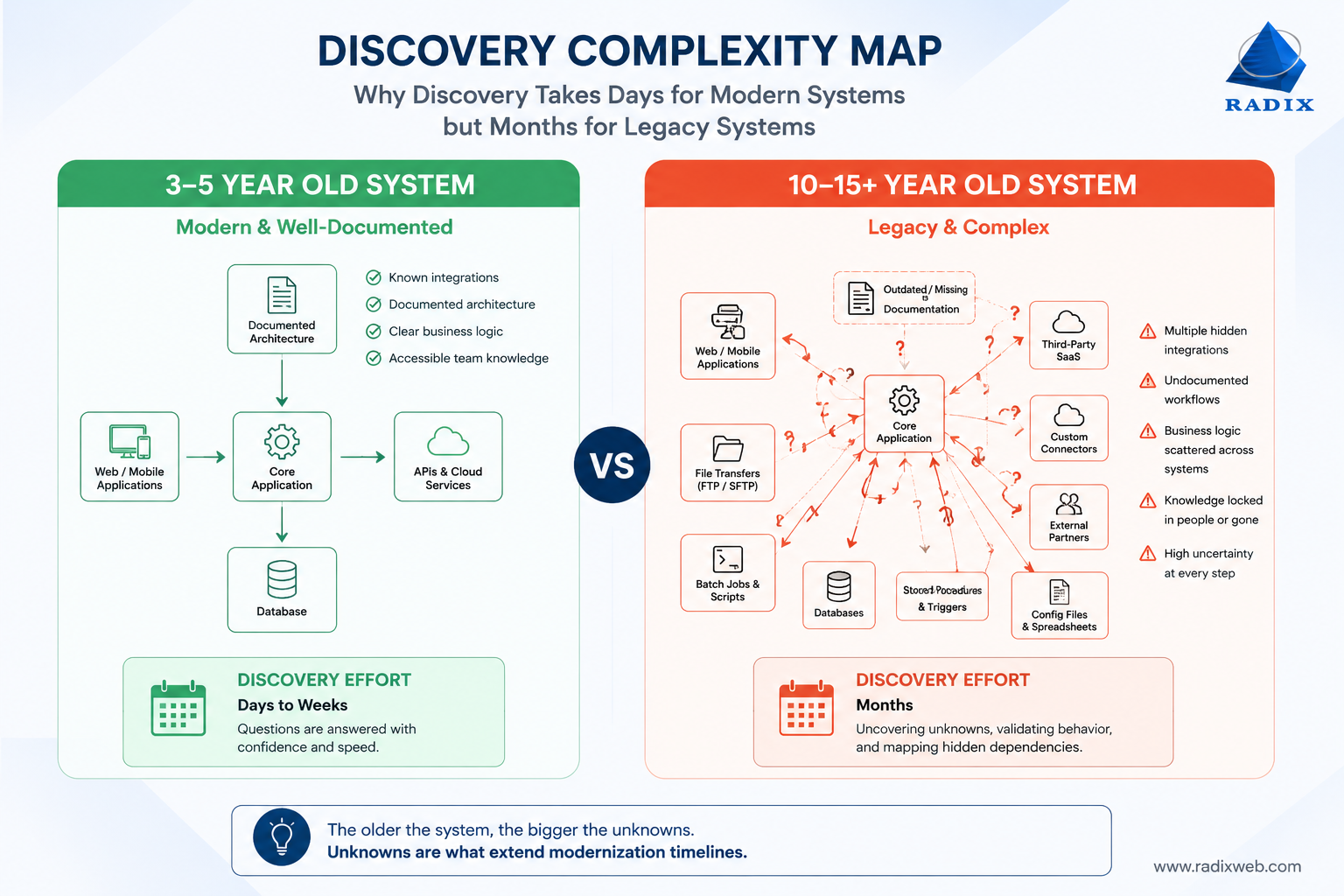
Here’s why the discovery phase for older systems is more complicated and often longer:
Systems accumulate behavior that was never written down. A feature built as a workaround in 2014 becomes critical by 2026 even when no document mentions it. Finding these undocumented behaviors requires reading code, running the system under different conditions, and interviewing whoever is left who remembers why certain decisions were made.
In our modernization work, one pattern is consistent: The number of integrations a system has is never what the documents tell.
For older systems, the expected vs. actual gap is wider. Each undocumented integration is a scope addition the original timeline didn't account for.
In recent system, business rules live in defined, testable application layers. In decade-old systems, they accumulate in stored procedures, batch scripts, configuration files, and temporary workarounds. Extracting, documenting, and validating that logic is why old-system projects run long.
This is the core reason the health insurance modernization needed 14 months despite having a 6-person team. With another client - a Melbourne-based HR software - initial architecture assessment helped understand the system's actual condition. The result? On-time delivery that the client noted was uncommon in their experience with IT projects.
A system built 3 to 5 years ago is a different category of problem. The technical debt is real but recent and understood. The architecture was built with current tooling. Integration patterns are API-based rather than file transfer or custom connector-based. And the team that built it is likely still partially accessible.
Here’s what a realistic timeline looks like phase by phase
| Phase | Duration | What It Covers |
|---|---|---|
| Assessment and architecture review | 3 to 5 weeks | Codebase audit, integration mapping, approach selection |
| Design and planning | 2 to 3 weeks | Target architecture, migration sequence, team setup |
| Execution (replatform or refactor) | 2 to 5 months | Migration execution, integration updates, testing in parallel |
| Validation and UAT | 3 to 6 weeks | Performance testing, stakeholder sign-off, edge case coverage |
| Cutover and stabilization | 2 to 3 weeks | Deployment, monitoring, initial post-launch support |
Total realistic range: 5 to 8 months for a mid-size system, replatform or refactor approach.
Pro tip for preventing timeline overruns: selecting the right application modernization strategy Architectural decisions made 3 years ago were optimized for the scale and constraints of that moment. A system that was designed as a monolith and has since grown to 10 times its original data volume may require rearchitecting rather than replatforming. So, if the assessment reveals that, add 4 to 6 months and recalibrate the approach before the execution phase begins.
Also Read: Finding The Right Partner For Mid-market ERP Modernization
A 15-year-old system requires a fundamentally different planning model. The phases are the same. The durations are not.
Why this category of system is different:
Here’s what a realistic timeline looks like phase by phase
| Phase | Duration | What It Covers |
|---|---|---|
| Discovery and architecture archaeology | 6 to 16 weeks | Codebase analysis, undocumented integration mapping, business logic extraction, dependency sequencing |
| Design and approach validation | 4 to 8 weeks | Target architecture, approach confirmed from discovery findings, risk register built |
| Execution (rearchitect or rebuild) | 6 to 18 months | Phased migration, parallel running for critical functions, integration rebuilding |
| Compliance and regression validation | 2 to 4 months | Full regression testing, regulated data validation where applicable, stakeholder sign-off |
| Cutover and decommission | 4 to 8 weeks | Phased cutover, legacy decommission with documented evidence, post-launch stabilization |
Total realistic range: 12 to 24 months for a mid-size enterprise system. Large enterprise systems with high integration counts or regulated data run 18 to 36 months.
What the discovery range (6 to 16 weeks) actually depends on:
The discovery phase for a 15-year-old system has a wider range than any other phase because it's the phase where the unknown-to-known ratio is highest. The specific variables that determine where in the range a project lands:

These are not random failures. They follow identifiable patterns that differ by system age.
A system planned as a replatform turns out to require rearchitecting. Or a planned refactor reveals that the core architecture is so tightly coupled that decomposing it without a rebuild is more expensive than rebuilding. When this discovery happens during execution rather than during assessment, the team has to stop, replan, and renegotiate scope. That replanning cost typically runs 4 to 8 weeks on top of whatever timeline revision follows.
This is one of the project-collapsing mistakes that are more common on 3-to-5-year-old systems than on genuinely old ones. Old systems are more likely to have had a full architectural assessment before work begins. But newer systems are more likely to be underassessed because the team assumes the system is simple enough to evaluate quickly.
If you plan on modernizing a legacy software solution in multiple parallel workstreams, it often hits a dependency: workstream 2 can't complete until a specific component of workstream 1 is stable. If this dependency isn't visible in the dependency map built during discovery, it surfaces during execution and requires a full replanning of the sequence. For a 15-year-old system, undocumented dependencies between components are common enough that a 30 to 40 percent contingency buffer specifically for this pattern is not pessimism but historical accuracy.
This is the most preventable timeline failure that we’ve seen happen across legacy software modernization engagements across domains and enterprise scales. What happens: A date gets communicated to the board or to customers before the discovery phase has produced findings that could support or contradict it. When discovery reveals that the system is more complex than the pre-discovery estimate assumed, the team has to either compress later phases or request a revision.
Compressed phases produce lower quality. Timeline revisions require explanation.
Both outcomes are avoidable by structuring the commitment as a range tied to discovery completion rather than a date tied to a project start.
Choosing reliable app modernization partners who understand the importance of the discovery phase can help avoid all these failure patterns.
Regulated systems add a compliance validation layer to the modernization timeline that operates independently of system age or technical execution speed. That’s why the timeline for modernizing an EHR system while staying HIPAA-complaint can be widely different from the timeline for modernizing a regular system.
The fixed additions for regulated systems include:
The legacy system must remain operational and demonstrably compliant while the new system proves itself. For healthcare systems under HIPAA, for example, this period runs 4 to 12 weeks after the new system reaches production stability. A retail system may show transformative modernization outcomes faster as it needs a shorter overlap.
Each migration phase for a regulated system requires documented evidence that data handling, access controls, and audit trail requirements were maintained throughout. This documentation work adds 10 to 15 percent to total project time on regulated systems versus equivalent unregulated ones.
Some regulated industries require advance notification to oversight bodies before migrating systems handling specific data types. This lead time is external and not controllable. Build it into the project calendar before execution begins, not after a notification window has passed.
For organizations in regulated industries, compliance requirements should be treated as a core part of the timeline, not an afterthought. Building these activities into the plan from the start leads to more accurate estimates and fewer surprises during execution.

Using AI for modernizing outdated systems is a common practice today. AI-assisted code analysis especially has changed the discovery phase economics. But that’s most noticeably for recent systems.
For a 3-to-5-year-old system on a modern stack with accessible documentation, AI tooling compresses dependency mapping, integration inventory, and test scaffolding generation. Discovery phases that previously ran 6 to 8 weeks on this type of system now run 3 to 4 weeks under AI-assisted workflows. That compression is real and clients see it in reduced assessment costs and faster project starts.
For a 10-plus-year-old system, the acceleration is partial. AI tooling reads code faster than humans and surfaces dependency patterns more quickly than manual analysis. But it cannot tell you whether a specific behavior is intended or an accidental one that became relied upon. It cannot reconstruct the business reasoning behind a 2013 stored procedure that has no comments and no corresponding documentation. Those determinations still require human judgment, and they still scale with system age.
Artificial intelligence is also being across the modernization project lifecycle, but that doesn’t mean timeline will shrink suddenly. Also, it is important to not apply AI-compressed timelines to old systems based on case studies from recent ones. The starting conditions are different enough that the outcomes aren't comparable.
Most vendors can give you a timeline before a legacy migration project starts. But the real question is whether that timeline is based on facts or assumptions. As legacy modernization projects become a strategic priority on the board agenda, accurate budgets and timelines are crucial.
Before you approve a modernization project, make sure the estimate takes the following factors into account.
Older systems usually take longer to modernize because there is more to uncover. Documentation may be outdated, key team members may have left, and important business rules may exist only in the code itself. The older the system, the more time is needed for discovery and planning.
Most business applications are connected to other systems, tools, and data sources.
The more integrations a system has, the more work is needed to understand, test, and migrate them. If some integrations are undocumented, the timeline can grow even further once discovery begins.
Not all systems of the same age are equally complex.
A well-organized application is usually easier to modernize than one that has been patched, extended, and modified for years. Hidden technical debt often adds work that isn't visible at first glance.
A timeline depends heavily on what you're trying to do.
Moving an application to a new platform is very different from redesigning its architecture or rebuilding major parts of it. A good estimate should be based on the right modernization approach for your system.
If your business operates in a regulated industry, additional steps may be required for testing, validation, documentation, and approvals. These activities take time and should be included in the timeline from the start, not added later.
So, before you choose from a list of the top app modernization partners, don't just ask for a timeline. Ask how they arrived at it. A strong partner should be able to walk you through each phase of the project, explain the assumptions behind the estimate, and show how the timeline was built.

The Timeline Starts with Knowing What You're Actually Modernizing
There is no way to share an accurate timeline for modernizing outdated applications and systems without proper discovery. In fact, the organizations that complete modernization programs on their stated timelines aren't the ones with simpler systems. They're the ones that built the timeline from a realistic assessment of what they were starting with, applied the right contingency for the type of system, and structured the stakeholder commitment as a range rather than a date.At Radixweb, the first step in our legacy modernization engagements is a bounded discovery engagement. It is during this phase that we produce the architecture findings and integration inventory needed to narrow the timeline range before the full project is committed. If you're planning a modernization and need a timeline estimate before your board presentation, schedule a 30-minute discovery call with our modernization specialists to get your discovery phase scoped first,
Ready to brush up on something new? We've got more to read right this way.

