Read More


Recognized for AI Excellence at 2026 Globee® Awards - Read More

Maitray Gadhavi
What's Inside: A framework for evaluating mid-market ERP partners that prevents the #1 failure pattern in mid-market modernizations: buying an enterprise engagement model built for companies twice your size. Includes the specific signals in a partner proposal that reveal whether they're built for your size or adapting downward.
The most expensive mistake in mid-market ERP modernization is not choosing the wrong platform. It's choosing the wrong engagement model for your organization's size.
Mid-market enterprises (typically 500 to 2,000 employees, $50M to $500M in revenue) sit in a structural gap in the growing app modernization market (expected to be worth more than $24.8 billion by 2029). Large system integrators (the Big Four and their equivalents) have delivery models built for Fortune 500 programs: large teams, layered governance structures, change request processes that add weeks to every scope adjustment, and billing rates that reflect the overhead of organizations serving clients 10 times your size. Boutique partners built for SMBs often lack the technical depth that mid-market ERP complexity requires.
The mid-market organization that buys a scaled-down enterprise engagement model typically discovers the mismatch within the first three months: the team is larger than needed, the process overhead is higher than the project justifies, and the change request mechanism is consuming budget faster than the actual development work.
This guide covers how to evaluate ERP modernization partners specifically for the mid-market context, what the right engagement model looks like, and the specific signals in a partner's proposal that tell you whether they've built for mid-market or adapted their enterprise model downward.
The failure patterns in mid-market ERP programs differ from enterprise failure patterns in two specific ways that inform how partners should be evaluated.
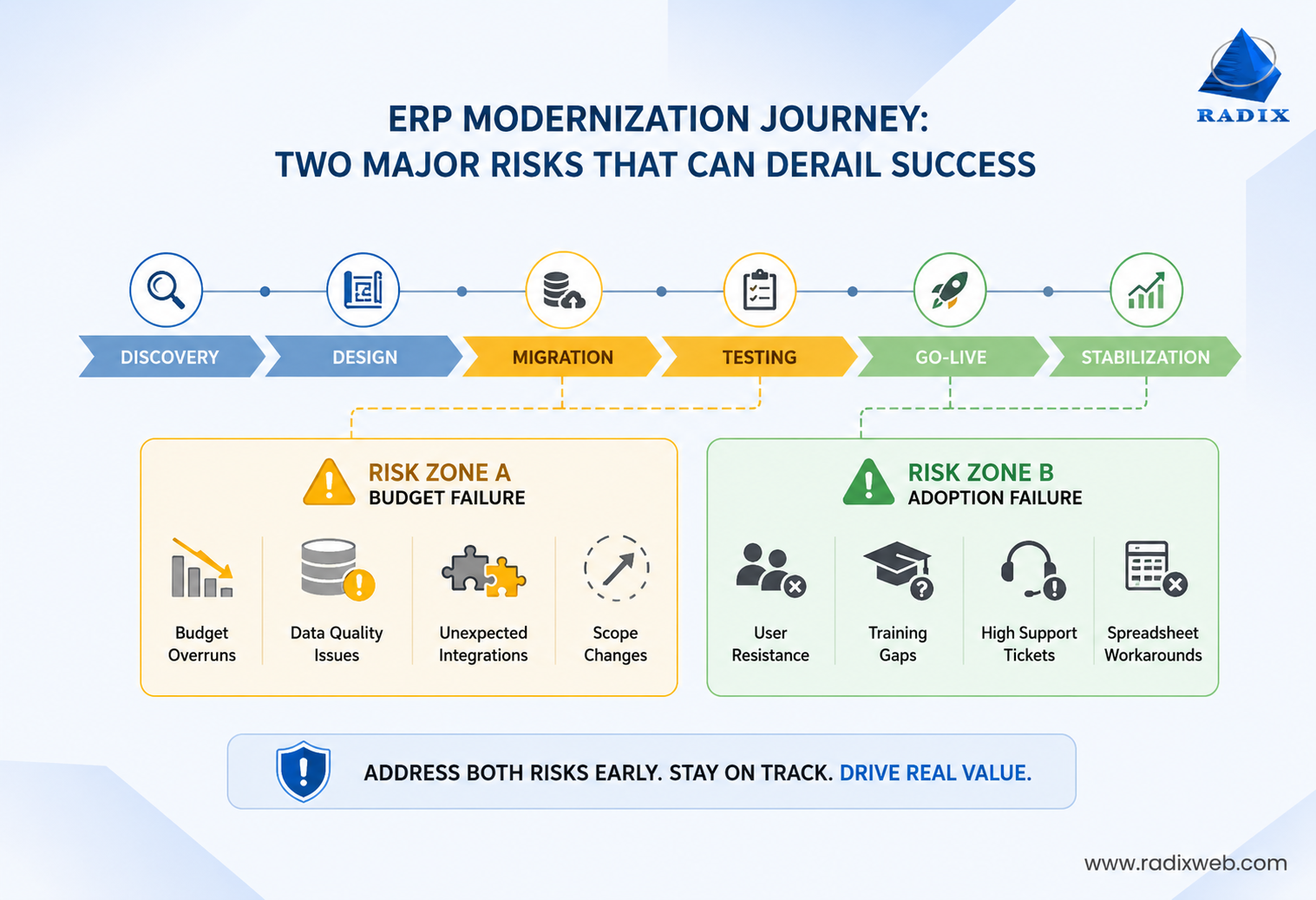
Mid-market organizations typically budget 20 to 30 percent less contingency than enterprise programs because the initial scope feels more manageable. When data quality issues surface during migration (they always do!), or when legacy customizations turn out to be more complex than the initial assessment documented, the contingency runs out before the program is complete. The project either stalls for a budget conversation or compresses the testing and change management phases to stay within the original budget. Both outcomes produce a worse go-live.
Softwaremodernizationservices.com's 2026 ERP modernization analysis puts the standard contingency recommendation at 20 to 30 percent of total program budget. That recommendation exists because scope creep and data quality issues are not exceptions in ERP modernization programs. They're consistent occurrences.
ERP systems change how people work. Finance, procurement, operations, and HR all have workflows that run through the ERP. When the new system works differently than the old one, those workflows break unless the people running them have been trained, supported, and given enough time to adapt before go-live.
Organizational change management (OCM) addresses this. Industry benchmarks put OCM investment at 15 to 20 percent of total program budget for successful ERP go-lives. Mid-market programs consistently under-invest in OCM because it doesn't look like technical work in the budget breakdown. The cost shows up later in the form of slower adoption, elevated post-go-live support load, and in some cases, user workarounds that recreate the problems the new ERP was bought to solve.
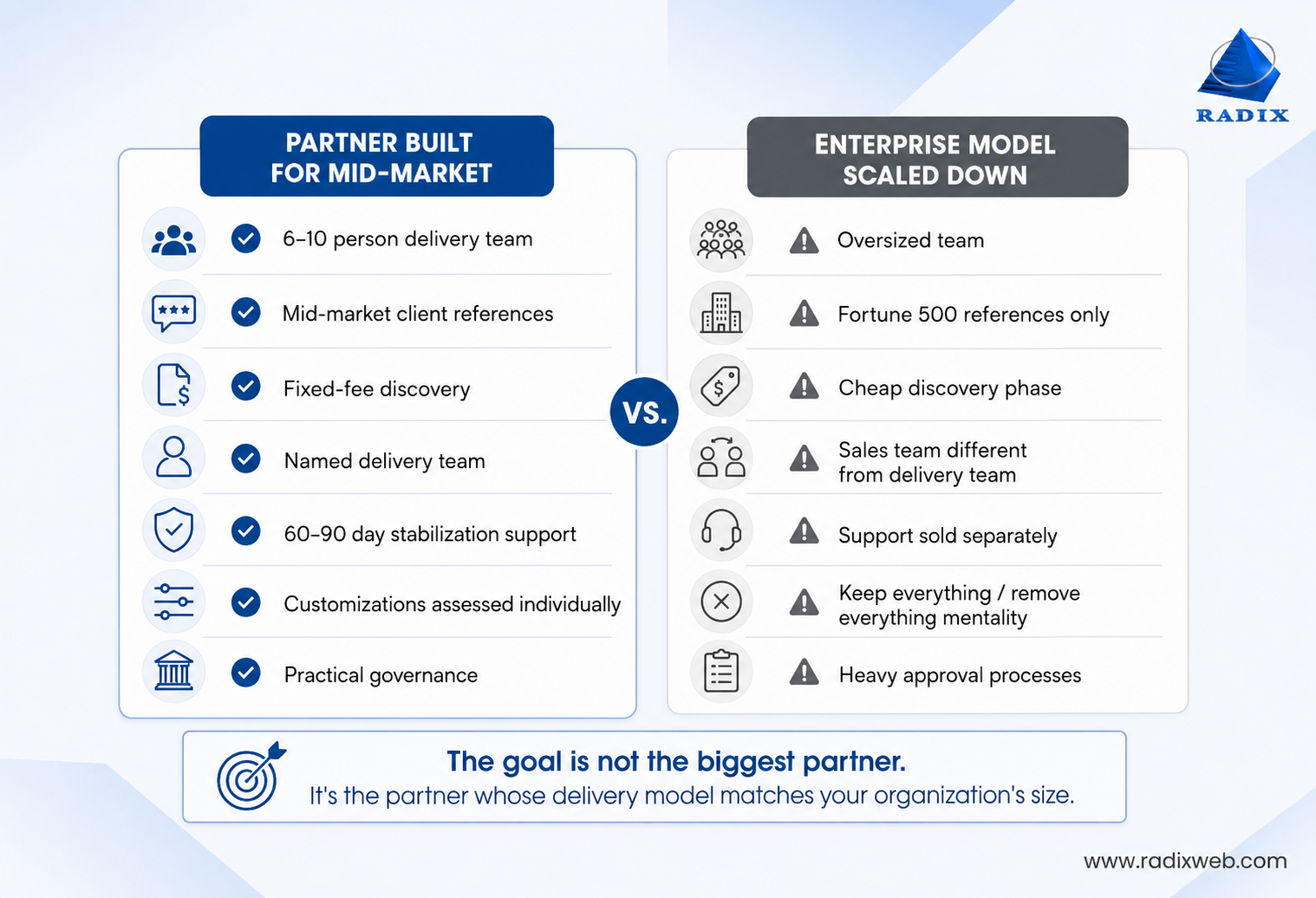
One of the biggest mistakes organizations make when getting their legacy systems modernized is believing that the right modernization partner is the largest firm available. In reality, it is the firm whose typical client profile matches your organization's size, complexity, and budget range. Here’s what you should be looking for:
For organizations with 500–1,000 employees, ERP modernization projects typically require a core team of 6–10 specialists. This includes a solution architect, 3 to 5 senior developers or functional consultants, a project manager, a data migration specialist, a QA engineer, and a change management lead. Partners proposing significantly larger teams may be introducing delivery overhead that increases costs without improving outcomes.
For example, when Radixweb modernized the IT infrastructure for a California-based health insurance company with 40-plus branch offices and 85,000+ customers, the delivery team was 6 experts over 14 months. The outcome: a complete on-premises-to-Azure migration of their contact center infrastructure, cutting over 240 minutes per case after go-live. The team size matched the program scope. There was no engagement overhead that didn't serve the delivery.
Mid-market reference clients, not enterprise case studies. Ask specifically for reference clients in your revenue range ($50M to $500M) and your industry. A partner whose case studies all feature organizations 10 times your size has a delivery model built for those organizations. Modernizing legacy business applications for mid-market organizations is not a smaller version of a Fortune 500 program. It has different governance requirements, different data complexity, different integration counts, and a different tolerance for program disruption.
Also, make sure you look for domain-specific expertise. An ERP implementation or modernization for healthcare differs widely from ERP for fintech or logistics, and your partner should understand not just the tech, but your business too.
Time-and-materials engagements transfer all the scope risk to you. Every undocumented requirement, every data quality issue discovered mid-migration, and every integration that wasn't in the initial inventory becomes a change request that adds to the T&M total. For mid-market organizations planning or building a legacy modernization strategy with tighter budget constraints, fixed-fee engagements are ideal for defined phases (discovery, data migration, testing). It helps balance the scope risk of the fixed fee is based on a genuine discovery phase not an estimate built from surface-level assumptions.
The 90 days after ERP go-live are the highest-support-demand period of the entire program. Integration failures, user adoption issues, and data quality problems that weren't caught in UAT all surface here. Also, if you have integrated artificial intelligence to your ERP, you’ll need model management and training support after go-live. A partner whose contract ends after launch leaves your organization managing this period without the people who built the system. Require post-go-live support terms (minimum 60 to 90 days of stabilization support) as a condition of the engagement, not an add-on negotiated after the primary contract is signed.
A strong ERP modernization partner aligns with your organization's scale, risk profile, and budget constraints, not just your technology requirements.
The discovery phase is the most consequential investment in an ERP modernization program and the one that partners most frequently underscope to make the initial engagement price competitive.
Also, the discovery phase should do more than produce a project estimate. It should reduce uncertainty, identify risks, and provide the information needed to make a confident modernization decision. At a minimum, look for these deliverables:
A complete inventory of ERP modules, integrations, data flows, and customization layers. Integrations should be validated through system analysis and logs, not interviews alone.
A documented recommendation of which customizations to retain, redesign, or retire. Customizations tied to competitive advantage or regulatory requirements should remain; those duplicating standard ERP functionality should be eliminated.
An evaluation of duplicate records, inconsistent data formats, orphaned transactions, and master data issues. This assessment helps determine the true effort required for migration and cleansing.
A prioritized list of the 3–5 most likely risks to timeline, budget, or deployment success, along with mitigation plans and ownership recommendations.
An updated implementation roadmap, resource plan, timeline, and budget based on actual findings rather than assumptions.
If a discovery phase cannot produce these deliverables, it is unlikely to provide the visibility required for a successful ERP modernization program.
Every mid-market ERP modernization program faces the same customization conversation, and most partners avoid taking a position on it because recommending elimination of customizations reduces their own scope.
The direct answer: most mid-market organizations carry 30 to 50 percent more ERP customization than they need. The accumulation happens the same way in almost every organization. An ERP is implemented with a set of customizations required at that moment. The business evolves. Some customizations become irrelevant but are never removed because nobody documents them as optional. The ERP upgrades. The customizations migrate with it. By the time a modernization program begins, the legacy ERP is running a combination of genuinely required customizations, historically relevant customizations nobody has assessed recently, and pure technical debt from decisions made a decade ago.
Here’s a decision matrix to help you decide:
| Keep | Eliminate | Assess |
|---|---|---|
| Unique business-process customizations | Native ERP functionality duplicates | Processes that may have changed |
| Regulatory and compliance requirements | Legacy workflow workarounds | Obsolete business workflows |
| Critical third-party integrations | Custom reports replaceable by built-in analytics | Low-usage or unclear-value customizations |
The partner who walks into a discovery phase with a predetermined answer to this question ("keep everything" or "eliminate everything") is not doing a genuine assessment. The right answer is specific to each customization, and it requires the partner to understand your business well enough to distinguish competitive differentiator from legacy technical debt.
A well-structured RFP process surfaces capability differences between partners that generic credential comparisons don't.
Four questions that most ERP modernization RFPs don't ask but mid-market buyers should ask for evaluating a partner for legacy software modernization include:
The best legacy application modernization partners who have genuine delivery experience will have specific answers to this question. They’ll be able to explain the type of data quality issues found, how the discovery phase surfaced them, what the remediation approach was, and how it affected the timeline and budget. A partner adapting an enterprise playbook to your size will give a generic answer about data migration best practices.
Not a methodology document. Not a case study summary. The actual discovery deliverable: architecture map, customization inventory, data quality assessment, and go-live risk register. Redacted for confidentiality is fine. This request separates partners who have a discovery process from partners who have a discovery slide deck.
This is where T&M versus fixed-fee risk allocation becomes concrete. The answer should describe a specific process: how the change is documented, how the impact is assessed, how the decision to proceed gets made, and how the budget adjustment is handled. Partners without a clear process for this will absorb scope changes in ways that either extend timelines unexpectedly or compress testing and change management phases.
Large system integrators frequently use senior partners to win engagements and then staff junior teams for delivery. For a mid-market program where the delivery team is 6 to 10 people, losing a senior developer or solution architect mid-program is a significant disruption. Ask for named team members, their direct experience with your ERP platform, and the partner's commitment and process for replacing key roles if attrition occurs during the program.
A partner's answers to these questions reveal far more about delivery risk than certifications, credentials, or case studies ever will.
The contract model you choose determines who absorbs the scope risk that exists in every ERP modernization program. Understanding the trade-offs before signing can prevent budget overruns, change request disputes, and project delays later.
| Criteria | Fixed-Fee | Time-and-Materials (T&M) |
|---|---|---|
| Scope Risk | Primarily absorbed by the implementation partner | Primarily absorbed by the client |
| Budget Predictability | High | Low to Moderate |
| Change Requests | Less frequent when discovery is thorough | More common as scope evolves |
| Best For | Well-defined projects with completed discovery | Projects with evolving or uncertain requirements |
| Cost Impact of Data Issues & Hidden Complexity | Usually covered within the agreed scope | Typically billed as additional effort |
| Mid-Market Suitability | Strong fit due to greater cost certainty | Often challenging because of budget |
For most mid-market ERP programs, a phase-gate approach for modernizing old or unyielding software solutions provides the best balance of flexibility and cost control. This typically means a fixed-fee discovery phase followed by a refined fixed-fee or capped T&M engagement based on validated findings. At Radixweb, we recommend grounding all commercial models in a structured discovery process that validates integrations, customizations, data quality, and implementation scope before long-term commitments are made.
Starting Your ERP Modernization Journey
Choosing an ERP modernization partner is not a vendor selection. It's a decision about who absorbs the risk that is inherent in every ERP program: scope risk, data quality risk, integration complexity risk, and user adoption risk. Before committing to a full program, ensure the discovery phase produces actionable deliverables, validate experience through mid-market references, secure post-go-live support in the primary contract, and treat organizational change management as a core investment. These steps create the foundation for a predictable modernization journey with fewer surprises.At Radixweb, we help organizations of all scales and across domains modernize legacy systems through structured discovery, application modernization, system integration, data migration, and long-term support services. Our bounded discovery engagements deliver the architecture roadmap, customization assessment, data quality analysis, and realistic cost estimates needed for informed decisions. Schedule a consultation with our experts to reduce modernization risk, validate project scope, and build a clear ERP transformation roadmap.
Ready to brush up on something new? We've got more to read right this way.