Read More


Recognized for AI Excellence at 2026 Globee® Awards - Read More

Nihar Raval

Why You Should Read This Article: If you are planning to build a mobile app in Australia, read this to-the-point article to understand where development costs come from beyond generic pricing estimates and plan more realistically before speaking with development vendors.
Key Takeaways
● Australian app costs range AUD 30K–300K+, varying by complexity from simple MVPs to enterprise builds.● App complexity drives 60%+ of pricing through features, user roles, integrations, and backend logic.● Quotes cover end-to-end delivery: discovery, design, development, testing, launch, and support.● Hidden costs add 20–50% annually, covering infrastructure, maintenance, third-party APIs, compliance, and app store fees.● Budget formula: Hours (2K–8K) × AUD 100–200 rate + 15–25% design + 10–20% QA + maintenance.● Radixweb’s delivery model blends global scale with Australia-specific compliance expertise for optimal ROI.
The type of app, the features you need, the platform you choose, and the complexity of design and integrations strongly impact the cost to build an app in Australia. A simple app with basic functionality may sit at the lower end of the budget range, but a feature-rich, scalable, or compliance-heavy product can require a much larger investment. A feature-rich, scalable, or compliance-heavy product can require a much larger investment.
For businesses planning an MVP, startup launch, or enterprise solution, understanding these cost drivers is essential before requesting quotes.
This guide breaks down how app development costs are actually formed beyond the surface-level pricing ranges you typically see online. We’ll look at how technical architecture, product decisions, platform strategy, compliance expectations, and even internal business workflows can quietly increase costs in Australia.
More importantly, it will help you distinguish between features that genuinely create business value and those that simply inflate engineering scope. The objective is to give you a more grounded understanding of how to budget realistically and make smarter product decisions before development.

A simple app might start around AUD 30,000 to AUD 80,000, while mid-range builds often sit around AUD 80,000 to AUD 150,000. Complex or enterprise apps can move above AUD 300,000 depending on scope, integrations, platform strategy, and compliance requirements.
| App type | Typical cost range | Best suited for |
|---|---|---|
| Simple app | AUD 30,000–AUD 80,000 | MVPs, basic business apps, lightweight product ideas |
| Mid-complexity app | AUD 80,000–AUD 150,000 | Growing businesses, multi-feature apps, connected workflows |
| Complex / enterprise app | AUD 300,000+ | Regulated industries, advanced integrations, scalable platforms |
What this includes: Strategy, design, development, testing, launch support, and cost variables such as integrations, platform choice, and compliance.
Startups commonly begin with an MVP approach to control risk and validate their product idea before committing to a larger technology investment.
In many cases:
Mobile app development costs in Australia are shaped by six core factors - the app's complexity, platform choices, design requirements, backend needs, testing scope, and team expertise.
Getting these right upfront prevents scope creep and budget overruns, which affect up to 70% of projects.
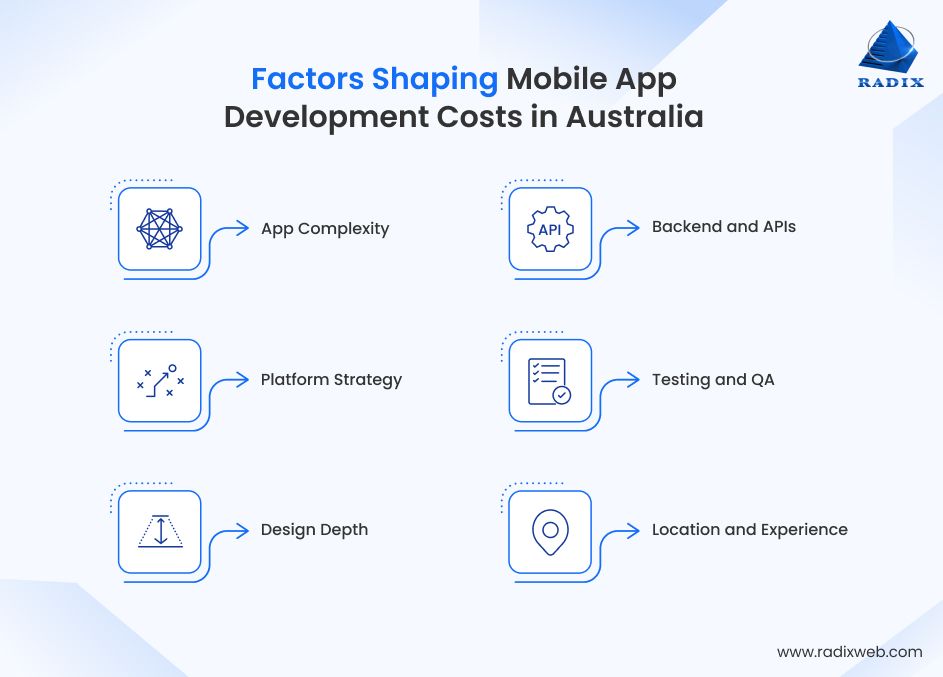
App complexity drives the largest pricing swings, since each added layer increases design, coding, testing, and maintenance effort.
Your platform choice directly impacts build time and cost. Understanding the strengths and trade-offs of each option is easier when exploring mobile app platform considerations for businesses before locking in a direction.
Basic design templates keep costs low, but custom UX with design systems, motion graphics, onboarding flows, and high-fidelity prototypes adds significant hours.
It’s important to understand the nuances of mobile app design to figure out where these investments have a directly impact.
Expect phases like:
Note: Custom design can increase the total budget by 20–30%, but it’s also important to improve retention and conversion rates.
Backend architecture handles authentication, databases, admin panels, and integrations. Cloud setup (AWS, Azure) supports scalability, and payment gateways (Stripe), maps (Google Maps), CRM/ERP systems, push notifications, chat, video streaming, or booking logic add custom development.
A well-planned mobile app backend development approach is one of the strongest levers for controlling both build cost and long-term infrastructure spend.
Testing scales with everything else. More features mean more test cases on devices, OS versions, and edge cases. Keeping up with the current trends in testing and QA — from AI-powered automation to continuous security testing — is key to managing this complexity efficiently.
Australian teams charge premium rates, which is AUD 100–200/hour due to local talent scarcity, higher living costs, and expertise in compliance-heavy projects.
Note: Experience level alone can vary quotes by 50%.
If you want a deeper breakdown of each phase where money is spent, the full stages of mobile app development explain how effort accumulates from discovery through launch.
One of the most practical ways to estimate app development costs is to categorize the project by product maturity and operational complexity. Most Australian mobile app projects fall into one of four broad categories - simple apps, MVPs, mid-complexity applications, and enterprise-grade systems.
Simple mobile apps are typically the most affordable category of app development in Australia. These apps are usually designed to solve one focused business problem or deliver a straightforward customer interaction.
Typical scope: 5–10 screens with basic navigation, static content, and one primary workflow like contact forms or product catalogs.
Core screens: Home, about, services, contact, simple forms.
Workflows: User onboarding, basic search/filter, email capture.
Backend: Minimal with static data or lightweight API for forms.
Timeline: 8–12 weeks.
Estimated price range: AUD 30,000–AUD 80,000.
An MVP, or Minimum Viable Product, is usually the most practical first investment for startups and early-stage businesses. You build the smallest possible version of the product and generate real user feedback.
A focused research on the current mobile app market process before building your MVP helps you validate assumptions earlier and reduce the risk of building features users do not actually need.
What belongs: Core value proposition only, such as 3–5 key screens to validate market fit, like user signup, basic dashboard, and one monetization flow.
What to exclude: Advanced analytics, social features, AI, or polish until validated.
Why best for startups: Startups rely on enterprise-grade services for MVP development to test assumptions fast at 30–50% less cost than full builds, reduces risk, and enables iteration based on real data.
Timeline: 10–16 weeks.
Estimated price range: AUD 50,000–AUD 100,000.
Mid-complexity applications represent a large portion of commercial mobile app projects in Australia.
Typical scope: 15–25 screens with multiple user roles (e.g., customer, admin), push notifications, and moderate customization.
User roles: Customers, support staff, basic admin dashboard.
Integrations: Payments (Stripe), email (SendGrid), analytics (Firebase).
Backend: User auth, moderate database logic, API orchestration.
Custom UI: Branded design with some animations.
Timeline: 16–24 weeks.
Estimated price range: AUD 80,000–AUD 150,000.
Enterprise mobile applications sit at the highest end of the Australian app development cost spectrum.
The architectural decisions made at this stage have long-term implications, and reviewing what goes into building mobile apps for complex business environments before scoping can prevent expensive rework later.
Typical scope: 30+ screens with high security, scalability for thousands of users, and deep integrations.
Security: Encryption, penetration testing, audit logs. SSO: OAuth, SAML integration.
Compliance: Australian Privacy Principles, APRA/PCI-DSS if regulated.
Scale: Cloud architecture (AWS/Azure) for high traffic.
Timeline: 6–12 months.
Estimated price range: AUD 200,000–AUD 500,000+.
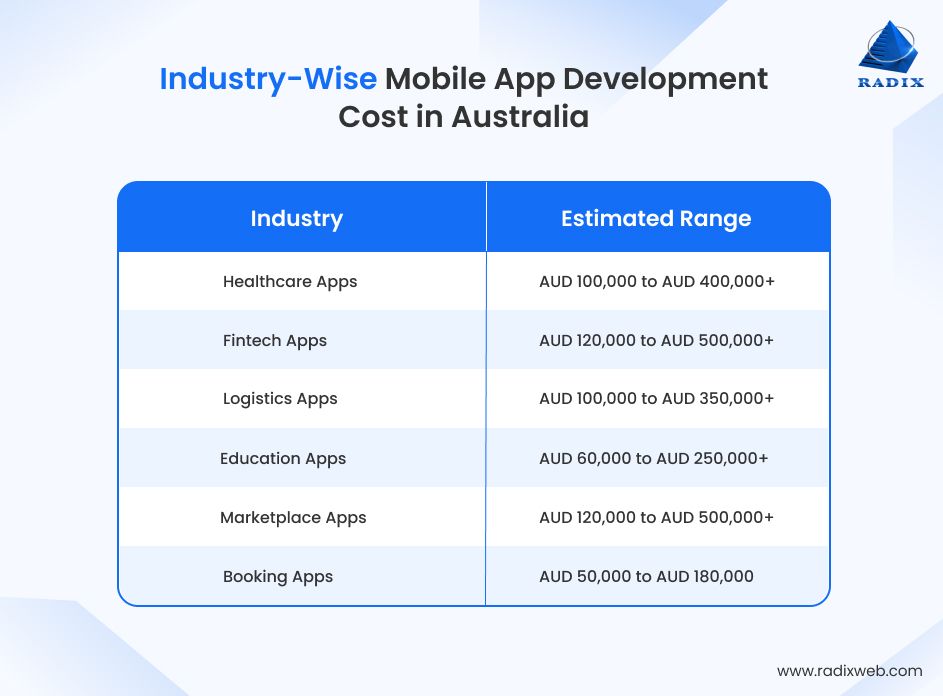
Industry-specific requirements can dramatically affect the cost to develop a mobile app in Australia.
1. Healthcare Apps
Because of privacy and security obligations, building apps for hospitals, clinics, and health networks costs more to develop and maintain than standard consumer apps.
Estimated range: AUD 100,000 to AUD 400,000+
2. Fintech Apps
Security testing and backend infrastructure significantly increase development complexity. Working with a team that specializes in fintech app development can help scope these costs realistically from the start.
Estimated range: AUD 120,000 to AUD 500,000+
3. Logistics Apps
These applications rely heavily on backend scalability and real-time data handling, core requirements in app solutions built for freight, fleet, and delivery networks.
Estimated range: AUD 100,000 to AUD 350,000+
4. Education Apps
Interactive learning workflows and content delivery infrastructure of education apps can substantially affect pricing, which is why app built for academic institutions and e-learning environments requires careful feature and infrastructure planning.
Estimated range: AUD 60,000 to AUD 250,000+
5. Marketplace Apps
Marketplace platforms are among the most technically demanding app categories because they support multiple user groups, payment systems, operational workflows, and transaction management.
Estimated range: AUD 120,000 to AUD 500,000+
6. Booking and Scheduling Apps
The complexity rises significantly when multi-location scheduling or operational automation is involved.
Estimated range: AUD 50,000 to AUD 180,000

Coding does not cover the entire Australian mobile app development pricing. You will find agencies deliver a complete end-to-end package, starting from initial consultation through launch and post-deployment support.
Enterprise leaders should understand what's included to compare apples-to-apples and spot gaps in cheaper quotes. A standard quote reflects 2,000–8,000+ hours across phases, with well-defined deliverables at each stage.
This upfront phase aligns your product idea with technical reality, with the goal of minimizing costly pivots as much as possible. It includes:
Expect 2–6 weeks and 5–15% of the total budget here. Skipping it risks 20–30% overspend downstream.
Engaging expert consulting services for mobile app development at this stage can sharpen your scope definition and reduce the likelihood of expensive mid-project course corrections.
Design is where your product's usability is won or lost, long before development begins. It also gives stakeholders a concrete artifact to react to. Quotes cover:
Custom design phases typically take 4–8 weeks and account for 15–25% of the budget, with 2–3 revision rounds included.
How this phase is structured, and how closely it tracks the original scope, is the single biggest determinant of whether you hit your timeline and budget. It includes:
The programming languages used for mobile app development directly influence how quickly the team can move and how maintainable the codebase remains long term.
This phase dominates at 50–60% of the budget and 12–32 weeks.
Testing and QA run in parallel with development and continue through to launch readiness. The coverage includes:
Expect testing for 10–20 devices, multiple OS versions, and performance benchmarks will be consuming 10–20% of the budget over 2–6 weeks.
Submitting to the App Store or Google Play is a process with its own requirements. Quotes of the app launch phase cover:
This 1–3 week phase catches 3–7% of the total budget.
Enterprises require ongoing compatibility work to keep the app functional and secure. Standard post-launch support and maintenance quotes include:
Budget 10–15% annually ongoing. Quotes often transition to retainer models here.
Understanding the full importance of mobile app maintenance after launch is critical, as it is where many businesses underestimate ongoing spend.
App ownership continues even after paying the development quote, with expenses that can add 20–50% to your first-year budget. While focusing on build costs is important, you should also take these ongoing fees like cloud bills, store commissions, and compliance work into account.
Apple Developer Program costs AUD 150/year; Google Play Console is AUD 35 one-time.
Both platforms take 15–30% commissions on in-app purchases, subscriptions, or paid downloads, which means earning AUD 10 subscription nets you AUD 7–8.50 after fees.
Enterprise distribution or beta testing tools add extra licensing, easily AUD 500–2,000 annually for active apps.
Servers (AWS EC2, Azure VMs), databases (PostgreSQL, Firebase), file storage (S3), CDN for global delivery, and monitoring (CloudWatch, New Relic) start at AUD 50–200/month for low traffic but scale to AUD 1,000–5,000+/month for active users.
A marketplace app with real-time data might hit AUD 20,000/year just on infrastructure. A well-thought-out mobile app architecture from the start can particularly prevent cloud infrastructure redesign-related costs as your user base scales.
Payment gateways (Stripe: 1.75% + AUD 0.30/transaction), SMS (Twilio: AUD 0.05/message), email delivery (SendGrid: AUD 0.01/email), maps (Google Maps: AUD 7/1,000 loads), CRM (HubSpot/Salesforce), and analytics (Mixpanel) add up fast.
A mid-sized app with payments, notifications, and tracking could see AUD 5,000–15,000/year in subscriptions.
Privacy policies, terms of service, and data handling reviews cost AUD 2,000–5,000 initially, plus annual updates for APP compliance.
Security audits or penetration testing for fintech/healthcare run AUD 10,000–30,000. At the same time, regulated apps need legal sign-off before launch, often 5–10% of the build budget.
App Store Optimization (ASO) tools and keyword research would take AUD 2,000–5,000.
Paid acquisition (Apple Search Ads, Google UAC) costs AUD 5,000–50,000 for initial traction, and Creative assets (videos, screenshots) and launch campaigns add another AUD 3,000–10,000.
Budget 15–20% of build cost annually (AUD 10,000–60,000) for bug fixes, OS updates (iOS 20, Android 17), new device support, security patches, and small features.

The most obvious strategy to reduce development costs seems to be removing features or choosing the cheapest delivery option available. Contrastingly, the largest savings in the average cost of app development in Australia usually come from reducing engineering waste, minimizing operational complexity, and improving decision-making before development begins.
Applying proven tips for mobile application development from the outset is one of the most effective ways to protect budget without compromising the product.
Here are a few cost-reduction strategies that are far more effective than simply cutting scope aggressively:
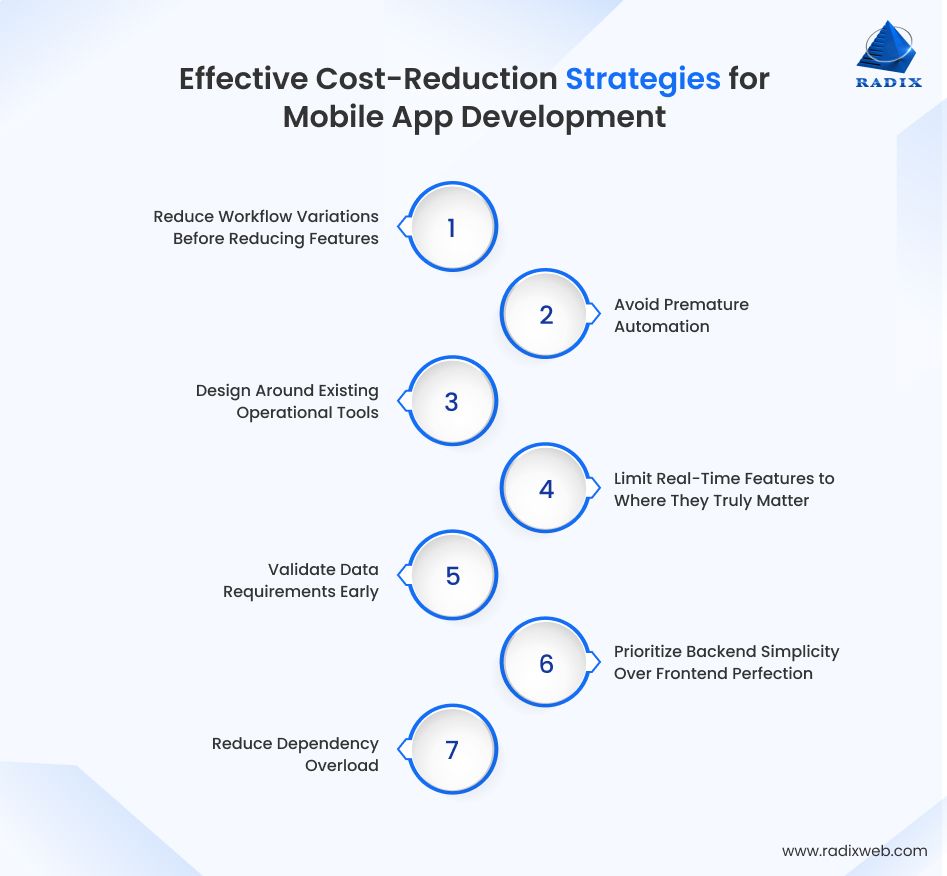
Apps become expensive not because they contain too many features, but because every user type follows a completely different workflow.
For example, separate onboarding journeys, dashboards, permissions, notifications, and approval flows for customers, vendors, managers, and support teams can multiply backend and QA complexity quickly.
Standardizing workflows wherever possible reduces:
Simplifying operational logic often saves more money than removing visible features from the product itself.
Businesses frequently invest in automation too early before validating whether manual operations are even a bottleneck.
Advanced automation systems for approvals, reporting, scheduling, AI recommendations, or workflow orchestration can substantially increase backend complexity and infrastructure requirements.
In early product stages, you can handle certain processes manually using admin panels or lightweight operational tools instead of fully automated systems.
This approach lowers development costs while helping businesses understand actual usage patterns before scaling into intelligent workflows that automate decisions and operational handoffs...
One of the fastest ways to optimize the cost of mobile app development in Australia is rebuilding functionality that businesses already manage through existing software platforms.
Instead of creating custom systems, enterprises can choose to integrate with tools they already use internally — a smarter alternative to building fully bespoke mobile applications around your workflows. Strategic integrations are often far more cost-efficient than recreating mature software capabilities from scratch.
Real-time functionality dramatically increases backend infrastructure, server communication complexity, testing effort, and cloud costs.
Many applications do not actually require true live syncing across the entire platform.
For example:
Reducing unnecessary real-time architecture can significantly lower both initial development and long-term infrastructure costs.
Data architecture mistakes are expensive to fix later. Businesses tend to over-collect data during early product planning without understanding:
Reducing unnecessary data collection lowers:
This is especially important for apps handling personal or regulated information.
Don’t focus heavily on visual polish while underestimating how backend complexity affects cost. In reality, backend architecture usually drives:
A simpler operational backend with clean workflows often produces larger long-term savings than aggressively reducing UI design effort.
Modern apps often rely on dozens of third-party SDKs, APIs, analytics tools, plugins, and infrastructure services. Every additional dependency increases:
The cheapest apps to maintain are usually the ones with the fewest unnecessary technical dependencies. Staying current with the latest mobile app development trends helps teams make smarter decisions about which new dependencies are genuinely worth adopting versus those that add cost without proportional value.
Building a realistic budget starts with a simple framework you can apply before contacting vendors. This approach uses Australian market rates and standard project phases to create a ballpark figure. Most businesses find their estimates within 20% of final pricing when they follow this method.
Start with hours × hourly rate as your base.
Total lands most projects in AUD 30,000–500,000+. Adjust up 20–30% for compliance-heavy apps.
Clarify these to get accurate estimates:
The clearer these inputs are, the more accurate and actionable the estimate becomes.

Creating a Sustainable Budget for Your Mobile App Project
As a global product engineering firm, time zone overlap or outsourced execution cannot be the sole criterion for delivering apps successfully in Australia. That realization had us build Australia-focused app development and delivery service capabilities specifically to understand the commercial and operational nuances that Australian businesses typically prioritize.Our local understanding is strengthened by the advantage of a globally upskilled engineering ecosystem. This exposure allows us to bring broader architectural thinking, scalability planning, and delivery efficiency into Australian app projects without forcing businesses into unnecessarily bloated development cycles.Apart from a lower development cost, our clients get a more commercially sustainable product roadmap with well-defined launch priorities, scalability planning, and a healthier long-term return on technology investment.Talk through your project requirements with us, evaluate possible delivery approaches, and receive a more grounded estimate based on your actual operational needs rather than broad industry averages.
Ready to brush up on something new? We've got more to read right this way.