
Read More


Recognized for AI Excellence at 2026 Globee® Awards - Read More

Sarrah Pitaliya
![[object Object]](https://d2ms8rpfqc4h24.cloudfront.net/anand_trivedi_bc7fce97ef.jpg)
Anand Trivedi

Before You Hire a Software Partner, Read This: Every software development company has a polished deck, glowing reviews, and success stories. But what do these actually mean? What should you look past, and what should you double-check? Because what (or who!) you choose now will shape your software, your team, and your business for the next decade. This guide tells you exactly how to read the room before you sign anything.
You have a business problem that software should solve. Maybe it's a manual process costing your ops team hours a week. Maybe it's a legacy system holding back your growth. Maybe it's a product idea that could create a new revenue stream. Whatever the trigger, you're now looking at external development partners and realizing the market is crowded, the proposals are vague, and separating substance from sales polish isn't easy.
Whether you are evaluating your first external development partner, reconsidering an existing one, or scoping a new product build, this guide helps cuts through the fluff. Not with a generic overview of software development, but with the specific information enterprise decision-makers need: how to identify the right type of firm for your use case, what to demand from the evaluation process, what fair pricing actually looks like, and how to structure an engagement that doesn't unravel six months in.
At Radixweb, we have delivered over 4,500 projects for enterprises across North America, Europe, and the Middle East. The principles in this guide come from these 26 years of delivery experience and the real patterns that separate successful technology partnerships from expensive ones.

A software development company is an organization that plans, designs, builds, tests, deploys, and maintains software products or systems on behalf of clients or for its own market. The core output is working software, not IT support, not infrastructure management, not consulting alone.
The distinction matters commercially and operationally. An IT services company keeps your existing technology infrastructure running through helpdesk, network management, cloud operations, uptime monitoring. A software development company creates net-new digital products or fundamentally transforms what already exists. Both are necessary. They are not interchangeable.
Here’s how the two differ:
| Software Development Company | IT Services Company |
|---|---|
| Builds new software products and systems | Manages and supports existing technology |
| Measured by delivery quality and product outcomes | Measured by uptime, tickets resolved, SLAs |
| Outputs: apps, platforms, APIs, integrations | Outputs: helpdesk, network management, cloud ops |
| Works to a product roadmap or project scope | Works to a service contract |
| Value: competitive advantage through technology | Value: operational continuity |
The cost of confusing the two is real.
Clarity on this distinction is the first step in building a successful vendor relationship.
USD 1.57 Trillion
Projected global IT services market revenue by the end of 2026, with custom software development among its fastest-growing segments (Statista, 2026)
Not every software development company is structured the same way. Choosing the wrong type of company for your project is one of the most common (and expensive!) mistakes enterprise buyers make. Here are the five primary types of software development companies and the circumstances where each one fits.
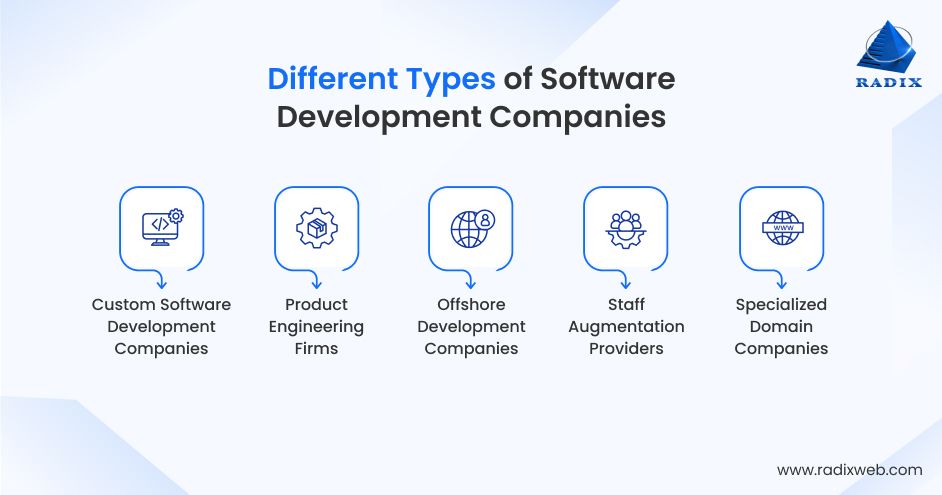
These firms build your software from scratch to your specification. They are the right choice when your requirements are unique, your workflows are proprietary, or you need off-the-shelf tools cannot integrate cleanly with your existing systems.
Product engineering companies solve business problems by building software products that their clients then take to market. They are hired by startups, scale-ups, and established businesses launching new digital products. The engagement model is collaborative, with the firm acting as a technical co-founder or product team extension.
Offshore and Nearshore Development Companies are usually firms located in South Asia, Eastern Europe, or Latin America that provide development capacity from lower-cost geographies. While the two are often clubbed together, offshore and nearshore development companies are different. While the former can be from anywhere across the world, the later are often based out of the nearest low-cost geography.
One of the top advantages of offshore companies in India, for example, is the significant cost advantage on hourly rates. But it requires careful evaluation of communication practices, time zone overlap, and quality assurance maturity before you can rely on them for complex or compliance-sensitive work.
Rather than delivering a complete project, staff augmentation service providers embed individual developers or small teams to work inside your existing structure. This model suits companies that have a strong internal engineering lead but need to scale capacity quickly without the overhead of full-time hiring.
Some firms focus exclusively on a specific technology stack or industry vertical. They bring deep domain knowledge but may not be the right fit for complex multi-stack or multi-industry engagements where breadth of experience matters as much as depth.
Important: Software development companies also differ based on the size of companies they serve. One of the best software development companies for startups, thus, may not be ideal for bigger enterprises or companies at different funding stages.
Make sure you are selecting a software development company that meets your domain, size, and project-specific requirements.
The scope of services varies significantly by firm. A full-service software development company covers the complete product lifecycle. Below is what that looks like in practice and the specific questions to ask when evaluating each service area.
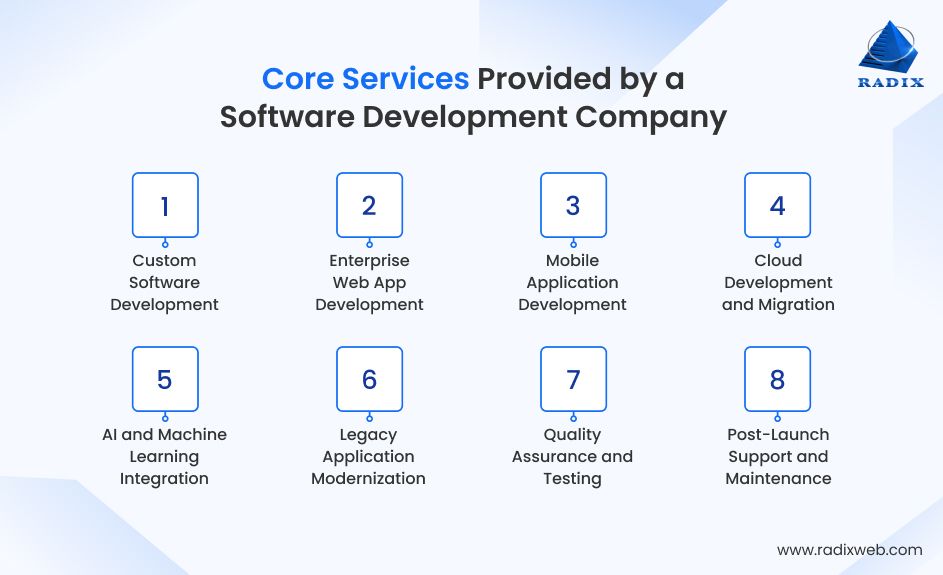
The design and development of software built specifically to your business requirements. The critical differentiator: does the firm conduct a structured discovery phase before writing a single line of code? Firms that skip discovery typically overrun on budget and miss requirements in the first major release. Ask to see their Software Requirements Specification (SRS) template before signing.
Developing web applications for enterprises can range from internal workflow tools to customer-facing platforms. Such enterprise apps fail most often at the integration layer, specifically where the new application must connect with existing ERP, CRM, or data systems. Ask specifically about the firm's enterprise system integration track record before evaluating their frontend capability.
This includes developing mobile applications for businesses across platforms like iOS (Swift) Android (Kotlin) or both (React Native or Flutter). The decision between native and cross-platform is a product requirement question, not a technology preference question. A firm that recommends one before understanding your performance, offline, and hardware access requirements is not doing discovery correctly.
This includes designing cloud-native applications from the ground up, or migrating legacy on-premise systems to AWS, Azure, or Google Cloud. Cloud migrations that fail almost always fail in planning, not execution. Ask what the firm's process is for assessing technical debt and migration risk before committing to any timeline.
Integrating artificial intelligence into existing software or solutions or building AI-native products from scratch is an in-demand service in 2026. This spans predictive analytics, natural language processing, computer vision, and intelligent automation. The relevant question for buyers: can the firm distinguish between AI use cases that produce measurable ROI and those that add complexity without value? That judgment is what separates credible AI development companies from those chasing a trend.
Modernizing dysfunctional or outdated legacy systems, whether it is via refactoring, rearchitecting, or replacement, helps target areas that are slowing your business down. The real risk in modernization is organizational, not technical. Systems running for 10–15 years carry undocumented business logic that lives nowhere except in the system itself. A development firm that doesn't plan for this will underestimate the project significantly.
The firms that deliver the most reliable software understand that value of software quality assurance and testing services early in the development lifecycle. At Radixweb, QA engineers join projects at Sprint 1, not after development closes. Defects found during development cost a fraction of what they cost to fix post-deployment. So, when you evaluate any development partner, ask when their QA engineers engage with a project. The answer tells you everything about how they think about delivery risk.
Software is not a one-time build. Annual, ongoing maintenance of software systems is important for bug fixes, security patches, dependency updates, and performance optimization. This typically adds 15–25% of the initial build cost each year. Budget for this from the first conversation, not as an afterthought when the system is live.
These are just the basics though. Modern companies keep updating their service offerings based on the key trends shaping the software development industry in order to meet enterprise buyers’ expectations.

Custom software is not a solution in search of a problem. The industries below have specific, recurring requirements that off-the-shelf tools consistently fail to meet, and where the cost of a poor implementation is measurably high.
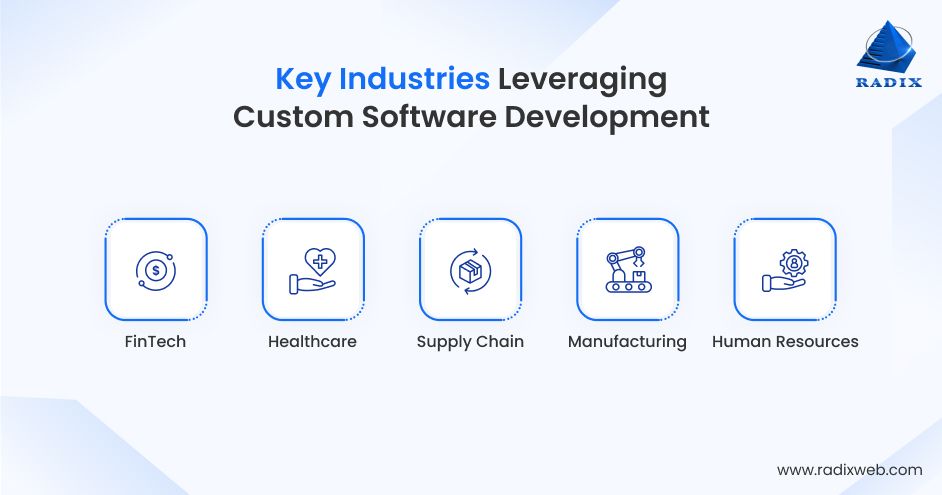
Regulatory compliance across jurisdictions, real-time transaction processing, fraud detection, and integration with legacy banking systems demand more than generic tools can offer. Off-the-shelf financial software rarely meets the combined requirements of compliance, scale, and system interoperability. Thus, institutions rely on financial software built for regulated, high-volume transaction environments.
For example, a Los Angeles-based direct private lender came to Radixweb with construction loan portfolios managed entirely through manual processes: paper-based NOC issuance, no centralised reporting, and a credit appraisal workflow that required manual intervention at every stage. Application processing took up to three working days. Radixweb built a cloud-based loan management platform over 14 months, led by Senior Technical Lead Vivek Chavda, automating NOC processing through smart contracts, integrating credit appraisal through an algorithm engine, and giving field inspectors a real-time mobile reporting interface.
"Deployment time was fast and the final product we received and have been using is very stable. We have now decided to expand the line of systems that we will have them develop for our company."
Drew Lloyd, Commercial Specialist
Read the complete case study to see how the loan management platform reduced processing time from 3 days to 4 hours
Healthcare systems operate at the intersection of clinical workflows, regulatory compliance, and patient-critical data, where failures carry real-world consequences beyond software defects. EHR integration, HIPAA compliance, and workflow automation must function reliably under clinical pressure. This is why organizations depend on healthcare software systems built for compliant, real-world clinical environments, where reliability and auditability are foundational.
A Dubai-based specialist healthcare institute needed to unify its telehealth capabilities with its existing EHR system without disrupting live patient care workflows during the build. The integration required resolving data structure disparities across two systems not originally designed to communicate, ensuring HIPAA and GDPR compliance throughout, and handling real-time patient record synchronisation across clinical roles. Radixweb phased the delivery: the telehealth platform was built and stabilised first; EHR integration followed with minimal workflow disruption, led by Technical Lead Disha Shah.
"We hardly faced any major issues. They took their time but gave us the solutions just as we needed them to be." Jassim Al Qama, Business Development Director
See complete details around how the EHR-integrated telehealth portal saves 500 physician hours annually here.
Warehouse management systems, real-time fleet tracking, demand forecasting, and multi-carrier integration require software that fits the exact operational model of the business. No two logistics operations are identical enough for a single off-the-shelf tool to serve them both well. That’s why forward-looking organizations invest in tailor-made supply chain systems aligned with real-world logistics workflows.
ERP customization, production line monitoring, quality control systems, and IoT integration for smart factory initiatives require software that interfaces directly with operational technology. Generic ERP systems don’t always offer that, which is why custom software solutions for manufacturing operations and workflows are important.
Talent acquisition platforms, HRMS systems, and workforce analytics tools require deep integration with third-party HR infrastructure and compliance with regional employment regulations. Radixweb has built several custom HR management software solutions for global enterprises including GPT-powered recruitment chatbots, cloud-migrated HR platforms, and integrated ATS systems.
A poor development partner decision does not surface immediately. It shows up six months in as missed milestones, twelve months in as technical debt, and two years in as a system that resists every change you need to make.
These are the criteria that separate firms worth engaging from those that look credible on paper but create long-term problems.
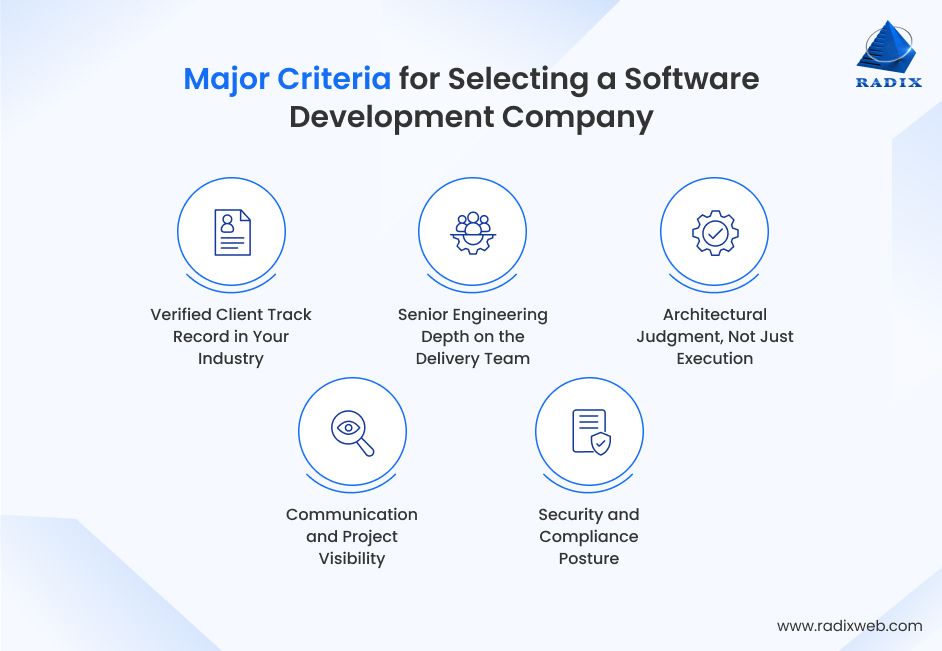
Ask for references from engagements similar in scope, industry, and complexity to yours. Read reviews on Clutch and GoodFirms, but go beyond the rating. Ask the reference client what the development company did when something went wrong. Something always does. Their answer tells you more than any case study.
Many firms front the sales process with senior engineers and deliver the project with juniors. Ask specifically what percentage of the delivery team will be mid-level or senior developers. Ask how the firm defines seniority. And ask (before signing anything!) to meet the actual lead engineer assigned to your account.
A credible software development partner doesn't just build what you ask for. It tells you when what you're asking for is the wrong approach. Firms with genuine expertise in software architecture patterns and system design challenge scope, identify technical risks early, and design systems that remain maintainable three years after delivery. Firms without it say yes to whatever is in the brief.
Ask what software project management methodology they use, what tools provide visibility into sprint progress, and how they handle scope changes. Vague answers during the sales process are a reliable preview of how they'll communicate mid-delivery.
If your product touches customer data, financial records, or healthcare information, your development partner's security practices are your liability. Ask about secure coding standards, penetration testing protocols, and ISO 27001 and SOC 2 certification. These aren't nice-to-have badges, they reflect the process maturity regulated industries require.
While software development has become increasingly global, local context still matters. Customer expectations may be broadly aligned across markets, but the details can differ significantly by region. A US-based software development company offering enterprise-grade solutions, for example, is much more likely to understand the nuances of US customer behavior, business practices, data expectations, and industry-specific regulatory and compliance requirements as opposed to a business operating from the Easter European market. This familiarity can help teams make more informed product and technology decisions, anticipate location-specific considerations early, and reduce the friction that can come from applying a one-size-fits-all approach to software development.
These are the important starting points, but the decision demands more.
Most organizations reaching the point of needing an external development partner have hit one of three ceilings:
That's the moment a custom software development company becomes a strategic necessity, not just a vendor option. With 26+ years of experience and having built software for 3,000+ clients, we understand this very well. That’s why, Anand Trivedi, our VP of Operations and Delivery, created a simple framework to help you assess your readiness before engaging a software development partner: The Radixweb Vendor Readiness Questionnaire.
This questionnaire is designed to clarify your project requirements, internal capacity, timeline expectations, data sensitivity, and post-launch plans. By answering just a few targeted questions, you can quickly determine whether you’re ready to issue an RFP, need a discovery-first engagement, or require consultative support before committing.
Use this as a practical guide to make informed decisions, reduce risk, and ensure your partnership with a development vendor starts on a solid foundation.
A. Our requirements are documented and stable. We know what we want to build.
B. We have a general direction but requirements will evolve during development.
C. We have a problem to solve but need help defining the solution.
A. We have a strong internal CTO or VP Engineering who can manage a vendor daily.
B. We have a product owner but no deep technical lead internally.
C. We have no internal engineering leadership.
A. We have a 3 to 9 month window with some flexibility.
B. We need a working product in under 3 months.
C. We have no defined timeline yet.
A. Moderately sensitive: internal business data with standard security requirements.
B. Highly sensitive: financial data, healthcare records, or proprietary algorithms.
C. Low sensitivity: consumer-facing product with public data and no defined security considerations.
A. We have a clear maintenance plan (in-house or vendor-supported).
B. We have a rough idea but no defined ownership yet.
C. We have not thought about this yet.
Step 1: Select one option for each question
Step 2: Count how many A, B, and Cs you have
Step 3: Use this to guide your next move:
This quick questionnaire helps you assess your readiness upfront—so when you engage a vendor, you do it with confidence and control.

The engagement model determines how you pay, how much control you retain, and how the project adapts when requirements change. There is no universally correct model. The right choice depends on your project's maturity, your internal capacity to manage a vendor, and your risk tolerance.
Here is a practical breakdown of the four primary software development engagement models and when each one actually fits.
| Model | Best For | Key Benefit |
|---|---|---|
| Fixed-Price Model | Defined scope, MVP builds, compliance projects | Budget certainty from day one |
| Time & Materials | Agile builds, evolving requirements, iterative delivery | Maximum flexibility as scope matures |
| Dedicated Team | Long-term roadmaps, ongoing product development | Deep institutional knowledge, low coordination overhead |
| Staff Augmentation | Capacity scaling, filling specific skill gaps | Speed without the overhead of permanent hiring |
Let’s explore each of these models in detail now:
Scope, timeline, and cost are defined upfront. Changes require a formal change order. This model works when requirements are stable and you need budget certainty. It is a poor fit for products that will evolve during development, because evolution in a fixed-price contract is expensive.
You pay for actual hours worked at an agreed rate. Scope can evolve. This model gives you flexibility but requires active client-side management to prevent scope expansion. It is the standard model for agile product development where requirements are expected to shift across sprints.
You retain a team that works exclusively on your product, typically on a monthly retainer. The team integrates with your internal processes and operates as an extension of your engineering function. This model suits companies that need dedicated software development teams for long-term product development rather than shorter projects.
Individual developers are placed within your existing team under your management. You direct their work and are responsible for their output quality. This model is appropriate when you have strong technical leadership internally but need to scale headcount without the overhead of permanent hiring.
The right engagement model depends on your project needs, internal capacity, and desired flexibility and you should choose an IT staff augmentation model that balances control, cost, and adaptability.
Cost is the question every buyer asks and every vendor struggles to answer without more information. Five variables drive the final number, and each one can move it significantly.
Understanding them before entering the procurement process is the difference between an accurate budget and an unpleasant surprise at month three.
North American developers typically bill at $100 to $200 per hour. Western European rates range from $80 to $160.
$25 to $50/hr
Radixweb's rate range for experienced software engineers, versus $100 to $200/hr for equivalent North American capacity, at the same delivery standard.
The relevant question is not the hourly rate in isolation though, it is the total cost of delivered software at the quality standard you need.
A simple internal tool with three user roles and a basic data model is a different engineering problem than a multi-tenant SaaS platform with real-time data processing, third-party API integrations, and a custom analytics layer. Complexity is the single largest driver of cost variation.
A full product build requires more than developers. UI/UX designers, a dedicated QA engineer, a project manager, a solutions architect, and a DevOps engineer all contribute to the final cost. Projects that cut corners on team composition early tend to pay for it in rework later, often at a higher rate than if the full team had been in place from the start.
Longer engagements on retainer models typically carry lower blended rates than short-term project work. If you anticipate a multi-year product development roadmap, negotiate the engagement structure accordingly at the outset.
Budget 15 to 25 percent of the initial build cost annually for ongoing maintenance. Security patches, dependency updates, performance optimization, and bug resolution are not optional after launch. They are the cost of keeping your software secure and functional in a changing environment.
Suggested Reading: Get the breakdown of the cost of hiring a software development company by project type, team size, geography, and engagement model with real 2026 benchmarks.

This is rarely a binary decision. Most companies at scale do both: internal teams own product direction and core IP; external partners supply execution capacity and specialist skills. The real question is which work belongs where.
The most effective arrangement for most scaling companies is a hybrid: a small internal team managing product direction and owning core IP, with an external development company handling execution capacity and specialist skills. This gives you control without the full overhead of an internal engineering organization.
Related Reading: In-House vs Outsourcing Software Development
A full comparison of in-house vs outsourced development covering cost, control, speed, quality risk, and the hybrid model most scaling companies use.
Most software development guides describe the standard six-phase lifecycle. Discovery, architecture, development, QA, deployment, support. Every development company publishes a version of it. This section describes what Radixweb does specifically at each phase, and why w do it the way we do.
Important: The practices below are not aspirational. We’ve successfully used this approach to deploy 4,500+ projects in the past 26 years.
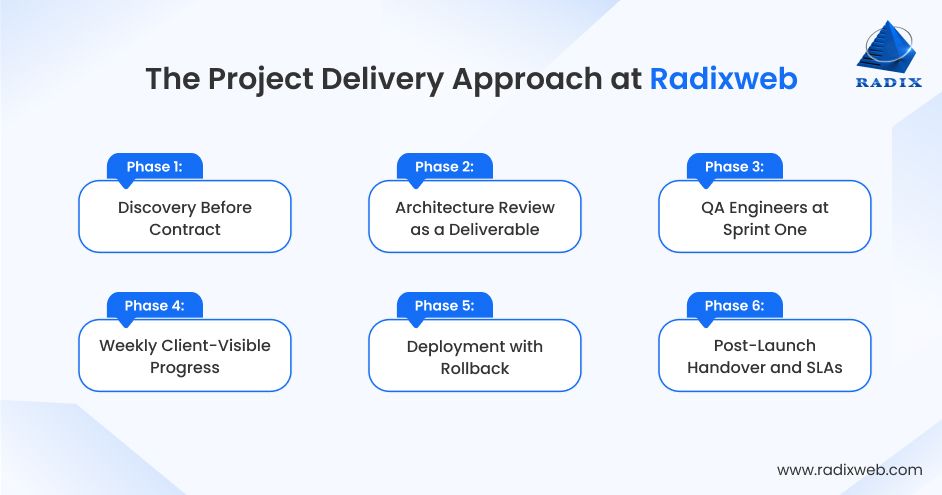
We require a structured discovery engagement before any development contract is signed. For projects above a certain complexity threshold, this is a paid engagement in its own right. The output is a Software Requirements Specification, co-reviewed and co-signed by both Radixweb and the client.
Why this matters: the three questions that most reliably surface misaligned expectations during discovery are:
These questions are uncomfortable. They are also exactly the questions that, unanswered at discovery, become budget disputes at month four.
"The projects that overrun are almost never the technically complex ones. They're the ones where the client and the development team had different assumptions about what was in scope, and nobody surfaced those assumptions before development started. The single most valuable thing we do is the discovery phase."— Anand Trivedi, VP of Operations and Delivery, Radixweb
Before a line of application code is written, we produce a technical architecture document that is reviewed by a Radixweb architect who is not on the delivery team. The separation matters. Engineers who design systems are invested in their own decisions. An independent architecture review catches the class of problems that internal team reviews miss, specifically the assumptions that nobody questioned because they seemed obvious.
Our QA engineers join at sprint one, not after development closes. This is non-negotiable in our project contracts because late QA integration is the most consistent predictor of budget overrun in complex software projects. When QA joins at the end, defects are fixed in production code. When teams hire dedicated QA testing services early in the project lifecycle, defects are caught in design decisions. The cost difference is significant.
Every engagement includes a weekly stakeholder report with three components:
The report goes directly to your nominated contact. If something is behind schedule, you know right when we do our internal escalation, not later.
We deploy to production using structured CI/CD pipeline workflows that include automated testing gates and a documented rollback procedure. Every production deployment has a tested rollback path. This is a process requirement, not an option. The reason: in our experience across thousands of deployments, the question is not whether something will go wrong in production, it is how quickly you can recover when it does.
Every project closes with one of two structured outcomes: a knowledge transfer sprint that equips the client's internal team to maintain the system, or a signed support SLA that defines response times and resolution targets. We do not close projects and walk away. The systems we build run businesses. The responsibility that comes with that does not end at go-live.
Radixweb has been building custom software for clients in North America, Europe, the Middle East, and Asia Pacific since 2000. The engagements in our portfolio span fixed-scope MVP builds completed in under two months and multi-year platform modernisation programmes for regulated industries.
What they share is the same engineering standard: deep enough domain knowledge to challenge the brief, technical depth to solve problems that surface mid-delivery, and enough team continuity to maintain context across a long-running account relationship.

Making the Right Move on Your Next Development Partnership
Choosing a software development company is one of the highest-leverage technology decisions your organization will make. If you're at the point of evaluating development partners, the most valuable next step is a structured discovery conversation.At Radixweb, every engagement begins with an engineer-led call where we assess your requirements, identify technical risks, and confirm whether we are genuinely the right fit for your project. Ready to have an honest conversation about what you're trying to build and what it will actually take to build it well? Schedule a consultation with our experts today and let's determine, together, what is the right 1st step for the next chapter of growth.
Ready to brush up on something new? We've got more to read right this way.

