Read More


Recognized for AI Excellence at 2026 Globee® Awards - Read More

Nihar Raval

The global IT staff augmentation market is worth USD 434.1 Billion (2026). Various estimates suggest that with IT staff augmentation services can cut hiring time by 30%-50% and hiring costs by 40%-60%. But if the math worked that cleanly, companies would have already replaced their entire recruitment function with staff augmentation. They haven't. Because here's what most vendors don't tell you: staff augmentation fails quietly on a significant percentage of engagements.
The failure isn't catastrophic, it is slow. A developer joins. The ramp up takes longer than project. You brush it off. But then the finance team tells you that the rate savings got absorbed by the onboarding overheads. Three months later, the project is still behind schedule and now the cost of IT staff augmentation has exceeded the cost of hiring a developer in-house. No vendor would say this out loud. But we do. Why?
Because staff augmentation is a genuine solution to a real business problem, but it is not the right solution for every single project. The conditions where it works are specific enough that you should know those before you sign a contract. In this guide, we cover those conditions and what you should do if staff augmentation is really what you need. Plus, the real IT staff augmentation cost calculations that vendors won't show you, only partners will.
The IT staff augmentation model delivers strong results when you have a clearly defined skill gap, a well-documented codebase, sufficient internal onboarding support, and an engagement long enough to offset ramp-up costs. But the real cost extends beyond hourly rates and includes onboarding delays and management overhead, which can significantly impact the ROI of projects where the IT staff augmentation process is poorly implemented. When implemented under the right conditions, staff augmentation offers faster access to specialized talent while maintaining full control over development and delivery.
| Aspect | Details |
|---|---|
| What this guide covers ? | IT staff augmentation benefits, when it works, when it fails, real cost of staff augmentation, choosing between augmentation and outsourcing, evaluating an IT staff augmentation company, onboarding best practices, engagement readiness, decision framework for hiring models. |
| Who should read this guide ? | CIOs, CTOs, Engineering Managers, VP of Engineering, Product Leaders, IT Directors, Technical Project Managers, Startup Founders, Enterprise Technology Decision-Makers, Organizations planning to scale development teams, Companies evaluating outsourcing or staff augmentation |

IT staff augmentation. Outsourcing. Dedicated development teams.
These words are often used as synonyms in business meetings and vendor decks. But they do not mean the same thing. IT staff augmentation is the practice of extending your development team with external technology professionals who work inside your processes, tools, and sprint cycles. Unlike the outsourcing model of software development, where the vendor owns the delivery outcome, with staff augmentation, the developer(s) work under your direction. You have full operational control, while the IT staff augmentation company handles sourcing, compliance, and payroll.
This model sits between two alternatives: full-time hiring (permanent capability, high overhead, slow to start) and full outsourcing (faster, less control, vendor accountability). It is the option that gives you control without permanent commitment.
But it isn't a one-size-fits-all staffing solution. Before you start looking for augmentation partners, know if it is the right solution for your situation.
Staff augmentation isn’t inherently “good” or “bad”. It all depends on whether or not your project creates the conditions to succeed. The following scenarios are where organizations see the strongest IT staff augmentation benefits.
Your team is capable of delivering the project. But you're missing a specific expertise. Say you need to hire just one or two developers with expertise in React, Salesforce, AI, or some other niche. Hiring a dedicated developer full-time isn't justified because the need is temporary, but delaying the project isn't an option.
The roadmap has expanded, deadlines have moved forward, or customer demand has increased. Instead of spending months recruiting permanent employees, you need experienced developers who can integrate into your existing sprint process and increase delivery capacity quickly.
The application architecture is documented. Development environments are standardized. And existing engineers can onboard new team members efficiently. New developers can become productive within the first few sprints instead of spending weeks understanding the system.
The work is expected to continue for at least six months, giving enough time for onboarding costs to be recovered through sustained productivity. Longer engagements generally produce stronger ROI than short-term assignments.
You already have technical leads or senior engineers who can answer questions, review code, and guide new team members during the first few weeks. This allows augmented developers to become productive without disrupting the rest of the team.
The more these situations match your project, the more likely is that the IT staff augmentation model will help you save time, add expertise, and keep development moving without long hiring cycles.
Staff augmentation isn't designed to solve every resourcing challenge. In these situations, staff augmentation often creates more overhead than value. Here are some such situations:
Most architectural knowledge lives with a handful of senior developers rather than documentation. New engineers spend weeks understanding the codebase before contributing, making the onboarding cost much higher than expected.
If the project lasts only one to three months, much of the engagement is spent onboarding the developer instead of delivering value. In these cases, a fixed-price engagement or managed outsourcing often provides better ROI.
Everyone who could onboard a new developer is already working at full capacity. Instead of increasing delivery speed, senior engineers lose valuable development time answering questions and reviewing work.
You're in the middle of a cloud migration, platform rewrite, or large-scale refactoring. Because the architecture is constantly changing, new developers struggle to build context and contribute.
Your goal isn't simply to add engineers; it's to hand over execution and be accountable only for business outcomes. In that case, managed outsourcing is a better fit because the vendor owns delivery instead of supplying additional developers.
Experiencing one of these situations doesn't mean your project is likely to fail. It simply means a different engagement model may deliver better results with less management effort and lower overall risk.
IT staff augmentation is not the only model. And when it doesn't fit, there are the other models that you can explore.
You get a vendor-provided a dedicated cross-functional team that works exclusively on your product over the long term. This includes developers, designers, QAs, and a project manager.
Control: High. Strategic direction stays with you while day-to-day coordination is shared.
Cost: Medium to High. Best suited for ongoing development.
Time to get started: Moderate, typically 2–6 weeks.
Benefits:
A vendor takes end-to-end ownership of project execution and delivery against agreed objectives. One of the most important benefits of such managed outsourcing is its high cost efficiency.
Control: Low. The vendor manages execution.
Cost: Medium. Depends on project scope and complexity.
Time to get started: Fast once requirements are finalized.
Benefits
A vendor delivers a predefined scope of work for a fixed cost and timeline.
Control: Low. Scope is agreed upfront.
Cost: Low to Medium. Ideal for well-defined work.
Time to get started: Fast after scope approval.
Benefits
An independent expert is hired temporarily for a specialized technical need or short-term assignment.
Control: High. You directly manage the specialist.
Cost: Low to Medium. Depends on expertise and duration.
Time to get started: Very fast, often within days.
Benefits
Here's a quick comparison to help you decide:
| Situation | Recommended Model |
|---|---|
| Need one or two developers with specific skills | IT Staff Augmentation |
| Building and continuously evolving a product | Dedicated Development Team |
| Want the vendor to own delivery outcomes | Managed Outsourcing |
| Project has a fixed scope and budget | Fixed-Price Project |
| Need a niche expert for a short-term task | Contract Specialist / Freelancer |
No single engagement model is universally better than another. The right choice between dedicated teams, staff augmentation, or extended teams depends on your project maturity, internal engineering capacity, and desired level of ownership.

The hourly rate is usually the first number vendors quote. But it isn't the full cost of an augmentation engagement. To understand what you'll actually spend, you also need to account for the time it takes a developer to become productive and the effort your own team invests in getting them there. In practice, the total cost of staff augmentation comes down to three components.
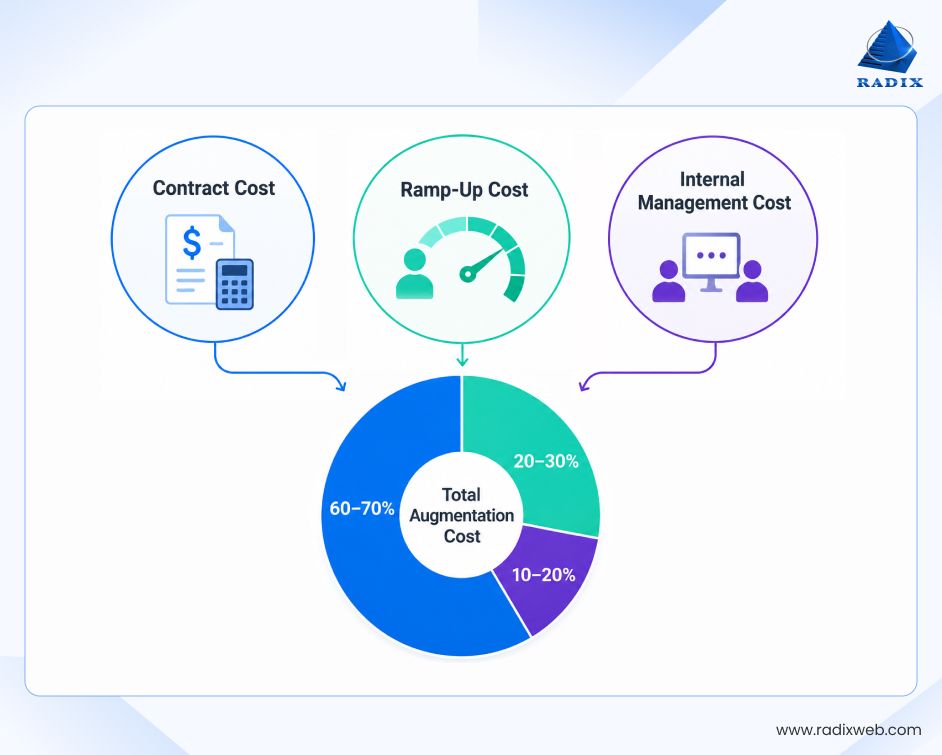
For senior developer through an India-based IT staff augmentation company such as Radixweb, rates typically range from $55-$80 per hour. This is the easiest cost to compare across vendors, but it rarely tells the full story.
Every developer needs time to understand your product, architecture, coding standards, and business logic before contributing at full speed. This onboarding period is a hidden cost because you're paying the full contract rate while productivity gradually increases.
On well-documented projects with structured onboarding, ramp-up typically lasts 1-2 weeks. On legacy applications with limited documentation or complex business logic, it can take 3-6 weeks. The longer the ramp-up, the longer it takes for you to start seeing meaningful IT staff augmentation benefits.
Staff augmentation also requires time from your own engineering team. Senior developers and managers answer questions, review code, explain architecture, and help new team members become productive.
During the first month, it's reasonable to expect 2-4 hours/week from an experienced engineer. While this cost doesn't appear on the vendor's invoice, it affects the total investment. And it should be considered when evaluating ROI.
In our engagements, we track developer velocity from day 1 through full sprint contribution for every placed developer. The pattern is consistent: clients who prepare a structured onboarding package before the developer starts cut their ramp-up time by 60-70%. That preparation is the most valuable hour you'll spend before an engagement begins.
To understand how preparation impacts cost, consider two identical staff augmentation engagements. Both use the same senior developer at $65 per hour, working 40 hours per week for 24 weeks. The only difference is the condition of the client's project.
In the first scenario, the project has clear documentation and a structured onboarding process. The engineering team is also available to support the new developer. In the second, the application is a legacy system with limited documentation. This makes onboarding slower and requiring significantly more internal support.
| Cost Breakdown | Well-Prepared Project | Legacy Project with Minimal Documentation |
|---|---|---|
| Contract Cost | $62,400 | $62,400 |
| Ramp-up Cost | $3,120 | $9,750 |
| Internal Management Cost | $2,800 | $5,250 |
| Total Cost | $68,320 | $77,400 |
The developer, contract value, and project duration remain exactly the same. Yet improving documentation and onboarding reduces the total engagement cost by $9,080. That's money saved without negotiating a lower hourly rate or shortening the engagement.
The same principle applies across most staff augmentation projects. Lower hourly rates don't automatically translate into lower project costs. Productivity during the first few weeks often has a much bigger impact on overall ROI than a small difference in contract pricing.
Before you start evaluating vendors, take two minutes to answer these three questions. If you answer "yes" to all three, you're likely in a strong position to benefit from staff augmentation.
Can someone unfamiliar with your system understand the architecture? Can they set up the development environment? Would they be able to start contributing without depending on constant guidance?
If the answer is yes, onboarding will be faster and your ramp-up costs will stay low. If not, invest time in documentation before bringing someone onboard. The effort will usually pay for itself.
Every successful staff augmentation engagement has one clear point of contact. That person should have enough technical context and enough time during the first few weeks to answer questions, review code, and help the developer become productive. Without a clear owner, onboarding becomes everyone's responsibility and no one's priority.
Every augmented developer needs time to learn your product. If the engagement is expected to last several months, that initial investment is usually recovered through sustained productivity. For projects lasting only a few weeks, a fixed-price engagement or managed outsourcing often provides better value.
If you answered ‘yes’ to all three questions, staff augmentation is likely to deliver. But if your response to one or more questions was ‘no’, address those gaps before starting the IT staff augmentation process. Or you may consider the other engagement models we discussed earlier.
The difference between a successful augmentation engagement and an expensive one is almost always decided in the two weeks before the developer joins. So, if you have decided to get IT staff augmentation services here's what to do first
It can just be a 2-3 page document explaining the system structure, the major components, data flows, and where the known debts live. This is not a full technical spec. It's the document that lets someone read your codebase with context instead of confusion.
Create a simple step-by-step guide. Assume nothing. It is what gets the developer from zero to running the application locally without asking a single question. Creating it is worth four hours of a senior developer's time before the engagement begins because it saves a lot more.
Ask a senior developer to record a walkthrough showing the major modules, the architectural patterns in use, the current sprint focus, the areas to avoid touching until they understand the context. Having it recorded ensures that the developer can rewatch it. This single investment compresses weeks of ramp-up into days.
Finalize one person who can block two hours per day in the first week for questions that will otherwise fragment across Slack threads that nobody owns.
Have a real task that the developer can complete independently using the documentation you've prepared. Not a test. A real contribution. A successful first sprint output confirms the environment setup worked. It also establishes the communication rhythm before stakes are higher. And it gives the developer the psychological momentum to go faster in sprint two.
These are not mere guidelines from a book. We've seen client actually benefit from it. In our recent engagement with a UK-based SaaS HRTech client, their clear codebase documentation before our developers joined directly enabled a 4-week faster release cycle and the elimination of 10+ quarterly incidents over a 6-month engagement. The outcome wasn't the result of developer quality alone. It was the result of preparation quality matched with developer quality.
Every vendor's sales pitch covers the same ground. Here's our vetting process. This is our talent pool size. This is how fast we respond. But none of it tells you whether their developers will be suitable for your situation.
Here are the four questions that help you find that out:
The answer should describe what the vendor provides (technical lead availability, documentation templates, structured first-week plans) and what they expect from you. A vendor whose answer is "the developer will get up to speed" is transferring the entire ramp-up cost to your side. A vendor with a structured onboarding methodology is sharing it.
You are not looking for a testimonial or a case study headline here. You need the actual velocity trend. A straight answer to: What was the developer's output in sprint 1 vs. sprint 4 vs. sprint 8? Any vendor running disciplined augmentation engagements tracks this. Firms that can't produce it aren't measuring it. And if they aren't measuring, they won't know whether their developers are delivering or just billing hours.
Large augmentation firms often assign senior talent to the sales process. But junior developers show up during delivery. So, before signing, get the named technical lead. Ask for their direct experience with your technology stack and their history on projects of similar complexity. If the firm can't name them before the contract is signed, it is a red flag.
A firm confident in their placement has a clear replacement protocol. It includes defined replacement criteria, a replacement timeline, and a process that won't require you to absorb weeks of underperformance while paperwork processes. A firm that becomes defensive at this question is telling you that replacement isn't handled well.
At Radixweb, when we onboard a dedicated developer to your team, we include structured developer onboarding support, sprint velocity tracking, and a named technical lead committed before the contract is signed. That's one reason behind our 4.9 star rating across third-party review platforms.

Start IT Staff Augmentation with Clarity
IT staff augmentation isn't the golden ticket it's often made out to be. But in the right situations, IT staff augmentation for manning your software project works exceptionally well. Success, however, also depends on far more than the hourly rate a vendor quotes. It comes down to understanding the true cost beyond the contract and ensuring your organization is prepared to integrate a new developer into your team.At Radixweb, we go beyond supplying developers. In the past 26+ years, we've helped 3,000+ businesses build and scale technology teams. And with our structured onboarding, transparent delivery, and engineering practices, we have a 97% customer retention rate. So, whether you need to extend your existing team or determine if another engagement model is a better fit, our experts help you decide right. Schedule a one-on-one session with our staff augmentation consultants to get a project evaluation today. The conversation is free. Selecting the wrong engagement model won't be not.
Ready to brush up on something new? We've got more to read right this way.