Read More


Recognized for AI Excellence at 2026 Globee® Awards - Read More

Nihar Raval
Organizations that effectively scale AI projects are 3.5X more likely to outperform their peers on revenue growth. Such figures sound impressive at first. Just like the ML demos. But they hide a quieter story: over 80% of ML projects fail to deliver their intended business outcomes. This gap between the companies that scale and the ones that stall rarely comes down to model quality. It comes down to one decision, made early, usually in a hurry, and often by the wrong people in the room.
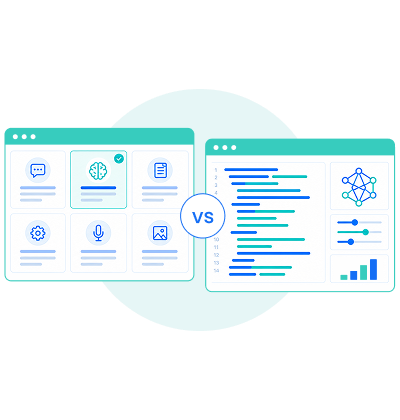
That decision is whether to build that intelligence or rent it. The debate around building vs buying machine learning models tends to run on instinct. Engineers lean toward building because it is more interesting. Finance leans toward buying because the first invoice is smaller. Both are optimizing for something other than the outcome.
Settling the custom machine learning model vs off-the-shelf platform question properly means looking at data, differentiation, scale, and team, in that order. Skip one and you will pay for it around month nine.
Not sure if you should build a custom machine learning model or use a ready-made platform? Read on as I walk you through the choice based on our hands-on experience of building ML models, customizing off-the-shelf systems, and integrating ready-made ML to existing business systems.
Custom ML models are built or fine-tuned for business needs, while off-the-shelf platforms offer ready-made solutions for fast deployment and easy maintenance. And the custom ML model vs off-the-shelf ML platform debate comes down to differentiation. Buy when the problem is commodity, speed matters, or you lack a data team. Build when the model is your core product, your data is proprietary, or regulation demands control. Platforms win year one, but custom models win beyond 30–40 million inferences yearly. From what we've seen practically, mature teams buy to launch, then build to differentiate.
| Aspect | Details |
|---|---|
| What does this guide cover? | Definitions of both approaches, a cost comparison with the break-even point, a side-by-side platform comparison, the conditions that favor building or buying, hybrid models, and a five-question framework for choosing. |
| Who should read this guide? | CTOs, heads of data and AI, product leaders, and engineering managers who must decide how to source an ML capability and then defend that decision to finance. |
Off-the-shelf ML platforms are commercial software products, cloud services, or APIs built by third-party vendors for standard, general-purpose tasks. Custom ML models are systems designed, trained, or fine-tuned around your own datasets, internal workflows, compliance mandates, and proprietary logic.
The real difference between the two is the direction of alignment. With an off-the-shelf platform, your business bends around the product's features, boundaries, and data formats. With a custom build, the intelligence bends around you. Almost every other difference is a consequence of that one.
This difference also explains the central trade-off: speed against control. So, a custom machine learning model and an off-the-shelf platform sit at opposite ends of that trade. Platforms offer rapid onboarding, minimal upfront capital, and vendor-managed maintenance. The custom route gives you domain precision, data sovereignty, full IP ownership, and a differentiator no competitor can buy with a credit card. That makes the "custom machine learning vs prebuilt ML model" question less about technology than about who owns the result and who carries the risk.
Note: If you are comparing building vs. buying AI solutions, check out our dedicated guide for CTOs.
Here are the key pros and cons of custom ML models vs. off-the-shelf platforms at a glance:
| Off-the-shelf ML platforms | Custom ML models | |
|---|---|---|
| Advantages | ● Live in days to weeks ● Low entry cost ● Vendor handles upkeep | ● Domain accuracy ● Full IP ownership ● Data control ● Deep integration |
| Disadvantages | ● Generic fit ● Data leaves your walls ● Fees climb with volume ● Vendor dependency ● No differentiation | ● $100,000+ upfront ● 6 to 24 months ● Scarce talent ● Permanent maintenance |
Now, none of this is a direct verdict. Each is a bill of sorts and below we discuss what each one costs.
Off-the-shelf ML platforms offer pre-trained models and ready-made tools for faster deployment, lower costs, and easier maintenance without building from scratch. Most off-the-shelf machine learning platforms run on multi-tenant cloud infrastructure that supports AI and have are available as plug-and-play APIs, SDKs, or features embedded in SaaS products. The vendor trained those models on huge, generalized public or licensed datasets. That is why pre-trained machine learning models work so well on common tasks and so unevenly on yours.
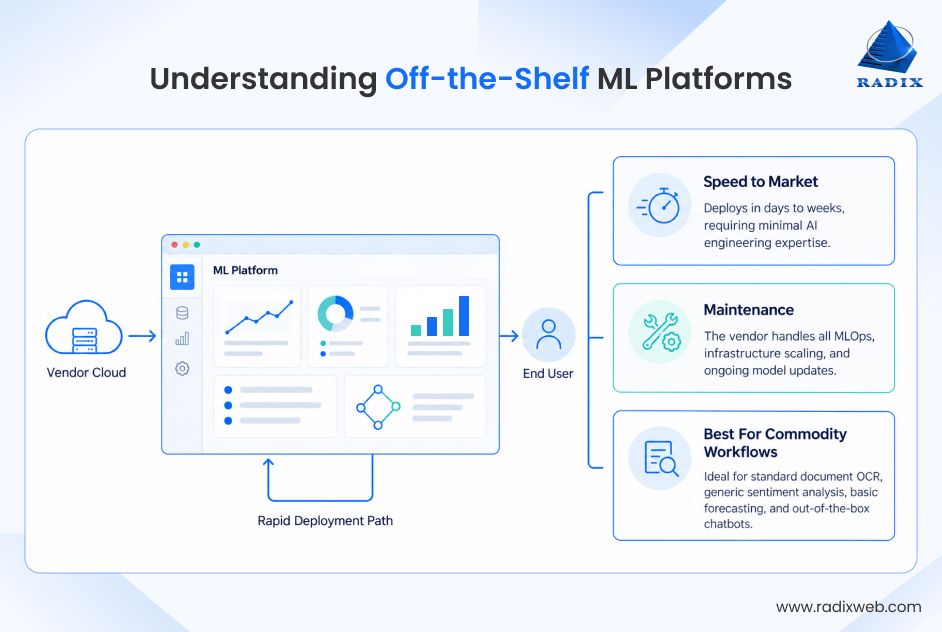
In a custom machine learning vs managed ML platforms comparison, the managed side wins on four counts:
The trade-offs are just as real.
Are Off-the-Shelf ML Platforms Suitable for Enterprise Applications?Yes, for the right workloads. Standardized enterprise workflows such as ticket routing, document processing, and sentiment analysis run well on commercial platforms. The answer turns to no when the work involves strict data residency, specialist vocabulary, or logic tied to how your business uniquely operates. Suitability depends on the workload, not on the size of the company.
Custom machine learning models are designed from the ground up, or fine-tuned from open-source base architectures, on your proprietary data. That data might be historical transaction records, manufacturing equipment, telemetry, medical diagnostic logs, or years of customer interaction history. It is the one ingredient a vendor cannot ship for you.
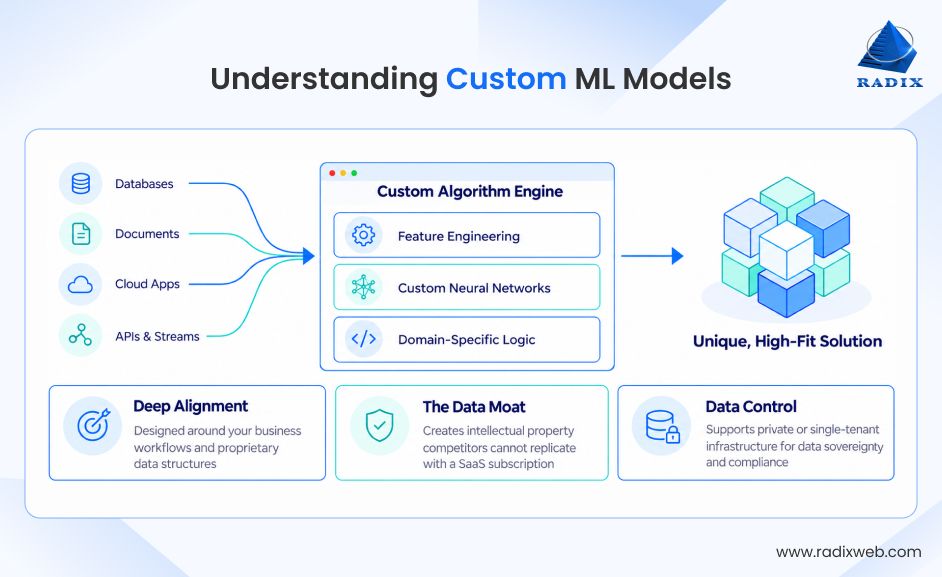
The case for building ML models from scratch is strong when you read it as a list of ownership benefits. The case against is strong when you read the price of that ownership.
Choosing a custom machine learning model or off-the-shelf platform gets easier once you have seen both the advantages and disadvantages of custom ML models.
The advantages:
The disadvantages:
In practice, that last line is the one teams skip in the business case. Nobody plans to maintain the model forever, and when the model is in production, the maintenance time and cost frustrate teams and disbalance plans.
When people are looking at the cost developing machine learning solutions, they are typically just pricing the model. But in a typical custom build, model selection and training account for only 15% to 25% of the spend. Data engineering takes 20% to 40%. System integration takes another 20% to 30%. Algorithm work is often the smallest part of the bill, and any custom machine learning model or off-the-shelf platform debate that ignores the other lines is comparing the wrong numbers.
Here is how the cost of building a custom machine learning model vs using a platform shapes up over time:
| Custom build cost component | Typical range |
|---|---|
| Data preparation and engineering | 20–40% of build budget |
| System integration | 20–30% of build effort |
| Model selection and training | 15–25% of build cost |
| Ongoing MLOps and retraining | 15–25% of build cost per year ($20,000–$150,000) |
The ML development timeline follows the same scale. A POC runs four to eight weeks. A production ML feature takes two to four months. A full custom solution costs $120,000 to $400,000 or more, and an enterprise AI platform can take six to twelve months or longer.
Commercial APIs are cheaper at low to moderate volume. The crossover arrives somewhere around 30 million to 40 million annual inferences, or thousands of executions a day.
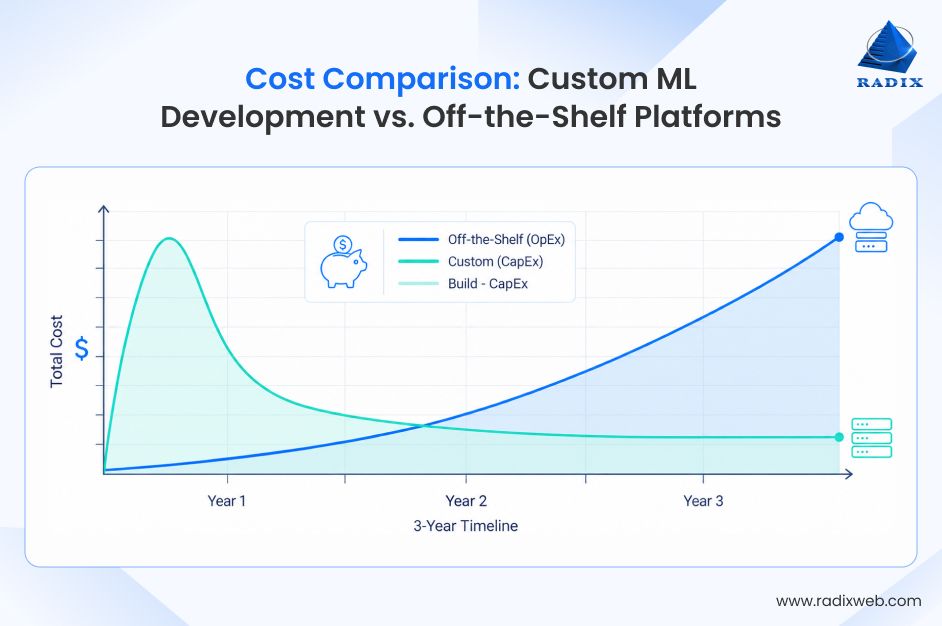
Past that, a self-hosted custom model is substantially cheaper per inference. There is also a middle path on cost: fine-tuning or RAG for a pre-trained open-source model typically costs 10% to 15% of building a foundation model from scratch and delivers 85% to 95% of the performance.
Strip away the sales pitch and pure cost comparison and the custom machine learning model vs off-the-shelf platform comparison shows up in four places:
Off-the-shelf tools hit a ceiling because they serve a broad market. Custom models are tuned continuously to your domain. This is also where the decision between custom machine learning vs third-party ML tools gets made for most teams: if the work needs your vocabulary, your edge cases, and your data structures, configuration only goes so far.
But before you commission custom model development, ask vendors, "Can off-the-shelf ML models be customized?" In most cases, the answer is yes, but within limits. Retrieval-augmented generation (RAG) and fine-tuning (where the vendor allows it) let you adapt a pre-trained model to your data. But the vendor sets the boundaries, and the model weights stay theirs. ML model customization beyond those boundaries means moving to open-source base models you control.
In terms of machine learning model deployment, platforms win on speed as they just take a few days or weeks, with the infrastructure already built. Full custom builds run 6 to 24 months, though fine-tuning workflows can compress that to weeks or months.
The vendor scales a platform and patches it. With a custom build, that falls to your team. On ML model scalability and maintenance, the platform route trades control for convenience, and the custom route does the reverse.
The end-to-end machine learning lifecycle covers data collection, training, deployment, monitoring, and retraining. A platform vendor owns most of it. With a custom build, you own all of it, including the parts nobody put in the business case.
Owning the lifecycle means owning the discipline around it. Using MLOps to ensure enterprise AI projects ship properly is the unglamorous work that decides whether a model survives its first year. Drift monitoring and retraining pipelines are not optional extras. They are what keep accuracy from quietly decaying once real-world data starts to move.
Here's a quick summary of how custom ML models and off-the-shelf ML platforms actually differ in production:
| Dimension | Off-the-shelf ML platforms | Custom ML models |
|---|---|---|
| Speed to deployment | Days to weeks | 6 to 24 months; fine-tuning can cut this to weeks or months |
| Data control and compliance | Vendor-controlled; data crosses multi-tenant cloud APIs | Self-hosted on private cloud, single-tenant, or on-premises |
| Domain accuracy and fit | Generic baseline that plateaus on specialist tasks | Highly specialized, optimized for your context |
| Cost at scale | Low upfront, fees scale linearly with volume | High upfront, low variable cost at high volume |
| MLOps overhead | Handled by the vendor | Owned by your team |
| Intellectual property | Rented software, no unique asset | 100% proprietary weights and algorithms |
Ultimately, the right choice depends on your business goals, data requirements, scalability needs, and long-term ML strategy.
Build proprietary ML models when the AI capability is core to your product, depends on your data, or operates under tight security and regulatory constraints. Custom models win the custom machine learning vs ready-made ML platform debate in the following scenarios:
These conditions often arise in specialized AI workloads where adapting an existing model or developing a custom solution can deliver better results:
When spreading your AI investment across ML, NLP and computer vision projects, evaluate each workload independently. Some may work well with off-the-shelf platforms, while others justify fine-tuning or custom development based on performance requirements, data constraints, and total cost of ownership.
Use an ML platform for standard, general-purpose work where speed and low initial investment matter more than differentiation. An off-the-shelf machine learning model earns it place in five situations:
One caution: Buying an ML model is not free of commitment. Vendor dependency is the cost that arrives later, so check data portability and exit terms before you sign.
Pure build or pure buy forces stark trade-offs, which is why roughly 56% of organizations take a hybrid approach. The principle is simple: buy to accelerate and build to differentiate.
Here are four hybrid ML model usage patterns that show up most often:
Strategizing your MLOps roadmap early keeps the hybrid from turning into two disconnected stacks that nobody fully owns. Decide up front who monitors the platform-based pieces, who retrains the custom ones, and how both report into one view.
The custom machine learning model vs off-the-shelf platform decision gets manageable when you evaluate it across five questions. The right answer usually emerges by the third.
| Low proprietary data | High proprietary data | |
|---|---|---|
| High differentiation | Custom or fine-tune; expect a longer timeline to collect data | Build custom; this creates a defensible moat |
| Low differentiation | Buy off-the-shelf | Hybrid: extend a platform with RAG or connectors on your data |
Models cannot perform without clean, structured, labeled data, and fragmented data inflates preprocessing costs fast. If regulation requires data to stay on private single-tenant infrastructure, custom or self-hosted open-source is your only route.
Under a few weeks points to a platform. A six-month runway makes custom feasible.
If the honest answer to question four is "not yet," a partner closes the gap. But remember that selecting the right machine learning development company means looking for delivery experience across data engineering and MLOps, not only modeling. Ask how they handled drift and retraining on a past project, not just the launch.
A custom build needs in-house data scientists, ML engineers, data engineers, and cloud architects, plus the willingness to maintain pipelines and manage drift long after launch.
Count the upfront build, the 15–25% annual upkeep, and your inference volume. Platforms are cheaper at modest volume and fees scale linearly. Past the tipping point, self-hosting wins.
Also, make sure you decide whether to get ML consulting first or jump to development. If you cannot yet answer the five questions above with confidence, start with consulting. If you can, and the answers point to build, go straight to development.
Buy the Commodity, Build the Edge: Making the Right ML Call
Building a custom ML model pays off only where the model is the advantage. For everything else, renting is faster, cheaper, and honest about what your business actually competes on. Get the custom machine learning model or off-the-shelf platform call wrong in either direction and you either overbuild a commodity or underinvest in your edge. Most teams building an ML-powered business software should buy first, learn what their data can do, and then build where it counts.With 26+ years of experience, we, at Radixweb, have helped businesses across 30+ industries and 25+ geographies build and scale ML solutions aligned with their goals. From model selection and fine-tuning to custom ML development and deployment, we've helped startups and enterprises identify the right approach, define a practical roadmap, and turn their AI investments into business outcomes. If you are still debating whether you should build or buy an ML model, schedule a consultation with our ML experts and get a roadmap tailored to your needs and get a clear path to getting started.
Ready to brush up on something new? We've got more to read right this way.