Read More


Recognized for AI Excellence at 2026 Globee® Awards - Read More

Maitray Gadhavi
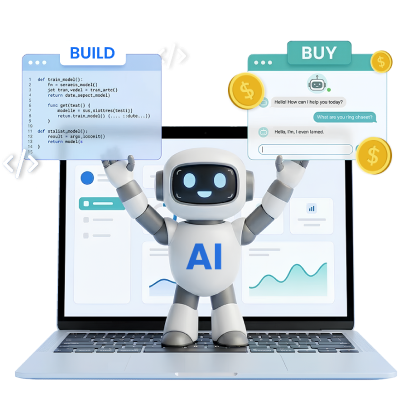
Your 7 Mins Read: AI innovation has made one C suite decision harder than ever – should you build or buy? The true differentiator now isn’t AI, it’s how you adopt it! This is a strategic guide where tech leaders evaluate their build vs buy AI decisions – frameworks, TCO drivers, execution paths governed by strategy, integration and best AI engineering practices.
TL; DR
● Build AI solutions when differentiation, deep data context, domain-specific logic and foundational workflows make your competitive edge. Retain end-to-end control over accuracy and compliance in high-stakes environments.● Buy AI solutions when rapid deployment, speed and predictability are your gamechangers. Reduce operational burden where readymade tools already deliver business value.● Adopt a hybrid approach where off-the-shelf intelligence delivers speedy wins and custom Ai layers deliver strategic IP, goal-aligned value and compliance adherence.● Quick wins don’t deliver a clear picture, evaluate with a long-term lens. Optimize for a 3-year TCO, integration complexities, scalability and governance postures so that your AI architecture stays cost-effective and free from vendor lock-ins.
AI-led innovation has flattened the expense of prototypes, while expanding the cost of owning business outcome. This quiet shift has made the build vs buy AI debate concentrated on portability, flexibility of solutions and governance.
While AI development providers sell you unbeatable speed, your internal teams build core control for AI systems. However, its really a tech leaders job to determine where your leverage lives: in your data, your workflows or your compliance posture.
The stakes are high because it’s not just about procurement. Its essentially the riskiest decision because how CTOs decide to build or buy AI determines your AI success. AI can automate, orchestrate and generate faster than release cycles now, which means one wrong architectural move can bring years of financial and technical creep.
The question you must ask yourself is no longer if you can build it, it rather is if you can own it! This guide is your line of sight for determining where your value lies; speed in a commoditized market, differentiate in a niche one or a mix of both which you run, audit and evolve at scale.
Lack speed in AI integration and your competitors outrun you with turnkey AI. Build it all, and you’ll get stuck in the eternal loop of model drifts, integration challenges and governance issues.
AI-assisted coding is launching rapid prototypes in record timelines, making a comeback for custom software demands. But owning outcomes in the modern AI landscape means navigating drifts, evaluations, observability and governance.
Yet the classic tradeoff ‘prototypes are cheap, production is pricey’ has shifted. With the global revenue for AI software market projected to reach $520-550 billion by 2030, the build vs buy AI models agenda should be viewed through a 12 quarter lens instead of pilot promises.
Because your boards expect quick and visible value, I believe the strategy for now is encoded in ‘build, buy or blend AI with embedded AI in existing apps and enterprise AI apps delivering niche value that vendors do not offer.
A hybrid approach is your newest AI leverage. Buy AI for speed, build custom enterprise AI for proprietary data semantics, nuanced workflows and compliance needs. The next step is to converge both with just and measurable governance.
The current state of AI is infrastructure + application. In the AI build vs buy decision framework, most leaders prefer to ‘rent’ foundational models while building their own solutions for enhancing business outcomes, governance and risk postures. Here’s a breakdown of when you should do what:
Building AI Solutions – A Definition:
Building enterprise-scale artificial intelligence solutions that deliver business value, essentially means designing and deploying custom-engineered builds from ground zero to meet business-specific requirements – from workflows, to business logic and data models. These need higher upfront investments to deliver specific capabilities that gives businesses an edge over competitors in the same business niche.
Build artificial intelligence solutions when:
How to Maintain Your Build Discipline:
Buying AI Solutions – A Definition:
Buying or renting AI solutions means investing in off-the-shelf, ready-made solutions that are pre-built platforms and tools from third-party vendors. They can be deployed with minimal customization. These offer faster time-to-deploy but often come with architectural and integration limitations, unrequired features and pricing dependencies from vendors.
Rent AI solutions when:
What to Monitor and Negotiate:
The best way to start is by integrating embedded AI apps into your existing solutions. Continuously weigh lift and encode portability safety nets. Before finalizing your ‘buy/rent’ strategy, thoroughly evaluate the recent AI use cases as your decision template.
Here’s a quick view comparison table for fast reference:
| Marker | Building AI Solutions | Buying AI Solutions |
|---|---|---|
| Time To Deploy | Months to Years | Days to Weeks |
| Upfront Costs | High | Low to Medium |
| TCO | Lower in Long-term | High in Long-term |
| Customization | End-to-end Customized | Limited Scope |
| Competitive Advantage | High; Proprietary Capabilities | Low; Same offerings as competitors |
| Data Control | Full-ownership | Vendor-managed or Shared |
| Scalability | Built-to-scale | Vendor Dependent |
| Maintenance | In-house | Builder Maintained |
| Compliance | Full control | Vendor Dependent |
| Risk Factor | Execution Challenges | Vendor Lock-in |
| Integration Flexibility | Unlimited | Limited to Vendor Scope |
| Suited for | Market Differentiators | Commodity Functions |
A recent MIT study on state of AI in business indicate a 67% success from vendor-led software partnerships in AI solutions, while only 33% of in-house builds stay winning. This is largely an execution gap. To bridge this, there’s the third approach, a blend of build and buy AI.
Most fast-moving businesses leveraging AI are leaning towards hybrid models. One, because they bring the foundational speed of vendors. Two, they help businesses retain the domain logic, policy guardrails while enhancing governance postures throughout the AI lifecycle.
What This Pattern Entails?
While most AI projects never evolve beyond the pilot stage, our experts at Radixweb have scaled more than 50+ prototypes into successful productions. They have followed strategic guidelines and proven primers from this guide on scaling AI. This is a must read!
Most business leaders do not fail the build vs buy AI decision because they lack information. They choose because they do not prioritize the right things:
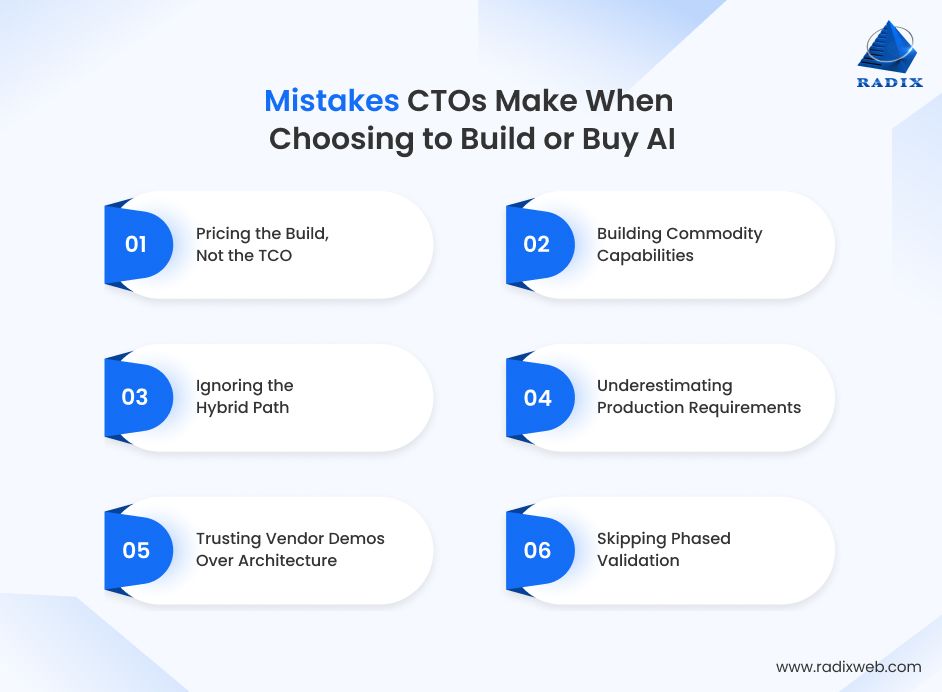
This is a board-ready decisioning framework to help you determine pros and cons of building AI in-house, core advantages and disadvantages of buying AI and where a hybrid approach fits in. Ask yourself these following questions and the decision will come easy:
Another crucial factor in this strategy is the cost analysis of build vs buy AI. Our recommendation would be running a pilot phase and thoroughly prioritizing evaluations, observability, token and GPUs along with vendor premiums. However, businesses can truly witness the true value of the AI models only with a 3 year TCo window.

Design AI for Reversibility – The Truth You Can’t Ignore
My observation says that most AI projects failed between 2023-2025 because of irreversible architectures. As a business leader, you must understand, AI models and vendor offerings will change. The only way to deal with it is having refactorable:● Modular agents● Auditable data flows● Model-agnostic interfacesOur experts at Radixweb, help you balance speed and control with off-the-shelf collective intelligence and speed and custom workflows delivering business outcomes with built-in accountability, accuracy and IP concentration. If your need further details on how we operationalize AI profitably, connect with us and we’ll deliver your tailored roadmap.
Ready to brush up on something new? We've got more to read right this way.