Read More


Recognized for AI Excellence at 2026 Globee® Awards - Read More

Vinit Kariatukaran
By the end of 2026, ML adoption across digital-first organizations is expected to reach 85%. Yet, ML market data reveals that 80% of these projects fail to deliver the intended business value. Also, only 6% of teams saw ROI within a 12-month window.
This gap is rarely about ML models or algorithms. Most of the damage happens earlier.
In fact, our proprietary research on AI failure patterns, published as the Radixweb AI Failure Report, reveals that most initiatives fail due to workflow integration issues. Some organizations start developing models before assessing how they will fit existing processes and systems. Others invest in planning but fail to translate the resulting strategy into a solution that meets the original business requirements.
Knowing when to consult, when to build, and how to align the two can determine whether an ML initiative delivers business value. In practice the machine learning consulting vs development question is really a sequencing question, not an either-or question, because one decides what is worth building; the other builds it. You need both, in the right order, or else the budget leaks.
Machine learning consulting decides what to build and whether your data can support it. ML development builds, deploys, and maintains it. If your use case or data is unvalidated, start with consulting because it costs less and prevents rework. If you already have a validated use case, clean data, and funding, go straight to development. Most businesses end up needing both, in that order.
| Aspect | Details |
|---|---|
| What does this guide cover? | The core difference between consulting and development, what each includes, cost and timeline ranges, ROI, the post-launch overlap, a decision framework, and the proof-of-concept bridge between machine learning strategy and implementation . |
| Who should read this blog? | CTOs, heads of data and AI, COOs, and product leaders weighing machine learning consulting or development for businesses before committing budget. |
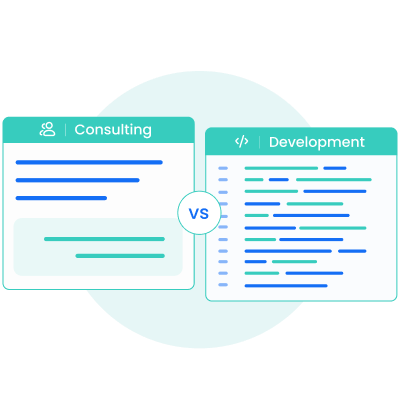
Machine learning consulting decides what to build and why. Machine learning development works out how to build it. That one-line split, planning vs. actually building, is the main difference between machine learning consulting and development, and almost every other contrast follows from it.
On the consulting side, the work is strategic clarity and includes feasibility assessments, data readiness audits, and ROI roadmaps. On the development side, it is hands-on engineering and includes data pipelines, model training, system integration, and production deployment.
Buyers sometimes frame the same split as machine learning consulting vs. implementation, and the logic holds either way. One reduces uncertainty. The other turns the answer into software.
| Dimension | ML Consulting | ML Development |
|---|---|---|
| Core question | What should we build, and why? | How do we build it? |
| Outputs | Strategy documents, data assessments, build-vs-buy recommendations, prioritized roadmaps | Tested running software, data pipelines, model serving endpoints, deployed systems |
| Primary focus | Reducing business risk before engineering budget is committed | Technical execution and operational performance in production |
Put differently, consulting protects the budget and development spends it.
But the two share responsibilities across every stage of the machine learning lifecycle: consulting owns problem framing and feasibility at the front, development owns build and deployment in the middle, and both show up again after launch. Most top machine learning service providers do both, which avoids handoff loss. Together, machine learning consulting and development help assess feasibility, plan ML strategy and build, test, integrate, and deploy solutions successfully. However, the two scopes should be priced and gated separately.
Before production code gets written, a business needs to know whether machine learning can solve its problem, whether the data is ready, and what success looks like. Machine learning consulting addresses these questions through four core activities.
1. Feasibility and Data Readiness Assessment
A machine learning feasibility assessment evaluates whether historical data has the quality, volume, and predictive signals needed to achieve the target accuracy. A data readiness assessment for machine learning goes deeper and examines how that data is collected, labeled, stored, and accessed. Together, these assessments reveal whether the primary challenge lies in the model, the data, or the underlying infrastructure.
2. Problem Framing and Algorithm Selection
Consultants translate business objectives into clearly defined ML problems and identify the appropriate approach, whether supervised classification, regression, time-series forecasting, computer vision, or NLP. Sometimes, a rules-based system is sufficient. A good consultant recommends the simplest approach that meets the business need, avoiding unnecessary complexity and development costs.
3. ROI Modeling and Roadmap Prioritization
Machine learning strategy development helps rank potential use cases by expected returns, implementation costs, and data dependencies. It also guides the allocation of AI investments across ML, NLP, and computer vision, ensuring resources go toward initiatives with measurable business value. The outcome is a machine learning project roadmap outlining priorities, milestones, and success metrics.
4. Governance and Architecture Design
Consultants plan data privacy, regulatory compliance, model risk controls, and MLOps architecture before deployment. In machine learning consulting for enterprise businesses, these decisions must account for existing systems, integration requirements, and regulatory exposure. Addressing them early reduces the risk of costly redesigns and operational issues later.
Together, these activities define your machine learning project requirements, including the problem statement, target metrics, data sources, and technical constraints. A machine learning consulting team typically combines an ML architect, data engineer, and domain specialist to establish these requirements. Many firms include this work within broader AI-related advisory, but effective machine learning consulting for AI project planning should deliver a specific use case, measurable goals, and a clear data readiness verdict.
This roadmap connects machine learning strategy and implementation, giving engineering teams a practical starting point. Knowing when to hire a machine learning consultant comes down to one question: can you confidently define these requirements yourself? If not, start with consulting.
If consulting answers what to build, development handles the engineering. These services cover the hands-on lifecycle needed to train, deploy, and maintain a model, typically across four tracks.
1. Data Engineering and Preparation
Data engineering typically includes ETL pipelines, raw data cleaning, feature selection and engineering, and feature stores. Machine learning pipeline development is often the longest part of the project because model performance depends on reliable, accessible, and well-structured data.
2. Model Training and Tuning
Model work involves selecting algorithms such as gradient-boosted trees, deep neural networks, and transformer models, then tuning hyperparameters and validating results. Machine learning model training and testing is iterative, making the accuracy targets defined during consulting essential. Effective machine learning model development involves repeated experiments against those targets rather than a single build.
3. Integration and Serving
Machine learning deployment and integration connect trained models to business applications through REST or gRPC APIs, enabling real-time inference or scheduled batch scoring. Without a reliable way for applications to use its predictions, even an accurate model delivers little business value.
4. MLOps and Infrastructure
CI/CD pipelines, model registries, automated retraining loops, and drift monitoring help maintain model performance after release. These capabilities support reliable operations as data patterns, business requirements, and production conditions change.
The scope depends on the use case. Custom machine learning solutions range from machine learning development for business automation, such as forecasting and workflow scoring, to using natural language processing solutions for document-heavy processes or deploying computer vision-powered enterprise systems for inspection and monitoring.

Machine learning consulting typically costs less upfront, while development requires greater investment in engineering. The ranges below are indicative, and scope, data condition, and integration depth will move them.
| Metric | ML Consulting | ML Development |
|---|---|---|
| Typical cost range | $800–$2,500 for a fixed feasibility audit, or $60–$300 per hour | $5,000–$30,000 for contained builds; $50,000–$500,000+ for enterprise systems |
| Typical timeline | 2 to 6 weeks | 6 weeks to 12+ months |
Note: The table above shows the cost of machine learning consulting vs. development in brief. For a fuller breakdown, see our detailed guide on the cost of developing ML solutions.
Machine learning consulting costs stay low because the deliverable is bounded: a report, a roadmap, a verdict. The machine learning development cost increases because engineering, infrastructure, and QA run continuously.
The financial case for starting with consulting is rework. Investing upfront typically saves 20–30% of total project costs by preventing rework and avoiding builds that were never feasible.
Machine Learning Consulting vs. In-House DevelopmentMachine learning consulting vs. in-house development is a different discussion altogether. An in-house team gives you long-term ownership, but you carry hiring time, retention, and tooling before the first model ships. Many companies close that gap by working with AI/ML specialists on the first project while building internal capability alongside it.
Also, proper machine learning ROI assessment starts before deployment, not after. To measure returns accurately, establish the following:
Treat this timeline as a planning range for how long it will take to build the ML solution and derive results from it, not a promise.
Launching an ML model is not the end of the project. Instead, it is where the cost conversation changes altogether. Once it enters production, teams must monitor performance, manage changing data, and maintain reliability. This is where consulting and development work together across three areas.
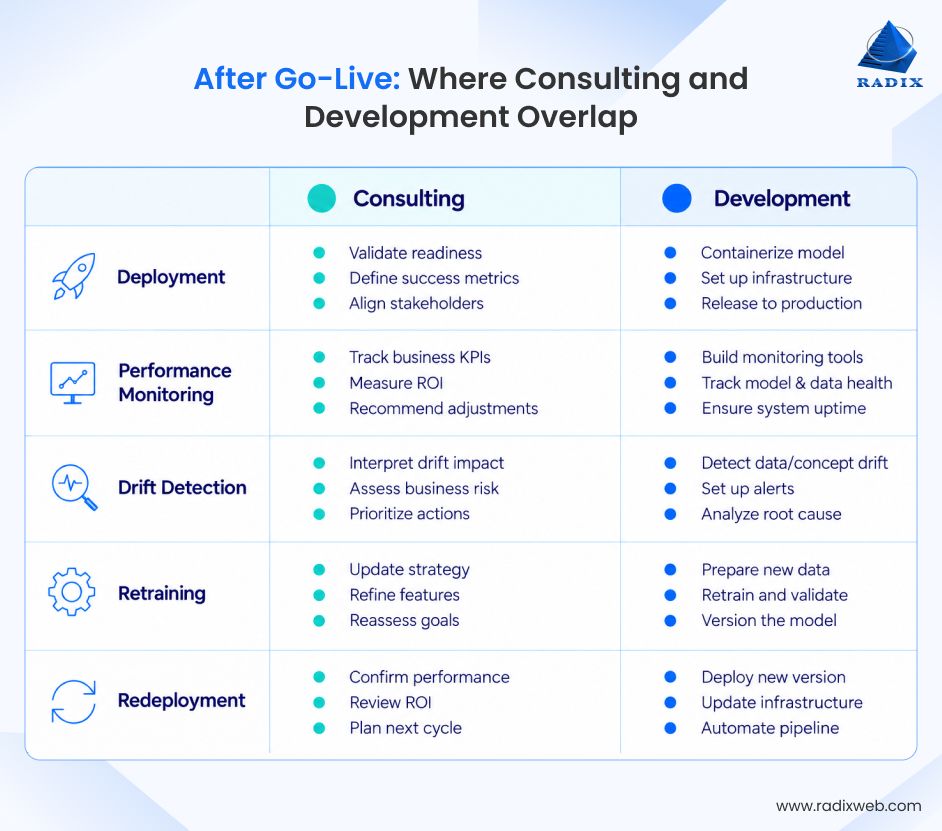
Models can lose accuracy as production data changes (known as data drift) or relationships between inputs and outcomes evolve (known as concept drift). Machine learning model monitoring helps detect these changes early, so teams can investigate performance issues and determine whether the model needs retraining or adjustment.
Development teams manage retraining pipelines, monitoring infrastructure, and technical fixes. Consulting teams help evaluate model risk, review accuracy thresholds, and determine appropriate retraining schedules. This is why machine learning consulting and implementation services often continue alongside development after release. A machine learning consulting partner for production deployment can also help teams establish these processes before handover.
Proper consulting with MLOps experts before deployment makes monitoring and retraining part of the original architecture rather than costly additions later.
Annual maintenance, retraining, and infrastructure monitoring can typically cost 15–20% of initial development costs, depending on the system's complexity and operating requirements. Planning for machine learning scalability and maintenance from the beginning helps businesses budget for ongoing support and avoid accumulating machine learning technical debt through neglected monitoring and outdated models.
Regular machine learning model optimization keeps predictions aligned with changing data and business needs. These recurring expenses should be included in the overall machine learning development cost presented to finance, giving decision-makers a more realistic view of the investment beyond launch.
Ultimately, production ML requires both engineering execution and ongoing oversight. Planning for these responsibilities early helps businesses maintain model performance, control long-term costs, and adapt as operational needs change.
The machine learning consulting vs. development decision gets easier once you test your project against a few plain conditions. Skipping this step is how businesses end up paying engineering rates to discover a use case was never feasible.
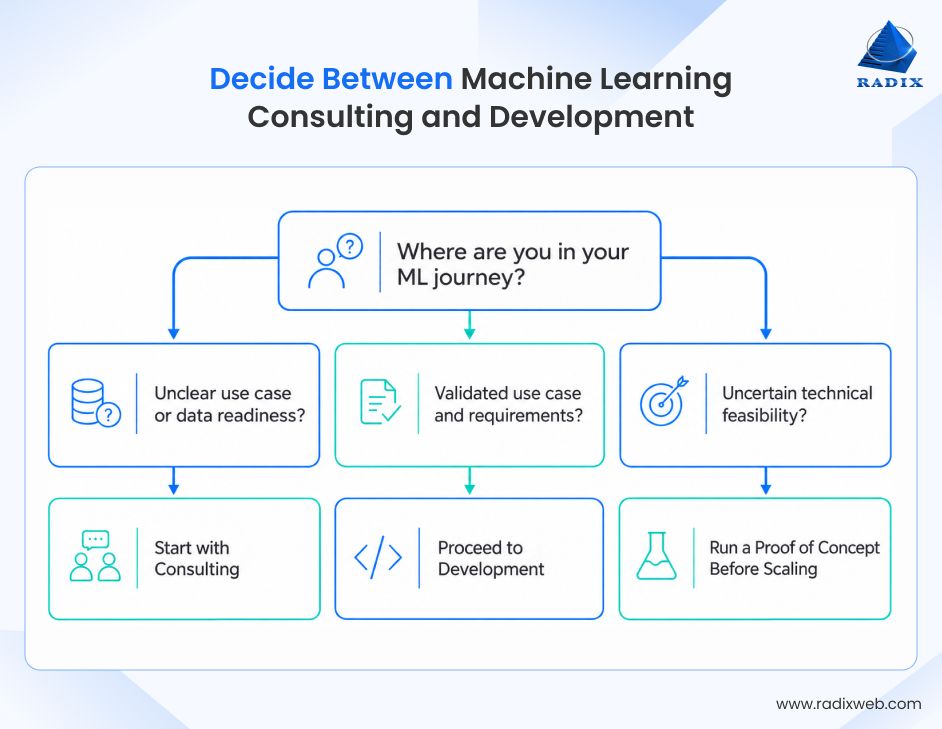
Here are the signals that help you decide when to choose machine learning consulting services:
Also, where the data is the unknown, machine learning consulting for data readiness assessment is usually the right first spend, and because machine learning consulting costs less than a build, it is also the cheapest way to settle the question.
The following signals indicate when to hire a machine learning development company:
Note: Once you know you need ML development, make sure you properly vet options and select the right ML development partner who has an understanding of your industry, business requirements, and technical needs
Most paths run through both: consulting validates, a PoC proves, and development scales.
If the use case or data quality is unvalidated, consulting comes first. Starting there means you don't pay full engineering rates to learn something a short audit would have told you.
A machine learning proof-of-concept is a short, time-boxed engagement, typically 2 to 6 weeks, that tests technical feasibility on a real sample of your data.
The proof-of-concept for any software is the bridge that connects abstract strategy to full-scale delivery by proving a model can reach a predefined quantitative pass mark, such as accuracy, recall, or precision, before you commit $50,000 or more to a production build. Set that mark during consulting, not after you have seen the results. Machine learning consulting for proof-of-concept development works well because the people who framed the problem also judge whether it passed.
A PoC confirms that your data supports the chosen algorithm and surfaces edge cases early, which directly addresses the high failure rate of ML pilots. Passing is not the same as being production-ready, though. A PoC does not prove integration, monitoring, or maintenance. That is why machine learning strategy and implementation have to be planned as one path, with the PoC as the gate in the middle.
Machine Learning Consulting and Development: From Strategy to Production
In most cases, you need both ML consulting and development. Consulting decides what is worth building and proves the data can support it. Development turns that decision into software that runs, scales, and stays accurate. So, treat the machine learning consulting vs. development debate as a sequence rather than a choice, and developing ML solutions for organizational impact stops being a gamble.At Radixweb, we offer both, delivered in the right order: assessment and roadmap first, a proof-of-concept to test the verdict, then production engineering and ongoing MLOps support. You get one team accountable from the first audit to the live system. Plus, we bring 26+ years of consulting and engineering experience across 30+ industries. So, book a one-on-one discussion with our ML experts who can guide you across options and build your ML development roadmap.
Ready to brush up on something new? We've got more to read right this way.