Read More


Recognized for AI Excellence at 2026 Globee® Awards - Read More

Maitray Gadhavi
A machine learning project can have a sound business case, a capable team, and a promising prototype, yet still fail to deliver in production. The difference often comes down to the development partner’s ability to handle data quality, model performance, integration, and long-term maintenance.
That’s why knowing how to choose a machine learning development company means looking beyond technical credentials and impressive demos. The right partner should understand your business goals, make sound technical decisions, and account for what it takes to move a model from experimentation to production. It also means evaluating more than technical expertise. It means finding a team that can turn machine learning investments into reliable, usable business outcomes.
Choosing a machine learning development company involves assessing project readiness, technical capabilities, production experience, costs, and long-term support. It is a risk decision, not a shopping exercise. Test your own readiness first, then make vendors prove capability on your data, not a demo. Check they can run models in production, compare proposals on assumptions and three-year cost, lock ownership and acceptance criteria into the contract, and score finalists. Reject cheap bids that hide their exclusions.
| Aspects | Details |
|---|---|
| What does this guide cover? | A three-stage vendor evaluation (readiness, capability testing, production proof), how to compare proposals beyond price, the contract clauses that protect you, and a weighted scorecard with rejection triggers. |
| Who should read this guide? | Technical and business leaders shortlisting or negotiating with ML vendors, CTOs, heads of data and AI, product owners, and the procurement teams who approve the budget. |
Investing in a machine learning project is not like buying software. A SaaS product ships with features you can click through before you pay. A model ships with a promise about data nobody has fully seen yet. That is why a generic list of machine learning company selection criteria (team size, years in business, a wall of logos) says so little. It measures the vendor. It never measures the fit between that vendor, your data, and your tolerance for being wrong.
A demo runs on curated data, chosen by the vendor, in a controlled setting. Production runs on whatever your ERP, sensors, and customers produce on a bad Tuesday. The gap between the two is where projects stall. According to market data by Gartner expects organizations to abandon 60% of AI projects that lack AI-ready data through 2026 and S&P Global found that 42% of companies scrapped most of their AI initiatives in 2025, up from 17% the year before. The models were rarely a problem.
So, what are the risks of choosing the wrong ML development partner? They are seldom dramatic. Budgets creep, accuracy settled at "almost good enough," and the team that built the model has moved on by the time it starts to drift. Someone calls it a failure a year later, after the money is gone.
Building is a project. Operating is a commitment. A model that tests well in March can degrade by September as customer behavior, supplier data, or upstream schemas change. What happens after an ML model is deployed? Someone has to watch it, retrain it, and decide when to roll it back. If a proposal stops at go-live, it covers the cheaper half of the work.
That is why we treat vendor selection as a decision about the entire lifecycle of an ML project, not the model alone. So, any machine learning development company comparison you build needs a column for operations, not just for build.
From assessing project readiness to validating vendor capabilities and production readiness, the following three stages help you make the decision with greater clarity and fewer costly assumptions.
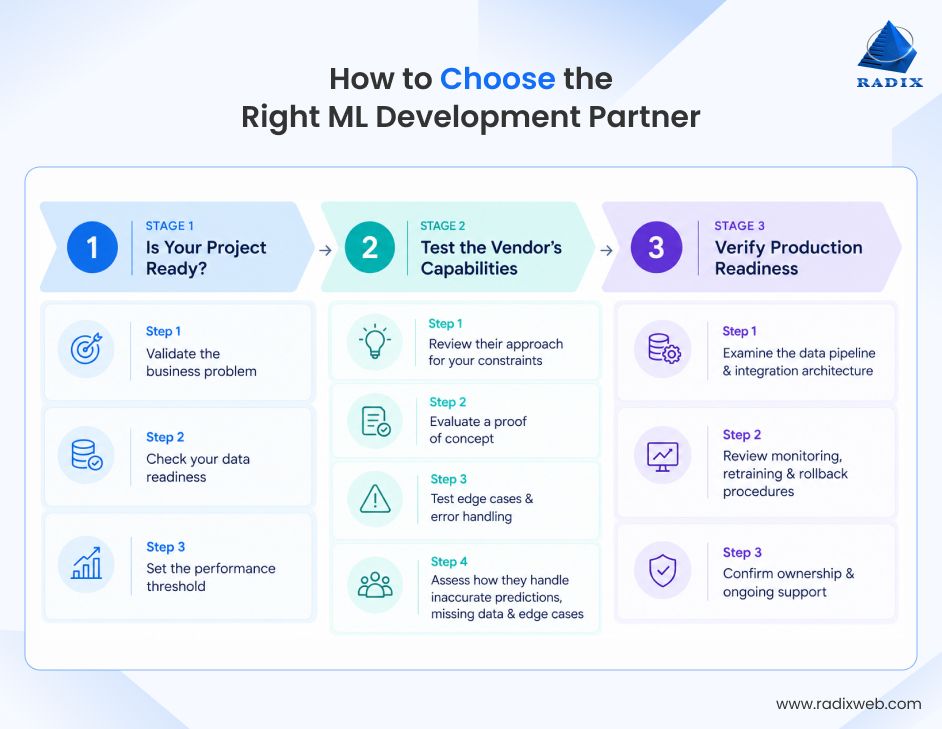
The vendor selection process actually starts even before you talk to any vendor. You need to first understand whether or not your business is ready for an ML project.
Once you do that and the answer is ‘yes’, you need a strong project brief. That’s because a weak brief will not get rescued by a strong team; instead it gets billed by the hour. So, the factors to consider when hiring an ML development company begin inside your own walls: the problem, the data, and the performance threshold. Settle those three and you can judge every vendor against something real.
State the problem as a decision, not a technology. "We want AI for churn" is a wish. "Flag the accounts most likely to leave 60 days early so account managers can step in" is a problem. The second version tells a vendor what to predict, how early, and who acts on it. It also exposes whether ML is the right tool at all.
Rules and basic analytics solve more problems than people admit, and an honest partner will say so. Your AI investment strategy across ML, NLP, and computer vision should be settled before the first vendor call. Write the problem down in one sentence. That sentence anchors your machine learning project evaluation criteria.
Data sits at the center of every ML project. To ensure your data is AI-ready and clean, check four things:
Machine learning market statistics reveal that companies with strong data integration report 10.3x ROI on AI investment against 3.7x for those with poor connectivity. That gap tracks data readiness more than model choice.
If you fail this check, your first purchase is a data pipeline, not a model. Tell shortlisted vendors the result, because data readiness needs to be an important machine learning development company selection criterion and ignoring it just rewards the vendor whoever promises the most.
Pick the number before the pilot, not after. Set the minimum accuracy, the maximum cost per error, and the break-even point. You should have a clear answer to, “How do you measure the success of an ML project?” And the assessment should not be based on model accuracy alone. A fraud model that predicts "no fraud" every time looks 99% accurate on imbalanced data and is worthless. Tie the metric to money or risk: cost per false alarm, hours saved, revenue recovered.
A threshold fixed in advance also protects you from the oldest trick in vendor sales, moving the goalposts after the demo. You own the outcome when the number is written down before the work starts.
Once your project requirements are clear, shortlist three or four vendors from a list of the top ML development companies. A longer list can consume more time in comparisons than it saves in decision-making. Start by examining their track records. And here’s how to evaluate an ML development company's portfolio:
Here’s what else to do:
Prepare a one-page brief covering the problem statement, data description (not the data itself), constraints, and performance threshold. Give every vendor the same inputs so you can compare their responses fairly.
Buyers often spend a lot of time trying to figure out the questions they should ask before hiring an ML vendor. But the better signal often comes from the questions the vendor asks you. A vendor who asks about label quality, refresh rates, and who will act on the predictions has likely dealt with real implementation challenges. One who asks only about the budget and how long the ML project will take may not have explored the problem deeply enough.
Give vendors concrete constraints to work with, such as a latency budget, data that cannot leave your region, an explainability requirement, or a small in-house team. A credible approach adapts to these conditions. A recycled proposal does not.
Here’s how to verify an ML company's technical expertise:
Put a senior engineer from your side across the table, and have the people who will build the system, not the pre-sales lead, defend their choices and explain what they rejected. Check specialist depth too. Developing a vision driven automation and custom NLP models bring different data and evaluation problems from tabular forecasting, and a generalist's answer sounds identical for all three.
Document the pass criteria in the PoC agreement including the metric, dataset, test method, and who controls the held-out test set (you). A software proof of concept graded by the vendor using a vendor-selected data split proves little about how the model will perform on unseen data.
Keep a one-page machine learning development company checklist for this stage. It should include:
Important: Pay for the PoC. Free ones can be optimized around winning the deal rather than establishing whether the solution will work.
Give vendors a deliberately messy sample containing nulls, duplicates, a mislabeled batch, or an input type absent from the training data. Strong teams provide an error analysis showing where the model fails, how badly it performs, and what happens next. Weaker teams focus on average performance and leave the exceptions unexplored.
One of the most important questions to ask before hiring AI/ML development partners captures the point: "Show me a model of yours that failed in production and what you changed." Teams with real delivery experience should be able to explain what went wrong, how they diagnosed the issue, and what they changed. If the answer quickly turns into another sales presentation, probe further.
A proof of concept shows that a model can work under specific conditions. Production demonstrates whether the vendor can keep it working as real-world data and business requirements change. Knowing whether to build PoCs or production systems first is where many proposals become vague. Among the tips to choose the best ML development services, one of the most useful one is to request a production runbook from a previous project, with client names and sensitive details removed.
Ask for a diagram showing how data travels from your source systems to the model and how predictions return to the workflow. Production ML depends on much more than the model itself. It requires ingestion, validation, feature stores, serving APIs, and batch jobs to work together reliably.
Also, check whether the pipeline and architecture covers the security factors that matter in ML development like:
Ask for evidence of certified practices such as ISO 27001, not a paragraph in the proposal.
Models can lose accuracy as real-world patterns change.
Adaptive learning platforms using AI features offer a clear example of how this happens in real time. Learner behavior shifts each term and a model trained on last year's cohort can quickly become less effective. So, ask the vendor what happens after an ML model is deployed. Ask them to explain its drift detection, retraining triggers, and rollback procedures step by step.
This is where MLOps consulting and strategizing becomes essential. A vendor should be able to explain which alert fires first, who receives it, and how long a rollback takes. Vague answers may indicate that the team has not established these processes in practice.
Ownership is often where vague proposals reveal their weaknesses. "Our team will support you" is not a defined responsibility. Identify the person accountable for uptime, the person responsible for model accuracy, and the person who approves retraining.
Also, decide whether your team, the vendor, or both will operate the system after handoff, and account for that arrangement in the budget. Documenting these responsibilities takes little time. Leaving them unresolved can lead to months of disputes. So, post-launch ownership is one of the most important factors to consider when hiring an ML development company that buyers often overlook, yet it is also one of the first areas where disagreements emerge.
What are the red flags when selecting an ML company?● Promises of guaranteed accuracy without testing against real-world data● No proven ML systems running in production● Vague answers about data quality, model limitations, or edge cases● No clear plan for monitoring, retraining, or model rollback● Proposals that focus on demos rather than measurable business outcomes● Unclear ownership of deployment, maintenance, and model performance● Pricing that excludes integration, infrastructure, or post-launch supportAny one of these red flags warrants closer scrutiny before you commit your budget, timeline, and business data to a vendor.
Once you have shortlisted vendors and tested their capabilities, the next step is to compare what each one is actually offering. Three proposals may look similar at first glance, but differences in assumptions, deliverables, and ongoing costs can have a significant impact on the outcome.
Run each proposal against the machine learning project evaluation criteria you established in Stage 1, and treat any proposal that overlooks them with caution, no matter how good the presentation looks.
Here’s how to compare ML development proposals:
Put every proposal on one sheet. And start with assumptions. One vendor may assume clean, labelled data, while another budgets weeks for data cleaning. Both can quote the same price while describing very different projects.
Next, compare deliverables like the model, pipeline, API, documentation, and training for your team. Then review exclusions, because that is where unexpected costs often emerge. Look for items such as labelling, cloud spend, security testing, and post-launch support.
If a proposal does not clearly state its exclusions, ask for clarification before moving forward. When narrowing your picks to the right AI ML development company finalists, pay attention to what each proposal leaves out, not just what it promises to deliver.
Your own team can be one of the biggest dependencies in an ML project. Data access, subject-matter experts for labelling, security and legal approvals, and an integration owner can all affect delivery. If any of these dependencies slip, the result may be a change request, turning a machine learning development company’s low pricing into a much higher invoice.
Ask every vendor to identify the three things most likely to delay the project. Their answers can reveal whether they understand the practical challenges involved and have accounted for them in their delivery plan.
Development is only one part of the total cost of an ML project. Factor in cloud compute and storage, labelling, monitoring tools, retraining cycles, and the people needed to manage them. Build costs are generally paid once, while operating costs recur every year.
These elements can quickly add up to the total. So, evaluate the machine learning development company’s pricing over three years rather than relying on the initial development quote alone.
Before signing, get clear answers on four questions about assets and ownership
Pay particular attention to "proprietary accelerators" that remain licensed to you even after you leave the vendor.
Your final machine learning development company comparison should include ownership and licensing terms alongside cost, capabilities, and delivery commitments. Clear terms protect your ability to maintain the solution, move it to another provider, or bring development in-house if your needs change.
A proposal is only as strong as the commitments behind it. Once you have compared the deliverables, dependencies, long-term costs, and ownership terms, you can make a more informed decision about which vendor offers the right fit for your business.
A good contract turns expectations into clear responsibilities. It defines what the vendor must deliver, how success will be measured, who owns the resulting assets, and what happens when things go wrong. Without these terms, even a promising partnership can lead to disagreements over performance, costs, and accountability.
Tie payments to milestones with measurable acceptance criteria, including the dataset, metric, threshold, and test procedure. "Model delivered" is not an acceptance criterion. "Agreed recall on the held-out test set, signed off by your data owner" is.
Carry the machine learning development company selection criteria you used to evaluate the vendor into the contract, turning key expectations into binding obligations. Include a key-personnel clause, too, so the team presented during evaluation is the team responsible for delivery.
Define what data the vendor can access, where it can be stored, how it will be protected, and when it must be deleted. Consider the security factors that matter in ML development beyond encryption and address whether your data can be used to train the vendor's other models (it should not without your explicit authorization), which subprocessors can access it, how quickly breaches must be reported, and what audit rights you retain.
Clarify intellectual property ownership as well. Specify the rights to source code, trained models, and derived features, while distinguishing these deliverables from the vendor's pre-existing tools and general know-how. Clear terms help prevent ownership disputes and make future changes easier.
List the required handover materials, including architecture documents, runbooks, retraining scripts, model cards, and reproducible environments. Include a shadow period during which vendor engineers operate the system alongside your team to transfer practical knowledge before the handover is complete.
One important question to ask before hiring AI/ML development teams is whether another team could maintain or rebuild the solution using the documentation provided. If not, you may have received a working model without the knowledge needed to operate it independently.
Define service levels for uptime and model performance, response times for incidents, and what qualifies as a model failure. That definition should include performance drift beyond an agreed tolerance, not just system outages. Specify who is responsible for monitoring, retraining, and the associated costs when data patterns change.
These terms help address the risks of choosing the wrong ML development partner before they become operational problems or unexpected invoices. Clear post-launch responsibilities also ensure that both parties understand their obligations long after the initial deployment.
After assessing project readiness, evaluating vendors, comparing proposals, and reviewing contract terms, you can bring your findings together in a single scorecard.
Here’s what you should look for in an ML development company:
Start with six pass-or-fail requirements:
This is the most important machine learning development company checklist to consider before scoring vendors. Each requirement should have a clear yes-or-no answer backed by evidence.
Once a vendor passes all six requirements, rate them from 1 to 5 against your machine learning company selection criteria. Apply the following weights to compare their technical capabilities, delivery track record, and commercial terms.
| Dimension | Weight | What earns a 5 |
|---|---|---|
| Technical fit | 40% | ● Approach adapts to your constraints ● PoC beats the baseline ● Strong error analysis |
| Delivery evidence | 35% | ● Production systems still running ● Verified references ● Real operations capability |
| Commercial risk | 25% | ● Stated assumptions and exclusions ● Three-year cost ● Clean ownership terms |
Delivery evidence deserves substantial weight and knowing how to evaluate an ML development company's portfolio is important. Score only what you can verify through reference calls, production metrics, or a live system. Adjust the weights to suit your business context. For regulated industries, for example, you may want to give commercial risk and security greater weight.
Some shortcomings should outweigh a competitive price. Reject a vendor that:
These are some of the most consequential red flags when selecting an ML company because they expose you to risks that may surface only after development begins. A lower bid is rarely a saving if it leaves you with untested performance, unclear accountability, or costly vendor dependency.
Ultimately, pick the right AI/ML development company based on verified delivery evidence, technical fit, and long-term accountability. Use price to distinguish between vendors that meet your requirements, not to compensate for gaps in capability or trust.
Getting Started with the Right ML Development Partner
Before you commit to a vendor, put your shortlist to the test. Share a clearly defined business problem, ask for a proposal that accounts for your data and production requirements, and challenge the assumptions behind the cost and timeline. The right partner should be able to explain its approach to the ML model and the ecosystem around it, define measurable outcomes, and take responsibility beyond deployment. Use that conversation to assess whether the team can develop and deliver ML outcomes that your business actually needs.At Radixweb, we approach machine learning development with a focus on business objectives, technical feasibility, and production readiness. Our engineering teams help businesses turn ML requirements into practical solutions, with attention to data pipelines, model performance, integration, and ongoing operations. Schedule a consultation with our ML architects to discuss your project requirements and get a proposal tailored to your goals, scope, and constraints. You can then evaluate our approach, deliverables, and costs against the same criteria you use to assess every other potential partner.
Ready to brush up on something new? We've got more to read right this way.