Read More


Recognized for AI Excellence at 2026 Globee® Awards - Read More

Nihar Raval
According to Deloitte’s 2025 AI ROI survey, 85% of organizations increased their AI budgets that year and 91% were expected to increase the budget next year. Despite that, only 6% saw a return within the first year.
That gap rarely comes from bad algorithms. Instead, it comes from budgets built around the machine learning model, while the model is the smallest and most predictable part of the bill. Data work, integration, infrastructure, and the operational upkeep that begins the day an ML model goes live carry far more of the spend.
This guide covers the stage-by-stage machine learning development cost, the deployment and running expense, where budgets quietly overrun, and how to arrive at an ML budget that you can defend to a CFO.
Machine learning development costs range from $25,000 for proof of concept to $500,000+ for enterprise solutions. Data preparation, system integration, and deployment often cost more than model development itself. Businesses should also budget for cloud infrastructure, inference, and annual maintenance, typically 15–25% of the initial build cost. Assessing data readiness and long-term operating expenses helps prevent budget overruns.
| Aspect | Detail |
|---|---|
| What this guide covers? | Cost by lifecycle stage, cost factors, cost by project type, deployment and running expense, team rates, hidden costs, savings levers, and a budget framework |
| Who should read this? | CTOs, product and data leaders, and finance teams budgeting an ML initiative |
If you search for machine learning development pricing, you'll find estimates starting from $25,000 to $1 million plus. Such wide estimates eventually stop being useful.
This wide range of and uncertainty around ML costs is because machine learning projects aren’t priced like conventional software. You aren't buying a feature set. Instead, you are paying for data work, experimentation, and operations, and only part of that is code.
Most projects fall into four cost bands:
| Project scale | Typical cost | Timeline | What you get |
|---|---|---|---|
| Proof of concept (PoC) | $25,000–$80,000 | 4–8 weeks | A data pipeline and one working model that answers the feasibility question |
| Production ML feature | $60,000–$180,000 | 2–4 months | A model embedded and monitored inside existing software |
| Full custom ML solution | $120,000–$400,000 | 3–8 months | End-to-end pipeline covering training, deployment, and MLOps |
| Enterprise AI platform | $150,000–$500,000+ | 6–12+ months | Multi-model platform with custom infrastructure and governance |
Computer vision and hardware-linked machine learning projects can easily run past $1 million.
The headline range is accurate, but the cost of machine learning development also includes everything that follows the build, which is why a single figure rarely survives contact with a real project.
Also, proof of concept is not a production estimate. A software proof of concept shows potential, it shows that the data can support predictions, but it skips integration, security review, monitoring, and a pipeline that survives messy real-world input. So, if you treat the PoC figure as the full machine learning project cost, the production build will arrive as an unplanned second budget.
Note: For the wider AI landscape, including generative AI and agents, see our guide to AI development cost.
Machine learning spending is never evenly distributed, and how much you pay varies significantly depending on where you are across the stages of the ML lifecycle.
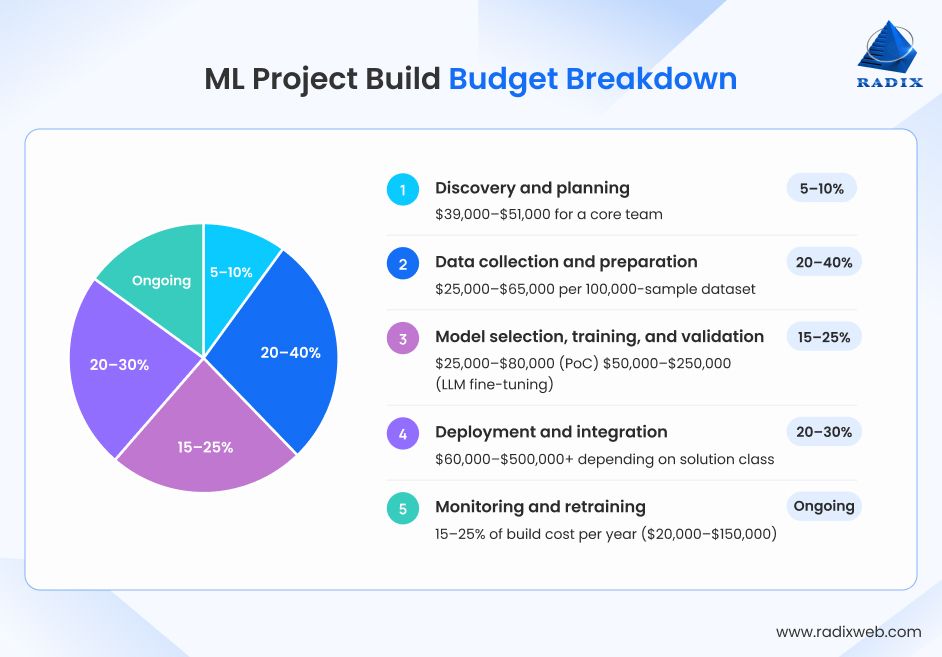
The five development stages that carry most of the money are:
| Stage | Typical Cost | Share of Build Budget |
|---|---|---|
| 1. Discovery and planning | $39,000–$51,000 for a core team | 5–10% |
| 2. Data collection and preparation | $25,000–$65,000 per 100,000-sample dataset | 20–40% |
| 3. Model selection, training, and validation | $25,000–$80,000 (PoC), $50,000–$250,000 (LLM fine-tuning) | 15–25% |
| 4. Deployment and integration | $60,000–$500,000+ depending on solution class | 20–30% |
| 5. Monitoring and retraining | 15–25% of build cost per year ($20,000–$150,000) | Ongoing |
Note: The deployment figures describe whole-project ranges by solution class, so don't stack them on top of the stages above.
When read as a complete breakdown of machine learning development costs, the pattern is clear: data work and integration outweigh the model itself. Let’s explore how the budget is spent across the development stages:
Discovery covers scoping business goals, assessing feasibility, and choosing a workable approach. A core team of a business analyst, a data engineer, and an ML engineer costs $39,000–$51,000 at onshore rates for a full engagement. Narrower use cases need lighter assessments and cost less.
Skipping this stage doesn't save money. It moves the same cost to a point where it's harder to absorb and correct decisions takes fundamentally more than it would cost to scope right.
This is where machine learning budgets most often go wrong. Acquiring, cleaning, deduplicating, and labeling a dataset of 100,000 samples costs $25,000–$65,000, and annotation alone can take 300 to 850 hours, even when you use LLMs for your data annotation strategy.
When data is unstructured or scattered across systems, preparation can consume up to 40% of the total project budget. Clean, structured records keep this line small, and everything else grows it.
This is the phase where you hire specialized AI developers, who select algorithms, train candidates, tune hyperparameters, and cross-validate. The cost to build a machine learning model here depends mostly on which path you choose:
Almost no business needs the third option, which is exactly why options like RAG and fine-tuning exist. Even at the top of the realistic range, machine learning model development cost stays smaller than the data and integration work around it.
Everything up to this point happens in a controlled environment. A model sitting in a notebook creates no value, and embedding it into a product, CRM, or operational system is where machine learning model deployment cost appears:
Integration is the quiet heavyweight. Wiring AI predictions into existing software can represent roughly half the engineering effort, particularly when the host system is older.
Models degrade as the world changes around them. Tracking drift, maintaining pipelines, and retraining live models typically takes 15–25% of the initial build cost every year, roughly $20,000–$150,000 annually. Every successful enterprise AI implementation with MLOps treats this as a standing budget line rather than a contingency.
Take the same machine learning project to three different vendors, and you’ll likely get three different quotes. Seven factors affecting machine learning development costs explain most of these variations between quotes.
Understanding these factors helps you compare estimates fairly and see what’s actually driving your budget.
A basic classification model or API integration needs far fewer engineering hours than a custom ML model development project with deep learning, real-time analytics, or computer vision. Real-time requirements in particular raise engineering, testing, and infrastructure cost at once.
Clean, structured, AI-ready data records keep spends low. Siloed or unformatted data pushes preprocessing and data engineering past the cost of the model itself.
Pre-trained models and third-party APIs minimize upfront expense. Building bespoke deep learning architectures demands GPU-intensive training and a longer experimentation cycle, which is what drives custom machine learning development cost up sharply.
GPU instance rates (NVIDIA A100 and H100 class hardware, for example) and cluster size scale training and inference bills directly.
US-based ML development specialists charge $99–$250/hour, Central and Eastern European teams cost $45–$85/hour, and outsourcing your software project to Asia-based teams brings down the cost to $20–$50/hour.
The same project can differ by 3x to 5x on labor alone, which is why AI and machine learning development cost comparisons between vendors need a like-for-like location basis.
Regulated industries like finance and healthcare need ML projects to have stronger encryption, HIPAA or GDPR controls, bias audits, and legal documentation. Such compliance-heavy builds commonly add 30–60% to baseline estimates, and retrofitting those controls after launch costs more than designing them in.
Continuous delivery, automated testing, drift monitoring, and scheduled retraining determine long-term operating spend. Teams that skip them early pay for rework later.
Together, these machine learning project pricing factors explain why two quotes for the "same" model can sit $200,000 apart.
Also, the cheapest model is rarely the cheapest project. Switching to a cheaper algorithm saves a few hundred dollars a month. Scoping the data properly saves tens of thousands. Cost control in ML happens upstream of the model.
The type of machine learning implementation being done is what sets the baseline for the budget, because each type brings a different data profile, accuracy target, and deployment pattern.
A useful machine learning development cost by project type view looks like this:
| Project Type | Scope | Typical Cost | Timeline |
|---|---|---|---|
| Proof of concept | Data pipeline and a single working model to test feasibility | $25,000–$80,000 | 4–8 weeks |
| Classification/ Regression | Structured-data predictions such as credit scoring or lead scoring | $15,000–$50,000 | 8–12 weeks |
| Forecasting and time series | Demand, sales, or churn prediction | $40,000–$150,000 | 8–12 weeks |
| Recommendation engine | Suggestions drawn from user behavior data | $40,000–$150,000 | 2–4 months |
| Production AI feature | Model embedded and monitored inside existing software | $60,000–$180,000 | 2–4 months |
| Full custom ML solution | End-to-end pipeline with training, deployment, and MLOps | $120,000–$400,000 | 3–8 months |
| Computer vision / complex ML | Image and video detection, pose estimation, smart hardware | $150,000–$1,000,000+ | 6–12+ months |
| Enterprise AI platform | Multi-model platform with custom infrastructure and governance | $150,000–$500,000+ | 6–12+ months |
Classification and regression sit at the affordable end because structured data is easy to prepare and the output is a single prediction. Forecasting and recommendation systems cost more because they depend on history and behavior at volume. Computer vision stands apart because labeling images is slow, accuracy expectations are high, and the model often runs on hardware at the edge.
Whether the work is tabular ML, language, or vision, AI investment across ML, NLP and CV follows one rule: data readiness sets the floor. Treat every range above as a planning figure, since a recommendation engine built on three years of clean purchase history prices very differently from one built on scattered logs.
Important: Anyone benchmarking machine learning software development cost against a conventional build should expect code to be the smallest line item; data and operations carry the rest. Labeling, training compute, and integration engineering usually dominate, while the model code itself is often a few hundred lines. For customer-facing products, machine learning application development cost rises further once latency, uptime, and explainability enter scope.
Most ML budget conversations stop at launch.
But model training is just a one-time event, while inference never stops. Every prediction, API call, and GPU-hour of serving adds to a bill that scales with adoption.
So, once your model is in production, budget for ongoing costs too, roughly 80% of which will be spent on inference and the other 20% on training. Success makes the model more expensive to run.
Levelized cost of AI (LCOAI) standardizes the comparison by spreading amortized capital cost and operating expense across every 1,000 valid inferences:
LCOAI = (Amortized CAPEX + Total OPEX) ÷ Total Valid Inferences
| Deployment Option | Upfront cost | Per-inference cost | LCOAI per 1,000 inferences |
|---|---|---|---|
| OpenAI GPT-4.1 API | $50,000 | $0.010 | ~$15.00 |
| Anthropic Claude Haiku API | $50,000 | $0.0048 | ~$9.80 |
| Self-hosted LLaMA-2-13B (8x A100 GPUs) | $200,000 | $0.0048 | ~$24.80 at 10M annual inferences |
These benchmarks are illustrative and shift with prompt length, volume, and amortization period. But the pattern holds. Self-hosting looks expensive at modest volume, then overtakes commercial APIs once annual inferences pass roughly 30 to 40 million. Below that, buying beats building.
The cost of developing machine learning software is paid once. Hosting is paid every month. A basic model on four vCPUs costs $150–$300 a month (roughly $1,800–$3,600 a year), while serving a high-throughput deep learning model or an LLM on dedicated GPUs costs $10,000+ a month. (GPUs are not cheap, and neither is the electricity behind them.) Secondary costs add up too and include storage for checkpoints and model artifacts, network bandwidth and egress charges, and logging tools.
Leaders working out the cost to implement machine learning in a business should model run cost separately: a model that costs $200,000 to build and $60,000 a year to serve has a very different business case than the build figure suggests.
Labor is the largest line item in any ML build. When comparing the cost of machine learning development services across vendors, rate cards alone are misleading. That’s because the team mix and the engagement model matter just as much.
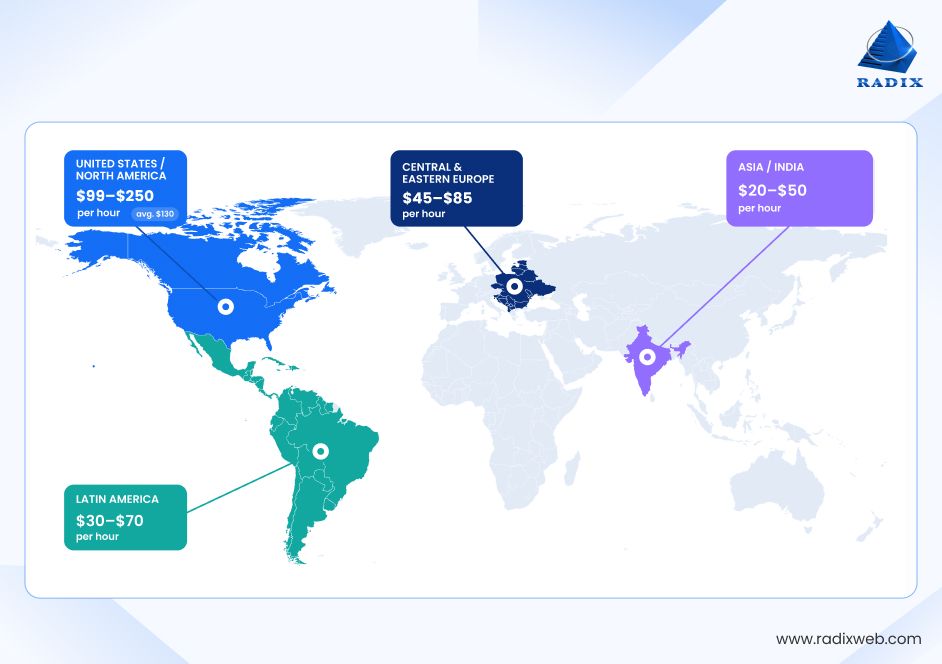
| Region | Hourly rate (USD) |
|---|---|
| United States / North America | $99–$250 (average ~$130) |
| Central and Eastern Europe | $45–$85 |
| Latin America | $30–$70 |
| Asia / India | $20–$50 |
A blended model usually gives the best cost-to-quality ratio by combining onshore architecture and product oversight with nearshore or offshore engineering at $30–$85/hour. So instead of simply comparing in-house vs. outsourcing to select one, look at hybrid options that offer the best of both models.
Pro Tip: A small investment in consulting can prevent costly mistakes later in development. Machine learning consulting cost starts around $15,000 for a narrow feasibility review and reaches $39,000–$51,000 for a full discovery engagement covering data readiness, architecture, and a deployment plan. Set against finding a data problem in month four, that is a modest premium.
The pricing model affects how you manage scope changes, control spending, and share project risk with your vendor. Here are five common options and when each makes the most sense.
You agree on the scope, deliverables, timeline, and total fee upfront. This works best for well-defined proof of concepts and projects with clear acceptance criteria. Changes beyond the agreed scope may cost extra.
You pay for the actual hours worked and resources used, including compute where applicable. T&M suits projects involving experimentation, evolving requirements, or uncertain data quality. Set a monthly spending cap and review progress regularly to control costs.
You pay for a team of ML engineers, data scientists, and data engineers over an agreed period. This model suits long-term projects that need ongoing development, specialized expertise, and consistent team involvement. Costs depend on team size, seniority, location, and engagement length.
Payments depend on agreed business outcomes, such as reducing fraud losses or improving conversion rates. This can align vendor incentives with business goals, but defining measurable targets and attributing results to the ML solution can be challenging.
You pay a recurring fee for access to a managed ML platform, model API, or ready-made AI capabilities. This reduces upfront infrastructure and development costs, making it suitable for standard use cases or variable workloads. However, usage-based charges and subscription fees can increase as adoption grows.
Before signing, compare the total expected cost, included deliverables, change-request terms, compute charges, and ongoing support. A lower initial quote may not be the most affordable option over the project's full lifecycle.
The hidden costs of machine learning development rarely appear in the first quote, because vendors can't judge data quality until they open the files. Each item below is a line you can ask about up front.
Add them up, and machine learning implementation cost typically lands 30–50% above the first quote. That's only part of the story. Change management, user training, and internal support time rarely appear in any vendor proposal, yet they decide whether the model gets used at all.
Reducing machine learning development costs isn't about choosing the cheapest vendor or cutting engineering hours. It's about making better decisions before development begins, using resources efficiently, and avoiding rework. These six strategies can help control upfront investment and long-term operating expenses without compromising model performance.
Spend $25,000–$80,000 to confirm that your data supports the intended prediction before committing to a six-figure build. A proof of concept helps validate feasibility, identify data gaps, and test assumptions early, when changes are less expensive.
Pre-trained models can eliminate the need to build and train a model from scratch. Open-source frameworks such as PyTorch, TensorFlow, and Hugging Face, combined with parameter-efficient methods like LoRA and adapters, can reduce training costs while meeting specific business requirements.
Inference costs grow with usage, making runtime optimization important for production systems. INT8 or INT4 quantization can reduce compute and memory requirements, while dynamic batching can improve hardware utilization and lower serving costs. The actual savings depend on the model, workload, and deployment environment.
Use spot or preemptible GPU instances for fault-tolerant tasks such as experimentation and batch training. Decentralized GPU networks may offer savings of up to 70% for suitable workloads, but evaluate availability, reliability, security, and performance before committing.
Investing in strategizing ML pipelines and deployments before the first sprint helps prevent costly architectural rework. Automated testing, standardized deployment pipelines, and continuous monitoring also make model updates more efficient and reduce the effort required to maintain production systems.
Keep architecture decisions and product oversight close to business stakeholders, while using nearshore or offshore engineering teams for development capacity. Depending on the region and skill set, rates of $30–$85 per hour can help balance specialist expertise with labor costs.
The biggest savings often come from validating feasibility early, preparing data properly, optimizing inference, and building reliable deployment processes. Evaluate each decision against the project's total lifecycle cost, not just the initial development quote.
A defensible machine learning development cost estimation starts with a formula. Once you have a number, pressure test it against your data and deployment plan.
Here’s a simplified formula to calculate the cost of your ML project:
Total ML budget = Initial build + Data preparation and integration + Inference and cloud OPEX + Annual maintenance (15–25%)
For projects with heavy training, a back-of-envelope compute estimate helps:
Training cost = (Training time ÷ GPU utilization rate) × Hourly resource price × GPU count + Infrastructure overhead (10–50%)
Utilization matters because GPUs rarely run at full capacity. A job that needs 100 GPU hours on paper can bill far more at 40% utilization.
A Worked ML Project Budgeting ExampleConsider a mid-market company embedding a demand forecasting model into its existing planning software:● Discovery and feasibility: $45,000● Data preparation and labeling: $50,000● Model development, training, and validation: $55,000● Deployment and integration: $65,000● Initial build subtotal: $215,000● Contingency (15%): $32,000● Year 1 cloud and inference: $24,000● Year 1 maintenance (20% of build): $43,000● Year 1 total: $314,000● Year 2 run cost (cloud $30,000 + maintenance $43,000): $73,000● Year 3 run cost (cloud $38,000 + maintenance $43,000): $81,000● 3-year total: ~$468,000This shows how a $215,000 build is a $468,000 commitment over three years. That is the machine learning development budget you should carry into approval.
Before approving an ML project, validate the assumptions behind your estimate. These four checks help you account for data preparation, infrastructure, and ongoing maintenance before they turn into unexpected expenses.
Specify the model's scope, dataset size, expected accuracy, and training requirements. Clear boundaries help estimate engineering effort and compute needs while reducing scope changes during development.
Assess data quality, completeness, accessibility, and labeling requirements before finalizing the budget. If the data needs extensive cleaning or labeling, add a 25–40% buffer to cover the additional work.
Estimate the cost of using a model API against self-hosting, based on forecast inference volume, infrastructure, and maintenance. Self-hosting may become more cost-effective beyond 30–40 million annual inferences, depending on the model and usage pattern.
Allocate 15–25% of the initial build cost annually for monitoring, drift detection, pipeline maintenance, and retraining. This helps keep the model reliable as data and business requirements change.
Use these four checks to turn machine learning project budget estimation into a defensible financial plan. Review the assumptions with your technical team, include a contingency for uncertainty, and account for both initial development and ongoing operating costs before seeking approval.
Budgeting Right for Machine Learning Projects
A realistic ML budget starts with understanding what your project actually requires. Assessing your data readiness, use case, accuracy targets, and deployment needs helps identify costs early and avoid expensive changes later. This is especially important when building machine learning solutions for enterprises, where integration, scalability, and ongoing maintenance all affect the total investment.With 26+ years of engineering experience, we, at Radixweb, support the entire ML lifecycle, from data engineering and model development to deployment, MLOps, and integration with existing systems. If you are exploring ML implementations, start by scheduling a no-cost strategy session with our ML architects to discuss your requirements and get a project roadmap and cost estimate grounded in your business goals, technical needs, and long-term operating costs.
Ready to brush up on something new? We've got more to read right this way.