Read More


Recognized for AI Excellence at 2026 Globee® Awards - Read More

Dhaval Dave
Summary: Over 80% of enterprise AI initiatives fail to deliver business value. The problem isn’t the model. It’s the absence of a structured, operational discipline that governs how AI systems are built, deployed, monitored, and maintained. That discipline is MLOps. This blog is for technology and business leaders at large enterprises who want to understand what MLOps does, why its absence is the single largest driver of AI project failure.
TL;DR:
● MLOps prevents enterprise AI failures by enabling scalable, governed, and automated ML pipelines● Ensures drift detection, compliance, reproducibility, and real-time monitoring● Reduces technical debt and accelerates deployment● Essential for multi-cloud, multi-region AI systems● Turns AI from experiments into reliable business engines.
Almost every large enterprise C-suite meeting in 2026 is running two AI conversations happening simultaneously. The first is about AI opportunity: the productivity gains, the automation potential, the competitive edge. The second, comparatively quieter conversation is about the real reasons of failure in enterprise AI. The pilot that never scaled to production, the model that degraded silently over six months and the compliance audit that revealed a system making decisions no one could explain.
As organizations scale AI, they encounter the difficult truth: building an accurate model is not the hard part, running it reliably in the production landscape is. The question every business leader must ask themselves: The tech works, the models are powerful, the infrastructure exists. So, what’s failing?
Most enterprises today lack the operational infrastructure to:
They lack the operational discipline MLOps for connecting model development to business outcomes. And its absence is the single most consistent driver of enterprise AI failure that our engineering teams witness across projects in banking, healthcare, retail, and manufacturing. Understanding what MLOps truly entails, from its core components to how it operationalizes machine learning at scale, and why it has shifted from a competitive differentiator to a business-critical requirement is where every enterprise AI strategy must begin in 2026.
As organizations invest in deploying and governance-ready AI systems at production scale, many are turning to partners that specialize in enterprise-grade machine learning development and deployment services to ensure reliability, speed, and long-term impact.
Market Reality
Building an AI model and building an AI system that delivers business value are two completely different engineering challenges. Most enterprises are brilliant at the first one. MLOps is what makes the second one possible at scale.
This blog explores precisely the discipline that MLOps and why it’s crucial for enterprise AI success.

Machine Learning Operations (MLOps) is the set of practices, tools, and organizational processes that standardizes model development, automates model deployment pipelines, and establishes continuous monitoring and governance for AI systems across their operational lifespan.
It’s the engineering, operational, and governance layer that transforms machine learning from siloed initiatives into enterprise-grade, compliant, scalable systems. Just as DevOps revolutionized software delivery, MLOps revolutionizes how AI is built, deployed, observed, governed, and improved.
The components of MLOps that matter most for large enterprises span the full ML lifecycle turning distributed data programs into high ROI AI projects: data pipeline automation and governance, feature engineering and feature stores, experiment tracking and model versioning, CI/CD pipelines for model deployment, model monitoring for drift and performance degradation, and automated retraining triggers.
What MLOps is not:
Understanding how to build AI software that performs reliably in production starts with this system design perspective. The organizations finding the most value from their AI investments treat MLOps infrastructure as a strategic asset, not a technical patchwork.
MLOps Market Context:
The global MLOps market was valued at approximately $3.18 billion in 2025 and is projected to reach $73.71 billion by 2035, growing at a CAGR of 41.8%. Across industry verticals, BFSI accounts for the largest share at 28.4%, followed by healthcare and retail. The signal is unambiguous: enterprise organizations are investing in MLOps infrastructure because the cost of not investing has become undeniable.
The enterprise technology community has reached a consensus: operationalizing AI without MLOps is not a shortcut; it’s the most expensive mistake an enterprise AI program can make.
Building enterprise AI MLOps infrastructure is about building a single project, it’s about building a system of interconnected capabilities. The table below maps each core component of an enterprise MLOps framework to its operational purpose and the specific business risk it eliminates:
| MLOps Component | Operational Purpose | Business Risks Without It |
|---|---|---|
| Data Pipeline Governance | Automates ingestion, validation, versioning, and lineage tracking for all training and serving data | Model training on stale, inconsistent, or ungoverned data |
| Feature Store | Centralizes reusable feature definitions and ensures training/serving parity across teams and models | Duplicate feature engineering effort, inconsistent model inputs, and training/serving skew that silently degrades accuracy at scale |
| Experiment Tracking & Version Control | Records hyperparameters, dataset versions, evaluation metrics, and model artifacts for every training run | Unreproducible models, inability to audit decisions, wasted engineering effort recreating experiments |
| CI/CD for ML | Automates model testing, validation, and deployment through structured, reviewed pipelines | Manual, error-prone deployments that delay releases, introduce instability, and create compliance gaps |
| Model Monitoring & Drift Detection | Tracks data drift, concept drift, prediction drift, latency, and performance continuously in production | Silent accuracy degradation that goes undetected until business, customer, or regulatory damage has already occurred |
| Automated Retraining Pipelines | Triggers model retraining based on performance thresholds, data refresh cadence, or defined business events | Models that become progressively less accurate as the world changes and training data ages |
| Governance & Explainability Infrastructure | Maintains audit trails, model cards, explainability reports, access controls, and regulatory documentation | Failed compliance audits, inability to explain model decisions, regulatory fines, and reputational damage |
| Observability & Alerting | Monitors payload quality, system latency, throughput, error rates, and cost with automated alerting | Operational blind spots that allow systemic problems to compound before any human becomes aware of them |
The business case for investing in MLOps infrastructure is not speculative. The outcomes are measurable and consistent across industries. The difference of performance between organizations with mature MLOps and those without, is visible across every dimension of AI investments.
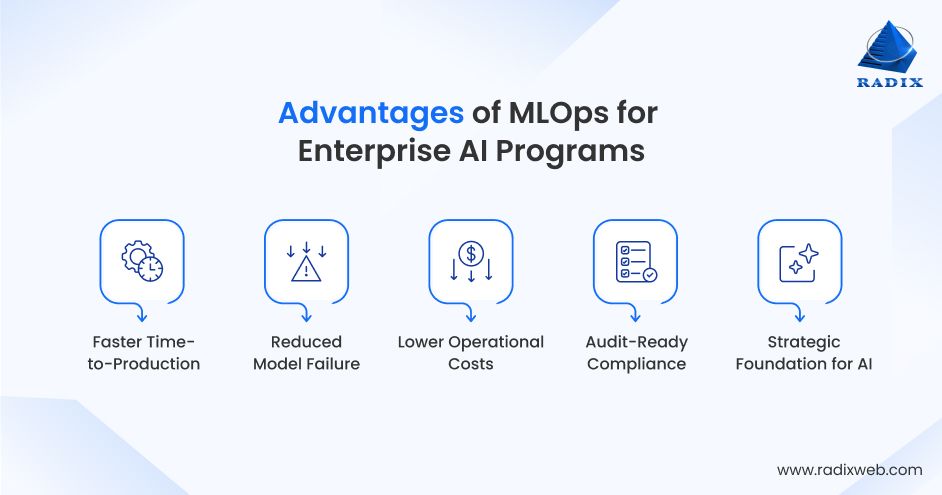
With automated CI/CD pipelines for ML, mature MLOps infrastructure consistently reduces model deployment timelines from months to days. In fact, our machine learning development and deployment practice has delivered more than 50 pilot-to-production transitions in the past year using Kubernetes-native deployment with canary and shadow rollout strategies. Lower deployment risks without sacrificing delivery velocity!
The CRISP-ML(Q) quality process model demonstrates that comprehensive pre-deployment evaluation identifies 80 to 90 percent of model problems before they reach production, reducing production incidents by 75%. For an enterprise running dozens of production models, that improvement translates directly into reduced remediation costs, fewer operational incidents, and significantly lower risk exposure across the entire AI portfolio.
Our data and AI infrastructure engineering teams have consistently delivered 15 to 30% improvements in model accuracy and 50% reductions in training time through systematic data preparation and feature engineering. We’ve observed that businesses with mature MLOps infrastructure spend 40 to 60% less on engineering labour for model maintenance, because automated pipelines replace manual monitoring and workflow optimization struggles.
Every model deployed through a mature, production-ready artificial intelligence program requires a documented audit trail covering training data provenance, model version history, evaluation metrics, deployment decisions, and post-deployment performance records. Without MLOps, this documentation either does not exist or is manually reconstructed under time pressure at precisely the moment regulators request it.
The generative AI use cases that deliver measurable enterprise value in 2026: RAG systems, AI agents, multimodal applications, require a solid foundational infrastructure. MLOps discipline provides governed data pipelines, reliable deployment automation, continuous monitoring, and explainability controls. Organizations that invest in MLOps infrastructure today are building the operational foundation that makes advanced AI capabilities deployable with confidence.
Similarly, the Microsoft Agentic AI and reinforcement learning advances that are reshaping enterprise automation in 2026 require production-grade MLOps infrastructure to deploy safely. Agentic systems that execute multi-step autonomous workflows in production environments, cannot be deployed without the monitoring, rollback capability, and governance infrastructure that mature MLOps provides.
Implementing MLOps for enterprise AI in large businesses is downright complex. It involves fighting both organizational resistance and tech complexities. Based on our delivery experience over 4500+ projects we have documented enterprise AI statistics where programs mostly fail. These roadblocks defeat most enterprise MLOps programs, but we’ve come up with tested approaches that resolve them:
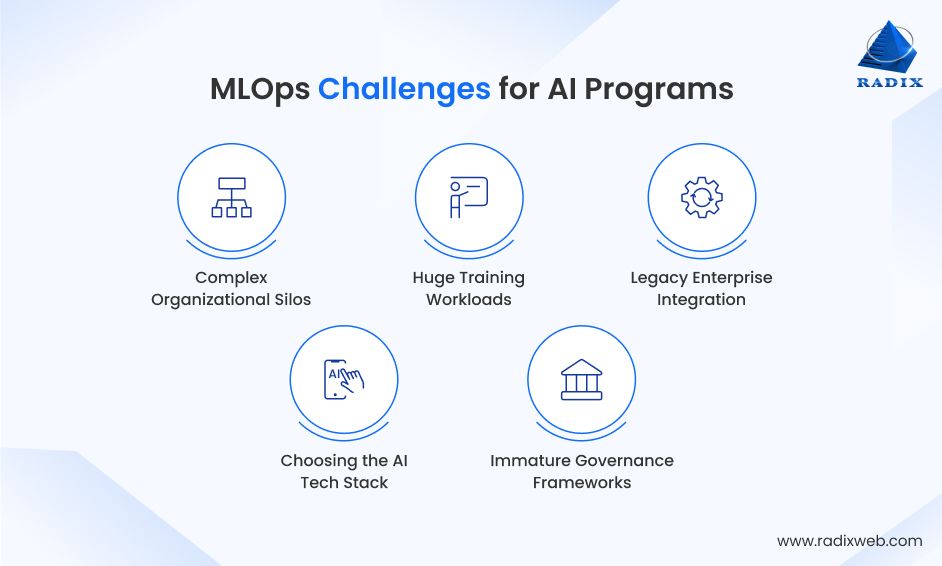
The most common structural failure in enterprise AI programs is not technical. It’s the organizational gap between data scientists who build models, software engineers who build systems, and operations teams who manage infrastructure. Each group operates with different tooling, different success metrics, and different risk tolerances.
Only a unified, strategic guidance on AI adoption roadmaps and governance can align these functions around shared pipelines, shared accountability, and shared definitions of production readiness. can align these functions around shared pipelines, shared accountability, and shared definitions of production readiness.
Research on large-scale ML workloads points out strong vulnerability to failures in distributed environments. Without proper big data infrastructure and distributed ML pipeline management, organizations lacking robust data platforms for large-scale AI workloads often see training jobs of 150 million GPU hours across 4 million runs suffer from compounding failure rates.
For businesses running serious ML workloads, we leverage Kubernetes-native orchestration with automated failover, checkpoint management, and distributed training coordination.
Almost 59% of organizations cite compliance barriers and 63% struggle with high integration complexity when implementing MLOps across existing systems. On-prem infrastructure, legacy data warehouse and fragmented tooling creates friction throughout the stages of the ML lifecycle. Businesses that use advanced data analytics techniques and integration patterns treat MLOps not as an orchestration layer that makes existing data investments AI-ready without requiring full platform replacement.
The most common implementation error in enterprise MLOps is over-engineering the tool stack before establishing the organizational practices. The AI programming languages and frameworks that power production ML systems: Python, Scala, SQL, with frameworks like PyTorch, TensorFlow, and LightGBM, demand strong process discipline.
Our ML engineers at Radixweb help you establish KPI-first scoping, data governance practices, and cross-functional alignment consistently before evaluating tools.
AI risk now appears in 72% of S&P 500 annual filings, but governance frameworks are still maturing across the industry. Regulators and investors are demanding accountability that most enterprise AI programs cannot currently provide. Implementing scalable intelligent automation with compliance controls is now table stakes for enterprise AI programs operating under regulatory scrutiny. Enterprises that haven’t built compliance infrastructure into their MLOps stack will face increasing pressure to remidiate at scale under regulatory scrutiny. Enterprises that haven’t built compliance infrastructure into their MLOps stack will face increasing pressure to remediate.

The most recent ML adoption benchmarks that reveal what high-ROI AI programs do differently. These practices that consistently separate enterprise AI programs that scale from those that stall:
Every successful MLOps implementation that delivers business value begins with a clear, quantified business objective defined before any technology is selected. At Radixweb, we begin every engagement with a structured discovery workshop that defines model goals, success metrics, guardrails, and failure modes before a single line of code is written. This is the most tried and tested machine learning blueprint enterprises use to eliminate deployment failures.
Most successful enterprise AI programs invest between 40 to 70% of their ML budget in data readiness. We recommend building versioned, governed, lineage-tracked data engineering pipelines for ML systems. Our experts have observed that schema contracts, automated quality gates, and refresh cadences aligned to model retraining schedules, is one of the highest ROI grossing investments an enterprise AI program can make.
Every model run must be fully reproducible, with hyperparameters, dataset versions, and evaluation metrics tracked automatically through platforms like MLflow or Weights & Biases. Reproducibility reduces the wasted engineering capacity that most teams spend recreating experiments whose source was not properly documented. It's the technical foundation for the audit trails that enterprise AI use cases in regulated industries increasingly require as a baseline compliance standard.
Production deployments absorb the most risk in enterprise AI programs. Safe rollout strategies like blue/green deployments, canary releases, shadow testing minimize that risk by validating model performance in production conditions before full exposure. Combined with payload logging and performance dashboards, these practices create the operational visibility that makes enterprise-grade AI application development sustainable.
Post-deployment monitoring surfaces the gap between what’s needed and what exists in most enterprise AI programs. Comprehensive monitoring must cover data drift, concept drift, prediction drift, latency, throughput, and cost with automated alerts triggering retraining pipelines when performance crosses defined thresholds. Our AI engineers leverage NLP and AI model monitoring solutions for end-to-end visibility into model behaviour across production systems.
Automated retraining without governance is a liability. Governance without automated retraining is a bottleneck. The right approach lies in building enterprise data governance and compliance frameworks for threshold-based retraining with version control, review gates for high-risk models, and automated evaluation before promotion. Operationalizing process automation with MLOps enhances both accuracy and accountability for models making consequential decisions.
The risks and challenges of enterprise AI without MLOps are not hypothetical. They are thoroughly documented outcomes for organizations that tried to scale AI on immature infrastructure.
Here’s a comparison drawn from our own delivery experience for enterprise-scale businesses across industries:
| Operational Dimension | Enterprise AI Without MLOps | Enterprise AI With MLOps |
|---|---|---|
| Deployment Speed | Weeks to months as per model update, largely manual | Hours to days via automated CI/CD pipelines |
| Model Failure Detection | Reactive: discovered after considerable business damage | Proactive: drift and degradation detected before impact |
| Data Governance | Manual, inconsistent, undocumented, not audit-friendly | Automated, versioned, lineage-tracked, audit-ready |
| Regulatory Compliance | Reconstructed manually during audits; high risk, high cost | Continuously maintained; documentation available on demand |
| Cross-Team Collaboration | Hand-offs create context loss, delays, and quality gaps | Shared pipelines and tooling eliminate coordination failure modes |
| Cost of Model Maintenance | High: manual monitoring, reactive fixes, growing technical debt | Low: automated pipelines handle routine operations at scale |
| Scalability | Linear cost growth: each new model adds proportional overhead | Near-horizontal scaling through reusable infrastructure |
| Business Value Realization | Episodic: tied to individual project launches | Compounding: each production deployment builds on shared infrastructure |
| Regulatory Audit Readiness | Low: documentation gaps create material compliance risk | High: every model version carries a complete audit trail |

Bottom Line: MLOps Is the Foundation for Enterprise AI Success
The data from 2025 and 2026 is disastrous. More than 80 cents of every enterprise AI dollar invested in 2025 failed to generate the intended return. Powerful models, larger datasets, and bigger AI budgets will not be able to close the gap AI investment-impact gap themselves.However, organizations that do close the gap build sturdy operational discipline within data governance, deployment automation, monitoring infrastructure and the compliance frameworks. MLOps as a foundation for enterprise AI success is an operational requirement that makes AI reliable, scalable, and governable in production.If your organization is experiencing undetected model drifting, month-long deployments and governance gaps in compliance reviews, leverage our custom MLOps consulting to refine AI deployments.We don’t answer with the ‘best model’, we depend on the operating model refined over years across scaling 50+ production AI deployments. We begin with exhaustive scoping that compounds outcomes. Let’s start the conversation.
Ready to brush up on something new? We've got more to read right this way.