

Read More


Recognized for AI Excellence at 2026 Globee® Awards - Read More

Vinit Kariatukaran
According to a 2025 Deloitte survey, only 6% of enterprises see ROI from AI investments within 12 months. Yet AI adoption statistics show that 92% of organizations are expected to increase their AI investments in 2026. The disconnect between investment and returns isn't about the AI itself. It's infrastructure. Teams build impressive models in development, then run into GPU shortages, data bottlenecks, and runaway compute costs when it's time to scale.
The answer (for most organizations) is: Proper cloud infrastructure for AI. Not because it's the default, but because the economics and elasticity of AI cloud architecture now outperform on-premises alternatives at nearly every scale point.
This guide is for the decision-makers who are ready to get their AI cloud infrastructure foundations right.
Cloud infrastructure gives AI workloads the elastic compute, scalable data pipelines, managed orchestration, and global deployment capabilities needed for production. But simply moving AI to the cloud does not guarantee scale or ROI. Enterprises need the right mix of compute, data, model serving, security, and governance, backed by FinOps and MLOps practices. The right approach is to place workloads where data and compliance requirements make sense, scale infrastructure with demand, and continuously optimize cost and performance.
| Aspect | Details |
|---|---|
| What does this guide cover? | AI cloud infrastructure, scalable AI cloud architecture, cloud GPU infrastructure and distributed model training, AI model deployment and serving, hybrid cloud strategies, AI workload costs and optimization, cloud governance and compliance |
| Who should read this guide? | CTOs and CIOs, AI and ML leaders, cloud architects, engineering and infrastructure teams, enterprise technology decision-makers, teams scaling AI from PoC to production |
Three years ago, the conversation was about whether to move AI workloads to the cloud. That conversation is largely settled. The real question now is how and which parts of your AI cloud architecture need to be built first.
The shift happened for reasons that have nothing to do with hype. Building and deploying artificial intelligence systems requires tens of thousands of GPU hours. Running inference at production scale requires low-latency, globally distributed endpoints. Managing the data pipelines that feed both requires storage, compute, and orchestration that most on-premises environments cannot provide cost-effectively.
This is what AI in cloud computing actually delivers: on-demand access to the exact compute tiers your workload needs, without the capital expenditure of buying hardware that will be obsolete in 18 months.
For enterprises building real intelligent software products, cloud isn't an option, it's the foundation. The data backs it up:
The shift toward cloud platforms for AI is not at the margins. It is the dominant deployment model.
A production-grade AI cloud architecture isn't a single service or a single provider's decision. It's a layered system and each layer has a job to do.
Here’s a quick summary of the cloud architecture components:
| Layer | Function | Key Cloud Services |
|---|---|---|
| Compute | GPU/TPU access for training & inference | AWS EC2 P4d, Google TPU v4, Azure ND H100 |
| Data Pipelines | Ingestion, transformation, feature stores | AWS Glue, GCP Dataflow, Azure Data Factory |
| Orchestration | Workflow management, experiment tracking | SageMaker, Vertex AI, Azure ML |
| Serving | Inference endpoints, autoscaling, monitoring | SageMaker Endpoints, Cloud Run, AKS |
| Security & Governance | IAM, data residency, audit logging | AWS IAM, GCP VPC SC, Azure Policy |
Let’s explore the components in detail now:
This is where model training and inference happen. Cloud providers offer GPU clusters (A100s, H100s), TPUs for specialized workloads, and CPU-based inference for lighter models. The key is elasticity that allows scaling to compute up during training runs and down between jobs to control costs.
AI workloads live and die by data quality and throughput. Scalable cloud data pipelines for AI handle ingestion, transformation, and feature engineering before data ever reaches a model. Services like AWS Glue, Google Dataflow, and Azure Data Factory are the workhorses here.
This is where AI model training using cloud GPUs happens at scale. Managed cloud AI platforms and services like SageMaker, Vertex AI, and Azure ML abstract the infrastructure complexity and let teams focus on model iteration rather than cluster management.
Inference endpoints, A/B testing, model versioning, and latency management all live here. Practical implementations like AI model deployment on cloud at scale requires autoscaling inference endpoints, canary rollouts, and observability tooling that tracks model drift, not just uptime.
The two hardest problems when integrating artificial intelligence into production systems are training large models affordably and serving them reliably. The top benefits of using cloud infrastructure for AI workloads solve both. Here’s how:
Modern foundation models cannot be trained on a single machine. Distributed AI model training splits computation across hundreds of GPU nodes using frameworks like PyTorch's DDP (Distributed Data Parallel) or DeepSpeed, while cloud orchestration handles node communication, checkpointing, and fault recovery automatically.
Cloud GPU infrastructure (specifically high-bandwidth interconnects like AWS EFA or Google's TPU pods) reduces inter-node communication overhead to levels that make training 70B+ parameter models economically viable for teams that aren't hyperscalers.
Practically: A training run that would take 3 months on a 4-GPU workstation takes 4 days on a 256-GPU cloud cluster. The cost difference, once you factor in power, cooling, and hardware depreciation, often favors the cloud, especially for workloads that don't run continuously.
AI model deployment on cloud has matured significantly. The pattern that works at scale: containerize the model with Docker, push to a managed registry, deploy behind an autoscaling endpoint, and route traffic with a load balancer that's aware of model version.
For latency-sensitive inference (real-time recommendation, fraud detection, conversational AI) cloud providers offer GPU-backed inference endpoints with sub-100ms SLAs. For batch inference, spot instances and scheduled jobs reduce costs by 60–80% compared to on-demand compute.
Teams exploring AI agent architectures for autonomous workflows need to think about deployment differently because agents require persistent memory, tool access, and orchestration layers that go beyond standard inference endpoints.
Not every workload belongs in the public cloud. So, it is important to first understand whether the cloud is a good fit for your business. Regulated industries like financial services, healthcare, or governments, often need a hybrid cloud AI strategy where sensitive data stays on-premise or in a private cloud, while compute-intensive training and non-sensitive inference runs on public cloud infrastructure.
Hybrid cloud architecture patterns for AI typically use a private model training cluster for proprietary data, with public cloud serving as the burst layer for peak training jobs and as the primary inference environment for external-facing workloads.

The cost of running AI workloads on cloud is real, and it surprises teams that haven't modelled it carefully before they start scaling. A 70B parameter model can cost $15,000–$50,000 per training run on standard GPU instances. Inference costs scale with request volume and model size in ways that aren't always obvious from early prototyping.
The cloud computing challenges that hit AI teams hardest aren't technical, but operational like:
The teams that maximize AI impact with a strategic mindset control costs in three ways.
One, they right-size their training clusters using spot instances with checkpointing. Two, they serve smaller quantized models where accuracy targets allow it. And three, they instrument every workload with cost attribution so they can identify waste before it compounds.
Achieving this level of operational discipline is part of what AI infrastructure modernization actually means in practice, not just migrating workloads to cloud, but rebuilding the operating model around cloud-native constraints and economics.
The transition from a localized experiment to a global, production-ready operation doesn’t happen by accident. It requires shifting your perspective from "managing servers" to orchestrating outcomes through AI infrastructure modernization. To move from a proof of concept that stalls to one that generates revenue, your AI cloud architecture must be built to handle the sheer weight of modern models and data volumes.
To ensure your cloud-based AI development is iterative and effective, follow these foundational steps:
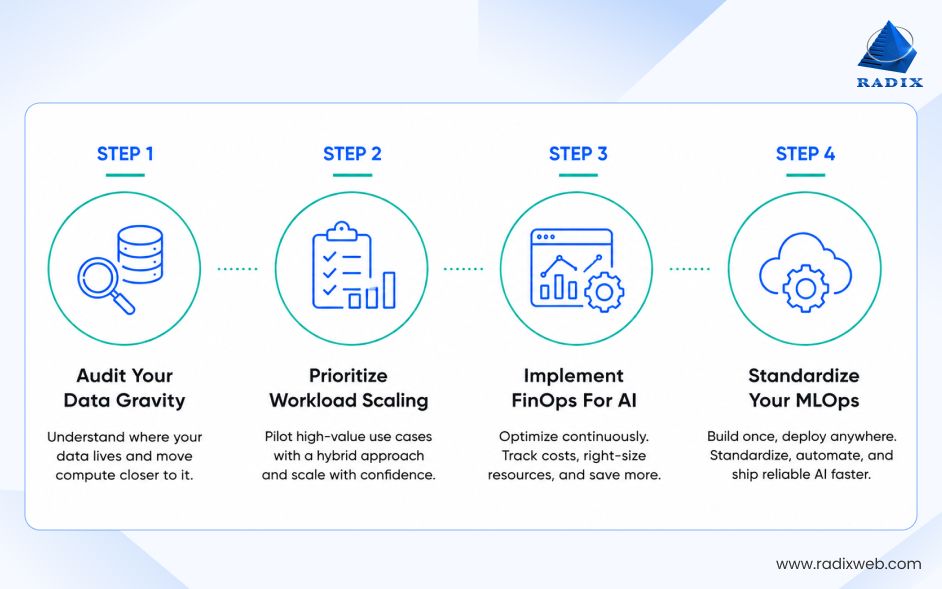
Before building, evaluate your cloud data pipelines for AI. Moving massive datasets creates egress costs; ideally, your compute should live where your data resides to minimize latency. You might also want to consider getting AI cloud consulting services at this stage. With experts guiding your AI strategy and how cloud fits in it, you can ensure a stronger foundation, which eventually leads to smoother outcomes.
Use a hybrid cloud AI strategy to pilot high-value use cases. This allows you to stress-test AI workload scaling without committing your entire budget to a single provider upfront.
Establish cost attribution early to manage and optimize the cost of running workloads on cloud. Use spot instances for distributed AI model training to save up to 80% on compute.
Leverage AI cloud solutions for practical AI model deployment. Containerizing models and using managed registries ensures that AI model deployment on cloud is repeatable and resilient.
The Path Forward: Scaling AI on the Cloud with Intent
The "wait and see" era of AI in cloud computing has officially closed. As we look ahead, the competitive divide will be defined by who can move from model selection to global inference the fastest. Maximizing AI impact strategically requires building enterprise-grade, scalable, and secure AI applications that offload the "undifferentiated heavy lifting" of hardware management. By focusing on cloud strategies for large AI models, your team can return to what actually moves the needle: refining algorithms and solving user problems. The infrastructure for scalable AI solutions is ready; the question is whether your strategy is built to take advantage of it.At Radixweb, our experienced AI developers don’t just deploy code but help you architect purpose-built AI application environments where models thrive. As cloud-native AI solution providers, we offer AI services that span the full lifecycle, ensuring your journey into enterprise AI in cloud is grounded in technical excellence and predictable performance. When you are ready to hire AI cloud experts who treat your infrastructure as a competitive advantage, we are here to help you lead the way. Schedule a no-cost consultation with our experts to explore your options and take the right step.
Ready to brush up on something new? We've got more to read right this way.

