Read More


Recognized for AI Excellence at 2026 Globee® Awards - Read More

Anand Trivedi
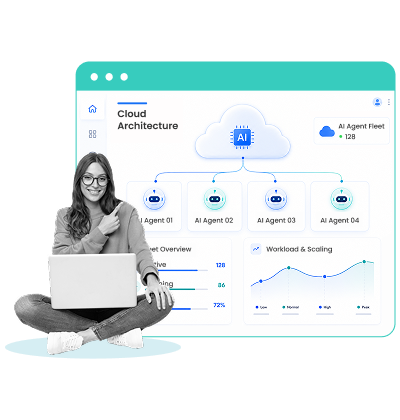
AI agents are moving from experiments to enterprise-scale systems. In Q2 2026, 53% of organizations reported deploying AI agents. The share of organizations orchestrating multiple agents across workflows doubled from 9% to 18% in a single quarter. The trajectory is set to accelerate. Gartner predicts an average Fortune 500 enterprise will have more than 150,000 AI agents in use by 2028, up from fewer than 15 in 2025.
The message is clear: preparing for one AI agent is no longer enough. Enterprises need infrastructure built for multi-agent systems and the scale they will demand.
But scaling hundreds or thousands of AI agents is not the same as scaling conventional cloud workloads. Agents reason, invoke models and tools, exchange messages, create subtasks, retain state, retry actions, and trigger other agents.
Your cloud architecture must be designed specifically to orchestrate, isolate, scale, monitor, secure, and control these workloads before agent sprawl becomes an infrastructure problem. This is why an AI agent cloud architecture needs a different design approach from a conventional microservices platform.
Below, we break down what it takes to build cloud infrastructure ready for the next phase of agentic AI.
A multi-agent cloud architecture gives enterprises the foundation to scale thousands of AI agents with reliable orchestration, secure data access, and controlled infrastructure costs. The key is to design the cloud around how agents actually work, with independent layers for execution, orchestration, communication, memory, model access, security, and observability, supported by autoscaling, governance, and recovery.
| Aspect | Details |
|---|---|
| What does this guide cover? | Agent-scale cloud architecture, orchestration, autoscaling, observability, security, governance, communication, memory, fault recovery, multi-tenancy, cost optimization, and single-cloud versus multi-cloud deployment |
| Who should read this guide? | CIOs, CTOs, enterprise architects, cloud architects, platform engineering teams, AI engineering leaders, DevOps teams, and technology leaders planning AI agents at scale |
Traditional enterprise cloud architectures were largely designed around predictable request-response patterns. AI agent workloads behave differently. An agent can trigger tools, delegate tasks, call other agents, retry failed operations, and continue a workflow long after the original request. The infrastructure demand is therefore generated by the workflow, not only by incoming traffic. This results in major AI agent deployment challenges to actually stem not from agent architecture, but the underlying cloud architecture.
Some of those challenges include:
A conventional cloud environment can host AI agents. But it is not automatically designed to operate an agent fleet. Designing and planning a purpose-built cloud architecture for thousands of AI agents treats agents as dynamic workloads and designs compute, state, communication, model access, and operations around how those workloads actually behave.
Also Read: Is Your Business Actually Ready for AI Agents?
Now let’s see what the key components of such an architecture are and what you need to know while building it.
A cloud architecture that can handle multi-agent AI systems deployed across the enterprise ecosystem needs to separate agent execution from orchestration, communication, state, model access, security, and platform operations. This separation allows each part of the architecture to scale independently as agent workloads grow and prevents one layer from becoming a bottleneck for the entire system.
Here is the core components typically required:
| Component | Why It Is Needed |
|---|---|
| API Gateway / Ingress | Handles incoming traffic, authentication, routing, throttling, and protection before requests to reach agent workloads. |
| Agent Gateway | Controls agent access, tenant policies, quotas, model routing, and agent selection. |
| Agent Orchestrator | Determines which agents should run, in what order, and whether tasks should be executed sequentially or in parallel. |
| Agent Runtime | Executes individual agents as independently scalable workloads. |
| Event Bus / Message Queue | Supports asynchronous execution, buffering, retries, and backpressure between agent workloads. |
| Service Mesh | Manages service-to-service communication, traffic policies, identity, retries, and observability. |
| Model Gateway | Centralizes model access, routing, rate limits, fallback models, caching, and usage tracking. |
| Short-Term Cache | Stores frequently access context and temporary results to reduce latency and repeated computation. |
| Persistent Memory Store | Stores durable agent state, workflow checkpoints, preferences, and conversation history. |
| Vector Database / Search | Supports retrieval of relevant enterprise knowledge and semantic agent memory. |
| Operational Database | Stores structured business state, configuration, agent metadata, and transactional information. |
| Object Storage | Stores documents, files, large artifacts, and other unstructured data. |
| Identity and Access Management | Controls which users, agents, services, and tools can access specific resources. |
| Secrets Management | Protects API keys, credentials, certificates, and other sensitive configurations. |
| Policy and Governance Layer | Enforces approved models, tools, data access, geographic restrictions, retention rules, and agent permissions. |
| Observability Platform | Tracks latency, failures, token consumption, tool calls, agent paths, and infrastructure health. |
| Evaluation Layer | Measures agent quality, retrieval performance, task completion, hallucination, and regression over time. |
| Autoscaling Layer | Adds or removes infrastructure capacity based on workload demand. |
| CI/CD and Agent Registry | Manages deployment, versioning, rollback, configuration, and agent lifecycle. |
| Cost Management Layer | Tracks model, compute, storage, and network consumption across agents, teams, tenants, and workflows. |
| Security Controls | Provides WAF, network segmentation, encryption, threat detection, and runtime protection. |
Here is a sample cloud architecture designed to handle thousands of AI agents:
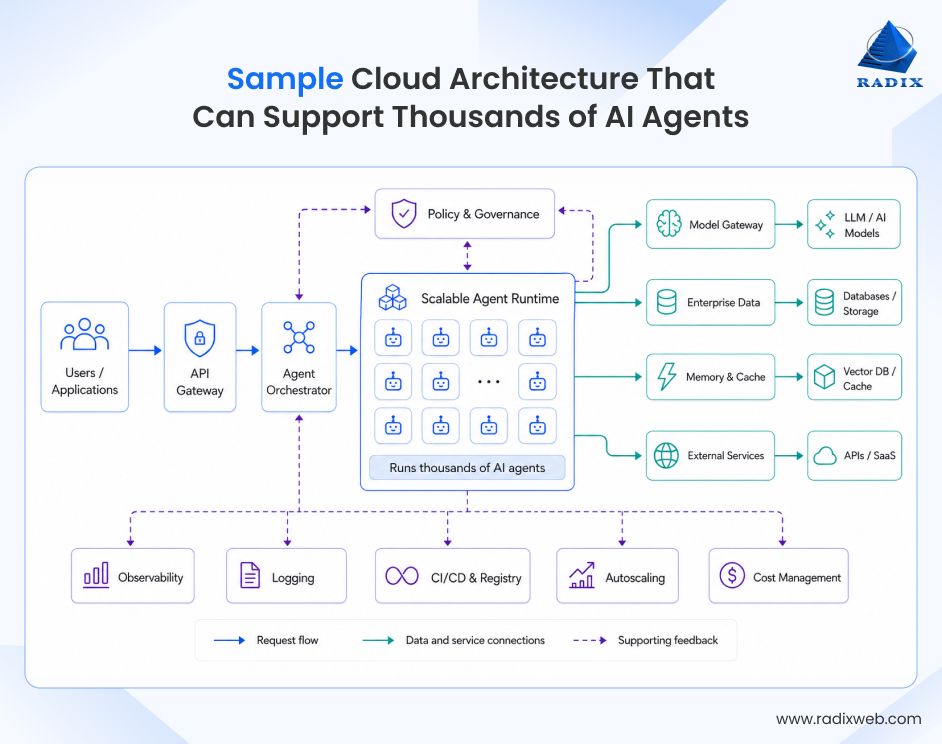
The exact technology choices will vary by organization and cloud environment. Also, not every component needs to be a separate product. The important principle is to separate the responsibilities so that the platform can scale and operate each layer independently.
Also, thousands of registered agents do not mean thousands of continuously running workloads. The architecture should distinguish between agent definitions, agent instances, and agent executions, so it only provisions resources when agents actually need to run.
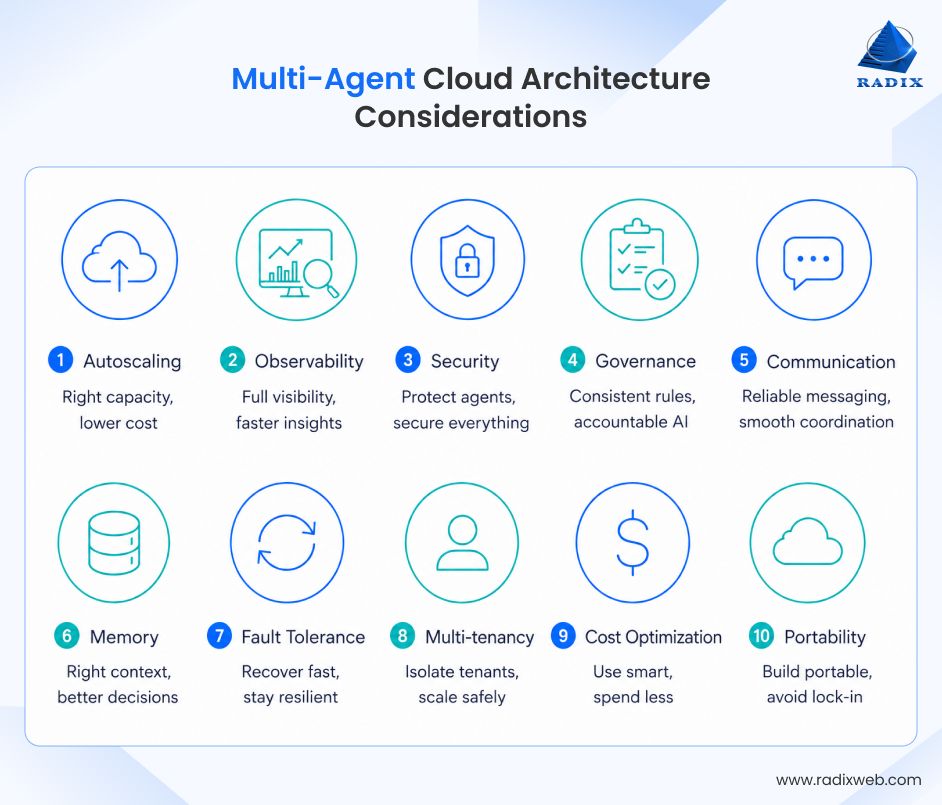
A cloud architecture built for a few AI agents can look remarkably similar to a conventional application stack. The differences become obvious when the workload grows and you integrate more AI agents to the enterprise workflow.
Thousands of agents introduce unpredictable execution patterns, high-volume model traffic, distributed state, agent-to-agent communication, and constantly changing infrastructure demand.
The following considerations determine whether your scalable AI agent infrastructure can absorb that growth without creating bottlenecks at the compute, networking, data, security, or cost layers.
A cloud architecture for thousands of agents should scale agent execution capacity, not keep thousands of machines running. When demand rises, the platform should automatically add worker capacity. When demand falls, it should release it.
The difficult part here is deciding what “demand” means.
CPU utilization alone does not tell you how much agent work is waiting. Queue depth, concurrent agent executions, request rates, model latency, and workflow backlog provide better signals.
Kubernetes supports horizontal scaling for AI agents using resource and custom metrics, while serverless compute works well for event-driven agent tasks. The tradeoff is straightforward: keeping capacity warm improves response time but costs more. Designing cloud scalability for AI agents therefore requires using different scaling policies for interactive, batch, and background workloads instead of treating every agent to workload the same.
The observability layer of an AI agent cloud architecture needs to see beyond infrastructure health. A server showing normal CPU and memory usage does not tell you whether an agent is stuck waiting for a model, repeatedly calling a tool, generating excessive tokens, or triggering another agent unnecessarily. Distributed tracing should connect the entire execution path across agent workers, orchestration services, model endpoints, queues, databases, and external APIs. At minimum, monitor:
For RAG workloads, infrastructure telemetry is only half the picture. Instead, you should also track the more important production RAG metrics like retrieval of precision and recall, context relevance, answer faithfulness, citation accuracy, latency, and token usage alongside cloud metrics. This lets the platform team identify whether a slow or expensive workflow is an infrastructure problem, a retrieval problem, or an agent behavior problem.
Security in cloud infrastructure for AI agents requires controls at the workload level because agents themselves become active participants in the cloud environment. Each agent you build and deploy to the ecosystem should have a defined identity and only the permissions required to perform its assigned work. The cloud architecture should control what an agent can access, which services it can call, which networks it can reach, and which other agents it can invoke.
| Layer | Cloud architecture control |
|---|---|
| Identity | User and agent identities |
| Access | APIs, tools, databases, services |
| Network | Segmentation and traffic policies |
| Data | Encryption and access boundaries |
| Secrets | Credentials, keys, and certificates |
Scalable AI agent workload identities, least-privilege permissions, short-lived credentials, network policies, encryption, and centralized audit logging should therefore be part of the infrastructure design. The important shift is from securing an application to securing a distributed system where autonomous workloads are continuously making service and data requests.
At scale, governance needs to be implemented as a cloud platform capability, not left to individual application teams. The best cloud architecture for AI agents is the one that provides centralized policies for model access, tool permissions, data boundaries, execution limits, retention, human approvals, and agent deployment.
A policy layer allows the organization to apply these controls consistently across hundreds of agents, even when those agents are developed by different teams or run in different environments. Some of the key governance questions to ask include:
A centralized governance layer also makes the infrastructure easier to operate. Instead of embedding separate rules into every agent, the cloud platform becomes the enforcement point for organization-wide policies.
Orchestration is the control layer that turns cloud resources into an agent execution platform. The infrastructure needs to know when to start an agent, where to run it, what state it needs, which other agents it should invoke, and when its execution should end.
A request might require one worker, while another could trigger several specialist agents concurrently. The orchestration layer coordinates these workflows without forcing every task through the same execution path.
A practical model of cloud orchestration for AI agents is the one that uses centralized workflow and policy control while allowing individual agent workers to scale and execute independently.
The cloud network and messaging layer need to support communication patterns created by agent workloads. Synchronous APIs work for short, immediate interactions, but long-running agent tasks are better handled through queues and event streams.
A document-processing workflow, for example, can place work on a queue instead of keeping an application server occupied while another agent performs extraction. Messaging infrastructure provides buffering, workload distribution, retries, and backpressure. It also protects downstream services when thousands of agents suddenly generate work at the same time.
The architecture should control fan-out as well. If one agent can trigger hundreds of downstream executions without limits, a single request can create a workload spike across the entire cloud environment. Communication design therefore becomes part of capacity planning, not simply an application-development decision.
A distributed cloud architecture for AI agents must assume that individual components will fail. Model endpoints will timeout. Queues will accumulate messages. Databases will become temporarily unavailable. External APIs will throttle traffic. The infrastructure should, however, be able to isolate these failures and recover without restarting an entire workflow. The following recovery mechanisms help the platform respond to different types of failures:
Fault isolation, checkpointing, retry policies, and recovery automation therefore need to be designed into the infrastructure when an AI solution is built rather than added after the first production incident.
The data layer becomes one of the most important scaling boundaries in a cloud-based AI agent architecture. When you build AI agents that work concurrently, it generate simultaneous reads, writes, searches, state updates, and retrieval requests. Keeping everything in one database creates a bottleneck and makes the entire platform scale around the least scalable component.
An ideal cloud architecture:
The objective is not to give every agent its own database. It is to ensure shared data services scale independently from agent compute and do not become the limiting factor.
A multi-tenant agent platform needs isolation at the infrastructure, data, network, identity, and resource levels. The right multi-tenancy model, however, depends on how much separation each workload requires.
| Approach | Best fit | Tradeoff |
|---|---|---|
| Shared infrastructure | Standard, lower-risk workloads | Lower cost |
| Dedicated workloads | Sensitive or high-value workloads | Higher cost |
| Hybrid isolation | Mixed enterprise workloads | Balanced approach |
Shared infrastructure gives the highest resource utilization, dedicated workloads provide stronger boundaries, and hybrid isolation combines both approaches. So, for most enterprise platforms, hybrid isolation provides the most practical architecture. It keeps ordinary workloads on shared infrastructure while placing sensitive tenants or workloads into dedicated compute, networks, or data environments.
The same isolation principles should extend to agent memory, secrets, logs, model quotas, and network access. Multi-tenancy is therefore not simply a database design decision. It affects how the entire cloud platform is partitioned.
AI agent cloud costs are driven by both infrastructure consumption and agent behavior.
Consider 1,000 agents, each executing 100 workflows per day. That produces 100,000 workflows daily. If each workflow makes five model calls, the platform handles 500,000 model calls per day. At an average of 4,000 input and output tokens per workflow, that is approximately 400 million tokens every day.
At this volume, small architectural inefficiencies become significant costs. Suppose 40% of those workflows are simple enough to use a model costing $1 per million tokens instead of $10. Simple cloud cost optimization strategies like moving those workloads would reduce the model cost for that portion from roughly $1,600 to $160 per day, assuming the same token volume.
The cloud architecture should include model routing, token budgets, caching, prompt compression, batching, workload scheduling, and execution limits. AI inference cost optimization belongs inside the platform architecture, not only in monthly FinOps reviews.
These ten considerations for building cloud architectures for handling AI agent fleets are all interconnected.
Autoscaling is ineffective if the database cannot handle the additional workers. Orchestration becomes a bottleneck if every agent workflow passes through one control point. Security becomes harder when workloads share infrastructure without clear identity boundaries. Cost increases rapidly when unrestricted agent fan-out creates unnecessary model calls.
So, a production-grade and scalable cloud architecture for AI agents needs to scale more than compute. It needs coordinated scaling across execution, orchestration, messaging, data, networking, security, observability, and model consumption. Build those layers as one cloud platform, and adding agents becomes a capacity-management problem rather than an architecture-rewrite problem.
Once you have designed the core architecture for agent workloads, there is another decision to make: how many cloud environments should run it? A single cloud gives you a more unified operating model and fewer moving parts. Multi-cloud AI agent deployment gives you greater provider independence and access to different cloud capabilities. Neither is inherently better. The right choice depends on what you need the architecture to achieve and how you are adding the AI agents to existing business stack.
Here’s a quick comparison to help you make the right choice:
| Aspect | Single-Cloud | Multi-Cloud |
|---|---|---|
| Cost | Lower (no multi-region overhead, no data transfer costs, committed discounts) | Higher (duplication, data transfer, operational complexity) |
| Latency | Lowest for agents in that cloud's regions; highest for distant regions | Can optimize globally; route agents to nearest cloud |
| Resilience | Depends entirely on that cloud's uptime; SLA-limited | Resilient to cloud-wide outages; can failover |
| Vendor Lock-In | High (proprietary services, pricing changes) | Lower (can move workloads between clouds) |
| Operational Complexity | Simpler (one billing account, one set of tools) | Higher (multi-cloud orchestration, cost tracking, monitoring) |
| Inference Routing | Simpler (all routing within one cloud) | More complex (choose cloud per inference call) |
| Data Compliance | May be forced to stay in one cloud if regulation requires | Can choose cloud per region for compliance |
For most enterprises, a well-designed single-cloud architecture is enough if:
Multi-cloud becomes relevant when:
It can also support portability and reduce dependence on a single vendor, but only if your organization has the engineering maturity to manage the added complexity. But a multi-cloud strategy should not mean duplicating the entire stack three times. A better approach is to build the right kind of cloud portability across Azure, AWS, and GCP for AI agent deployment.
Architecting Your Cloud Ecosystem for the Agentic Future
The biggest mistake we see enterprises make is waiting until they have 1000s of agents to start thinking about a cloud architecture that supports AI agent fleets. However, the right time to build a proper cloud architecture is before you greenlight the development of enterprise-grade agentic system, not after you face a crisis. However, it is equally important to not build an oversized platform for a hypothetical future.At Radixweb, we've been building large-scale cloud architecture for AI agents for clients across fintech, healthcare, and enterprise software. And we don't just build the cloud architecture. We also help you maintain it. Based on our practical experience, we know the patterns from real production systems, we know what breaks, and we know how to fix it before it becomes a crisis. So, if you are planning to scale your agentic fleet, schedule a call with our cloud experts to build a scalable cloud architecture for AI agents.
Ready to brush up on something new? We've got more to read right this way.