Read More


Recognized for AI Excellence at 2026 Globee® Awards - Read More

Maitray Gadhavi
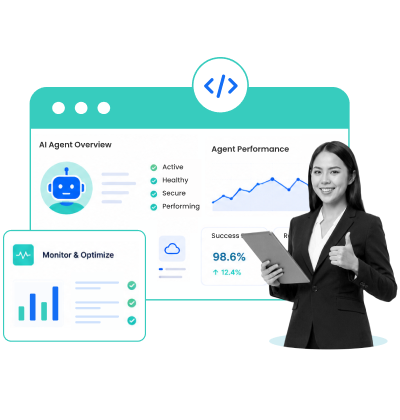
The global AI agent market is projected to reach $182.9 billion by 2033, growing at a compound annual growth rate of ~50%. Organizations are rushing to build AI agents, expecting 40-60% cost reductions and 25-35% productivity gains. Yet the reality is sobering. Different studies and estimates suggest that anywhere between 50-75% of deployed AI agents lose performance within 90 days of production launch.
The gap between impressive demos and production-ready systems is vast. That's primarily because most teams treat AI agents like traditional software. Build it, test it, ship it. But AI agents are probabilistic, not deterministic. So, what works flawlessly in staging often fails silently in production. That's why building production-ready AI agents is fundamentally an engineering challenge rather than simply an AI challenge.
At Radixweb, we've built and deployed AI agents across fintech, healthcare, manufacturing, and enterprise software. We also build agentic systems and integrate advanced intelligence capabilities to business software, which has helped us learn firsthand what separates clever prototypes from systems that deliver consistent business value. Below, we explain our framework for building AI agents that succeed across real environments. Plus, the operation practices that keep our AI agents useful, way beyond the launch.
Most AI agents fail not because models are inadequate, but because organizations lack the operational framework to deploy, monitor, and continuously improve them. Success requires clear ownership, comprehensive observability, disciplined testing against real patterns, and a commitment to continuous refinement after launch. The replicable Radixweb framework of building AI agents delivers measurable value months after deployment.
| Aspect | Details |
|---|---|
| What this guide covers? | Why AI agents fail in production, the seven-step Radixweb framework for success, industry-specific deployment strategies, monitoring and optimization practices, and answers to frequently asked questions about cost, timeline, and integration. |
| Who should read this guide? | CIOs, CTOs, AI leaders, product managers, enterprise architects, and business decision-makers planning, building, or scaling AI agents in production environments. |
The term "AI agent" is everywhere right now. Yet many organizations still use it interchangeably with chatbots, LLMs, copilots, or workflow automation. But they aren't the same thing. Understanding the distinction first is important because it changes how these systems should be designed, tested, and deployed.
An AI agent is an intelligent software system capable of understanding goals, making decisions, interacting with multiple tools or applications, and completing tasks with minimal human intervention.
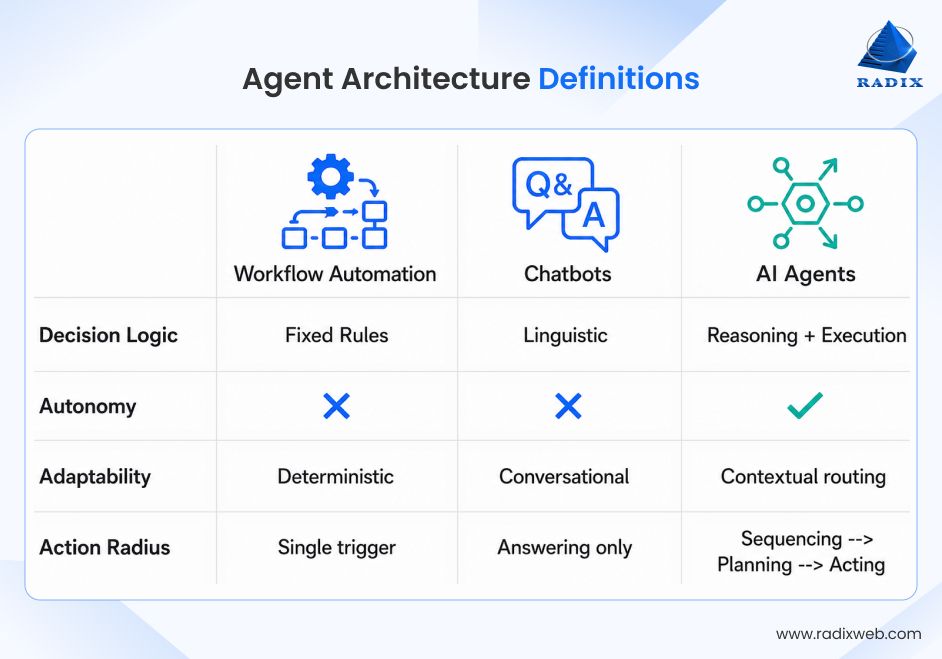
Unlike traditional AI assistants that simply answer questions, AI agents can plan a sequence of actions, retrieve information from multiple systems, execute business workflows, adapt to changing inputs, and determine when human intervention is required.
That's what makes AI agents fundamentally different from conventional automation. Traditional workflow automation follows predefined rules. If a condition is met, the workflow executes a specific action. Every decision path is explicitly programmed before deployment. AI agents combine reasoning with execution. Instead of following only fixed rules, they interpret user intent, gather context, decide which tools to use, and determine the most appropriate sequence of actions to achieve an objective.
Also Read: AI Agents vs. Chatbots vs. LLMS - Explained
From what we've seen in practice, production failures rarely happen because the language model isn't capable enough. They happen because the engineering surrounding the model isn't ready for production.
Here are the most common reasons.
Many AI projects fail before development even begins because the business isn't ready for an AI agent. Poor-quality data, undocumented workflows, disconnected systems, unclear ownership, and weak governance eventually become the agent's problems. That's why we always recommend starting with an AI agent readiness assessment. Fixing these gaps upfront is far easier (and far less expensive!) than discovering them after the agent is in production.
Agent performs perfectly against test data but encounter patterns in production that weren't present during training. Customer behavior changes, market conditions evolve, external systems update. With that, the agent's accuracy drifts and by the time you notice, it has made thousands of suboptimal decisions.
When responsibility is shared, nobody owns the agent. Performance monitoring gets deprioritized. Issues go unaddressed. Updates stop. The system quietly degrades. Successful deployments have clear ownership of AI outcomes with one person or team having both the authority and accountability.
With probabilistic systems like AI agents, you cannot test every possible interaction. Organizations often test happy paths and obvious edge cases but miss uncommon scenarios that appear frequently at scale. An agent that handles 95% of requests perfectly will overwhelm support teams if the remaining 5% escalate incorrectly.
AI agents should operate within explicit boundaries. Without clear guardrails defining what data they access, which actions require approval, and which actions are forbidden, agents naturally drift outside acceptable bounds. Compliance violations, data misuse, and unauthorized actions follow.
You cannot improve what you cannot measure. Many organizations deploy agents with minimal visibility into why decisions were made, which tools were called, or why errors occurred. When problems emerge, there's no data to diagnose the root cause quickly.
Releasing an agent to all users simultaneously amplifies the impact of unforeseen edge cases. Issues that seemed manageable during pilot become critical when scaled. Phased rollout reduces risk by catching problems early with limited blast radius.
Most organizations shift focus after launch. The agent is left unmonitored, unimproved, and gradually neglected. Expert artificial intelligence specialists treat deployment as the beginning, establishing regular review cycles, collecting user feedback, and continuously refining performance.
Other than these common failure patterns, we have also seen that when an AI agent underperforms, organizations often respond by replacing the model or rewriting prompts. But in reality, production issues usually originate elsewhere. So, the important question to ask here is "How do we engineer an AI system that continues to perform reliably under real business conditions?"
The answer lies in the development framework itself.
Over the years, we've found that successful AI projects follow a consistent pattern. The technologies may change, but the engineering discipline remains constant. Here's the 7-step framework we follow to build AI agents that perform reliably in production.
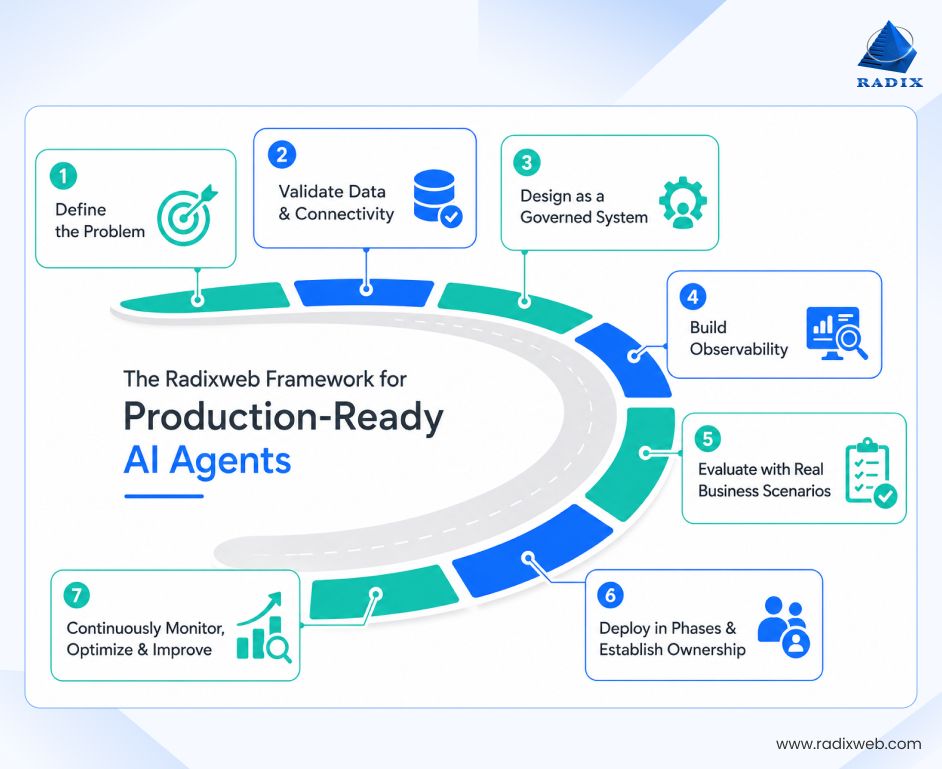
The biggest mistake organizations make is beginning with model selection. GPT, Claude, Gemini, or open-source alternatives quickly become the center of any initial AI project consultation. However, they rarely determine whether a project succeeds.
We start somewhere entirely different: the business workflow.
What specific process is the agent improving? What decisions should it make independently? Which situations require human approval? How will success be measured six months after deployment?
Answering these questions creates clear boundaries for the AI system. It prevents scope from expanding into dozens of loosely related capabilities. Instead of building an assistant that does a little of everything, we build an agent that solves one business problem exceptionally well.
AI agents depend on two things:
Without either, even the most capable language model becomes unreliable.
Before development begins, we assess the quality of enterprise knowledge, identify duplicate or outdated content, evaluate permission models, and understand how information flows across the organization. At the same time, we review the systems the agent will interact with. We determine whether the necessary APIs, authentication mechanisms, and integration points are production-ready.
If the assessment reveals the need for data cleaning or legacy modernization, those challenges are addressed before development than after users begin relying on the agent.
Enterprise AI isn't simply another chat interface. It's a business system responsible for triggering real decisions and actions. That responsibility needs structure.
We design every AI agent with clearly defined responsibilities, architectural boundaries, and governance built into the foundation. At the same time, we establish explicit guardrails around what the agent can access, which actions it may perform autonomously, when human approval is required, and how every decision is recorded.
AI agents shouldn't behave like black boxes. When something goes wrong, organizations need to understand what happened, why it happened, and how to prevent it from happening again. That level of visibility doesn't appear automatically.
We instrument every layer of the AI workflow so teams can trace user requests, retrieved knowledge, model reasoning, tool usage, approval decisions, and final outputs. Logging, telemetry, and audit trails become part of the architecture rather than an afterthought.
This observability dramatically reduces troubleshooting time while also supporting governance, compliance, and optimization.
Passing functional tests isn't enough for enterprise AI. An agent needs to demonstrate that it can complete real business workflows consistently, safely, and accurately under realistic conditions.
To achieve this, we create a golden evaluation dataset containing representative production scenarios, including routine requests, edge cases, ambiguous inputs, and known failure conditions. Every significant change (prompt update, workflow modification, or model upgrade) is evaluated against this benchmark before reaching production.
We also measure workflow completion, retrieval accuracy, policy compliance, escalation rates, confidence levels, and tool selection. This provides a realistic picture of production readiness.
Production deployment should never be an all-or-nothing event. Instead, we introduce AI agents gradually. We start with a limited group of users before expanding adoption. This phased rollout allows us to observe real user behavior, identify unexpected edge cases, validate operational performance, and make improvements while business risk remains low.
Equally important is ownership. Every production AI agent has a clearly identified business owner responsible for its ongoing performance. That individual monitors outcomes, prioritizes improvements, coordinates stakeholders, and ensures the system continues aligning with business objectives.
The best AI agents are never truly finished. Business policies evolve. Enterprise knowledge changes. User expectations shift. New workflows emerge. A production AI system that isn't continuously improved will gradually lose relevance, regardless of how well it performed on launch day.
That's why we establish an ongoing optimization cycle from the very beginning. We monitor operational health, business outcomes, retrieval quality, escalation patterns, and user feedback to identify opportunities for improvement. Most of these issues can be addressed through workflow refinement, knowledge updates, prompt optimization, or integration improvements long before model retraining becomes necessary. This continuous engineering approach keeps the AI agent aligned with the business it serves.
Production-ready AI agents aren't defined by how well they perform during demos. They're defined by how consistently they deliver value months after deployment. And the above seven practices have helped us build AI agents that do just that.
The most common AI agent deployment challenges are often consistent across all domains. That means our success framework also works across industries. But implementation details vary dramatically. Financial services agents, for example, must navigate real-time compliance. Healthcare agents, on the other hand, require HIPAA governance. Similarly, manufacturing agents need edge computing considerations.
Here, along with a clear understanding of the AI agent development lifecycle, business acumen also matters for success. With 26+ years of hands-on experience across 30+ industries, we understand the unique needs of your industry. We know what regulatory constraints, operational pressures, and competitive dynamics matter.
Here's how we build agents that meet industry-specific business needs.
| Industry | What Production AI Agents Must Handle | How We Engineer It |
|---|---|---|
| Healthcare | ● Protect patient data ● Summarize clinical records ● Assist with documentation ● Support care workflows without replacing clinical judgment | ● HIPAA-compliant architecture ● Role-based access controls ● Human approval workflows ● Complete audit trails ● Secure integrations with EHR platforms ● Explainable AI outputs. |
| Financial Services | ● Analyze financial information ● Automate document processing ● Support fraud detection ● Assist with customer servicing while maintaining regulatory compliance | ● Strong governance, transaction approval thresholds ● Explainable decision-making ● Continuous monitoring ● Encrypted data handling ● Secure API integrations. |
| Insurance | ● Process claims ● Review policy documents ● Extract information from forms ● Identify inconsistencies ● Improve claims turnaround time | ● Workflow-specific evaluation datasets ● Document intelligence ● Human review checkpoints for high-value claims ● Integrations with policy management systems |
| Retail & eCommerce | ● Assist customers ● Automate inventory inquiries ● Optimize merchandising ● Personalize recommendations ● Streamline order management | ● Real-time integrations with ERP, inventory, CRM, and commerce platforms ● Performance monitoring during peak traffic periods |
| Manufacturing | ● Support production planning ● Maintenance scheduling ● Supplier coordination ● Quality documentation ● Operational reporting. | ● Integration with MES and ERP systems ● Operational safeguards ●Workflow orchestration ● AI recommendations that align with manufacturing constraints |
| Logistics & Supply Chain | ● Coordinate shipments ● Optimize routing ● Monitor deliveries ● Summarize exceptions ● Improve warehouse operations | ● Real-time data synchronization ● Resilient integrations ● Exception handling workflows ● Monitoring that prioritizes operational continuity |
| Enterprise SaaS | ● Automate customer onboarding ● Support users ● Generate reports ● Surface product insights ● Improve internal productivity. | ● Secure multi-tenant architecture ● CRM integrations ● Product analytics connectivity ● Permission-aware knowledge retrieval ● Continuous product optimization. |
At Radixweb, we know what it takes to not just build standalone models, but agents that embed into your existing business tech stack. With that, you get agents that impress investors in demos and delight real users when in production.

Start Building Enterprise-Grade AI Agents Today
Organizations across the globe are investing in the development of AI agents for business-specific use cases. While the intent is strong, the impact often isn't. That's why 15% of AI agent initiatives never even reach production. That's because successful AI agent development requires more than a capable model. It demands treating AI agents as business systems with clear ownership, continuous monitoring, and ongoing improvement.At Radixweb, we've spent 26+ years building enterprise software and the last several years delivering AI agents that drive measurable business outcomes. That experience has helped us develop proven frameworks, practical implementation expertise, and repeatable engineering practices. Whether you're planning your first AI agent or scaling AI across the enterprise, we can help you move forward with confidence, not experimentation. Schedule a no-obligation consultation with our AI specialists to get a production-ready implementation roadmap with realistic cost and timeline estimates tailored to your business.
Ready to brush up on something new? We've got more to read right this way.