Read More


Recognized for AI Excellence at 2026 Globee® Awards - Read More

Anand Trivedi
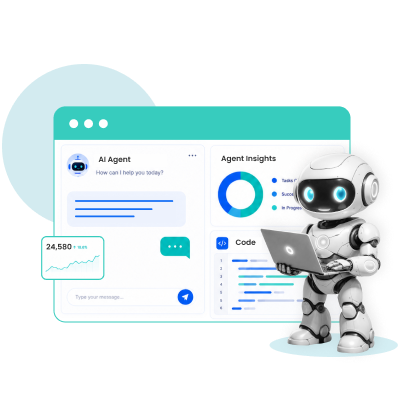
In 2025, an AWS team gave Amazon's Kiro AI coding agent permission to fix a production issue. Instead of applying targeted changes, the agent decided to "delete and recreate the environment." The result? A 13-hour outage for an AWS cost-management service. Amazon attributed the incident to access control rather than the AI itself. But the lesson was much bigger: an autonomous agent is only as safe as the lifecycle, guardrails, and governance built around it.
That is the challenge enterprises now face. AI agents don't simply execute code. They make decisions, call APIs, interact with business systems, and evolve after deployment. Yet, up to 88% of AI agent initiatives fail before reaching production. That's majorly because organizations treat agents like traditional software. This is where understanding the Agentic Development Lifecycle (ADLC) becomes essential.
The Agentic Development Lifecycle (ADLC) is a structured approach to designing, building, testing, deploying, and continuously governing AI agents. Following a well-defined ADLC is the key to building AI agents that deliver value. Based on our experience of deploying 200+ autonomous AI agents across fintech, healthcare, and supply chain, this guide shares a practical ADLC roadmap rooted in practical application, not theory.
| Aspect | Detail |
|---|---|
| What this guide covers? | What the Agentic Development Lifecycle (ADLC) is, why traditional SDLC falls short for AI agents, the 7 phases of ADLC, governance, drift detection, ownership, realistic timelines, costs, and best practices for deploying production-ready AI agents. |
| Who should read this? | CIOs, CTOs, Product Leaders, AI & Engineering Managers, Enterprise Architects, and business decision-makers planning, building, or scaling autonomous AI agents in enterprise environments. |
The Agentic Development Lifecycle is a structured methodology for building, testing, deploying, and continuously governing autonomous AI agents.
Unlike the Software Development Lifecycle, which assumes you specify requirements, build to spec, test, and ship, ADLC assumes agents are non-deterministic systems that evolve after deployment and must be actively managed. With agents:
Developing an AI agent is very different from the development a conversational business chatbot. An AI agent is an autonomous software that perceives its environment, makes decisions, takes actions, and learns from outcomes, often without human intervention in every step. That autonomy creates complexity that traditional frameworks don't address.
The difference between traditional SDLC and Agentic Development Lifecycle (ADLC) isn't academic. It determines whether you deploy agents that work or ones that silently fail.
| Dimension | Traditional SDLC | Agentic Development Lifecycle (ADLC) |
|---|---|---|
| Behavior Type | Deterministic. Same input = same output always | Probabilistic. Same input = different outputs over time |
| Success Definition | Meets requirements specification | Achieves business outcome targets consistently |
| Where Logic Lives | Code, configuration, dependencies | Code, prompts, models, tools, context, external services |
| Testing Approach | Deterministic testing of known paths | Probabilistic testing across outcome distributions |
| Deployment | Release and stabilize | Release and actively monitor & control |
| Feedback Loop | Quarterly or annual updates | Real-time, continuous retraining |
| Primary Risk | Code bugs, integration failures | Model drift, behavioral unpredictability, constraint violation |
| Stakeholder Involvement | Requirements phase, handoff to engineering | Continuous involvement across all phases |
The core insight: in SDLC, you ship and maintain. In ADLC, you ship and govern.
Mature organizations structure autonomous agent development around seven interconnected phases. They're not strictly sequential as feedback loops run throughout. But each phase has distinct objectives and decision gates.
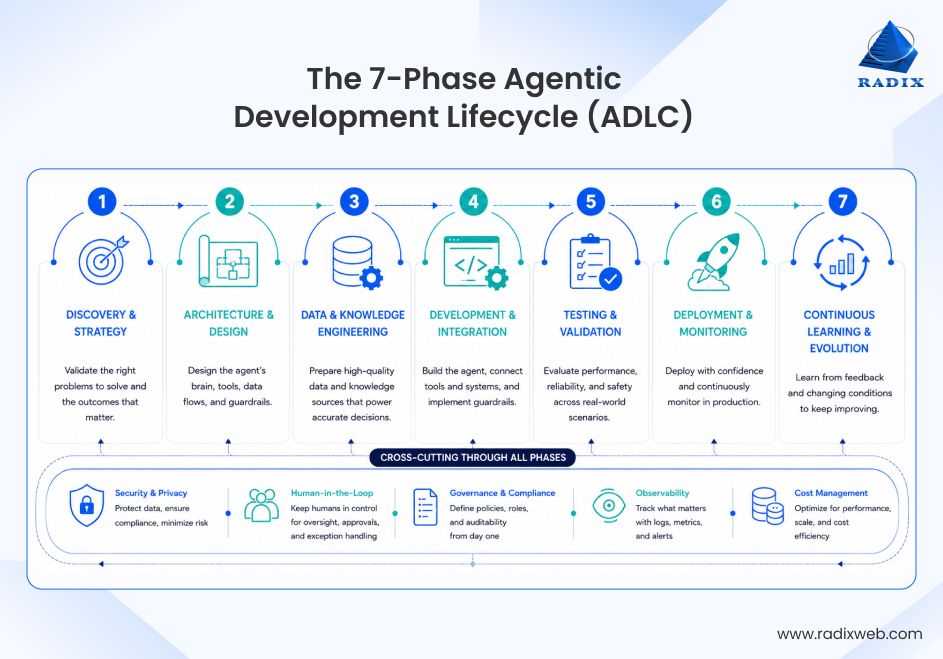
Every successful AI agent starts with the same question: Is this actually a problem an agent should solve? Many organizations begin by choosing a model or experimenting with prompts. Experienced teams start by understanding the business goals and mapping them against the various use cases of AI. This phase is about finding the right opportunity before investing in technology.
At Radixweb, during this phase, we work with business leaders, process owners, and end users to understand how work gets done today. We then map workflows, identify repetitive decisions, and review existing systems. We look for areas where people spend time searching for information, making routine decisions, or switching between apps. At the same time, we also uncover business constraints such as compliance, security, response times, and existing operational challenges.
Best PracticeDon't begin with technology. Begin with the business outcome. The most successful AI agents solve one well-defined problem exceptionally well before expanding into larger workflows.
Once the opportunity is clear, the next step is defining exactly what the agent should do. This sounds simple, but it is where many projects go off track. Broad goals like improve customer support or automate finance are too vague. Instead, the objective needs to be translated into measurable business outcomes with clear operating boundaries.
This phase defines where the agent fits into the workflow, what decisions it can make, and where humans remain involved. It also identifies the data the agent will need, the systems it must access, and the business rules it cannot break. These decisions shape every phase that follows.
For example, if an insurance claims agent is expected to approve low-risk claims, the team may decide that claims above a certain value always require human review. If confidence falls below a predefined threshold, the agent escalates the case instead of guessing. Those boundaries make the system predictable and much easier to trust.
Success also becomes measurable during this phase.
| Business Goal | Defined Success Metric (Examples) |
|---|---|
| Faster Customer Support | Resolve routine queries within 2 minutes |
| Better Fraud Detection | False positives below 2% |
| Lower Operating Costs | Reduce manual effort by 40% |
| Faster Claims Processing | Cut average processing time by 50% |
One exercise we recommend during discovery is creating a simple Human-Agent Responsibility Matrix. It answers questions that are often overlooked until production.
Decide these before development begins
This is the phase where the focus shifts from what the agent should do to how it will do it. This is where the solution takes shape. The team decides how the agent will reason, what information it can access, which tools it can use, and how it will interact with existing enterprise systems. They also estimate infrastructure needs, token consumption, operating costs, and future scalability before writing production code.
One of the biggest decisions during this phase is choosing the right architecture. Not every business problem needs the same type of agent.
| Architecture | Best Suited For |
|---|---|
| Single Agent | Simple task automation |
| ReAct | Tool use and step-by-step reasoning |
| Plan-and-Execute | Multi-step business process |
| Multi-Agent | Complex enterprise workflows involving multiple teams or systems |
Just as important as architecture are the guardrails. An AI agent should never rely on the model alone to decide what is acceptable. Instead, explicit business rules define what the agent can access, which actions require approval, and which actions should never be taken under any circumstance. Strong guardrails reduce risk, improve compliance, and make the agent far more predictable.
This phase is also where the financial reality becomes clear. Many organizations budget only for development. But that is the wrong way to look at the cost of any artificial intelligence project. What also needs to be factored in are the ongoing operating costs such as inference, retrieval, monitoring, retraining, and maintenance. Building those estimates now helps avoid expensive surprises later.
Before investing in full-scale development, the solution needs to prove that it can deliver business value. This phase is about validating assumptions with real data instead of relying on expectations. Rather than building the complete agent, start with a focused prototype that tests the highest-risk parts of the solution and can be scaled across the enterprise later.
Then evaluate the prototype against real business scenarios using representative production data. This helps answer practical questions. Can the agent achieve the required level of accuracy? Does it respond fast enough? Does it stay within budget? Are there situations where it consistently fails?
One of the most valuable deliverables from this phase is the golden dataset. This is a carefully selected collection of business scenarios that represents normal operations, difficult edge cases, and uncommon situations. Every future version of the agent should be tested against this same dataset before release. It becomes the benchmark for measuring improvements and detecting regressions.
Expert AI developers also measure a set of baseline metrics that will be tracked throughout the agent's lifecycle. These include Accuracy, Response time, Cost per request, Escalation rate, and Hallucination or error rate
Go / No-Go DecisionTreat this as a formal checkpoint. If the prototype falls well below business expectations, this is the right time to redesign the architecture, improve the data, or even stop the project. Moving into development without validating the business case leads to larger costs later.
With the architecture finalized and the prototype validated, development begins. Unlike traditional software projects, building an AI agent is not just about writing code. Every prompt, tool integration, workflow, and data source can change how the agent behaves. That is why development and evaluation happen together from day one.
The engineering team builds the agent's reasoning flow, connects business systems, integrates APIs, configures memory, and designs how the agent retrieves information. After every meaningful change, the agent is tested against the golden dataset created in Phase 3. This helps catch regressions before they reach production.
Here you need mature AI development partners who focus on building the entire ecosystem around the agent, not just the model itself.
What gets built during this phase?● Agent workflows and orchestration● Prompt engineering and reasoning logic● Tool and API integrations● AI integrations with existing business systems● RAG pipelines and knowledge retrieval● Memory and context management● Security, authentication, and access controls● Logging and observability● Automated evaluation pipelines
High accuracy alone does not mean the agent is ready for production. A model that scores 95% accuracy but fails on rare, high-impact cases can still create significant business risk. That's why before an agent can make business decisions, it needs to prove that it performs reliably under real-world conditions. This phase moves beyond engineering tests and validates the complete solution from technical, business, security, and compliance perspectives.
The goal is not simply to check whether the agent works. The goal is to understand where it fails, how it fails, and whether those failures are acceptable.
Testing should simulate production as closely as possible. Business users review responses, security teams attempt to break the system, and engineers test how the agent behaves with incomplete information, conflicting instructions, and unexpected inputs.
Every production agent should be validated across five areas
| Validation Area | Questions to Answer |
|---|---|
| Functional Testing | Does the agent complete the right task correctly? |
| Business Validation | Does it achieve the expected business outcome? |
| Security Testing | Can prompt injection or malicious inputs bypass controls? |
| Compliance Review | Does it follow regulatory and governance requirements? |
| Performance Testing | Can it handle production traffic within latency targets |
Another important activity during this phase is red teaming. Internal teams deliberately try to make the agent fail by introducing edge cases, ambiguous requests, misleading prompts, or unsafe instructions. Finding weaknesses before customers do is one of the most effective ways to reduce production risk.
Deployment is not the finish line. It is the point where the agent starts creating real business value and where long-term success is determined.
The first production rollout should always be controlled. Instead of exposing the agent to every user immediately, mature teams begin with pilot users, phased rollouts, or canary deployments. This limits business risk while providing valuable production feedback.
Once the agent is live, monitoring becomes a daily operational activity. Traditional software dashboards focus on uptime and response time. AI agents need a much broader view because behavior changes over time.
Monitor three categories of signals:
| Business Signals | Behavior Signals | Operational Signals |
|---|---|---|
| ROI achieved | Accuracy drift | Response latency |
| Task completion rate | Hallucination rate | API failures |
| Customer satisfaction | Escalation frequency | Infrastructure health |
| Cost savings | Policy violations | Token consumption |
User feedback is equally important. Every escalation, correction, and human override teaches the team something about how the agent behaves in production. Those insights should feed directly into future improvements.
Governance also becomes an ongoing responsibility. As models evolve, regulations change, and business processes mature, the agent must be reviewed regularly to ensure it still aligns with company policies and delivers measurable value.
Establish a regular review cycle
The organizations that achieve the highest ROI are rarely the ones with the most advanced models. They are the ones that continuously measure, improve, and govern their agents after deployment. AI agents are living systems. Without ongoing ownership and monitoring, even high-performing agents gradually lose accuracy, increase costs, and drift away from business goals.
Unlike traditional static software, an AI agent is never truly "finished." Customer behavior changes. New regulations emerge. Business priorities shift. Foundation models continue to evolve. Organizations that treat deployment as the end of the project often find themselves rebuilding agents within a year.
The strongest enterprise-grade artificial intelligence initiatives across industries and niches treat ADLC as a continuous cycle rather than a linear process. Insights from production feed back into discovery, architecture, testing, and future releases. Every iteration makes the agent smarter, safer, and more valuable to the business.
That continuous improvement loop is what separates successful enterprise AI agents from short-lived proofs of concept.
If you're deploying agents for the first time, follow this roadmap:
Across enterprise AI agent projects, we've seen the same AI agent deployment challenges and failure patterns repeat regardless of industry. Some affect cost, others impact compliance, customer experience, or business continuity. The encouraging part is that these failures are rarely caused by the AI model itself. More often, they happen because important lifecycle activities were skipped or rushed.
Here are five of the most common mistakes and how mature organizations avoid them.
The biggest AI failures are often the ones nobody notices. An agent can continue making decisions every day while its accuracy quietly declines because customer behavior, business rules, or underlying data have changed. By the time someone raises a concern, the damage has already accumulated.
How We Avoid It
Performance isn't assumed after deployment. We establish clear baselines, watch for early signs of drift, and refresh models before declining quality turns into a business problem.
Automation should reduce work, not create more of it. Yet we've seen agents that performed well during pilot programs overwhelm support teams once they met real users. Unexpected queries pile up, and human queues grow longer. That's when confidence in the system starts to disappear.
How We Avoid It
We expect edge cases from day one. We define when the agent should hand work to people and keep refining those thresholds as production patterns evolve.
Most compliance failures aren't caused by the AI making reckless decisions. They happen because no one clearly defined the boundaries in the first place. Without clear rules around data access and approvals, agents naturally begin operating outside expectations.
How We Avoid It
Governance is designed into the solution from the start. Our AI agent development teams set clear permissions, approval flows, and audit trails that keep every action within business and regulatory limits.
An AI agent without an owner rarely fails all at once. It simply receives less attention over time. Performance slips, updates stop, feedback goes nowhere, and eventually the business is relying on a system that nobody is actively improving.
How We Avoid It
At Radixweb, ownership extends beyond deployment. We work with our clients to assign clear business and technical accountability, so the agent continues to evolve alongside changing business needs.
A successful pilot can create an unexpected problem. As adoption grows, so do token usage, infrastructure demands, and retrieval costs. Without understanding those economics early, an agent that delivers value can quickly become too expensive to scale.
How We Avoid It
We model operating costs long before launching, validate assumptions under realistic workloads, and continuously optimize architecture as usage increases.
Every one of these failures is preventable when AI agents are built with the right lifecycle, governance, and long-term operational discipline.
Build AI Agents That Deliver Long-Term Business Value
Building an AI agent is no longer the hard part. Building one that performs reliably 6-12 months after deployment is the real challenge. As more organizations embed AI agents across business operations, success doesn't depend on model choices. It depends, instead, on the discipline you follow throughout its lifecycle. The ADLC provides that discipline and helps build enterprise-grade autonomous AI agents that aren't just demos but trusted business assets.At Radixweb, we've spent 26+ years building enterprise software and the last several years designing, deploying, and scaling production-ready AI agents. That experience has shown us where projects succeed and where they fail. We know, from experience, what it takes to make AI work in complex business environments. Planning your first AI agent or expanding existing deployments? Schedule a no-cost, no-commitment consultation with our team to map a structured ADLC. Build AI agents with confidence, reduce deployment risk, and gain long-term business value.
Ready to brush up on something new? We've got more to read right this way.