Read More


Recognized for AI Excellence at 2026 Globee® Awards - Read More

Nihar Raval
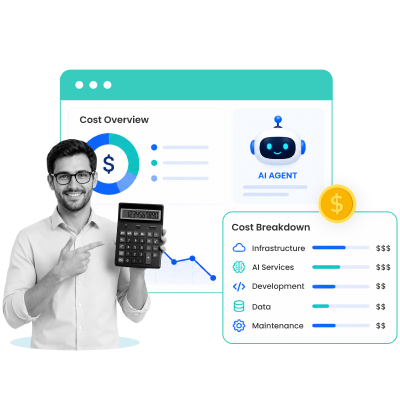
Most organizations underestimate the cost of building an AI agent. Not because they receive a bad quote. But because the quote often covers only the build. Everything required to deploy, operate, integrate, and improve the agent in production is left out. By the time those costs become visible, budgets have shifted, timelines have slipped, and the expected ROI becomes much harder to achieve.
That's why your first question shouldn't be, "How much will an AI agent cost?" It should be, "What are we actually paying for?" Development is only one part of the investment. Data readiness, integrations, infrastructure, governance, security, and ongoing operations all influence what any artificial intelligence initiative truly costs over its lifetime.
In this guide, we walk you through what it really costs to build successful AI agents.
AI agent costs range from $5,000 for a simple rule-based bot to $400,000+ for enterprise systems. But that's just the build. Year 1 all-in costs run 1.4x to 1.8x the headline number once you add infrastructure, tokens, and maintenance. The biggest variable isn't the agent type. It's whether your data is actually ready for AI.
| Aspect | Detail |
|---|---|
| What this guide covers | AI agent development cost by agent type, with real ranges, the factors that move your number up or down, infrastructure costs most budgets forget, integration expenses for existing software, a formula to estimate your specific AI agent development cost, ROI math that determines payback |
| Who should read this | CTOs, product leaders, and anyone committing budget to an AI agent project before understanding the full picture. |

AI agent development cost is the total investment required to design, build, integrate, test, deploy, and maintain software that can autonomously perceive inputs, reason over them, take actions, and learn from outcomes without continuous human instruction. It includes not just engineering time but LLM infrastructure, data preparation, security architecture, third-party integrations, and ongoing operational costs that accumulate after launch.
The honest 2026 range:
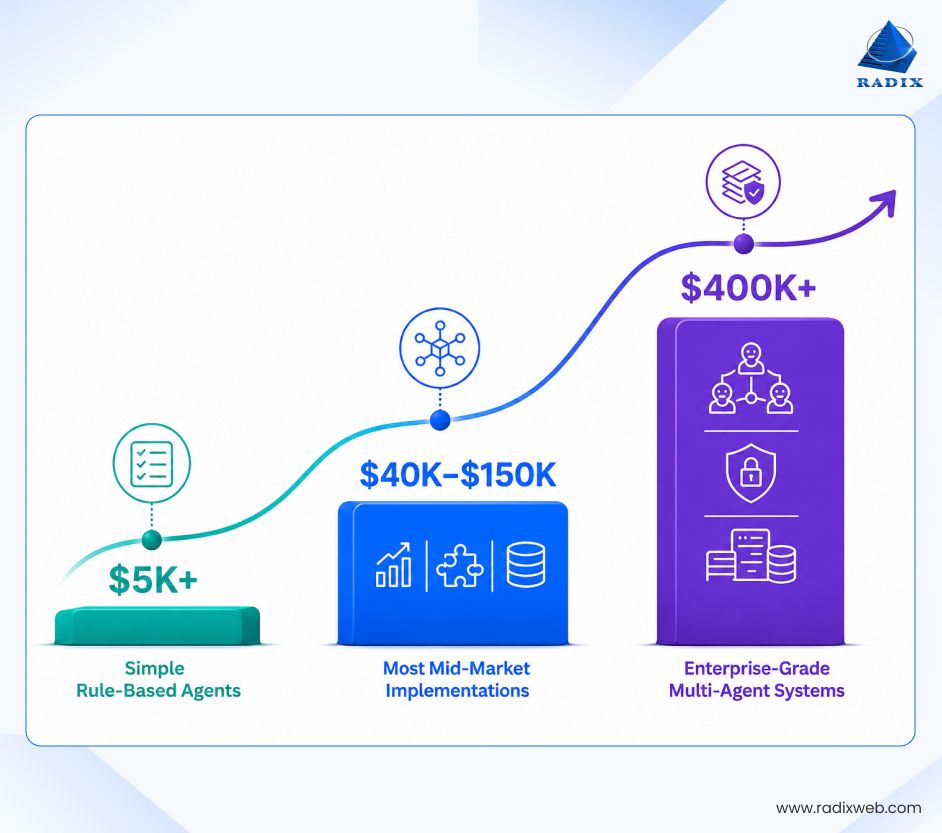
But the build cost is only the first invoice.
Before any cost estimate makes sense, you need to identify which tier of agent your use case actually requires. This is the decision most teams get wrong, and it's expensive in both directions.
Choosing a multi-agent architecture for a rule-based problem inflates cost by 3 to 5x. Similarly, trying to build a genuinely complex workflow as a simple agent produces a product that fails in production and requires a rebuild.
Here are the types of AI agents and how much they cost:
| Agent Type | Complexity | Typical Use Cases | Build Cost | Timeline |
|---|---|---|---|---|
| Rule-based / scripted | Low | FAQ bots, ticket routing, form automation | $5,000 – $20,000 | 1 – 3 weeks |
| Single-task RAG agent | Medium | Document Q&A, internal knowledge base, support assistant | $20,000 – $60,000 | 4 – 8 weeks |
| Autonomous multi-tool agent | High | Sales automation, research agents, workflow agents | $60,000 – $150,000 | 8 – 16 weeks |
| Multi-agent enterprise system | Very High | Claims processing, supply chain, cross-department orchestration | $150,000 – $400,000+ | 4 – 9 months |
Note: Year 1 all-in cost is typically 1.4x to 1.8x the headline build cost. A $60,000 agent doesn't cost $60,000 in year one. It costs $85,000 to $110,000 when you account for infrastructure, LLM tokens, monitoring, and maintenance. More on that in the hidden costs section.
Now let’s understand each of the types of AI agents:
Rule-based agents follow scripted decision trees. They handle FAQ responses, basic ticket routing, form completion, and predefined workflow triggers. There is no machine learning involved. The agent executes a fixed logic path based on the input it receives. These are the least expensive agents to build and the most predictable to maintain. They're appropriate when your use case has a finite, well-defined set of inputs and outputs, and when edge cases can be handled by human escalation.
RAG (Retrieval-Augmented Generation) agents connect an LLM to a knowledge base, document store, or database and retrieve relevant context before generating a response. A customer support agent that searches your product documentation before answering, a legal research tool that pulls from case files, or an internal HR assistant that references policy documents are all RAG implementations. The cost step-up from rule-based agents comes from the vector database infrastructure, retrieval logic, and the ongoing LLM API costs that scale with usage.
Also Read: RAG vs. Fine-Tuning: Which is Better for Enterprise Gen AI?
These agents can reason about a goal, select from a set of tools (web search, code execution, API calls, database writes), execute actions in sequence, and adjust based on intermediate results. They don't just retrieve and respond. They plan and act. A sales agent that qualifies a lead, pulls CRM data, drafts a personalized email, and schedules a follow-up is operating at this tier. The engineering complexity increases significantly: tool integration, error handling, retry logic, and safety guardrails all add to the build.
Multi-agent systems involve multiple specialized agents working in parallel or hierarchically, with an orchestration layer coordinating their outputs. One agent handles data retrieval, another handles analysis, another handles action execution, and a supervisor agent coordinate them all. These systems power enterprise automation at scale and are used for end-to-end claims processing, autonomous supply chain management, and cross-department workflow orchestration. They require the most engineering, the most infrastructure, and the most rigorous governance architecture.
Think of agent type as your cost baseline. Next, we explain the variables that determine where your project ultimately falls within that range.
Two AI agents with similar capabilities can have very different price tags. That's because development cost isn't determined by the agent alone. The decisions you make around delivery, models, data, compliance, and infrastructure impact where your project falls within the cost range.
Here are the factors that have the most impact on the cost:
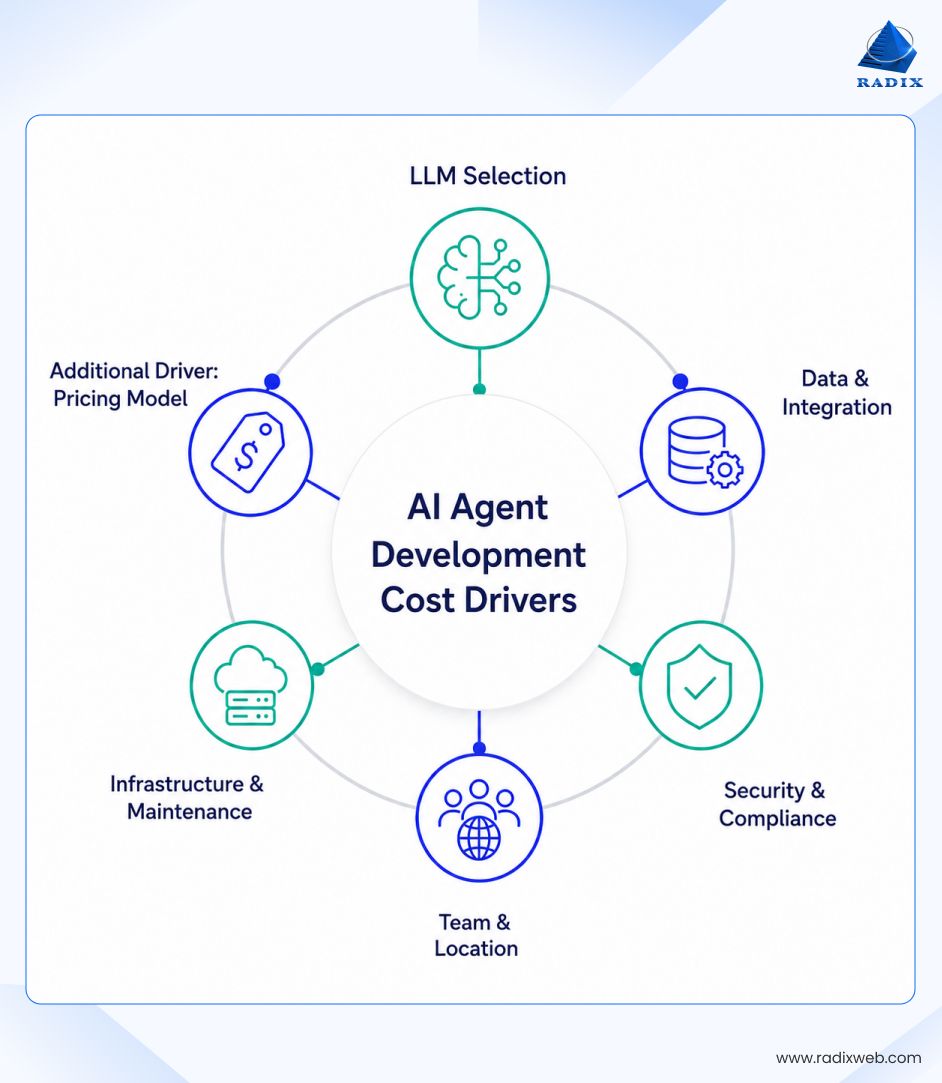
This shapes your infrastructure cost structure for the entire life of the agent. Hosted API models (GPT-4o, Claude Sonnet, Gemini) are faster to integrate and require no GPU infrastructure. And they are managed by the provider while you pay per token.
Self-hosted open-source models (LLaMA 3, Mistral, Qwen) eliminate this recurring token fees. But they require dedicated GPU infrastructure, DevOps management, and scaling capacity. This typically raises infrastructure costs by 30 to 50% compared to API-based deployments.
The right choice depends on what you're optimizing for.
For most projects, the practical path is to prototype with hosted APIs. You can then migrate to self-hosted infrastructure when actual usage data justifies it.
Data preparation is the cost that organizations consistently underestimate. Your data is never as clean, structured, or AI-ready as you think it is. Gartner estimated that organizations will abandon 60% of AI projects due to lack of AI-ready data. The programs that succeed earmark 50 to 70% of their total project timeline for data readiness work before a single agent is trained or deployed.
Practically, data cleaning, structuring, and annotation for a mid-complexity agent can cost between $10,000 to $100,000. The exact cost depends on domain complexity and data volume. Each API integration your agent needs to connect to adds $3,000 to $10,000 in engineering time for authentication, error handling, rate limit management, and testing.
Say you have a customer service agent that connects to your CRM, ticketing system, and product database. These three integrations can add $9,000 to $30,000 to the base build before you've written a single line of agent logic.
One thing we have consistently observed while delivering enterprise AI strategy and consulting is that security, compliance, and governance are often treated as post-launch concerns. But they must be designed into the AI agent system from the beginning. Here's how it impacts development effort and thus, the cost:
HIPAA
What it adds: PHI protection, audit logs, access controls, breach workflows
Cost impact: +20-30%
GDPR
What it adds: Consent management, data deletion, AI memory controls
Cost impact: +15-25%
SOC 2
What it adds: Security controls, audit logging, documentation, validation
Cost impact: +10-20%
EU AI Act (High-Risk AI)
What it adds: Risk management, human oversight, monitoring, governance
Cost impact: +20-40%
While these controls increase upfront development costs, retrofitting compliance after deployment, recovering from a data breach, or rebuilding an AI agent that lacks monitoring, accountability, and ownership almost always costs significantly more. So it is important to build these safeguards into the architecture from day one.
A typical production-grade AI agent project requires a team of specialists including:
That team composition is consistent regardless of location. The rate differences are significant. The average cost of AI specialists across geographies are:
For a 12-week, 1,500-hour project, that difference between a US team and a senior India-based team represents $187,500 to $292,500 in cost.
The meaningful question however, is not location but experience. AI architects who have shipped production-grade agentic systems in 2025-2026 are scarce everywhere. But their experience shows in architecture decisions that prevent expensive rework. So, make sure you evaluate portfolios and agent delivery track records, not just hourly rates when hiring AI development specialists.
This is something that most AI agent budgets omit entirely. The build gets scoped, priced, and contracted. The infrastructure that the agent runs on accumulates costs every month, and those costs scale with usage in ways that are invisible until the invoice arrives. Here are the infrastructure costs that you should budget for:
LLM API Costs
Every AI interaction consumes input and output tokens. Costs increase with longer prompts, larger context windows, multi-step reasoning, memory, and higher user volumes.
Vector Database
Agents using Retrieval-Augmented Generation (RAG) or long-term memory need a vector database to store and retrieve embeddings.
Cloud Hosting
Infrastructure requirements vary depending on whether you use hosted AI APIs or self-hosted models.
Monitoring and Observability
Production agents require monitoring for latency, failures, prompt quality, costs, and system health.
A realistic monthly operational cost breakdown for a medium-complexity agent at moderate scale:
| Infrastructure Component | Monthly Cost Range |
|---|---|
| LLM API costs (hosted) | $500 – $5,000 |
| Vector database (managed) | $500 – $2,500 |
| Cloud hosting / orchestration | $200 – $800 |
| Monitoring and observability | $200 – $800 |
| Total monthly operational cost | $1,400 – $9,100 |
The exact monthly spend depends on user volume, model choice, and deployment architecture. A low-traffic internal tool might run at $1,400 per month. A customer-facing agent handling thousands of daily interactions could reach $9,100 per month or more.
Beyond the technical and infrastructural factors, the contract structure shapes your cost exposure. Here are the different pricing models to choose from when building an AI agent:
Building an AI agent is not just a software project but an ongoing operational investment. Factoring in these variables early helps align budgets with long-term business goals and total cost of ownership.
Choosing between a custom AI agent and an off-the-shelf platform isn't just a cost decision. It's a trade-off between upfront investment, deployment speed, flexibility, and long-term total cost of ownership. The right choice depends on your business goals, technical environment, and how you expect your AI initiative to evolve.
| Approach | Upfront Cost | Ongoing Cost | Deployment Timeline | Best For | Key Trade-offs |
|---|---|---|---|---|---|
Low-code / No-code Platform (Voiceflow, Botpress, n8n, Make.com) | $5,000 to $15,000 | $100 to $2,000/month | 2–4 weeks | MVPs, internal automation, simple workflows | Limited customization, vendor lock-in, subscription costs increase with usage |
| Hybrid Approach | $20,000 to $80,000 | Infrastructure + platform subscription | 1–3 months | Mid-market businesses needing moderate customization and integrations | More flexible than platforms but still partially dependent on vendor capabilities |
| Custom AI Agent | $25,000 to $400,000+ | Infrastructure, LLM usage, monitoring, maintenance | 1–9 months | Enterprise workflows, legacy integrations, proprietary data, regulated industries | Higher upfront investment and longer implementation timeline |
Note: Don't assume the lowest upfront cost is the most economical option. Platform subscriptions, usage-based pricing, and customization limitations can increase costs over time. For organizations with high usage volumes or complex workflows, a custom AI agent often delivers a lower total cost of ownership over three to five years.
Use these three questions to narrow down the right approach.
1. Does your use case fit an existing platform without major workarounds?
If yes, start with a low-code or no-code platform. It's the fastest and lowest-risk way to validate your AI use case.
2. Do you need proprietary workflows, legacy integrations, or complete control over your data?
If yes, a custom AI agent is usually the better long-term investment because it can be designed around your business instead of adapting your business to platform limitations.
3. What will your AI usage look like over the next three years?
Estimate your transaction volume and compare cumulative platform subscription costs with the one-time investment in a custom build. For many organizations, the financial crossover happens between 18 and 36 months of moderate production usage.
The best AI investment isn't the one with the lowest implementation cost. Instead, it's the one that delivers the lowest total cost of ownership while supporting your business as it grows.

The word "AI agent" covers an enormous range. A startup building a focused single-task agent to test a product idea and an enterprise deploying a multi-agent system across departments are both "building AI agents," but the economics are completely different.
| Deployment | Typical Timeline | Typical Budget |
|---|---|---|
| Startup / MVP AI agent | 4 to 8 weeks | $20,000 to $50,000 |
| Enterprise AI agent | 3 to 6 months | $100,000 to $300,000 |
For startups, cost is primarily determined by scope rather than technology. Building an agent that performs a single task well reduces engineering effort, testing surface area, and integration complexity, often lowering initial development cost by 30 to 50% compared to a broader first release.
Open-source models such as LLaMA 3 and Mistral are often suitable for early-stage development, with a move to commercial APIs once requirements justify the cost.
Enterprise projects are driven less by feature count and more by integration and governance. Common requirements include:
These requirements significantly increase implementation complexity, even when the underlying AI functionality is similar to a smaller deployment.
For many organizations, the AI agent isn't a standalone application, it's an additional intelligence layer added to existing business software. In these projects, integration costs are separate from AI development and can equal or exceed the cost of building the agent itself.
Here’s how much it is expected to cost to integrate AI agents based on your system type:
Integrating intelligent agents with ERP, CRM or SCM platforms such as Salesforce, HubSpot, ServiceNow, and Jira is typically the simplest scenario, thanks to mature APIs and SDKs. Integration typically costs $3,000 to $8,000 per platform and takes 1 to 3 weeks. This includes authentication, webhook handling, rate-limit management, and error logging as the primary engineering tasks.
Older enterprise applications often lack modern APIs and require additional integration layers before an AI agent can access their data.
Thus, the cost of integrating AI in legacy systems also includes the cost of middleware, data transformation pipelines, and proprietary integration methods. These projects are also significantly more complex than SaaS integrations.
The integration effort depends largely on how the original application was designed. Typical cost of embedding AI agents in business software with well-designed APIs and modular architecture is $5,000 to $20,000. However, applications built without API layers, proper authentication, or tightly coupled architecture, often require architectural improvements before AI agent integration can begin. In such cases, the integration cost can range between $20,000 to $80,000.
A realistic integration cost table:
| Integration Type | Typical Cost | Timeline |
|---|---|---|
| Modern SaaS platform (Salesforce, HubSpot, etc.) | $3,000 – $8,000 per platform | 1 – 3 weeks |
| Legacy ERP (SAP, Oracle EBS, Microsoft Dynamics) | $15,000 – $60,000 | 4 – 12 weeks |
| Proprietary internal software with API layer | $5,000 – $20,000 | 2 – 6 weeks |
| Proprietary internal software without API layer | $20,000 – $80,000 | 6 – 16 weeks |
| Multi-system orchestration (3+ integrations) | $30,000 – $120,000 | 8 – 20 weeks |
One thing to account for in your budget is that integrations create ongoing maintenance obligations. Every time a connected system updates its API, changes authentication methods, or deprecates an endpoint, your agent integration needs to be updated. So, budget 10 to 15% of your integration build cost annually for integration maintenance.
Compliance requirements, data sensitivity, and regulatory architecture all push costs in specific directions depending on your industry. Use this table as a benchmarking input when defining scope or comparing vendor proposals.
| Industry | Cost Multiplier vs. Baseline | Primary Driver |
|---|---|---|
| Healthcare (HIPAA) | +25 – 35% | PHI handling, audit trails, BAA requirements, access controls |
| Financial services | +20 – 30% | SOC 2, real-time fraud logic, model explainability, transaction audit |
| Legal / HR (EU AI Act high-risk) | +15 – 40% | EU AI Act high-risk classification, decision explainability, human oversight |
| Insurance | +20 – 30% | Underwriting explainability, claims audit, state regulatory compliance |
| E-commerce / SaaS | Baseline | Standard integrations, moderate compliance, lower data sensitivity |
| Internal enterprise tooling | Baseline | Lower risk profile, no consumer-facing compliance requirements |
Healthcare and financial services agents cost the most, not because they're technically more complex but because the compliance architecture required for PHI handling and financial transaction logging is non-trivial. Building that compliance layer in from the start is always less expensive than retrofitting it after an audit or incident.
There's no universal price tag for an AI agent. That's because no two projects have the same data, integrations, compliance requirements, or level of autonomy. However, you can estimate your project with reasonable accuracy. The following framework gives you a practical starting point before you compare proposals from the top companies offering AI development services:
AI Agent Cost Estimation Formula
AI Agent Build Cost = (Development Hours × Hourly Rate) + Data Preparation Cost + Integration Cost + Compliance & Security Cost + Infrastructure Setup Cost
To estimate your Year 1 Total Cost of Ownership (TCO), add 40–80% of the build cost. This covers infrastructure, LLM usage, maintenance, monitoring, and ongoing optimization.
Here's how to use the formula:
Your first estimate depends on the type of AI agent you're building.
Development cost varies significantly by engineering location.
The cleaner your data, the lower your implementation cost.
Each connected system increases implementation effort.
Regulated industries require additional engineering, security, and validation.
Here's how the calculation looks like in practice:
A mid-market eCommerce company builds an autonomous customer service agent that integrates with Salesforce and a custom order management system using an India-based engineering team.
Notice how development accounts for only part of the total investment. Data preparation, integrations, and operational costs often determine what an AI agent actually costs in its first year. Budgeting for all these costs upfront leads to more accurate financial planning and fewer surprises after deployment.
The development quote is rarely your complete AI budget. But the expenses that affect long-term ROI often appear only after the system is live.
These are the hidden costs need to be part of your budget from day one:
AI agents degrade over time as the data distribution they were trained on diverges from real-world inputs. Production agents need periodic evaluation, prompt adjustments, and in some cases full retraining cycles. Typical cost is $5,000 to $20,000/annum, depending on how fast your domain evolves.
Getting an agent to perform consistently in production requires ongoing prompt refinement. Initial prompt engineering is typically scoped into the build. Post-launch optimization as edge cases surface is not. Budget $2,000 to $8,000 per quarter in the first year.
Token consumption in production is almost always higher than projected. Agents operating in multi-turn conversations or using extended memory windows consume more tokens than initial estimates based on average conversation length. Build a 30 to 50% buffer into your token cost projections.
Connected systems update their APIs. Authentication methods change. Data schemas evolve. Each integration your agent depends on is a potential breakage point. Maintenance for three active integrations typically runs between $5,000 to $15,000 annually
Deploying an AI agent changes how people work. Teams need training on when to trust the agent, how to escalate appropriately, how to provide feedback, and how to interpret agent outputs. Projects that skip this step see adoption rates well below expectations and underperforming ROI. For a 50-person department, plan $5,000 to $20,000 for structured change management.
Budget 15 to 25% of your initial build cost per year for ongoing maintenance. On a $100,000 agent, that's $15,000 to $25,000 annually before you add any new features or address model drift.
Here's a quick summary of the hidden costs and what you should budget for:
Planning for these costs and budgeting from the common AI agent deployment challenges from the outset gives you a realistic picture of your TCO. It also helps ensure your AI agent continues delivering measurable business value beyond the launch date.
Knowing what an AI agent costs is only half the decision. The real question is how quickly that investment pays for itself. According to industry insights, AI agent deployment see an average of 171% ROI. Also, in-house custom builds see value within an average of just 94 days.
But what's also important to understand is that 88% of AI agents fail in production, and 19% never reach payback. So, understanding the cost of AI agent development in isolation isn't enough. You also need to understand the expected ROI before a funding call can be taken.
You can estimate your AI agent ROI using two simple formulas:
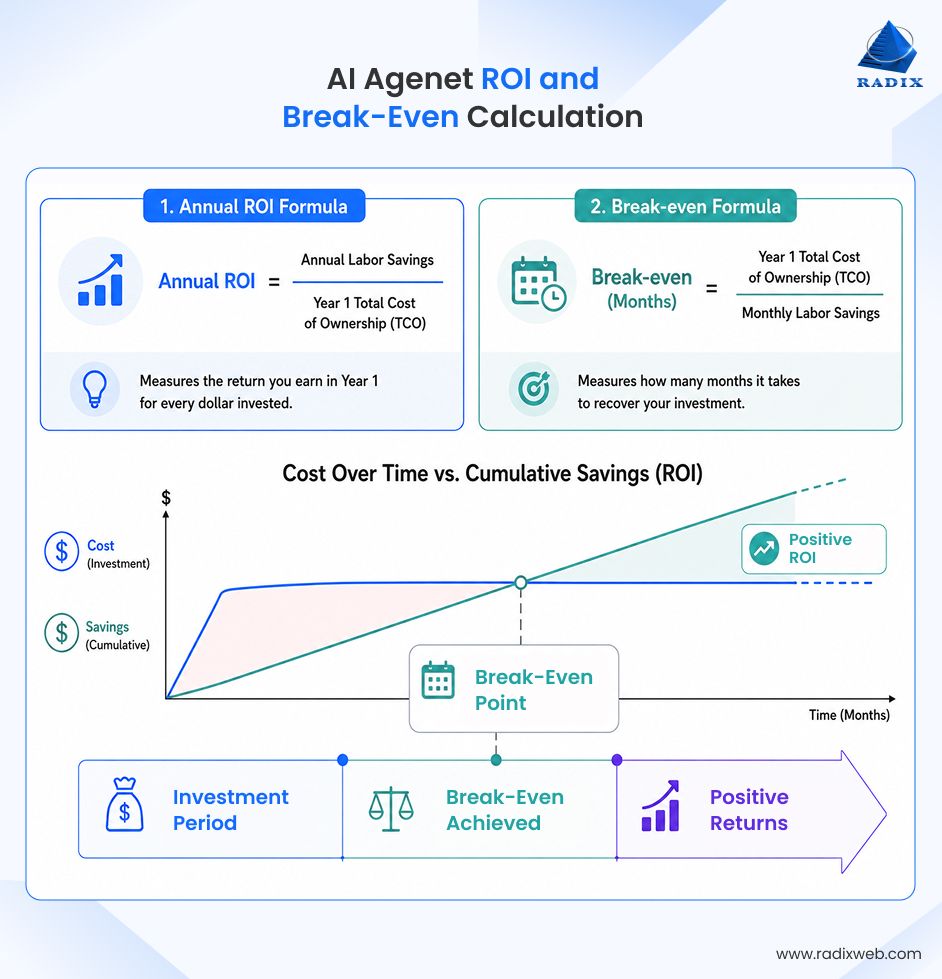
Let's understand this with an example.
An eCommerce company invests $52,000 to build a returns processing agent that automated 73% of return requests. Including infrastructure and ongoing operations, the Year 1 TCO reached $74,000. The agent saved $14,000 per month in manual processing costs. This results in a 5.3-month break-even, 2.3× ROI in the first year, and more than 6× ROI over three years.
Whether your AI agent delivers similar returns depends on three factors:
AI agents built for a single, high-volume business process outperform general-purpose agents. A specialist agent handling three tasks at 95% accuracy creates more business value than a generalist attempting twenty workflows at 60% accuracy.
Clean, structured, and accessible data reduces implementation time, improves accuracy, and lowers costs. Most AI projects that exceed budgets discover data quality issues after development has begun.
AI agents require monitoring, governance, and continuous improvement after deployment. Organizations that budget for maintenance and performance optimization and have clear long-term ownership set for AI outcomes achieve stronger long-term ROI than those treating AI agents as a one-time implementation.
At Radixweb, we run structured scoping engagements that produce a realistic cost estimate. We also offer AI Agent readiness assessments and break-even timelines, so you know what to expect in terms of costs and returns before development begins.
Plan AI Agent Development Economics Before You Plan the Build
The AI agent market is projected to reach $182.97 billion by 2033, growing at a 49.6% CAGR from 2026 to 2033. As adoption accelerates, organizations investing in enterprise AI development for business-critical workflows are realizing that success depends on much more than just the initial build. The highest returns come from budgeting for the complete lifecycle from the beginning and understanding the total cost of ownership before contracts are signed.That's why, at Radixweb, we focus on complete cost transparency from the very beginning. Our agent development estimates don't just cover the cost of developing the AI agent. It also includes the cost of data readiness, integrations, infrastructure, governance, security, testing, and the ongoing costs to keep the AI agent reliable in production. So, if you are evaluating an AI agent project, don't start with complicated contracts. Instead, schedule a consultation with our AI specialists for an honest cost conversation.
Ready to brush up on something new? We've got more to read right this way.