Read More


Recognized for AI Excellence at 2026 Globee® Awards - Read More

Maitray Gadhavi

Quick Summary: Adding AI to a legacy system typically costs $75,000–$300,000 for a focused mid-market implementation and can exceed $1.5 million for complex, regulated environments. But the biggest expenses items are not AI models themselves. They’re the integration, data, and operational work behind them. In this guide, we break down the real costs, hidden budget drivers, and the key decision that can dramatically change your investment.
| Aspect | Detail |
|---|---|
| What this guide covers? | Cost by legacy system type, five cost drivers, hidden budget lines, modernize vs. layer decision, 3-year TCO, real mid-market delivery examples |
| Who should read this? | CTOs, IT Directors, CFOs, and Engineering Leads at mid-market companies ($25M–$250M revenue) budgeting an AI integration project |
| TL;DR in <60 seconds | For a mid-market company integrating one production AI workflow, the realistic Year 1 cost is $75,000 to $300,000 for a focused single workflow. Multi-workflow or regulated builds run $300,000 to $1.5 million. Labor and integration are 60–75% of total cost. The AI model is rarely the dominant line item. |
| Read Time | 15 min |
Legacy systems weren't built for AI.
That's where most AI initiatives hit their first roadblock. Mid-market companies often have leadership buy-in and budgets approved for AI. But there’s not much they can do when the software running their business wasn't designed to support modern AI capabilities. Replacing an entire ERP, CRM, or core platform just to add an AI assistant or intelligent workflow is rarely justifiable. Especially when modernization can take 6–18 months and competitors are ready to ship AI features this quarter. And just adding AI to a system that’s not ready for it leads to inevitable failure.
The practical path here is to make legacy systems AI-ready without replacing them. This involves strengthening the data foundation, integration layer, security, and architecture that AI depends on. What this also means is that the real cost of implementing artificial intelligence is different from what most organizations expects. The model API is the smallest line item while integration setup and data infrastructure are bigger budget contributors.
This guide breaks down the cost, what influences it, and how to budget realistically for a successful AI integration.
Adding AI to a legacy system means implementing one of the many AI use cases (via a language model, a predictive algorithm, an automation workflow, or a recommendation engine) to software that was not designed to support them.
In theory, "adding AI" implies something cosmetic. A feature, a chatbot, a dashboard widget. In practice, adding AI to a system that is ten or fifteen years old involves:
The AI model is just a small part of that programme. These factors directly determine how much the actual cost of AI in legacy systems will be. Understanding them before you choose from the available AI service provider options is the difference between a realistic budget and a budget that expands by change order.
Before you scope integration costs, you need to answer one foundational question:
Should we build a modern AI-ready foundation first, or should we layer AI capabilities onto the system as it exists today?
This decision carries a $150,000–$500,000 budget consequence and yet receives surprisingly little structured guidance. The right answer depends on the state of your legacy infrastructure, your timeline, and whether modernization delivers its own ROI independent of the AI project.
Modernization before AI integration makes sense when the legacy system is creating parallel problems: integration complexity and architectural constraints that the AI layer would have to work around.
Modern legacy system upgrades for mid-market companies cost $150,000–$500,000 and extend the timeline before AI value arrives. But in specific scenarios, this investment pays back:
When you're addressing one of these scenarios, investing in legacy system modernization pays back through maintenance cost reduction. The subsequent AI integration is also faster, cheaper, and more capable because you're building on modern foundations rather than working around legacy constraints.
When the legacy system is stable, well-documented, and has some API exposure, you can build a middleware or data replication layer that connects AI without touching the underlying system. Data replicates to a modern layer. The AI operates against replicated data. Results push back through existing interfaces.
This approach delivers faster time to production value, avoids disrupting a stable operational system, and defers modernization investment:
But the tradeoff is real: data latency, integration fragility (the middleware must be maintained as the legacy system changes), and a ceiling on what the AI can do (some use cases simply require real-time source system access).
Not sure whether to modernize or add AI first? Answer the five questions below to reveal which path matches your actual system state, not your timeline preference.
Q1. What is the current state of the legacy system's API coverage?
Q2. Is the legacy system a known maintenance burden or compliance risk?
Q3. Does the AI use case require real-time source system access, or does it tolerate latency?
Q4. How much of the IT budget currently goes to maintaining this system?
Q5. What is the timeline constraint?
Across hundreds of legacy modernization engagements at Radixweb, we’ve seen that an in-depth pre-project technical assessment consistently surfaces the answer to this decision.
Teams that skip assessment make the decision based on timeline preference. Teams that commission a technical assessment make it based on system readiness. It also impacts the budget surprises later on.
"The engagements where the budget surprises are smallest are the ones where the client had a clear answer to one question before the project started: what is the actual state of the data? Not an intuition about data quality, but an actual assessment. Every other cost driver flows from the answer to that question." explains Anand Trivedi, VP Operations and Delivery, Radixweb
The single biggest cost variable in adding AI to legacy systems is not which AI model you choose. It's the architectural maturity of the system you're integrating with.
A modern system with documented APIs and clean data is a constrained, predictable integration problem. A 20-year-old undocumented system with siloed data is an archaeology project before it's an integration project. The cost difference between these scenarios is $70,000–$240,000 per system.
Let's narrow the wide ranges into specific scenarios so you can benchmark against your own infrastructure.
For a mid-market company integrating one production AI workflow in 2026, the realistic range is:
Labor and integration consistently account for 60–75% of total project cost. The model API is rarely the dominant line item. This is the reality that separates initial expectations from actual budgets.
The timeline, integration complexity, and cost of connecting AI to your legacy system depend directly on the system's age and API maturity:
| Legacy System Profile | Architecture Age | Integration Cost Range | Timeline | Primary Cost Driver |
|---|---|---|---|---|
| Modern system with documented APIs | Under 8 years, REST APIs | $30,000 - $60,000 per system | 4-8 weeks | Configuration and testing |
| Older system, limited APIs | 8-15 years, partial API coverage | $60,000 - $120,000 per system | 8-14 weeks | API development and data mapping |
| Legacy system, no API, undocumented | 15+ years, no APIs | $100,000 - $200,000 per system | 14-24 weeks | Custom middleware and data archaeology |
| Mainframe integration | Any age, COBOL/AS400/zOS | $120,000 - $300,000 per system | 16-30 weeks | Specialist expertise and extraction layer |
Sources: Radixweb delivery data and market metrics
When the legacy system has no API, the integration team must build one before AI work can begin. That means reverse-engineering the system's data model, writing extraction logic, building a data pipeline, and creating a middleware layer that modern systems can communicate with.
This prerequisite work adds $40,000–$150,000 to the budget and 8–16 weeks to the timeline. It's the item most frequently missing from initial cost estimates and the most common source of mid-project budget expansion.
For organizations whose core ERP, manufacturing system, or CRM dates to the early 2000s, this is the likely starting point.
The cost of AI in legacy systems is not set by the AI capability you want. It's set by the state of the infrastructure you're starting from and the depth of integration the use case requires. Here are the 5 factors that have the most impact:
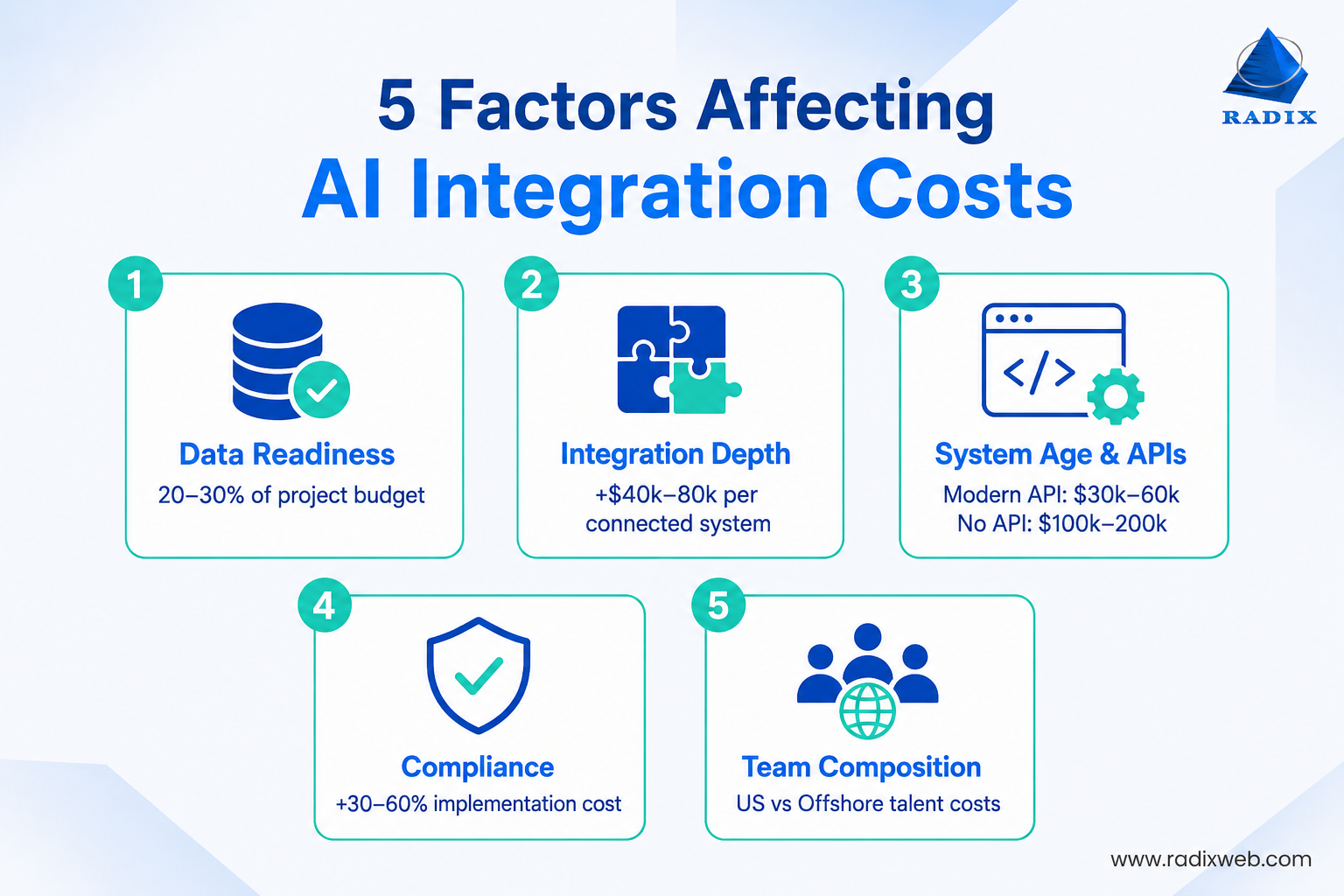
The baseline before you can implement any artificial intelligence business solution is clean, structured, accessible data. Mid-market organizations typically hold siloed data across 5–15 systems with inconsistent formatting, duplicate records, and years of accumulated errors. Data preparation and cleansing typically represents 20–30% of the total project budget.
Organizations that skip upfront data assessment discover the cost mid-project, where it's more disruptive and more expensive to address. A $10,000 data audit commissioned before scoping prevents a $40,000 data remediation effort discovered in month three.
The number of systems the AI solution must connect to multiplies the integration cost. A RAG-based document search connecting to one repository is a contained project. The same system connecting to a CRM, an ERP, a document management platform, and a customer portal is four separate integration workstreams, each with its own data mapping, API development, error handling, and testing requirement.
Each additional system integration adds $40,000–$80,000 to the timeline and budget. This is why single-use-case deployments cost less than enterprise-wide rollouts, and why phased approaches often make more sense than trying to solve everything at once.
A modern system with documented REST APIs integrates for $30,000–$60,000. A 15-year-old system with no API starts at $100,000–$200,000 for the same integration outcome. The age and documentation state of the legacy system sets the floor for integration cost before the AI work begins.
This is the cost driver that senior technical leaders understand but that non-technical stakeholders often underestimate. A system that is five years newer can cost two-thirds less to integrate with AI, even if it performs the same business function.
Mid-market companies in healthcare, financial services, and insurance routinely add 30–60% to baseline implementation budgets for compliance: HIPAA technical safeguards, GDPR data residency controls, SOX audit trail requirements, and model explainability documentation. These are architecture decisions that must be designed in from the start.
Retrofitting compliance requirements post-launch is consistently more expensive than building them into the integration architecture from day one. If your organization is regulated, treat compliance as a cost driver that shapes the entire integration approach, not as an add-on to the technical scope.
One senior AI engineer in the US costs $180,000–$250,000 annually, fully loaded. Eastern European and Latin American specialists with equivalent seniority cost $50,000–$90,000 annually. However, if you hire an AI expert from India, it would cost $35,000–$70,000/year.
The team location decision carries as much budget impact as the technical scope decision for mid-market companies where total project cost is the primary constraint.
This doesn't mean always choosing the lowest-cost option. It means being deliberate about where you invest in specialist expertise (usually near your organization) and where you can use highly capable, lower-cost teams without sacrificing quality. Hybrid team models are common in mid-market AI integrations.
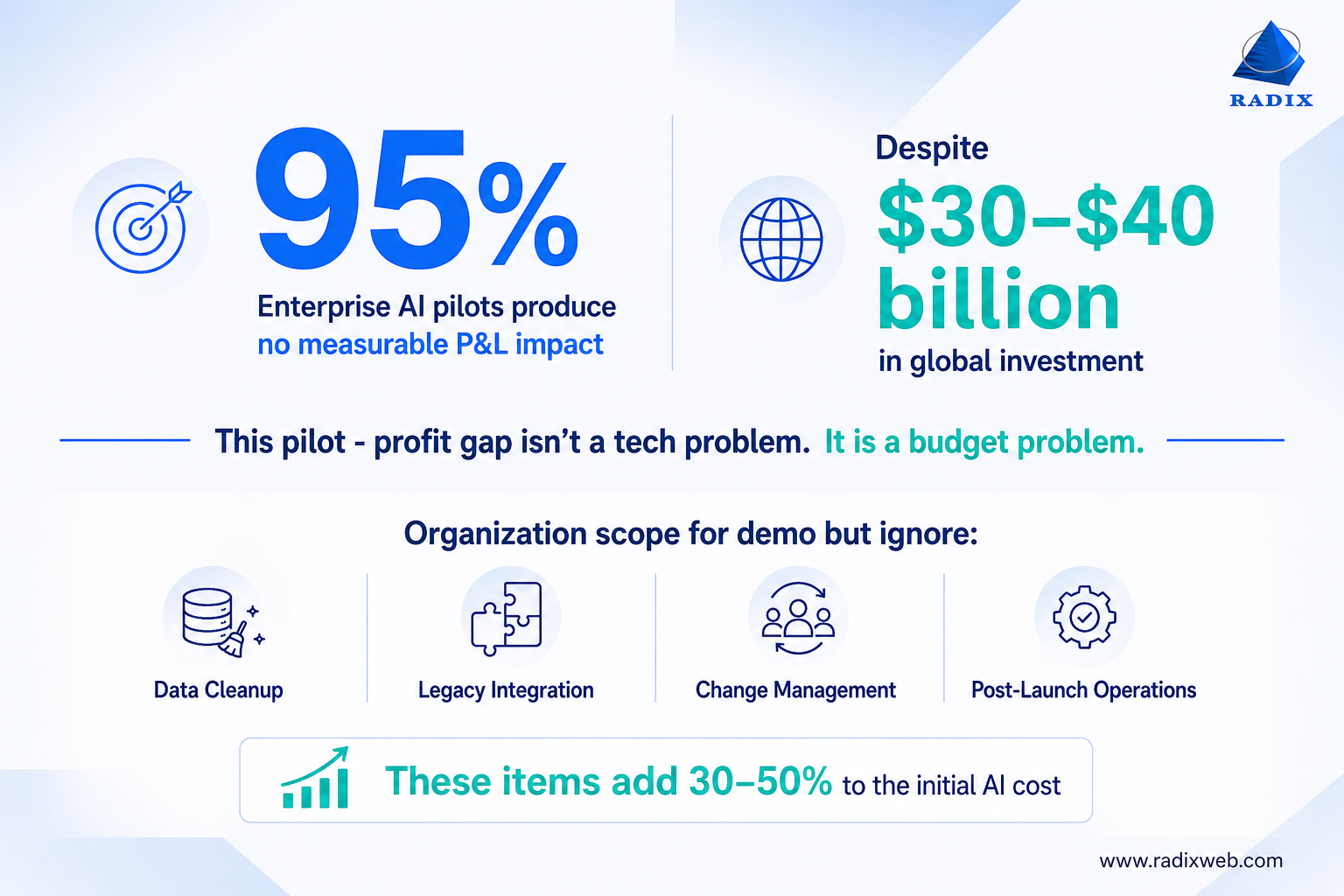
Remember: Pilots Cannot Predict Production CostsPilots typically run at 12-25% of the hard problem but skip 70% of the hard problems like:● Data cleanup● Change management● Post-launch operationsThe most common mid-market AI budget overrun is scoping based on the pilot, only to discover production-grade complexities mid-project. The realistic approach here to properly plan your pilot to production transition and budget for the latter from scratch, not extrapolating the pilot costs.
There are five common budget lines that appear in change often in change orders, but never in the initial proposals. Here’s what they are and how to prevent them from becoming surprises:
Initial scoping rarely includes a full data audit. When the integration team begins mapping data sources, they discover inconsistencies, missing fields, duplicate records, and format mismatches that must be resolved before the AI system can use the data. Organizations that commission a pre-project data assessment ($8,000–$20,000) avoid discovering these problems mid-project, where they cost three times as much to fix.
Systems built 15 or 20 years ago are often under-documented. Integration engineers spend time reconstructing what the system does before they can build connectors. This documentation work is rarely scoped explicitly and consistently extends timelines by 20–40%, which compounds into cost overruns.
The recommended allocation for training and change management is 10–12% of total project cost. Most organizations budget 5% or less. The consequence: AI systems that function correctly but are used incorrectly or avoided entirely by the people they were built for, producing no measurable business outcome.
Annual operational costs for a production AI system typically run 15–20% of the initial implementation cost. This covers model monitoring, retraining when the model drifts, infrastructure management, and support. This line is almost universally absent from Year 1 budget plans and becomes a surprise in Year 2.
AI systems that perform acceptably at pilot query volumes sometimes fail at production scale. Moving from 90% to 99% accuracy on a production requirement can multiply implementation effort by three to five times. Latency, throughput, and infrastructure costs that were acceptable in a test environment become cost drivers when the system serves real users at production volumes.
Together, these five items add 30–50% to initial budgets. Most organizations discover them as change orders in months two through six of the project. But a pre-project assessment helps surface them before scope is committed.
AI Integration Cost ≠ AI Feature CostMost teams compare the cost of AI in legacy systems to the cost of the AI feature itself. But the feature cost is just the model API ($100–500/month). The integration cost is everything that makes the model useful in a system that exists in production and serves real users ($75,000–$300,000).These are not the same number. For a legacy system without APIs, the integration cost frequently exceeds the feature cost by a ratio of three to one or higher.
Most AI integration budgets cover Year 1. But the total cost of ownership over three years looks materially different and that is the number that a mid-market company’s CFO needs to see before approving they can approve the project.
| Cost Component | Year 1 | Year 2 | Year 3 | 3-Year Total |
|---|---|---|---|---|
| Integration development | $120,000 | $0 | $0 | $120,000 |
| Data preparation | $40,000 | $10,000 | $8,000 | $58,000 |
| Model and API fees | $15,000 | $24,000 | $36,000 | $75,000 |
| Infrastructure | $20,000 | $28,000 | $35,000 | $83,000 |
| Training and change management | $25,000 | $10,000 | $5,000 | $40,000 |
| Post-launch operations and support | $30,000 | $35,000 | $40,000 | $105,000 |
| Model monitoring and retraining | $0 | $15,000 | $18,000 | $33,000 |
| Total | $250,000 | $122,000 | $142,000 | $514,000 |
Figures above are indicative ranges based on Radixweb delivery data and assume mid-market AI workflow integration with one legacy ERP connection and a two-department rollout.
Important:
Infrastructure and operational costs also grow, but more slowly. The integration development cost is a one-time investment that doesn't compound. This means the three-year cost curve flattens significantly after Year 1 if the project is scoped and executed correctly because Year 2 and Year 3 are not repeating the Year 1 engineering effort.
A $250,000 Year 1 investment that costs $514,000 over three years isn't a $250,000 decision, it's a $514,000 commitment. That said, the costs and commitments shouldn't be considered alone. They're only meaningful when evaluated against the return on investment your AI system will generate.
BCG's 2025 data found AI leaders achieving 1.7x revenue growth and 1.6x EBIT margin improvement versus laggards. At the mid-market level, a $250,000 Year 1 investment that recovers one operations FTE ($100,000–$150,000 annually) and improves one revenue-adjacent metric by two percentage points on a $30 million revenue base pays back within 18–24 months.
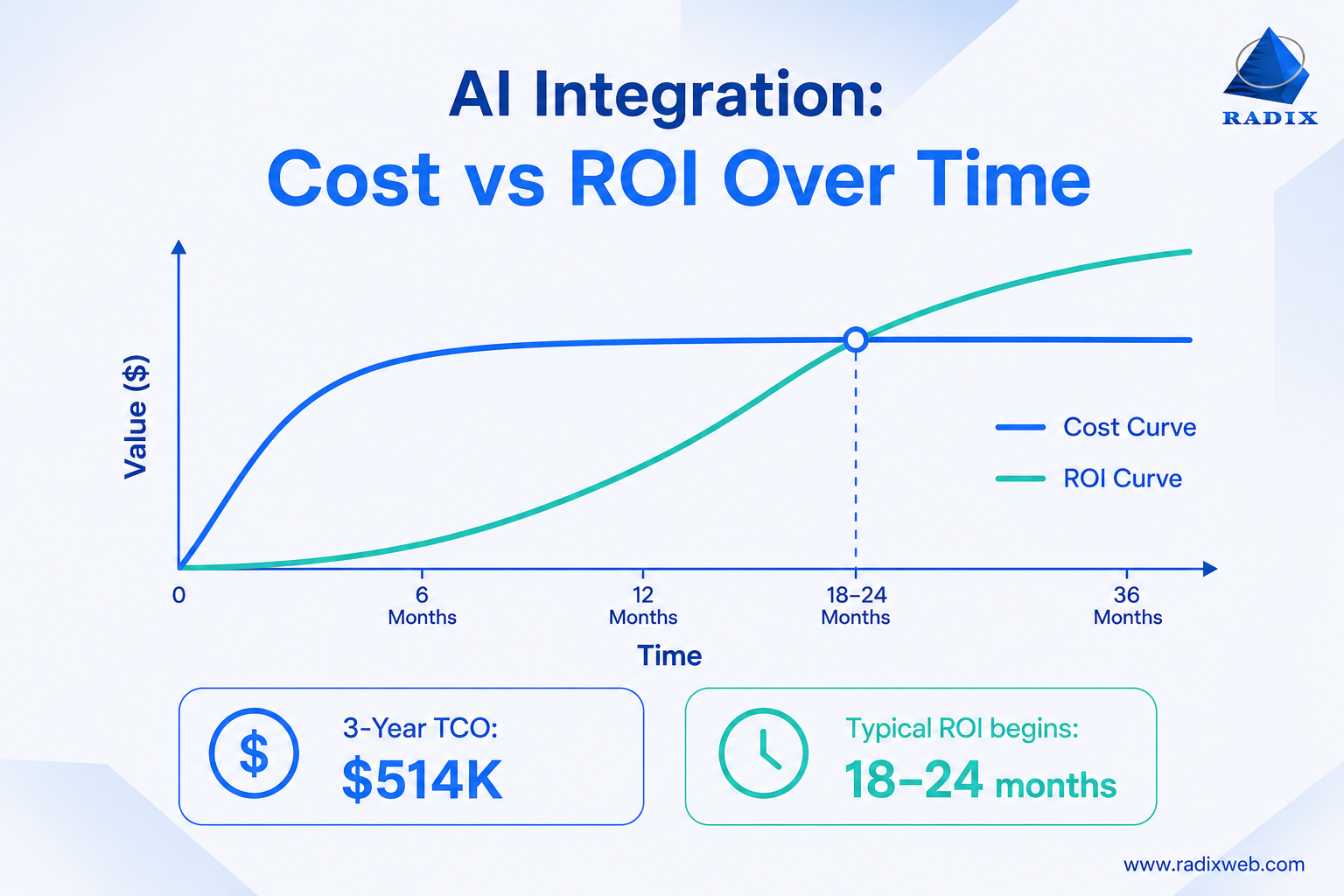
The ROI model works when the use case is specific, the outcome is measurable, and the post-launch operations investment is funded. It breaks down when the use case is "add AI to improve efficiency" without a defined metric, a defined baseline, or a defined measurement period.
So, before approving a project for modernizing your legacy system with artificial intelligence, define what success looks like, how you'll measure it, and what happens in Year 2 if the system doesn't deliver.
At Radixweb, we’ve seen several mid-market AI integrations patterns across a range of engagements. Two documented outcomes illustrate the range of what's possible:
An Australian HR firm commissioned a full-cycle automation platform integrating GPT-3.5 with existing HR workflows. The AI chatbot automated 70% of operational tasks, simplified internal processes, and delivered a 3x speed improvement in turnaround times. The integration connected to existing HR systems without requiring full legacy system replacement. The AI integration cost was recovered through operational efficiency within the first operating year.
A RAG-based document search platform built on Azure connected to legacy document repositories. The outcome: 40% reduction in infrastructure costs and 97% query interpretation accuracy. The integration focused on building the retrieval layer that connected existing document storage to AI search capabilities. The legacy system wasn't replaced but was augmented with an AI layer that made its data queryable in a way it had never been before.
Here’s a quick overview of how the two projects differed:
| Aspect | Recruit.IQ | Doyele O'Keefe |
|---|---|---|
| Use Case | Workflow automation and chatbot | Document search and retrieval |
| Integration Scope | Single legacy HR system | Multiple legacy document repositories |
| Primary Outcome | 70% task automation, 3x speed improvement | 40% infrastructure reduction, 97% accuracy |
| System Approach | Modern integration to existing workflows | Augmentation layer on legacy storage |
| Cost Recovery Timeline | First operating year | First operating year |
Both projects illustrate the pattern Radixweb's delivery teams observe consistently: the AI capability itself is a smaller investment than the data and integration work that makes it function in production.
In both cases, the pre-project assessment identified the integration approach before scope was committed, which prevented the mid-project scope expansions that are the most common cause of budget overrun in this category of work.
Note: Not every project fits these patterns exactly. Some organizations have unique infrastructure challenges or regulatory requirements that create their own integration approaches. What matters here is that your approach is grounded in an assessment of your actual system state, not a template fit. The AI system that matches your constraints and delivers measurable outcomes is the right AI system for your organization, regardless of how it compares to other deployments.
Knowing these answers before you talk to vendors is critical. It prevents scope confusion, establishes a realistic budget baseline, and ensures you're asking vendors the right questions rather than accepting their first estimate as fixed.
This single answer changes the per-system integration cost range by $50,000–$200,000. A system with modern REST APIs integrates for $30,000–$60,000. A system without APIs and poor documentation starts at $100,000–$200,000.
Most organizations have an intuition about data quality. "It's probably okay" or "There are some duplicates, but nothing major." Intuition is wrong 70% of the time when it comes to legacy data. Commission a data assessment ($8,000–$20,000) before scoping the AI project.
The Year 1 cost gets the AI into production. The Year 2 and Year 3 costs determine whether it stays there, improves, and delivers the ROI that justified the investment. Budget both before approving the Year 1 spend.
When you walk into your first vendor discussion with these three answers in hand, you ask better questions, evaluate proposals more realistically, and avoid the scope confusion that creates mid-project surprises.

Building Your AI Foundation on Legacy Infrastructure
The first step when adding artificial intelligence capabilities to a mid-market legacy system is an assessment, not a proposal. A pre-project technical assessment costs $15,000 to $40,000. It maps every integration point, evaluates data readiness, and produces a realistic scope before any development commitment is made. It costs less than one change order and prevents several.Radixweb's AI software development and legacy modernization teams specialize in AI integrations for mid-market clients across sectors like manufacturing, professional services, healthcare, and logistics. But our value isn't in one-size-fits-all proposals. It's in surfacing the constraint that determines your budget before any development commitment is made. We start with a pre-project technical assessment that maps every integration point, evaluates data readiness, and produces a realistic scope before time and money are committed. Schedule a conversation with our experts to gain clarity on your budget, timeline, and next step.
Ready to brush up on something new? We've got more to read right this way.