Read More


Recognized for AI Excellence at 2026 Globee® Awards - Read More

Dhaval Dave
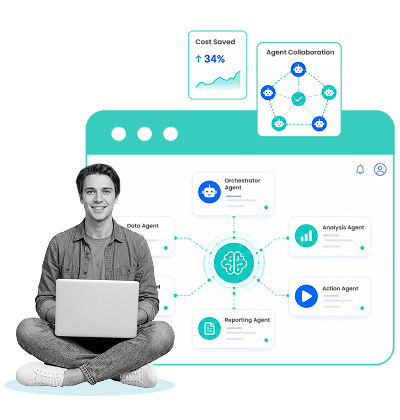
The first wave of enterprise AI was about building a single intelligent assistant. The next wave is about building teams of AI agents that plan, collaborate, and execute work together.
That's because real business processes rarely end with one task or one decision. And enterprises are now expecting AI to operate the same way. The results are compelling. Organizations deploying multi-agent systems consistently report lower operating costs, faster decisions, and higher productivity. Unsurprisingly, enterprise adoption of multi-agent orchestration doubled from 9% to 18% in a single quarter, according to KPMG's Q2 2026 AI Pulse survey.
But adding more AI agents doesn't automatically create a better system. In practice, coordination failures, poor orchestration, and governance gaps make multi-agent systems surprisingly fragile. So, when does a single AI agent suffice, and when is a multi-agent architecture the better choice? This guide answers that question and shows how to build enterprise-ready multi-agent systems that actually work.
Multi-agent systems orchestrate specialized AI agents working in tandem to solve business problems that no single agent can handle alone. Unlike single agents optimized for one task, multi-agent architectures partition responsibilities across focused agents that communicate and coordinate toward common business outcomes. The decision to build multi-agent systems isn't about choosing the more sophisticated option. It's about honestly assessing whether your business problem demands the coordination, resilience, and depth that multiple specialized agents provide.
| Aspect | Details |
|---|---|
| What this guide covers? | Why single agents hit their limits, the architecture and components of multi-agent systems, how they differ from single-agent approaches, the business benefits and adoption drivers, enterprise architecture patterns, integration challenges and solutions, decision frameworks for when to use multi-agent systems, implementation roadmaps, and real-world deployment considerations. |
| Who should read this guide? | CIOs, CTOs, AI Directors, VP of Engineering, Enterprise Architects, Product Leaders, Business Decision-Makers, and Technical Leaders planning or scaling AI initiatives who need to decide between single-agent and multi-agent approaches. |
Most organizations start in the same place. They identify a workflow that's repetitive, rule-based, and expensive to maintain manually. And then they quickly hire AI developers and architects to build a well-designed, enterprise-grade AI agent. The agent works. It reduces workload. It demonstrates ROI. And for a while, everyone is satisfied.
But then the cracks appear. The agent succeeds at its narrow responsibility but can't handle exceptions. There are specific situations where single agents consistently struggle.
When a task requires sequential decision-making across different domains, a single agent either oversimplifies cutting corners or becomes so complex that understanding and maintaining it becomes nearly impossible.
When one part of your process needs speed and another needs accuracy, an agent optimized for both inevitably sacrifices one. A single loan approval agent torn between fast processing and thorough risk assessment will either rubber-stamp applications or create bottlenecks that kill efficiency.
Some tasks require expertise in different areas. Risk assessment, customer communication, and regulatory compliance each involve different reasoning patterns, different data sources, and different decision frameworks. Squeezing all three into one agent dilutes each function.
Many times, your agent becomes the bottleneck. If you need to process 10,000 customer inquiries daily and 500 fraud investigations simultaneously, a single agent architecture forces you to overprovision for peak load on whichever task is busier.
When the agent goes down, everything stops. A system handling loan approvals, payment processing, and customer support can't afford that single point of failure. You need independent systems that can fail gracefully.
Say your first use case was loan assessment, now you need to handle refinancing offers, retention outreach, and compliance escalations. Each requirement pulls the agent in different directions, making the system increasingly brittle.
In each of these scenarios, organizations face the same decision: invest heavily in a more complex single agent, or architect multiple specialized agents that coordinate. Before you make that choice, ensure you understand how the two options differ.
It might seem like multi-agent systems are just single-agent systems repeated multiple times. That's not true. And the difference isn't quantitative, it's architectural.
Simply stated, a single agent solves problems through reasoning within one context. Multiple agents solve problems through coordination across specialized contexts. Here's how they differ:
| Dimension | Single Agent | Multi-Agent System |
|---|---|---|
| Problem Scope | Single, well-defined task or workflow | Complex processes spanning multiple domains or workflows |
| Reasoning Pattern | Sequential decision-making within one context | Parallel or coordinated reasoning across specialized contexts |
| Optimization | Optimized for one objective or metric | Each agent optimized independently; orchestrated toward shared outcome |
| Scaling | Scales vertically (more powerful model, larger context) | Scales horizontally (add new agents for new capabilities) |
| Resilience | Single point of failure | Fault isolation — if one agent fails, others continue working |
| Governance | One policy framework across the entire system | Agent-level governance + orchestration-level coordination rules |
| Typical ROI Window | Months to establish value | Months to establish, scales significantly over time |
This comparison isn't about which is better. It's about fit. Building production-ready AI agents is ideal for focused, well-defined problems. Multi-agent systems excel when you need specialization, scale, resilience, and the ability to evolve your capabilities independently. The right choice depends entirely on what you're trying to achieve and how your business needs to evolve.
A multi-agent system isn't monolith. It's an ecosystem of specialized components working in concerts. Understanding those components is essential before you decide whether to build one.
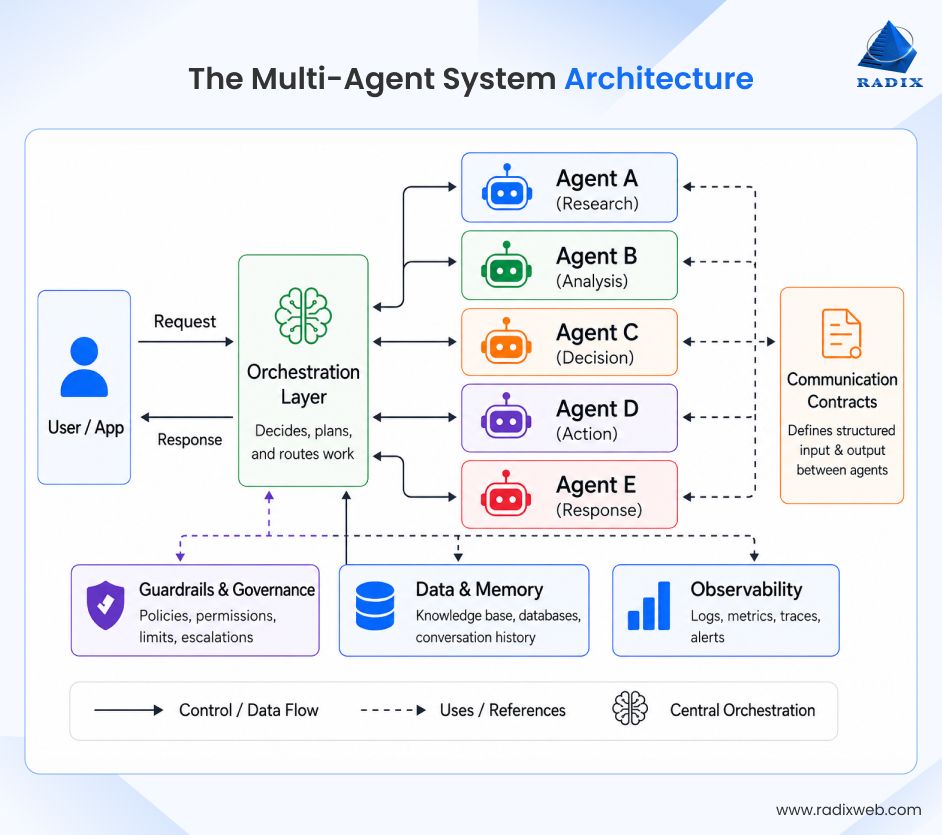
Each agent is a focused AI model or reasoning system responsible for one specific function. They have their own model, prompt engineering, training data, and success metrics. This specialization allows each agent to be optimized for its specific task without compromising other functions.
The orchestration layer decides which agents to invoke, in what sequence, and with what information. It's the traffic controller of the system. This layer also handles failure states. So, if one agent times out or returns unexpected results, the orchestrator decides whether to retry, escalate, or route to a human.
This is the most overlooked and most critical component. Agents don't communicate in natural language. They communicate through defined contracts. Agent A outputs structured data in format X. Agent B accepts input in format X and outputs format Y. These contracts are negotiated upfront and enforced strictly. Without clear contracts, agents would make assumptions about what they're receiving, misinterpret data, and propagate errors downstream. In production of multi-agent systems, communication contracts are documented with the same rigor as API specifications in traditional software.
Each agent operates within explicit constraints. What data can it access? What decisions can it make autonomously? When does it require human approval? When does it escalate? These aren't guidelines, but constraints built into the agent's instructions and actively monitored. Governance exists at two levels:
Multi-agent systems are opaque without comprehensive logging and monitoring. You need complete visibility into what each agent decided, what information it processed, when it communicated with other agents, when and at what point the system fumbled, and why those AI failures occurred. Without this, debugging is impossible.
When these components work together, they create a multi-agent system that's more resilient, scalable, and maintainable than any single agent could be.
Even though they are complex, expensive, and time-consuming to build, organizations choose multi-agent systems because they deliver measurable business value that single agents can't match. Here are the top business cases for building a multi-agent system:
A single agent might automate 40-60% of a workflow, but the remaining still requires human intervention. Multi-agent systems can push that automation depth to 75-85% because specialized agents handle the edge cases and complexities that a single generalist would miss. For example, a risk assessment agent catches subtleties that a general agent overlooks. Together, they automate substantially more of the workflow.
When you need to process applications, claims, or customer inquiries, time matters. A single agent might take 3-5 minutes per request because it's reasoning sequentially. Multiple agents working in parallel can process the same request in 60-90 seconds. That speed differential compounds across thousands of transactions.
A single agent optimized for speed often makes trade-offs on accuracy. A single agent optimized for accuracy becomes slow. Specialized agents don't make these trade-offs. A risk assessment agent is tuned for thoroughness and regulatory compliance. A communication agent is tuned for personalization and customer satisfaction. Each agent operates at its peak capability within its domain. The result is higher quality across the board.
When a single agent fails, your entire automation stops. When an agent in a multi-agent system fails, the others keep working. A compliance agent might be down for a model update, but intake and assessment agents continue operating. They route uncertain decisions to humans, but they don't create a total system outage. This resilience translates directly to operational continuity and reduced business risk.
In a multi-agent system, each agent can evolve independently. Say, you discover that your risk assessment needs improvement. You update that agent's model and prompts without touching the communication agent. When new compliance rules emerge you update the compliance agent without rebuilding the entire system. This modularity means you can optimize your system continuously without the cascading risks.
These benefits compound over time. In the first 90 days, you might see 30-40% improvement in automation depth. By month six, you're seeing 2.4x improvements in throughput and measurable quality gains. That's the ROI curve that justifies multi-agent system complexity.

Multi-agent systems aren't all built the same way. Different organizations adopt different architectural patterns depending on their specific business problem, what data they have available, and how operationally mature their teams are. Here are five patterns that have proven successful at scale in real enterprise environments.
In the hierarchical pattern, one supervisor agent receives the initial request and routes it to appropriate specialized agents. The supervisor doesn't execute the work, it orchestrates. For example, when a customer inquiry comes in, the supervisor agent decides: Is this a technical support issue (route to tech support agent)? A billing issue (route to billing agent)? A product question (route to sales agent)? The supervisor learns which agent handles which category most effectively and routes accordingly. Each specialized agent executes with full autonomy within its domain.
Here's how it looks like in practice:
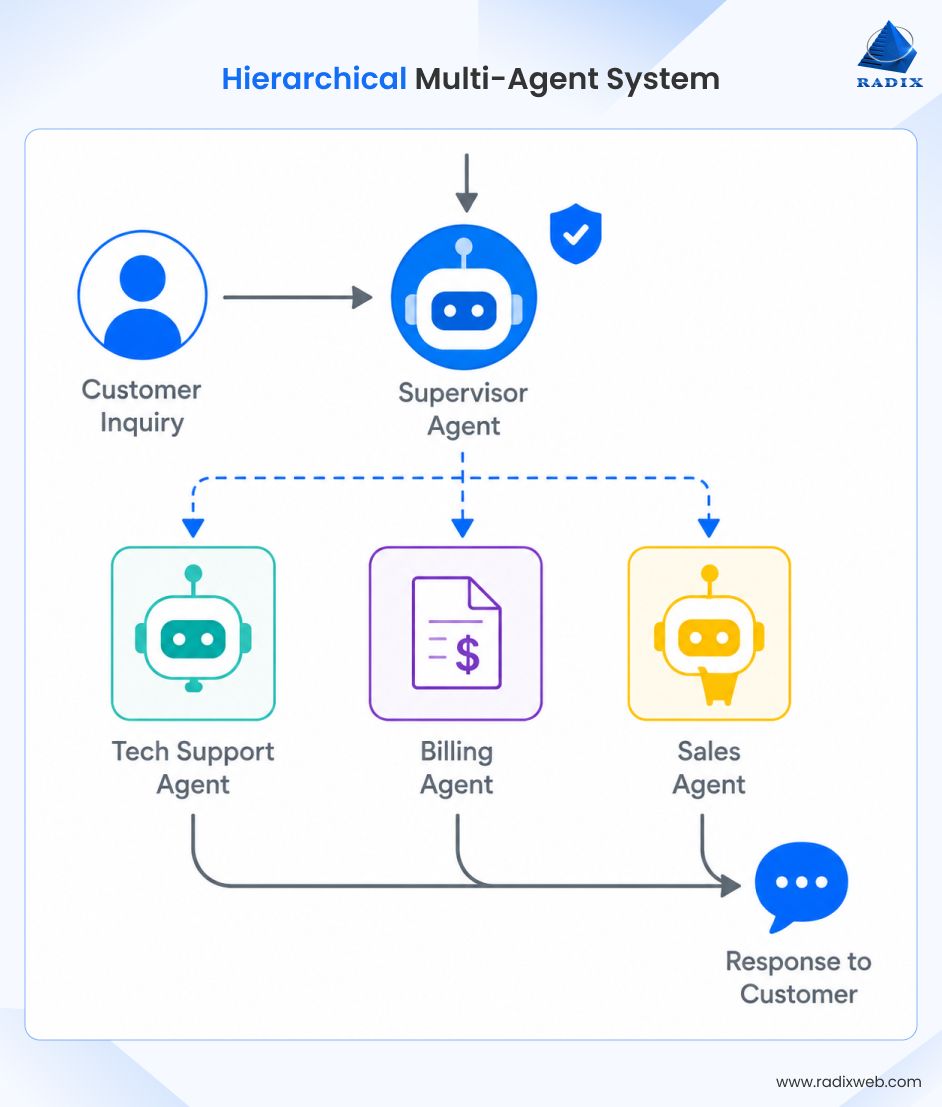
This pattern works exceptionally well for customer support, IT operations, and service desk automation.
For workflows with clear, deterministic stages, the sequential pipeline pattern works exceptionally well. Here, when Agent A completes its task, it passes structured output to Agent B, which processes and passes to Agent C, and so on. Each agent knows exactly what to expect as input and what output format is required. For loan processing, for example, here's how the different agents work together:
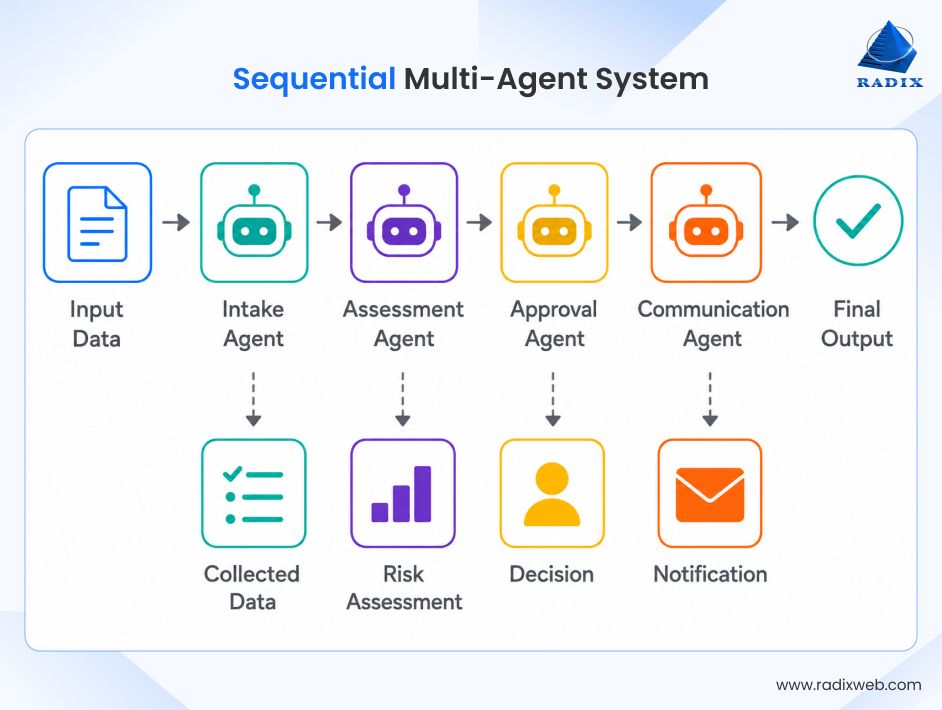
Each stage is in the sequential pipeline multi-agent system is independent, well-defined, and hands off clean data.
In the collaborative or debate pattern, multiple agents work in parallel on the same problem from different angles. A market analysis agent assesses competitive positioning. A customer sentiment agent analyzes buyer mood and preferences. An economic agent evaluates market conditions. They share context, challenge each other's assumptions, and converge on a shared recommendation. The agents don't vote, but reason through their different viewpoints and reach a consensus or identify where disagreement is fundamental.
Here's how it works:
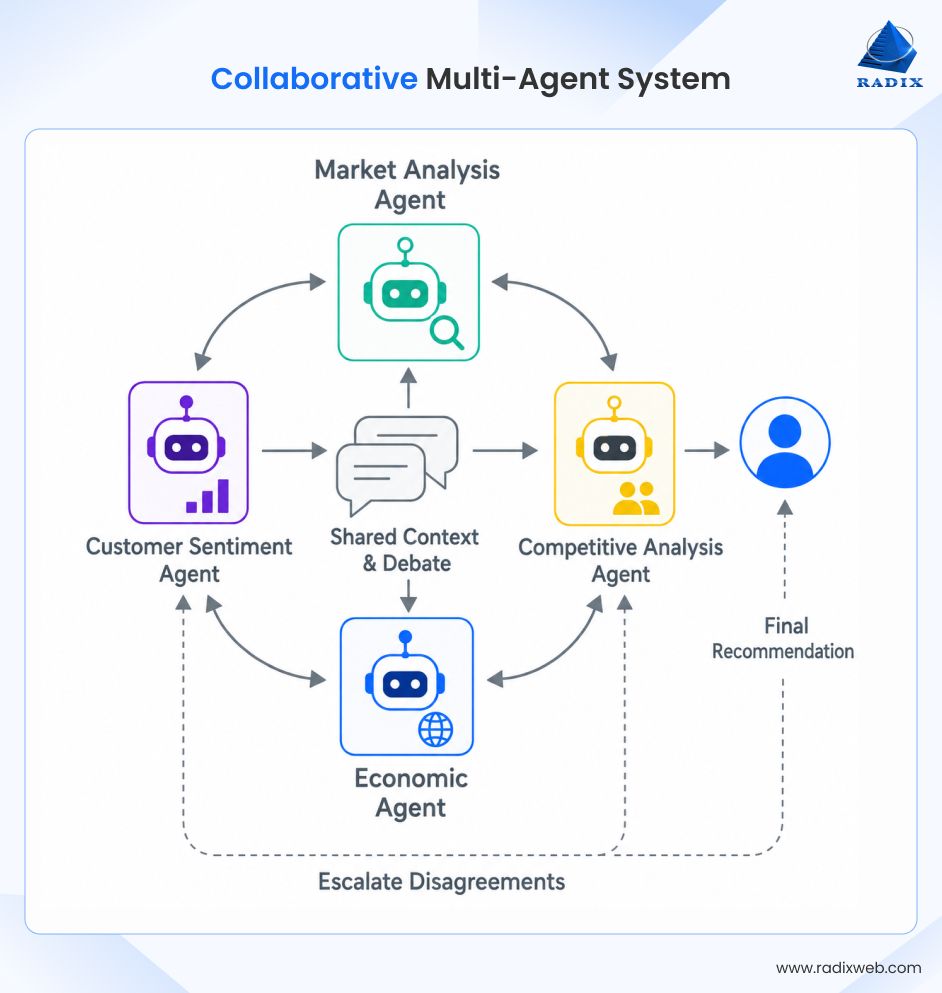
This pattern is powerful for complex strategic decisions where you need multiple perspectives before committing to a direction.
How it works: Initial problem → Agents analyze independently in parallel → Share findings and context → Debate implications → Converge on recommendation or escalate disagreements to human decision-maker.
If your need a multi-agent system that helps with throughput and scale rather than specialization, the swarm pattern is ideal. With this parallel execution architecture, multiple identical or similar agents work in parallel on independent pieces of a larger problem. Say, you have 10,000 customer support tickets to route, categorize, and assign. Instead of one routing agent processing them sequentially (taking days), you have 20 identical routing agents working in parallel (completing in hours).
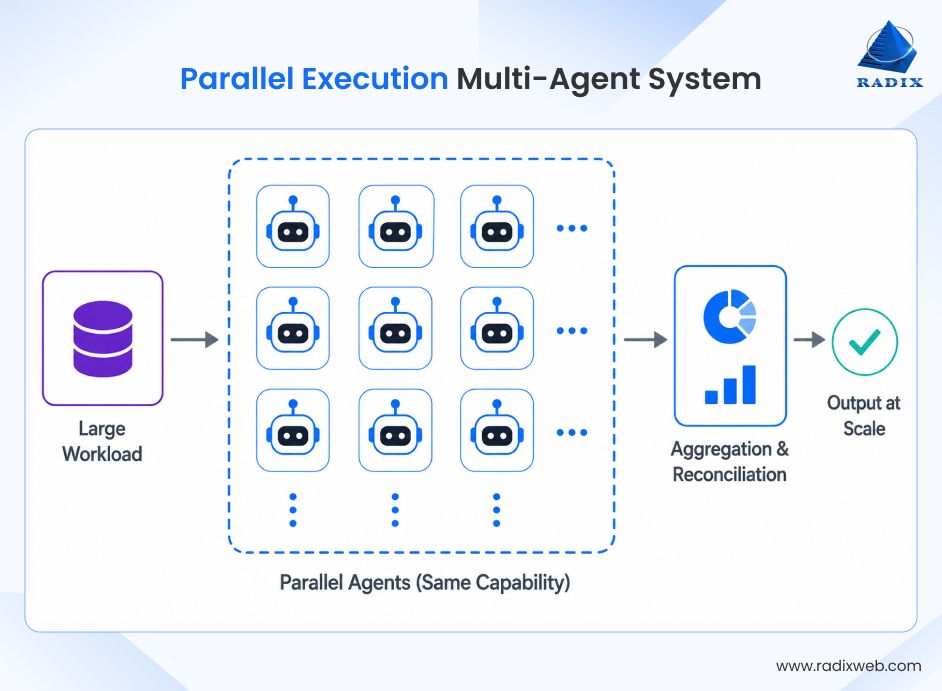
This pattern is commonly used for multi-agent systems for data processing, batch operations, or scenarios where you need to apply the same logic to many items quickly.
In large organizations with multiple business units or geographic regions, you might have semi-autonomous agent networks in each region or department. These federated networks operate independently but coordinate on shared concerns. A North American loan processing network has its agents and governance. A European network has its own. But when cross-border issues emerge or company-wide policies need updating, the federated networks coordinate through higher-level agreements.
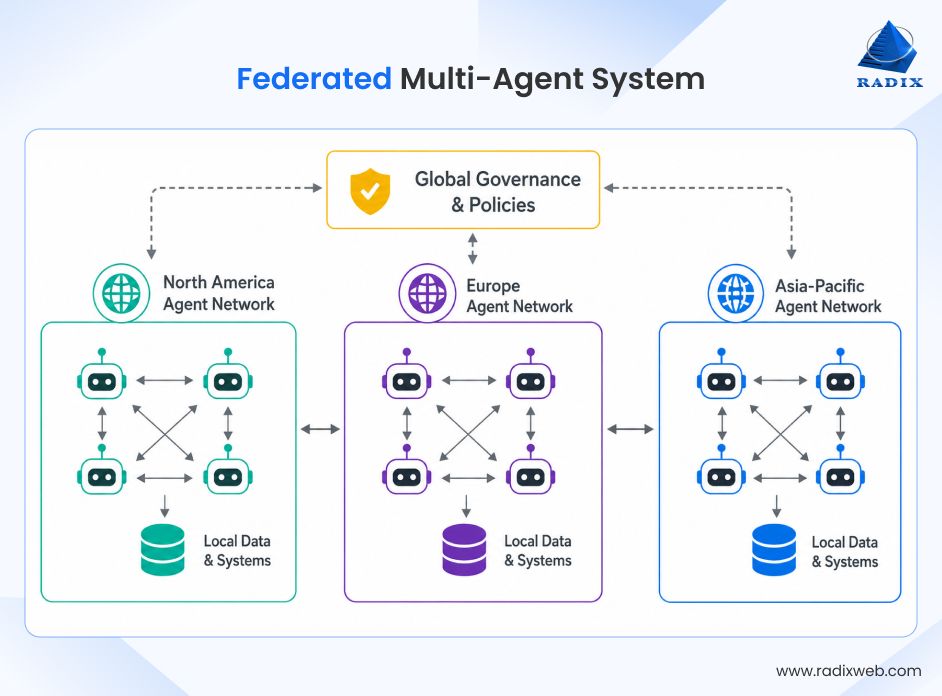
This pattern is essential for enterprises that can't have a single centralized control point.
Here's a quick summary of the different multi-agent architectures you can choose from:
| Pattern | Best For | Complexity | Coordination | Fault Tolerance |
|---|---|---|---|---|
| Hierarchical | Routing, customer support, mixed domain requests | Medium | Centralized orchestrator | Orchestrator is single point of failure |
| Sequential Pipeline | Well-defined workflows with clear stages | Low-Medium | Contract-based handoffs | One agent failure can halt entire pipeline |
| Collaborative | Complex decisions, strategic analysis, research | High | Multi-directional debate and synthesis | Robust — disagreement highlights uncertainty |
| Swarm | High-volume parallel processing, batch operations | Low | Result aggregation and reconciliation | Very robust — loss of one agent is negligible |
| Federated | Large enterprises with regional/departmental autonomy | Very High | Autonomous locally, coordinated globally | Isolated failures, requires governance discipline |
Which pattern you choose shapes how your system behaves, how well it scales, and how it fails. Most mature organizations actually use a hybrid approach with hierarchical routing to direct incoming requests, sequential processing for core workflows, and swarm execution for high-volume batch operations. If you are not sure what combination would work for you, the key is to consult with AI strategists who can help you pick pattern(s) that match your business problem, not the other way around.
There are many challenges that surface after you've deployed AI agents. But when we specifically talk about multi-agent systems, they don't fail because organizations aren't aware of the challenges. It is because even when they see it coming, they underestimate the severity of these challenges. Here's what can (and usually does!) go wrong with multi-agent systems and how we, at Radixweb, prevent it.
Multi-agent systems rely on agents exchanging information correctly. If one agent sends incomplete, inconsistent, or unexpected data, every downstream agent is affected. A single communication error can spread through the workflow. By the time anyone notices something is wrong, the mistake has cascaded through three or four agents, and figuring out which agent actually caused the problem becomes a detective game.
How we avoid it: Before any agent is deployed, we define strict interface contracts for every interaction. We validate every payload automatically and version communication rules so changes never break downstream agents.
An agent may perform well at launch but gradually become less accurate as data, customer behavior, or operating conditions change. Since multiple agents influence the final outcome, declining performance often goes unnoticed until users experience poor results, making the root cause difficult to isolate.
How we avoid it: We benchmark every agent before launch. We monitor its performance independently in production. And we trigger reviews when accuracy, response quality, or escalation rates fall outside acceptable thresholds.
Every agent makes decisions independently. But all of them must follow the same business policies. Without consistent governance, agents may apply rules differently, bypass approvals, or create compliance gaps. These inconsistencies are often discovered only during audits or after costly business mistakes.
How we avoid it: Irrespective of the type or scale of project, we build governance-first, secure artificial intelligence solutions. We enforce shared governance policies across every agent, validate them during testing, and use centralized policy controls so compliance changes are applied consistently across the entire system.
When a multi-agent workflow fails, the final outcome rarely shows where the problem began. Without detailed logs and end-to-end tracing, teams cannot identify which agent made the wrong decision or why. Troubleshooting becomes slow, expensive, and largely based on guesswork.
How we avoid it: We capture every decision, prompt, response, and agent handoff with end-to-end tracing, making it possible to replay complete workflows and pinpoint failures within minutes instead of days
Most system works beautifully when you're processing 100 requests per day. Then business grows and you scale to 10,000 requests daily. Suddenly, agents are timing out waiting for responses from other agents. The coordination overhead becomes real and visible. Costs explode because every single request is now triggering multiple model calls across multiple agents. You didn't anticipate any of this because you never actually load-tested the multi-agent system under realistic volume. Before you know it, performance drops just as business demand grows.
How we avoid it: We simulate production-scale workloads before launch, measure orchestration overhead and model costs, then optimize agent interactions to keep performance predictable as demand grows.
The success of a multi-agent system isn't measured by how many agents it has. It's measured by how reliably those agents work, adapt, and continue delivering value. And even though these systems are complicated, failures are predictable and preventable. All you need is better design, testing, and management after deployment.

The decision to build multi-agent systems shouldn't happen in isolation. It needs to be made against a decision framework that assesses your business problem, technical capabilities, and organizational AI maturity.
So, ask yourself these questions before deciding whether you need an AI agent, multi-agent system or something else:
Not every workflow needs multiple agents. If the work follows one clear objective, a single agent is usually enough. If it spans across business functions, uses different data sources, or requires different expertise at each step, then multiple agents can deliver better results.
Building the system is only the beginning. Running multiple agents means more monitoring, debugging, governance, and maintenance. If your AI ops are still developing, a simpler architecture is often the better choice.
More capability comes with more complexity. Multi-agent systems typically cost 40-60% more to build and 50-100% more to operate. Make sure the expected business value is large enough to justify that investment.
You don't have to build everything at once. A single agent helps you validate the business case with lower cost and risk. As new requirements appear, you can introduce specialized agents where they create real value.
Every additional agent adds another layer to manage. If you operate in a regulated industry or handle sensitive data, design governance from day 1. It becomes much harder to add later.
More agents do not automatically mean better reliability. A well-designed multi-agent system can improve resilience. A poorly designed one creates more points of failure. The architecture matters more than the number of agents.
Based on your answers to these questions, here's how to think about your architectural choice:
| Situation | Recommendation | Why |
|---|---|---|
| Simple, focused workflow with a single objective | Start with a single agent. Add complexity only if needed. | Complexity should be justified, not preemptive |
| Multi-stage workflow with different requirements at each stage | Consider multi-agent. Start with 2-3 agents, add more incrementally. | Specialization delivers clear value at each stage |
| High-volume, complex problem requiring resilience | Multi-agent architecture is probably justified. Plan for operational complexity. | Multi-agent resilience and scalability justify the investment |
| Uncertain workflow or evolving requirements | Start with a single agent. Build multi-agent capability incrementally as you learn. | Architecture can evolve once you understand the problem better |
Here's what we've observed from working with dozens of organizations: The best multi-agent systems rarely start as multi-agent systems. They begin by solving one problem well. Then they grow as new needs emerge. That's usually the safest and smartest path forward.
Once you have assessed your organization's readiness for a multi-agent system, here's how mature organizations approach building them. This is the exact roadmap that we've used to deploy successful multi-agent systems across domains.
Timeline: Week 1-2
Before you write prompts or pick models, define what each agent does and how they communicate. This sounds obvious, but most teams skip it or do it halfway, which is a mistake.
For each agent, document its responsibility, data needs, decisions, success metrics, constraints and outputs. For communication between agents, specify the input format and schema, expected response time, what happens if the agent times out, retry logic, and error handling. Once you write this down make sure all business stakeholders are aligned on it.
Timeline: Weeks 2-3
Define your governance framework now, not after you build agents. Which decisions require human approval? When does an agent escalate? What constraints apply to each agent? What compliance or regulatory requirements must every agent respect? Which stakeholder owns the outcomes of the decisions made by artificial intelligence? Document these as hard rules that will be built into agent instructions. They are not soft guidelines that agents might respect if they feel like it. Also, test governance compliance as rigorously as you test functional accuracy.
Timeline: Weeks 3-4
Plan your logging and monitoring strategy before you build the first agent. What metrics will you track for each agent? How will you trace decisions across agents? What alerts trigger investigation? What dashboards do you need? Design this as part of your system architecture, not as a retrofit because structured logging, consistent schemas, and traceability are not optional, but foundational.
Timeline: Weeks 4-8
Start with the agent that has the most clearly defined responsibility. Build it to the specifications you defined, tune it and test it against your golden dataset. Get its accuracy metrics to the level you need. Establish baseline performance. Only then move to the next agent.
Timeline: Weeks 8-12
Now build your second agent. Test it in isolation to the same level of rigor as the first agent. Then test the coordination between them. Does Agent A's output match Agent B's expected input format? Do they communicate within the expected timeframes? What happens when Agent A is slow or returns unexpected data? Test failure scenarios. Load-test the two-agent system to understand communication overhead and bottlenecks. Only when coordination is solid, add the next agent.
Timeline: Weeks 12-16
Once you have multiple agents working together, test the entire system. Run scenarios where one agent fails. Test under load. Verify that observability captures everything you need. Test edge cases and failure modes. Measure end-to-end latency and cost. Identify bottlenecks. Optimize before scaling.
Timeline: Weeks 16-20+
Don't flip a switch and expose your multi-agent system to production at full volume. Start with a small percentage of traffic. Monitor closely and gradually increase. As you see real-world behavior, optimize individual agents and system coordination. This is not a time-bound phase in an agentic system's lifecycle that comes with an end date. Continuous improvement is the steady state for multi-agent systems.
This timeline is for a well-scoped multi-agent system with 2-4 agents. More agents, more complex coordination, or stricter compliance requirements will extend the timeline proportionally. The principle remains the same though. Define, build iteratively, test at each stage, and roll out carefully.
Getting Started with Enterprise Multi-Agent AI Systems
Multi-agent systems represent a significant shift in how enterprises deploy AI. The technology has matured and business cases are proven. Organizations implementing and optimizing multi-agent AI systems are building a real competitive advantage. But these systems also introduce complexity that demands discipline and thoughtfulness. That means success doesn't depend on advanced tech or big budgets. It depends on the building discipline and operational maturity.At Radixweb, we've architected, built, and deployed multi-agent systems for organizations across niches. And we don't just hand off a system at deployment. We also provide ongoing multi-agent system monitoring and optimization. That's how we ensure multi-agent systems keep delivering business value over time. We've seen what works in practice, what doesn't, and where the actual ROI comes from. So, if you're evaluating multi-agent systems, schedule a conversation with our AI architects and get a roadmap that matches your organization's AI maturity levels.
Ready to brush up on something new? We've got more to read right this way.