Read More


Recognized for AI Excellence at 2026 Globee® Awards - Read More

Vinit Kariatukaran
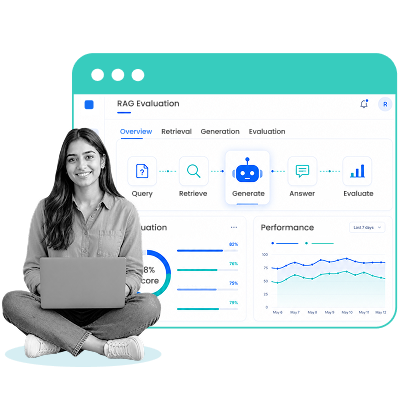
Retrieval-Augmented Generation (RAG) has become the standard architecture for enterprise AI. The market, projected to expand to USD 9.86 billion by 2030, is showing clear signs of adoption and growth. That's primarily because RAG improves the factual accuracy of LLMs, by up to 74% as per some studies.
However, production deployments often reveal a different reality. Challenges such as retrieval failures, stale knowledge, and prompt injection show up, even when benchmark scores were flawless.
The gap between benchmark success and production reliability isn't a failure of RAG itself. It's a failure of evaluation strategy. Organizations invest heavily in generative AI systems with strong benchmarks. They launch systems that look perfect on paper. But later they discover that benchmarks measure one thing, while production reliability measures something else entirely.
This disconnect isn't new to AI, but RAG systems have made it acute. In this blog, we explain what RAG benchmarks don't tell you and how to build RAG systems that perform in production.
Benchmarks measure isolated retrieval performance in controlled conditions. They don't evaluate reasoning quality across documents, knowledge freshness, edge case handling, latency under production load, or semantic drift over time. Production-grade RAG requires a separate evaluation framework that measures what actually matters, which is whether users receive accurate, timely, trustworthy answers at scale.
| Aspect | Details |
|---|---|
| What This Guide Covers ? | RAG fundamentals, benchmark metrics, why benchmarks fail to predict production success, common production challenges, practical evaluation frameworks |
| Who Should Read This Guide ? | CTOs, Engineering Leaders, Enterprise Architects, AI Product Managers, Technical Decision-Makers, teams planning or deploying enterprise RAG applications beyond proof-of-concept into production |

Before discussing what benchmarks miss, it's important to understand what they are designed to measure.
Retrieval-Augmented Generation (RAG) is an AI architecture where a language model retrieves relevant documents from a knowledge base and uses them to generate context-aware responses. Instead of relying solely on the model's training data, RAG supplements the model with external information, making it capable of answering questions about proprietary data, recent events, or domain-specific knowledge.
Also Read: How RAG Differs from Fine Tuning
A RAG benchmark consists of a curated collection of documents, queries, and expected answers or relevant passages. They provide a standardized way to compare retrieval models and measure improvements during development. While they differ in domain and task complexity, they all answer the same fundamental question: Can the system retrieve the right information for a given query?
When building large language models for enterprise-grade use, RAG benchmarking matters because it allows teams to compare different retrievers, tune vector databases, optimize embedding models, and measure improvement over time.
Let's explore some popular benchmarks and what they measure.
Here are five of the most widely adopted benchmarks used by enterprise teams to evaluate RAG systems.
BEIR is one of the most comprehensive retrieval benchmarks available today. Rather than focusing on a single dataset, it combines 18 different information retrieval tasks covering domains such as scientific literature, news articles, finance, and question answering.
This diversity makes it particularly valuable for evaluating whether a retriever generalizes well across different types of enterprise data instead of being tuned to one specific use case.
MS MARCO is built from millions of anonymized Bing search queries paired with human-labeled passages. Because the queries resemble real user searches, it has become one of the most widely used benchmarks for dense retrieval models.
Teams commonly use it to compare embedding models, rerankers, and vector search techniques before deploying them in production search or RAG applications.
Natural Questions is based on genuine Google Search queries and evaluates whether a retrieval system can locate documents containing factual answers.
Unlike synthetic benchmark datasets, its questions reflect how people naturally search for information, making it useful for evaluating open-domain question-answering systems and enterprise knowledge assistants.
Unlike traditional retrieval benchmarks that focus on finding a single relevant document, HotpotQA evaluates multi-hop retrieval and reasoning. Many questions require combining evidence from multiple documents before an answer can be generated.
As a result, it provides a better indication of how well a RAG system supports knowledge synthesis rather than simple document retrieval.
Many enterprise AI teams eventually move beyond public benchmarks and evaluate their systems using industry-specific datasets such as FinanceBench, LegalBench, or internally curated benchmark collections.
These benchmarks contain domain terminology, regulatory content, and specialized knowledge that more closely resemble real enterprise workloads. While they provide better signals for a particular industry, they still operate within controlled evaluation environments.
Now let's see what evaluation metrics these benchmarks use to assess RAG system performance.
Although the benchmarks differ in their datasets and objectives, they rely on a common set of evaluation metrics to measure performance. These metrics generally fall into three categories, each evaluating a different stage of the RAG pipeline.
Retrieval metrics evaluate whether the search component finds the right documents before the language model begins generating a response.
Together, these metrics help teams optimize embedding models, vector databases, and retrieval pipelines.
Once documents have been retrieved, generation metrics evaluate the quality of the answer produced by the language model.
These metrics help determine whether the model is making effective use of the retrieved documents rather than simply generating plausible text.
Modern RAG evaluation increasingly measures the entire pipeline instead of retrieval and generation separately.
These metrics provide a more holistic view of RAG performance by evaluating how well retrieval and generation work together instead of treating them as isolated components.
Here's the reality though: Even together, these benchmarks and evaluation metrics are designed primarily for controlled development environments. They measure performance against static datasets with known answers. This makes them excellent for comparing retrievers, tuning embedding models, and validating improvements during development.
Production environments, however, introduce challenges that benchmark datasets were never designed to capture. That's why a RAG system with excellent benchmark scores can still struggle after deployment.

Enterprise RAG applications operate in dynamic environments where data changes, users behave unpredictably, and business requirements evolve. These conditions introduce failure modes that benchmark datasets aren't designed to capture. Production teams therefore need to evaluate far more than retrieval accuracy. Here are some of the most important aspects traditional RAG benchmarks overlook.
Benchmarks measure whether the retriever finds the right documents. They do not measure whether the model can correctly combine information from those documents. In production, answers often depend on comparing multiple sources, resolving conflicting information, and giving more weight to the latest or most reliable document. Even when retrieval is accurate, weak reasoning can produce incomplete or misleading answers. All because the model failed to use the retrieved context as intended.
Most RAG benchmarks use a fixed dataset that never changes. Real knowledge bases are different. New documents are added. Old ones are updated. Business rules or regulations change over time. Traditional benchmarks don't measure whether the retrieved information is accurate or relevant now. A system may continue achieving excellent retrieval scores while returning outdated guidance. But knowledge freshness is just as important as retrieval quality.
Benchmark datasets usually contain clear questions with known answers. Real users rarely behave that way. They ask vague questions, mix multiple topics, or request information that does not exist in the knowledge base. Traditional benchmarks do not evaluate how well a RAG system handles uncertainty. In production, the system should recognize missing evidence, ask follow-up questions when needed, or state that it cannot answer instead of making confident guesses.
Benchmark latency is usually measured in controlled environments with a few requests. In production, hundreds of users may send queries at the same time. Also, vector databases, APIs, and language models compete for computing resources. Traditional benchmarks do not show how response times change under heavy traffic. A production-ready RAG system should maintain predictable performance and remain responsive even as demand increases.
Language does not stay the same. New products, technologies, regulations, and business terms appear regularly. This changes how people ask questions. Users may also adopt different phrases to describe familiar problems. Because benchmark datasets are static, they cannot measure whether the retrieval system still understands current language. Over time, this semantic drift can reduce retrieval quality. Even when benchmark scores remain the same. This makes continuous evaluation essential for long-term reliability.
Retrieving relevant documents does not guarantee a correct answer. The language model must also interpret those documents accurately and avoid adding unsupported information. It may combine unrelated facts, overlook important details, or generate claims that are not backed by the retrieved evidence. Traditional retrieval benchmarks rarely detect these failures. Mainly because they focus on document selection, not answer faithfulness. Production evaluation should, however, verify that claims are grounded in the retrieved sources.
Traditional benchmarks are an important starting point, but they show only part of the picture. To build a RAG system that users can trust, teams need a broader evaluation strategy that measures real-world performance, reliability, and answer quality.
At Radixweb, evaluating a RAG system doesn't end with retrieval metrics. We test how it behaves with changing data, ambiguous queries, production traffic, and evolving business knowledge. The goal is simple: ensure the system delivers accurate, trustworthy, and consistent answers long after it moves from proof of concept to production.
We recently developed a RAG-powered legacy document search software that performed not just in pilots, but production too. Handing 500+ concurrent queries, it helped our client cut infrastructure cost by 40%. Here's the evaluation framework we followed for this and many other RAG-powered projects:
Benchmark questions are typically clean, well-formed, and aligned with the knowledge base. Production questions are much messier. That's why we build a golden dataset of 100-200 real queries based on how users actually interact with the system. This includes ambiguous questions, edge cases, and queries that fall outside the knowledge base. We evaluate the system against this dataset before launch and continue testing against it regularly in production too.
A golden dataset typically includes:
Our evaluation goes beyond checking whether the right documents were retrieved. We assess whether the final answer is correct, complete, and fully grounded in the retrieved documents. Human reviewers score every response on a 1-5 scale, where 1 means completely wrong, 2 mostly wrong, 3 partially correct, 4 correct but incomplete, and 5 a complete answer supported by the retrieved evidence.
A RAG system is only as reliable as the knowledge it retrieves. That's why we establish a refresh cadence based on how quickly information changes in each domain and continuously monitor the health of the knowledge base.
We track metrics such as:
The refresh cycle depends on your specific artificial intelligence use case. Compliance systems often require monthly updates. Customer support knowledge bases may need weekly refreshes. And product documentation can change daily. By making knowledge freshness an ongoing operational process instead of a one-time task, we reduce the risk of outdated information reaching users.
Finding the right documents is only the first step. We also evaluate whether the model understands those documents and combines them correctly to produce accurate answers.
Our evaluation measures:
Human reviewers compare every generated answer with the retrieved documents. A perfect response uses all relevant evidence correctly. Lower scores indicate missed context, incorrect synthesis, or unsupported conclusions. This helps us evaluate reasoning quality, not just retrieval quality.
We don't test RAG systems with evenly distributed queries. That's because production traffic rarely behaves that way. Instead, we simulate realistic burst patterns, varied query complexity, and concurrent user loads. This helps us understand how the system performs under real operating conditions.
Our testing includes:
We document the breaking points and identify the concurrency level at which latency increases from 200ms to 500ms to 2 seconds. We also measure when the system starts timing out or returning empty results. Based on these findings, we implement circuit breakers and graceful degradation. For example, if vector search exceeds one second, we fall back to keyword search. If latency crosses a defined threshold, we return cached results instead.
Language, products, and user behavior continue to evolve after deployment. To keep retrieval quality high, our evaluation framework includes ongoing monitoring for semantic drift.
We regularly track:
When we see a consistent decline over two or three months, we investigate the cause. Depending on the findings, we may re-embed documents using a newer embedding model, refresh the knowledge base, or update the retrieval pipeline. This makes semantic drift a planned maintenance activity, not an unexpected production issue.
We build explicit out-of-scope detection into the RAG architecture so the system knows when it should not generate an answer. This reduces hallucinations and improves user trust.
Our evaluation includes:
We also define what "out of scope" means for each business domain. For customer support, it may mean there is no documentation for a requested feature. For compliance, it may mean there is no official guidance on regulation. Making these boundaries explicitly helps the system respond honestly instead of guessing.
Our evaluation framework also measures business outcomes, not just technical metrics. A RAG system should improve productivity and user experience, not simply achieve high benchmark scores.
We track metrics such as:
These metrics show whether the system is creating real business value. A system with 95% accuracy but a 40% escalation rate may not save users much time. On the other hand, a system with slightly lower accuracy but fewer escalations delivers a better user experience and stronger operational outcomes.
Deploy RAG with Production Confidence
Benchmark scores tell you whether your retriever works in isolation. Production metrics tell you whether your system works for users. The gap between these is where most RAG systems fail. Successfully deployed, enterprise-grade AI solutions thus start with a clear evaluation framework that goes beyond benchmarks. They evaluate not just retrieval quality, but reasoning, knowledge freshness, resilience, and long-term operational performance too.At Radixweb, we've 26+ years of software engineering experience and have helped enterprises across industries design, build, and validate production-grade RAG systems that perform reliably beyond the proof-of-concept stage. From retrieval architecture and evaluation frameworks to knowledge management, monitoring, and optimization, our AI engineering teams help organizations deploy RAG solutions with confidence. Schedule a consultation with our artificial intelligence experts to discuss your use case and build a production-ready RAG system today.
Ready to brush up on something new? We've got more to read right this way.