Read More


Recognized for AI Excellence at 2026 Globee® Awards - Read More

Maitray Gadhavi

Why You Should Read This Article: This article helps you move beyond a generic understanding of generative AI and into practical decision-making. It breaks down how development services actually work, what it costs, and how to choose the right approach, so you can evaluate, plan, and execute AI initiatives with clarity and well-predicted business outcomes.
Article Highlights
● Gen AI services build integrated systems, not just model usage● Structured lifecycle ensures successful deployment and continuous optimization● Model choice depends on cost, speed, control, scalability trade-offs● Real value comes from embedding AI into business workflows● Use cases span copilots, automation, and industry-specific applications● Strong tech stack ensures accuracy, performance, and scalability● Costs driven by complexity, infrastructure, and ongoing model usage● Partner selection should focus on execution capability, not demos● Data readiness and process clarity determine scalability success● Continuous monitoring and optimization are critical for long-term performance
Generative AI development services are used by enterprises to build custom AI solutions like intelligent copilots, content generators, and decision agents that work with raw data and deliver automation-focused business value like cost savings, time reduction, or revenue impact.
There is a sustained surge in demand for these services. As per recent industry benchmarks:
For Fortune 1000 CTOs, custom LLM orchestration has become as indispensable today as cloud migration was a decade ago. Generating as much as 4x ROI through agentic workflows that autonomously handle Tier-2 knowledge work is now a no-brainer.
Generative AI development services build production-grade AI systems like RAG pipelines over enterprise data, tool-using agents integrated with SAP/CRM/ERP, fine-tuned domain models - all secured for AI Act compliance and hallucination rates under 0.5%.
For enterprise leaders under pressure to deliver Q3 pilots amid 200% model cost inflation, this guide gives you the vendor-proof framework, maturity benchmarks, and red-flag checklist to deploy at scale - or get left behind.
Generative AI development services are end-to-end solutions for designing, building, integrating, and optimizing AI systems. In addition to using AI tools, these services include building custom applications, connecting APIs, orchestrating models and data, and embedding automation into enterprise processes.
Using Gen AI tools vs. building Gen AI systems
The second approach is what makes Gen AI scalable, governable, and measurable inside an organization.
Why this is important - AI tools help individuals work faster, but AI systems help organizations change how work gets done. Custom Gen AI services are for enterprises looking for experimenting and deploying enterprise-grade automation.
These services include a sequence of tightly connected stages, from ideation to development, monitoring, and optimization. Here’s what Generative AI development lifecycle looks like:
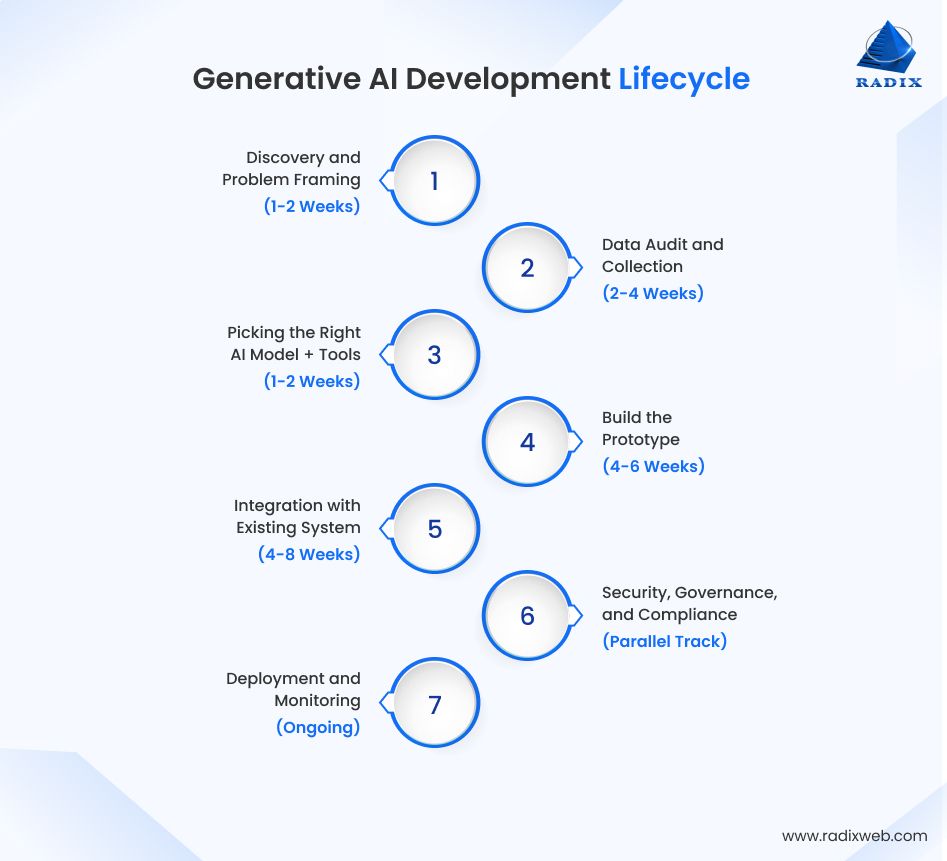
The generative AI development process starts with workshops to pinpoint the implementation areas as in where AI can save time or money. For example:
By the end, you have clear goals and numbers to hit like reducing review time by 70%.
Your company already has goldmines of data like customer emails, support tickets, product docs, and sales records. A generative AI development company structures, cleans, and segments data for retrieval or fine-tuning. For enterprise generative AI use cases, this stage also includes access control and data sensitivity checks.
Choose the generative AI model development approach based on trade-offs between speed, control, and cost. API-based models are suitable for rapid deployment, but if your priority is data control or domain specificity, go for open-source or custom models.
Using a slice of production data, you build an end-to-end prototype, a working version for employees to test it with real enterprise workflows - "Does this actually save me 2 hours a day?" Gen AI specialists tweak until it's 85%+ accurate and validated against KPIs with 500-2K production-like queries.
Integrate the AI system into existing enterprise apps using APIs, backend services, or UIs - Salesforce for customer insights, ServiceNow for ticket auto-resolution, SAP for inventory what-ifs. To stabilize the system in production environments. Gen AI developers work on setting up workflows, access layers, and fallback mechanisms.
RBAC controls who accesses what, audit logs track every query, and NER models redact PII automatically. For EU clients, full AI Act compliance is needed. Bias audits should have <5% disparity, along with transparency reports and human oversight workflows. SOC2/ISO paths have to be included.
Track system performance post-deployment using logs, user feedback, and automated evaluation pipelines. Introduce improvements through prompt refinement, retrieval tuning, or selective fine-tuning. Mature teams implement LLMOps practices for versioning and governance.
Generative AI development services fall into three categories: API-based (fastest, lowest control), fine-tuned models (domain-specific performance), and custom model development (total control, highest investment).
This approach connects your apps directly to foundation models like GPT-4o, Claude 3.5, or Gemini via APIs.
Perfect for: Enterprise-grade conversational AI chatbot, customer support assistants, content generators, and internal productivity tools.
Why choose it:
The trade-offs:
Take a foundation model (Llama 3.1, Mistral Large) and train it on your specific data.
Perfect for: Domain-specific needs like legal contract analysis, medical report summarization, and financial statement extraction.
The sweet spot:
Reality check:
A fully controlled approach where the Gen AI development company trains or heavily modifies models using proprietary data.
When it makes sense:
The reality:
Which Approach Should You Choose? (Your Decision Framework)
Start with APIs for proof of concepts (PoCs) and non-sensitive use cases. Move to fine-tuning when domain accuracy matters, but time/cost constraints exist. Design and build a custom Gen AI system only for regulated industries or proprietary advantages. Most enterprises run hybrid - 70% API/fine-tuned, 30% custom.
| Criteria | API-Based | Fine-Tuned | Custom Model |
|---|---|---|---|
| Time-to-Market | 2-4 weeks | 8-12 weeks | 6-12 months |
| Upfront Cost | $25K-$75K | $100K-$300K | $500K-$2M |
| Per-Query Cost | $0.01-$0.10 | $0.001-$0.01 | $0.0005-$0.005 |
| Control | Low | Medium | Complete |
| Scalability | High (vendor) | High (your infra) | Highest |
| Customization | Templates | Domain-specific | Unlimited |
| Best for | Chatbots, content | Industry verticals | Regulated, proprietary |
Pro tip: 85% of successful Gen AI programs start with API POCs, then selectively migrate high-value use cases to fine-tuning or custom as ROI proves out. Don't over-engineer day one.
Gen AI services deliver measurable ROI by automating repetitive tasks, personalizing customer experiences, and embedding intelligent decision-making in enterprise operations. The benefits below reflect measurable business outcomes observed across production deployments.
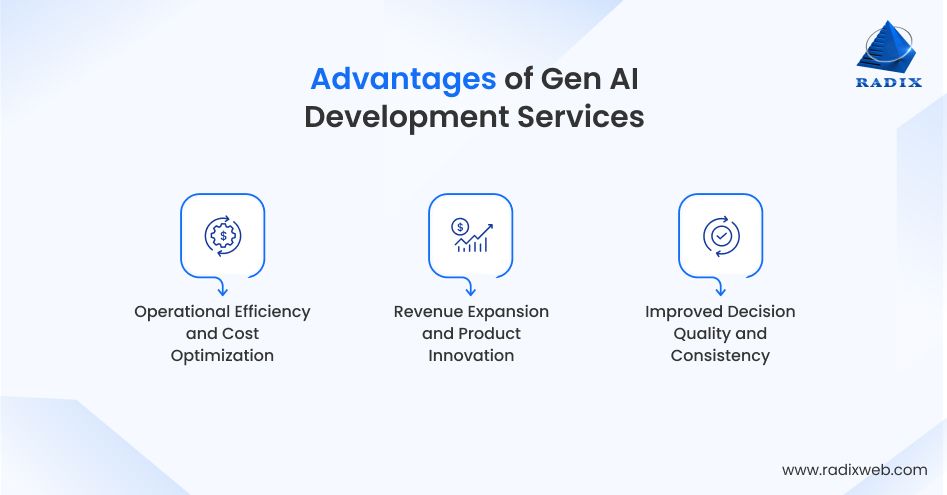
Generative AI reduces dependency on manual, repetitive knowledge work by automating tasks such as ticket resolution, document processing, and internal query handling. Organizations typically report 20-50% productivity improvements, along with faster turnaround times for support, operations, and back-office functions. Cost savings compound as usage scales.
By enabling hyper-personalization and real-time content generation, generative AI supports new revenue streams. Businesses can launch AI-powered features such as intelligent copilots, recommendation engines, and automated sales assistants. It also shortens the prototype-to-production cycle of custom AI software.
Generative AI systems standardize outputs for multiple teams. It reduces variability caused by human interpretation, which leads to more consistent decision-making in areas such as reporting, analysis, and customer interactions. Over time, this consistency improves overall service quality and operational predictability.
Additional High-Impact Benefits :
Generative AI delivers the strongest outcomes when aligned to specific workflows rather than broad experimentation. The examples below reflect how organizations are embedding gen AI use cases into day-to-day operations to improve speed, accuracy, and scalability.
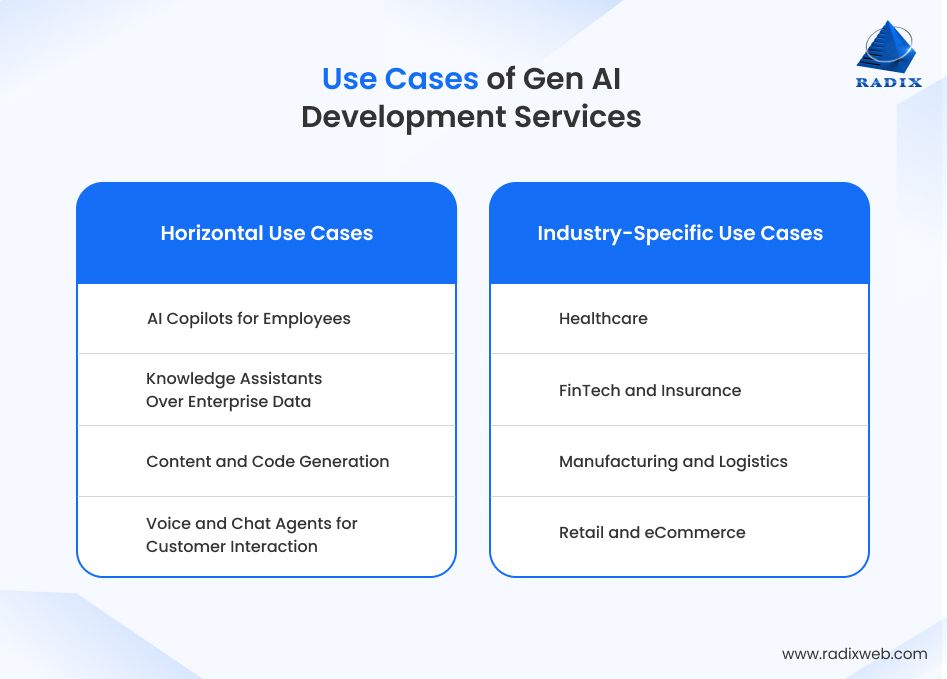
These use cases apply across industries and functions, forming the foundation of most generative AI deployments.
Healthcare
Outcome: Faster patient handling, reduced documentation effort, improved care coordination
FinTech and Insurance
Outcome: Reduced processing time, improved generative AI compliance and governance, lower operational risk
Manufacturing and Logistics
Outcome: Reduced downtime, improved operational planning, and better resource utilization
Retail and eCommerce
Outcome: Faster catalog expansion, improved conversion rates, enhanced customer engagement
Custom Generative AI solutions are built on a layered technology stack that combines programming frameworks, large language models, data retrieval systems, orchestration layers, and cloud infrastructure. Each component works together to process inputs, retrieve relevant context, generate outputs, and deliver responses within business applications.
| Layer | Tools / Technologies | Role in the System |
|---|---|---|
| Programming Language | Python | Core language for building AI pipelines, APIs, and data processing workflows |
| Model Frameworks | PyTorch, TensorFlow | Used for training, fine-tuning, and running open-source models |
| LLM APIs / Models | GPT (API), LLaMA, Mistral | Generate outputs (text, code, insights) based on prompts and context |
| Vector Databases | Pinecone, Weaviate | Store embeddings for semantic search and enable Retrieval-Augmented Generation |
| Orchestration Layer | LangChain, custom pipelines | Manage prompts, workflows, tool usage, and context handling |
| Cloud Infrastructure | AWS, Azure, GCP | Provide compute, storage, scaling, and deployment environments |
| Monitoring & Logging | Custom dashboards, observability tools | Track performance, accuracy, latency, and system reliability |
The cost to hire development services to build Gen AI solutions ranges from $20K-$60K for basic pilots to $400K-$1M+ for enterprise rollouts, depending on scope, model choice, data complexity, and integrations. Most mid-sized apps land at $60K-$250K with 3-6 month timelines.
| Solution Type | Typical Cost Range | Timeline | Scope |
|---|---|---|---|
| MVP / Proof of Concept | $25,000 – $60,000 | 4–8 weeks | Basic chatbot, limited data integration, API-based model |
| Mid-Scale Solution | $60,000 – $150,000 | 2–4 months | RAG-based system, multiple workflows, moderate integrations |
| Enterprise-Grade Implementation | $150,000 – $300,000+ | 3–6+ months | Custom workflows, fine-tuning, compliance layers, full integrations |
| Cost Component | What It Includes |
|---|---|
| Development Effort | Engineering time for architecture, integration, orchestration, and testing |
| API / Token Usage | Ongoing cost based on the number of requests and tokens processed by LLMs |
| Infrastructure | Cloud compute, storage, vector databases, and hosting environments |
| Maintenance | Monitoring, updates, prompt optimization, and model improvements |
Outcome: 40–60% ticket deflection
Outcome: End-to-end workflow automation, measurable cost reduction across departments

85% of Generative AI software project development projects fail to scale past POC. Your vendor choice determines if you join the 15% succeeding at enterprise scale. Here's your evaluation framework.
End-to-End Lifecycle Ownership: They must own from discovery through Year 2 monitoring. Ask for 3+ reference clients running production for 12+ months.
RAG + Agentic AI Experience: Request the vendor to show live RAG pipelines handling 10K+ docs with <2% hallucination and demo tool-using agents (API calls, calculators, databases).
Security, Compliance, Data Residency: Companies known for advanced AI development capabilities are SOC2 Type II audited and have AI Act Article 13 transparency reporting, multi-region data residency (EU, US, APAC), and PII redaction at 99.9% accuracy.
Domain Expertise (Your Industry): 5+ case studies should be presented in your vertical. They must understand your acronyms, workflows, and KPIs. Bonus if they have existing connectors for your CRM/ERP/SaaS stack.
Example of a great answer: Multi-layer (grounding scores, source citation verification, human eval loops). <1% rate at 1M queries/month. Tools: LangSmith + custom evals.
Example of a great answer: Automated lineage tracking, bias audits (<3% gaps), Article 13 reporting, human oversight workflows. Pre-built compliance frameworks.
Example of a great answer: SLA-backed: 99.9% uptime, <3s p95 latency, <0.8% hallucination, $X cost/query. Quarterly business outcome reviews (tickets deflected, etc.).
Bonus: "Walk me through a production failure you had and fixed."
Strategic move: Shortlist 3 vendors. Run parallel POCs on the same dataset. The winner takes production. It will save you 6 months of pain.
Most enterprises sit at "Experimenting" (Level 1). This framework shows your true position and clear next steps to move from AI prototype to production-ready solutions and amplify ROI from custom gen AI development solutions.
1Data Quality & Readiness (40% of Success)
Red flag: "Our data is in SharePoint silos" = 6-month delay.
Process Clarity & Measurability (30%)
Red flag: "We know AI will help" = no ROI path.
Talent and Change Management (30%)
Red flag: "IT will figure it out" = 18-month stall.
Quick Score:
| Level | Indicators | Risks | Priorities |
|---|---|---|---|
| Experimenting | ChatGPT tabs open everywhere | 90% projects stall | Pick 1 use case, baseline KPIs |
| Piloting | 1-2 POCs running | Scope creep kills budget | $50K POC proving 3x ROI |
| Scaling | 3-5 production apps | Cost explosion, drift | MLOps team, governance |
| AI-Native | 20%+ knowledge work autonomous | Talent wars | AI-first operating model |
Months 1-3: Quick Wins (3x ROI Proven)
Budget: $60K-$150K total. Team: 3-4 engineers + 1 PM.
Months 4-6: Scale Winners
Budget: $150K-$300K. Key hire: MLOps engineer.
Months 7-12: Enterprise Platform
Budget: $400K-$800K. ROI: 15-25% knowledge worker productivity.
Governance Must-Haves (Start Day 1):
Your fastest path: Pick the function processing the highest volume of repetitive queries/documents. Pilot there first. Success compounds across the organization.
Our approach to generative AI product development has been shaped by a long-standing engagement with artificial intelligence well before the current surge in large language models. We have worked through earlier phases of AI adoption in data-heavy environments.
As generative AI matured, we invested deliberately in upskilling our teams across prompt engineering, retrieval-based gen AI system architectures, model evaluation frameworks, and LLMOps practices. Today, we're all-in on Gen AI with a 30+ strong AI/ML team that's upskilled aggressively since ChatGPT's launch.
Our engineers are certified in LangChain, LlamaIndex, and RAG architectures. PMs are trained on AI Act compliance and MLOps best practices, and domain consultants bridge underwriting workflows with agentic AI.
We begin by identifying high-impact use cases, mapping workflows, and defining success metrics. This includes feasibility analysis, ROI estimation, and selecting the right approach (API, RAG, or custom models). Typical duration ranges from 1 to 3 weeks.
Focused implementation of 1–2 use cases to validate performance, accuracy, and cost assumptions. This phase includes rapid prototyping, evaluation frameworks, and integration with limited datasets or systems. Most pilots are delivered within 4–8 weeks.
For organizations moving beyond pilots, we establish scalable architectures, integrate AI across multiple workflows, and implement governance, monitoring, and optimization frameworks. This includes LLMOps, cost control strategies, and continuous improvement cycles.
We’ve been working on a mix of generative AI software development projects over the past few years. Some were focused on automating everyday workflows, others on building entirely new AI-driven capabilities. While each engagement had its own context, a few stood out for the kind of impact they delivered. Here are some of those examples.
AI Meeting Intelligence Platform Integrated with Meta Llama and Hosted on AWS
Impact:
AI Language Learning Platform Built with Langchain and OpenAI APIs
Impact:
GPT-Powered Recruitment Automation (ATS + CRM Integration)
Impact:
Next Steps: Make Gen AI Work for Your Business
If you've made it this far, you understand Gen AI's potential and the pitfalls to avoid. Now comes the critical part of execution – how you strategize, design, and create generative AI systems. Here's exactly what to do next, based on where you sit in your decision journey:For Leaders Just Starting Their Gen AI JourneyTake 15 minutes this week to audit your highest-volume knowledge process. Look at your support ticket backlog, contract review cycle, or sales enablement materials. Calculate the fully-loaded cost per hour, and then imagine automating 60% of that volume.Your immediate next step is to schedule a free 15-minute process audit with our team. We'll analyze your workflow and identify your fastest ROI opportunity.For Teams Evaluating OptionsYou're ready for proof this works in your specific environment. Book our gen AI use case workshop - a focused 60-minute session with your operations leads and our AI architects. We'll establish baseline KPIs and build a custom ROI projection using your data. We do them virtual or onsite.For Decision-Makers Ready to DeployIf you need a partner who executes, not theorizes, schedule a 30-minute strategy session with our Head of AI Delivery. We'll scope your pilot end-to-end (budget, timeline, deliverables) and commit to hitting your KPIs or we iterate at no extra cost. Our pilots ship in 6-8 weeks with production APIs and monitoring.The operational truth: While you deliberate, competitors are automating 40% of knowledge work. The gap widens monthly. Your most profitable move starts with one conversation. Let's make it happen.
Ready to brush up on something new? We've got more to read right this way.