Read More


Recognized for AI Excellence at 2026 Globee® Awards - Read More

Dhaval Dave

What This Article Covers: This article explains Generative AI from an enterprise perspective, focusing on how it delivers practical business value beyond experimentation. It clarifies what Gen AI systems are, how they function in real operations, where they fit within existing technology stacks, and what leaders should realistically expect in terms of use cases and outcomes.
Editor's Note: If you are looking for a beginner’s overview, this article will feel redundant. It is written for readers who already know the term and want to understand how Generative AI works within a product or organization.
Generative AI is a subset of Machine Learning that creates original content (texts, code, visuals, audio, and interactive elements) from patterns learned from massive datasets using transformer neural networks.
While it’s used as a standalone model responding to prompts in isolation, Gen AI now functions as a system where multiple layers work together around the model. Production Gen AI delivers business value through orchestrated LLMs, enterprise data retrieval, and validation systems, not single models.

Generative AI is a familiar territory now. Most leaders reading this already know how it works at a conceptual level or have explored it in some form. The literacy gap closed in 2024. The open question for many organizations is how it works once it is placed inside production software and exposed to real constraints.
In practice, Gen AI is operated by everything around the model. How context is assembled, what information the system is allowed to reference, how outputs are constrained, and how failures are handled all matter as much as the model itself. Most fail because executives don’t understand the full system complexity.
Our article approaches explaining Generative AI from that operational perspective. Instead of reintroducing the concept, we explain what modern Gen AI systems mean, how they function end to end, where they tend to fail, and why many implementations stall after early success.
Gen AI operates as a 12-18 component system in production environments. It includes GPU clusters for inference and fine-tuning, agent orchestrators for multi-step reasoning, RAG pipelines to ground outputs in enterprise data, and observability stacks that track latency, cost, drift, and response quality.
For business leaders, Generative AI delivers value not because a model can generate text, code, or images, but because the surrounding system makes those outputs accurate, auditable, secure, and operational at scale. The real differentiation comes from how well you design, integrate, and run the system over time.
Direct model invocation works well in controlled environments. where inputs are simple, stakes are low, and no one tracks latency, cost, misuse, or data lineage. This is why many pilots are impressive in demos but collapse in production. The surface area is small, and the system has very little to account for beyond producing a response.
At production scale, you must handle noisy, ambiguous inputs, secure data, enforce policies, and keep responses consistent across thousands of users and Generative AI use cases. Without those controls, systems become fragile, expensive, and untrustworthy for enterprise workloads. Toy-to-production gaps persist as the #1 reason 95% of Gen AI pilots fail.
GenAI should be understood as a coordinated system where the model is responsible for content generation, but it is supported by layers that shape what the model sees, how it responds, and how its output is handled afterward. The foundation model itself, in most deployments, accounts for roughly 8% of the overall cost and complexity.
Context comes from retrieval layers and data pipelines. Uncertainty is handled through guardrails, validation, and human-in-the-loop reviews. And accountability depends on observability, audit logs, access control, and governance. Together, these components manage uncertainty and enforce accountability.
When Generative AI is understood with system-level thinking, it becomes less mysterious and more manageable. This fundamental shift from consumer curiosity to enterprise infrastructure makes Gen AI just not a model choice but like ERP or any other critical enterprise system implementations.
Consumer Gen AI vs. Production Gen AI
| Factor | Consumer Gen AI (2023) | Production Gen AI (2026) |
|---|---|---|
| Cost | ~$500/month | ~$3M/year |
| Team | 1 prompt engineer | 3-5 MLOps engineers |
| Timeline | 2 weeks | 6-18 months |
| Output | Blog posts | Revenue systems |
| Risk | None | Career defining |
Generative AI processes user requests through a 5-step pipeline that includes problem framing, contextual grounding, controlled generation, post-generation control, and feedback logging. This system orchestration (not model choice) delivers reliable enterprise outcomes and manages cost, risk, and compliance.
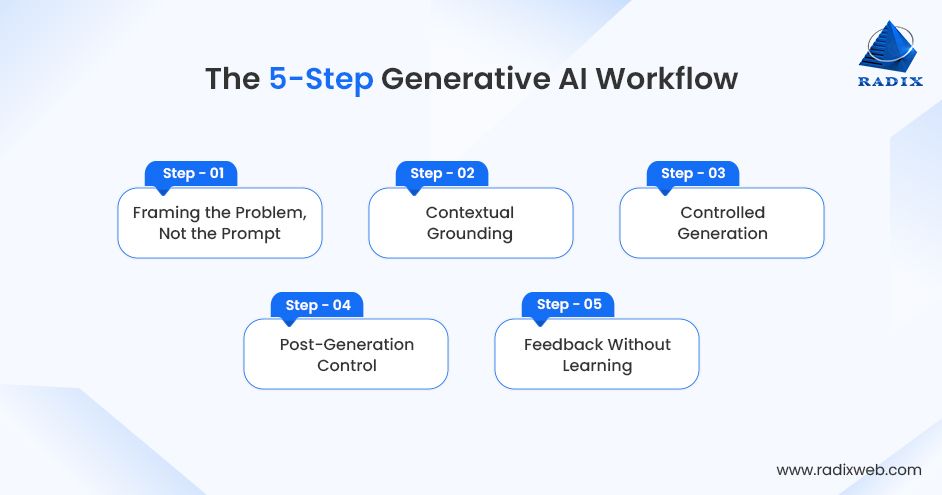
Prompts are more popular because they are visible. But what they are in reality is a downstream artifact of earlier decisions. Before any prompt is constructed, generative AI platforms have already made choices about intent, scope, and acceptable outcomes. Framing replaces prompt engineering with intent classification running at near 100% accuracy in mature systems.
What happens is:
"Write Q4 summary" > Intent classifier > "Summarize pipeline data from CRM for executive presentation, 300 words maximum, exclude confidential pricing"
System adds user role, department policies, and recent conversation history automatically.
Contextual grounding means allowing Gen AI systems to use/avoid specific information when generating answers. Production Gen AI systems diverge sharply from generic chat models here.
Contextual grounding typically involves:
This step exists to reduce hallucination, but it cannot eliminate it entirely. With a controlling context, Generative AI systems generate plausible outputs that are most likely to align with enterprise demands.
Gen AI models create content within strict constraints. Production systems override "be creative" defaults with enterprise parameters, which are set to limit variability, response length, and speculative reasoning. These constraints are intentional.
Here are some examples of key controls:
Note that the "magic creativity" executives saw in demos becomes deliberately constrained behavior as production Gen AI systems prioritize reliability over novelty.
Raw model output never reaches users. Response passes validation to ensure format, accuracy, policy compliance, and quality before delivery. If an output fails validation, Gen AI tools may retry with adjusted constraints or escalate it for review. This layer is where enterprise accountability is enforced.
Four validation gates are:
Production Gen AI does not "learn" from user feedback in real time. This is because if you allow live learning from user input, there will be significant risks around data leakage, bias reinforcement, and even compliance. Instead, feedback is typically used to:
Systems powered by Generative AI for business improve through engineering (routing, retrieval tuning), not self-improvement.
Modern Gen AI systems work with the following pattern - analyzing intent, assembling context, invoking the model within constraints, and validating the result before it reaches a user or downstream system. The system around the model has been designed to control what the model reads, how it responds, and what happens to its output afterward.
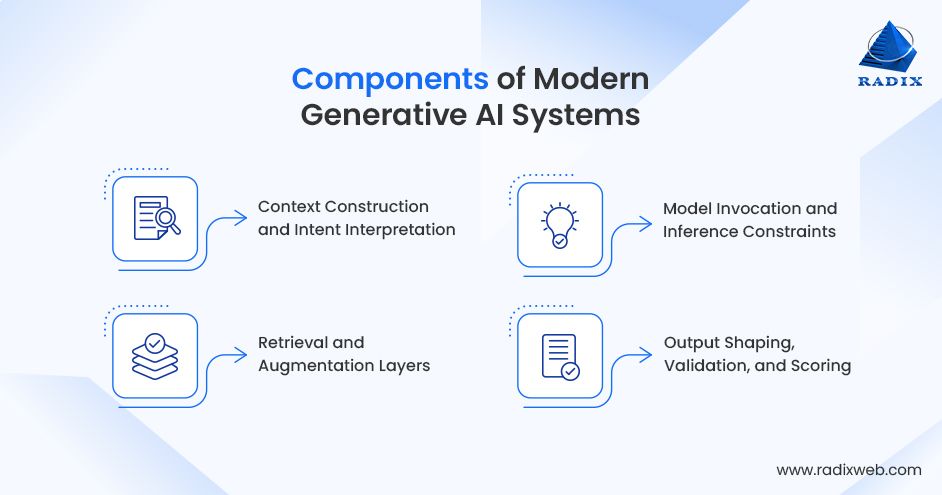
Before a model is invoked, a GenAI system interprets user intent and constructs a controlled context that determines what information the model can use and how it should respond.
In production, GenAI pulls fresh, domain‑specific knowledge from enterprise systems in addition to pretraining information. This is why retrieval‑augmented generation (RAG‑style patterns) dominate real deployments.
Only after intent and context are prepared does the system call one or more models, under strict constraints like temperature limits, output length controls, and policy guardrail.
The first model response is not usually what the user sees. Modern Gen AI applications run responses through additional layers to shape and validate them before delivery.

The LLM model license or API call costs $0.03-$15 per million tokens, which is less than 8-15% of total spend. Production Gen AI systems need considerable investment because 85-92% goes to infrastructure, data pipelines, and specialized engineering. Generative AI costs are driven more by orchestration, retrieval, validation, and monitoring than by model inference itself.
| Category | What You Pay For | % of Total |
|---|---|---|
| GPU Infrastructure | H100 cluster (16 GPUs), inference serving | 65%+ |
| Data Systems | Vector databases, RAG pipelines, enterprise connectors | 15-20% |
| Engineering | MLOps engineers (fine-tuning, deployment) | ~15% |
| Model/API | GPT, Claude Sonnet, Gemini, Dall-E | <10% |
GPU clusters of Gen AI platforms scale linearly with concurrent users, not model parameters. A single H100 supports 100-200 simultaneous enterprise queries. 10,000 executives, for example, need 50+ GPUs running 24/7. Inference serving layers add redundancy, load balancing, and caching that multiply base compute costs.
Your Salesforce, Workday, and internal documents don't become AI-accessible by default. Enterprise-scale retrieval infrastructure costs multiples of consumer APIs because:
Production Gen AI technology demands specialized MLOps teams that traditional IT cannot provide. Enterprises need 6-10 engineers with distinct expertise like Generative AI developers, platform engineers, data engineers, ML engineers, and security engineers. These aren't generalist IT roles, so each demands specialized skills absent from most corporate IT departments, which in turn requires hefty investment.
It's safe to say that CTOs debating "Llama vs GPT-4" miss the point entirely. Infrastructure capacity, data connectivity, and MLOps maturity determine ROI 10 times more than model selection. Hence, the smartest C-suites invest in systems engineering expertise, not model shopping.
Production Generative AI falls into 3 categories - Conversational Agents, Content Generators, and Agentic Systems. Most companies start with Gen AI agents for immediate ROI, add content generators for scale, and build agentic solutions only after controlling orchestration.
Conversational agents answer questions and handle knowledge work using your company's live data. for example, "Ask HR about benefits," "Sales team queries CRM pipeline," or "Finance pulls Q4 forecast insights." These systems connect Gen AI to your internal systems through RAG pipelines without complex multi-model orchestration.
Primary Use Cases
Content Generators create documents, code, and assets at scale. These systems produce customer emails, generate test cases from requirements, create wireframes from specs, or draft technical documentation from codebases. Multiple model types often collaborate (LLM for text, diffusion models for visuals).
Primary Use Cases
AI agents are autonomous digital workers that complete multi-step business processes end-to-end. Multiple specialized agents collaborate under central orchestration to replace entire workflows. Agentic Gen AI systems work best when they assist human operators or automate internal processes with strong constraints, rather than acting independently.
Primary Use Cases
Generative AI excels at pattern transformation (emails, summaries, code completion), data summarization, classification, and assisted reasoning. Production Gen AI platforms work best for repetitive, well-defined tasks with clear success metrics.
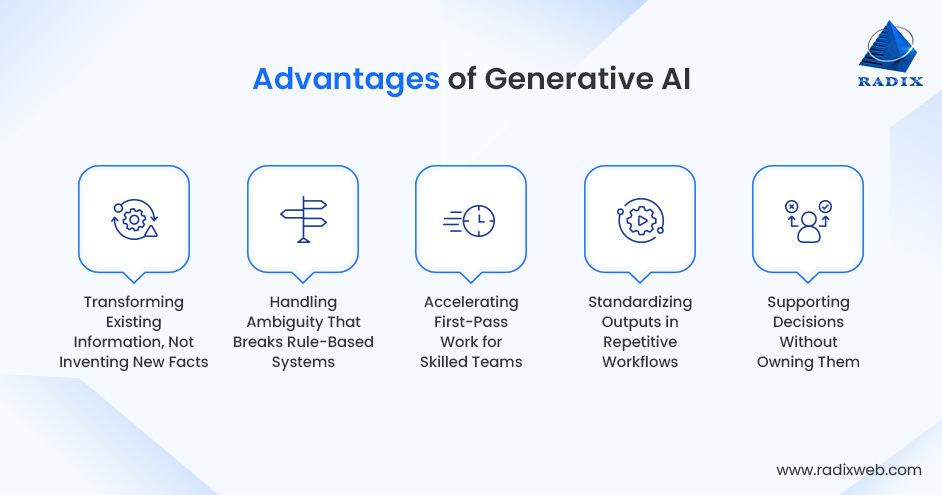
Gen AI is strongest at transforming, summarizing, and restructuring existing information rather than creating net-new facts. Summaries, rewrites, classifications, comparisons, and extractions all benefit from probabilistic reasoning without requiring factual originality.
When inputs are incomplete or ambiguous, but the outcome still needs to be directionally correct, Generative AI performs well. Traditional systems struggle when inputs do not match predefined patterns. Gen AI can interpret intent, infer relationships, and produce usable outputs even when the request is loosely framed.
Generative AI is effective at producing first drafts, initial analyses, and preliminary outputs that humans can refine. As Gen AI automates the time-consuming early steps, systems that treat it as an accelerator rather than an authority tend to scale more successfully.
When constrained correctly, Gen AI produces uniform structure, tone, and formatting at scale. This is particularly valuable in enterprise environments where variability comes from human execution instead of business logic.
Generative AI works best as a decision support layer. What it should not do is make final calls in high-stakes contexts. Enterprises must maintain this boundary to benefit from GenAI’s reasoning ability. This distinction is one of the clearest indicators of mature deployment.
Production GenAI fails on high-stakes judgment tasks that need causal reasoning, regulatory nuance, competitive context, or liability (strategy, legal review, security analysis, pricing). These domains demand human synthesis beyond pattern matching.
Tier 1 - Strategic Judgment
Tier 2 - Regulatory/Compliance
Tier 3 - Security/Technical Risk
70% of enterprise Gen AI projects fail to reach production because executives underestimate data complexity and infrastructure requirements. Hallucinations represent a fundamental limitation, while infrastructure consumes 80%+ of budgets despite 2% model costs.
In 2023, New York lawyers in Mata v. Avianca were sanctioned for submitting a court brief citing six fake cases invented by ChatGPT. The Gen AI model confidently fabricated non-existent legal precedents.
Hallucination is a core model behavior. Large Language Models predict "statistically likely" text sequences, not verified facts. When training data lacks complete information or contains gaps, models confidently fill blanks with plausible fabrications.
C-suite implication: Every hallucination-protected answer requires 3-5x more infrastructure than raw model inference. Hence, leaders need to budget accordingly.
It is relatively easy to reach the first 80 percent. A capable model, a working prompt engineered over a weekend, and visible output impress stakeholders immediately. That early demo success creates the dangerous illusion that the hardest work is done.
The remaining 20 percent destroys most systems. This invisible layer contains:
C-suite reality: The flashy 80% demo gets funding approval. The 20% of engineering behind the scenes determines ROI. 70% of projects die here because executives celebrate early wins without budgeting for production work.
C-suite leaders should evaluate Gen AI by system maturity, ROI potential, infrastructure readiness, and team capability. Production success requires evaluating orchestration, retrieval accuracy, cost controls, and governance over raw model intelligence.
The questions below reflect how GenAI actually behaves once it is embedded in system workflows.
1. Start with the job-to-be-done, not the model
Leaders should evaluate Generative AI by the specific job it must perform and the acceptable range of outcomes, not by model capability or popularity.
Before discussing models, clarify:
If the job cannot be clearly bounded, GenAI will struggle in production. Precision here reduces risk everywhere else.
2. Evaluate the system, not the demo
A Gen AI demo shows generation quality, not production readiness.
Ask to see how the system handles:
Demos that only show best-case prompts are incomplete. Production systems are defined by how they behave when inputs are messy and expectations are unclear.
3. Demand clarity on context and data boundaries
Reliable Gen AI applications depend on strict control over what information the system can access and use.
Leaders should require clear answers to:
Weak data boundaries are a leading cause of hallucinations and compliance issues.
4. Insist on observability and ownership
If a GenAI system cannot explain why it produced an output, it cannot be trusted at scale.
Production-grade systems provide:
Without observability, teams are forced to guess. Without ownership, issues linger unresolved.
5. Evaluate cost predictability, not just price
The true cost of Generative AI is determined by system behavior, not model pricing.
Leaders should look for:
Predictability matters more than low initial cost. Unbounded systems rarely stay cheap.
6. Separate assistance from authority
Mature GenAI systems assist decisions; they do not own them.
Ask explicitly:
Systems that blur this boundary tend to lose trust quickly.

The core Gen AI models are remarkably capable and increasingly commoditized. Despite that, many enterprise initiatives still treat them as magic fixes that will improve strategy, culture, data, and process all at once. The result is a widening gap where PoCs impress in demos, but production systems die in pilot or overrun budgets.
For C‑suite leaders, the shift is simple but uncomfortable - stop asking, “How smart is the model?”. Their question should be “How strong is the system around it?”. Mature use of Gen AI means respecting its strengths (pattern-heavy, repeatable work with clear success criteria) and its limits (high‑judgment, high‑liability decisions that still demand human ownership). It means funding the infrastructure with the same seriousness as the model itself.
As a Generative AI development partner, this is exactly where our work starts. Instead of selling you “a model,” we help C‑suite teams:
Schedule a discovery session with our Technical Lead to get executive‑ready Gen AI capabilities. Let us help you avoid the traps that have already sunk so many “AI transformation” programs.
Ready to brush up on something new? We've got more to read right this way.