Read More


Recognized for AI Excellence at 2026 Globee® Awards - Read More

Dhaval Dave
Quick Summary: Hospital AI agents for document processing perform well in controlled pilots but consistently stall during production EHR integration. The bottleneck isn't the AI model or the documents. It's the architectural mismatch between how AI agents need to operate and how EHR systems were designed to function. Bridging that gap requires fundamentally different integration architecture than traditional EHR system integrations. Without planning for this early, projects add 3-4 months to timelines and require significant design rework.
| Aspect | Details |
|---|---|
| What this guide covers? | The architectural reasons AI agents stall at EHR integration; why traditional EHR integration approaches fail for AI; the five specific barriers that block deployment; how to design AI architecture that works within EHR constraints; realistic timelines from pilot to production; |
| Who should read this? | CIOs and CTOs planning healthcare AI deployments; Healthcare IT directors managing EHR integrations; Clinical operations leaders evaluating AI agents; Product managers building healthcare software; Enterprise architects designing systems for regulated environments |
Over the past three years, we, at Radixweb, have scoped, deployed, and analyzed 50+ AI healthcare agents that process documents. The most common failure pattern we noticed: EHR integration. The agent works perfectly in a standalone pilot environment with clean data and controlled access. Then it is connected to the EHR system and everything changes. What was supposed to go live in 6 weeks ends up taking 4 months.
And this isn't a one-off case. It happens so consistently that we now treat it as a predictable phase in any artificial intelligence deployment in healthcare ecosystems, not an anomaly. Based on our hands-on experiences, below we explain the 'what', 'why', and 'how' of AI agents and EHR integrations. Plus, how we design AI agents around the EHR integration challenges and what separates successful deployments from stalled ones.

AI agents designed to process hospital documents (admit notes, discharge summaries, lab reports, imaging reports) look phenomenal in proof of concept. The agent reads a document, extracts relevant data points, validates them against business rules, and surfaces structured information to clinicians. Accuracy runs at 94–97%. Speed is measured in seconds. Stakeholders are impressed. The budget for full deployment gets approved.
Then the integration work begins.
Engineers start connecting the agent to the actual EHR system and then:
A simple AI agent readiness assessment before production-grade development could have surfaced the problem: EHR systems are designed for human-driven workflows with explicit authentication, controlled access, and quarterly updates. AI agents, however, are autonomous systems that need real-time access to broad datasets, make decisions without human approval at every step, and evolve based on production feedback. These two models are in conflict, and that conflict shows up at integration time.
An AI agent built to process hospital documents makes a handful of implicit assumptions about the system it's connecting to. But typical EHR systems were never designed to support these.
AI agents often need information from multiple clinical records to complete a task. Well-designed EHR systems with security-first design, however, don't grant access based on tasks, they grant access based on predefined user roles such as physicians, nurses, radiologists, billing staff, and administrators. An AI agent does not naturally fit into any of these roles.
Giving the agent broad access creates security and compliance concerns because it violates the principle of least privilege. Instead, organizations usually have to define a dedicated AI service account with carefully scoped permissions. This requires governance approvals, documentation of why each dataset is needed, risk assessments, and security reviews before access is granted.
Access decisions also affect downstream architecture. Audit logging, data masking, validation rules, and escalation workflows all depend on the permissions assigned to the agent. Until access requirements are finalized, development, testing, and compliance validation remain incomplete, making access control one of the earliest causes of project delays.
During pilots, an AI agent might process 50 documents over a week, one at a time. But upon deployment, a 500-bed hospital might have 500 admissions per day, each with multiple documents. The AI agent now needs to make hundreds of API calls per hour. Most EHR vendors apply API rate limits to protect database performance and maintain responsiveness for clinicians. As request volumes increase, the AI agent begins encountering throttling, delayed responses, or rejected requests.
To overcome this challenge related to AI agent deployment, organizations typically redesign the integration. Common approaches include batching requests, pre-fetching patient information, caching frequently used data, or implementing asynchronous processing queues. Some organizations negotiate higher API limits with the EHR vendor or distribute requests across multiple service instances.
Each option introduces tradeoffs. Caching increases the risk of outdated information, batching adds latency, asynchronous workflows complicate orchestration, and higher API capacity often increases implementation cost.
Pilots use curated sample data. Production EHR data is rarely standardized. Clinical notes, lab reports, and imaging records differ across departments and systems. Without additional validation layers, AI agents generate more exceptions and require greater human review.
At the same time, while working on artificial intelligence integration teams must balance data freshness against system performance. Fetching live information for every request provides the most current patient data but significantly increases API traffic and response times. Caching patient information improves speed and reduces API usage but introduces the possibility that the agent makes decisions using outdated information.
Different clinical workflows tolerate different levels of staleness. And defining acceptable freshness windows becomes an architectural decision rather than simply a technical optimization.
Many organizations view AI agent implementation as a software integration project. Once production deployment begins, compliance requirements significantly expand the scope.
An AI agent handling protected health information must satisfy healthcare privacy regulations, security controls, audit requirements, and organizational governance policies.
Implementation teams often need to introduce additional safeguards within custom EHR software built for healthcare organizations, including
Every model update may require additional testing, security review, and compliance approval before deployment. Unlike conventional software updates, AI improvements often follow controlled release processes to ensure patient safety and regulatory compliance. As a result, compliance becomes an architectural requirement that shapes workflows, infrastructure, monitoring, and release management rather than simply being a final approval step.
Every AI decision, API request, and data access must be logged for years for compliance. At production scale, audit volumes grow rapidly, creating storage, performance, and retrieval challenges. EHR audit systems were designed for human actions, not AI agent making thousands of decisions per day. The audit architecture that works for human workflow generates performance problems for AI workloads.
Also, without defined ownership, responsibility often becomes fragmented. Engineering teams focus on infrastructure, while clinical teams expect IT to manage AI performance. Security oversees compliance, but no single team owns ongoing optimization.
Over time, model performance changes because workflows evolve, documentation practices change, regulations are updated, and clinical terminology shifts. Without continuous evaluation, error rates gradually increase and clinicians lose confidence in the system.
These five gaps aren't minor. They're architectural. And successful AI integration with existing EHR systems depends on designing it around the constraints instead of expecting the EHR to adapt to the AI agent.
Most healthcare integrations follow a familiar pattern: connect APIs, map data fields, handle errors, and deploy. That approach works because traditional software is deterministic. Given the same input and it produces the same output every time. This makes its behavior predictable and easier to validate.
But AI agents are probabilistic. Their outputs are based on patterns and probabilities rather than fixed rules. Even with the same document, responses can vary depending on context, prompting, or model updates. They also process larger volumes of data, require broader clinical context, and make decisions that influence downstream workflows.
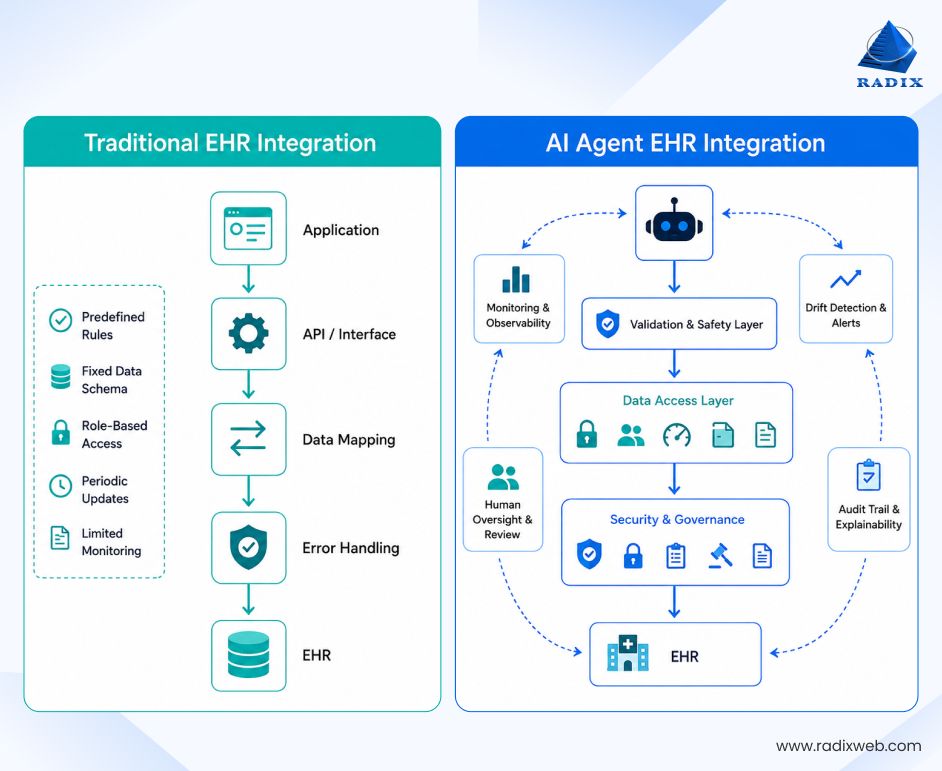
As a result, connecting an AI agent to an EHR is no longer just an integration exercise. Teams must account for governance, data quality, validation, monitoring, scalability, and human oversight from the beginning. Without these architectural considerations, an AI agent may work well in a pilot but struggle to deliver reliable performance in production.

Organizations that successfully deploy hospital AI agents for document processing don't try to force a traditional integration. Instead, they take a different architectural approach right from the very beginning of the AI agent development lifecycle.
Here are the architecture shifts that we have implemented with measurable success:
Rather than having the AI agent call the EHR API directly, we introduce a data-access layer in between. This layer handles: authentication, authorization, rate limiting, caching, audit logging, and data validation. The AI agent calls this layer, not the EHR directly.
Why this matters: The data-access layer absorbs all the EHR-specific complexity. It handles rate limits by queuing requests. It maintains fresh-data caches that the agent can use. It enforces access control policies consistently. It provides detailed audit trails. With that, the AI agent can focus on processing logic rather than EHR integration complexity.
Instead of giving the agent broad access to patient records, an EHR-ready AI Agent defines exactly what data it needs for each document type. An agent processing discharge summaries might need current admission notes, allergy list, active medications, and recent lab results. It doesn't need the patient's entire 20-year medical history.
Why this matters: Tighter data scopes mean smaller security perimeters, faster API calls, less hallucination risk (because the agent has less irrelevant context), and easier compliance review. The result? Performance improves and risk decreases.
The agent doesn't output final clinical decisions. Instead, it outputs structured candidates for clinical decisions. A validation pipeline then checks those candidates against business rules, data consistency rules, and safety thresholds. Only validated outputs proceed to clinical teams. Everything else escalates for human review.
Why this matters: This preserves AI speed while maintaining clinical safety. Hallucinations don't propagate to patient records. Conflicting data gets caught before it reaches clinicians. The system maintains audit trails of every escalation, supporting compliance and continuous improvement.
Traditional EHR monitoring watches for uptime and response time. AI agent monitoring needs to watch for accuracy drift, hallucination rates, escalation rates, demographic bias, and access pattern anomalies. That's why when we build artificial intelligence agents for production environments, we set thresholds for these parameters too. When thresholds are crossed, the system triggers alerts and investigation.
Why this matters: Early drift detection prevents silent failures. An agent that's slowly becoming less accurate gets caught and retrained before clinical impact. Teams can prove to regulators that they're actively monitoring and improving the system.
Every enterprise-grade AI deployment needs a designated owner and in healthcare context it is usually one business owner (from Clinical Operations) and one technical owner (from IT/Engineering). Once ownership is established, formally define and document their responsibilities including monitoring dashboards, escalation review, model update approval, training data curation, and quarterly performance reviews.
Why this matters: Without assigned ownership, AI agents stall post-launch. With clear ownership, they continuously improve. The difference is measurable.
These architectural shifts address the issues that commonly delay AI agent deployments in healthcare. They help organizations move beyond pilot success and build integrations that remain secure, scalable, and reliable in production.
But how long does this transformation actually take? Below is a realistic implementation timeline, from initial planning and EHR integration to validation, rollout, and production readiness.
Getting an AI agent from pilot to production EHR integration is a phased process. Healthcare organizations often underestimate how long it takes. Beyond development, there's also security reviews, governance approvals, EHR integration, testing, and clinical validation that should be factored in. In most hospitals, this takes 17–23 weeks, followed by a gradual production rollout.
Here's what a realistic timeline looks like:
The first step is defining how the AI agent will securely interact with the EHR. This includes designing the data-access layer, identifying the minimum data required for each workflow, and aligning access policies with clinical and security teams.
If the existing EHR cannot support these architectural requirements, organizations may need to migrate to a modern EHR platform while ensuring HIPAA compliance, making it a much larger modernization initiative rather than a simple AI integration project.
Typical effort: 80–120 hours
Before development moves ahead, the proposed architecture goes through security, privacy, and compliance reviews. Any gaps in governance, data handling, or AI controls are addressed early to avoid costly redesigns later.
Typical effort: 60–100 hours
With approvals in place, development begins on the components that connect the AI agent to the EHR. Authentication, caching, rate limiting, audit logging, and testing environments are all implemented during this phase.
Typical effort: 200–300 hours
The AI agent is integrated with the new architecture (data access layer) and evaluated using production-like workloads. Along with functionality, teams verify throughput, response times, data accuracy, and behavior under peak demand.
Typical effort: 100–150 hours
Instead of a full rollout, the AI agent is introduced to a limited group of users or document types. Clinical feedback, performance metrics, and escalation rates help refine the system before wider deployment.
Typical effort: 80–120 hours
The final phase focuses on documentation and approvals. Risk assessments, audit controls, validation results, and governance requirements are completed before the solution is cleared for production use.
Typical effort: 60–100 hours
Production rollout starts with a small percentage of daily document volume (usually 10%) and expands in stages as performance is validated. This phased approach reduces risk while giving teams time to monitor the system and address issues before full deployment.
Total timeline: 17–23 weeks or beyond
This is significantly longer than the pilot. But it's realistic. Organizations that try to compress this timeline typically skip compliance review, governance alignment, or operational readiness. Those shortcuts create problems that emerge in production. The hospitals that succeed are those that treat this timeline as non-negotiable and plan their clinical rollout around it.

Build AI Agents That Integrate with Existing EHRs
The gap between AI agent pilots and production EHR deployments isn't luck or engineering talent. It's planning. Successfully deployed enterprise-grade AI solutions are designed for EHR complexity as a core part of the agentic architecture, not an afterthought. The key is to understand that EHR system have constraints that were never designed for autonomous agents. Rather than fighting those constraints, build architectures that work within them. That's the difference between a four-month integration and a twelve-month stall.At Radixweb, we've deployed AI agents across 50+ ecosystems . We've learned which integration approaches work and which ones create bottlenecks. We know how to design AI architectures that work with existing EHR systems rather than against them. We understand governance and compliance. And we know how to move from pilot to production without stalling. So, if you're building hospital AI systems, schedule a consultation with our healthcare AI specialists. Let's map out your specific integration challenges and build a realistic roadmap to production.
Ready to brush up on something new? We've got more to read right this way.