
Recognized for AI Excellence at 2026 Globee® Awards - Read More
AI in Healthcare: Use Cases, Benefits & Implementation
For healthcare organizations evaluating AI adoption, the decision isn’t about whether the technology works but about choosing the right implementation path. Below we break down proven real-world applications, the operational and financial returns providers are already seeing, and a scalable integration framework built for measurable business impact.
Written By:

VP – Digital Marketing
Expert Insights By:

VP – Ops & Delivery
- $187.95B
- Market by 2030
- 37%
- Annual Growth rate
- $200B+
- Annual Savings with AI
- 147%
- ROI in 3 Years
AI in healthcare is the technology layer that converts clinical data, operational workflows, and patient behavior into decisions that improve margins, reduce errors, and drive competitive advantage across the care continuum. AI in healthcare uses intelligent algorithms to analyze patient data, automate clinical workflows, and surface insights that improve both care quality and operational efficiency. It operates across diagnostics, surgery, drug discovery, remote monitoring, and revenue cycle management. Providers using it are cutting costs, reducing errors, and making faster decisions with greater confidence. The case for adoption is no longer theoretical. Health systems with the right integration strategy in place are already measuring the returns others are still projecting.
How AI Differs from Traditional Healthcare IT
| Feature | Traditional Healthcare IT | AI in Healthcare |
|---|---|---|
 Logic Model Logic Model | Rule-based and strictly deterministic. | Adaptive, probabilistic, and self-learning. |
 Data Interaction Data Interaction | Manages and organizes structured data. | Interprets structured and unstructured data. |
 Primary Goal Primary Goal | Streamlining administrative documentation. | Enhancing clinical and diagnostic accuracy. |
 Outcome Nature Outcome Nature | Static; the system follows instructions. | Dynamic; the system improves with more data. |
 Example Example | Electronic Health Record (EHR) storage. | Predictive analytics for patient risk levels. |
 User Role User Role | Human interprets all data provided. | AI surfaces insights for human validation. |
How AI is Transforming Healthcare?
The healthcare industry is undergoing a radical shift, driven by a need to move from reactive treatments to proactive, data-driven wellness. Artificial Intelligence is the critical engine addressing these core market pressures.
Data Explosion in Healthcare
Health systems drowning in EHR, wearable, and genomic data cannot afford manual processing. AI converts that volume into clinical decisions that protect revenue and patient outcomes simultaneously.
Demand for Precision Medicine
Generic treatment protocols cost providers in readmissions and adverse outcomes. AI delivers patient specific therapy recommendations that improve efficacy, reduce liability, and position your practice as a precision care leader.
Operational Inefficiencies
Clinician burnout and administrative bloat are revenue problems before they are culture problems. AI automates scheduling, billing, and patient flow so your workforce performs at capacity without the overhead.
Regulatory Pressure
Compliance failures are expensive. AI driven documentation and real time data monitoring keep healthcare organizations audit ready, reducing the financial and reputational risk of human error across every reporting requirement.
Shift Toward Value-Based Care
Value based contracts reward outcomes, not volume. AI tracks long term patient health, prevents costly readmissions, and aligns your operational performance directly with the reimbursement models replacing fee for service.
The State of Artificial intelligence in Healthcare Industry
AI in healthcare has moved decisively from pilots and experimentations to enterprise-scale adoption. Healthcare providers are increasingly embedding ML and Gen AI applications into core systems for AI-assisted radiology, clinical decision support, fraud detection and hospital workflow optimization.
Regulatory pressure, operational costs, clinician shortages, and patient data volumes are increasing the need for secure, compliant AI infrastructure.
“AI has shortened wait times in my practice by reducing image review time from 48 hours to under 6 hours for eye scans... but setup costs are expensive for small practices, ranging from $18,000 to $40,000 per workstation"

Dr. Rron Bejtullahu
Challenges in Implementing AI in Healthcare

Data Privacy & HIPAA Compliance
Protecting sensitive patient information is the cornerstone of healthcare trust. AI systems require access to vast amounts of Protected Health Information (PHI) to function effectively, which inherently increases the surface area for potential cyber threats and unauthorized data leaks.
For us, maintaining rigorous HIPAA compliance and international standards like GDPR is non-negotiable. That’s why we implement robust end-to-end encryption, de-identification protocols, and strict access controls to ensure that innovation never comes at the cost of patient confidentiality or legal standing.

Integration with Legacy Systems
Many healthcare providers still rely on aging infrastructure and fragmented "siloed" databases designed decades ago. These legacy systems often lack the modern APIs or processing power required to feed data into sophisticated AI models, creating a significant technical bottleneck for real-time analysis.
We bridge this gap by using a middleware strategy or comprehensive cloud migration. Success depends on creating a unified architecture where AI can coexist with existing Electronic Health Records (EHRs) without disrupting clinical workflows or causing system downtime.

Data Quality & Interoperability
AI is only as good as the data it consumes, yet healthcare data is notoriously messy. Information is often trapped in inconsistent formats across different departments—ranging from handwritten notes to various imaging standards—which prevents a cohesive "single source of truth" for the algorithm.
We avoid that by standardizing this data through frameworks like FHIR (Fast Healthcare Interoperability Resources) and ensuring seamless exchange. Without high-quality, normalized data, AI outputs remain unreliable, leading to "garbage in, garbage out" scenarios that can compromise decision-making.

Model Bias & Validation
If an AI model is trained on non-representative datasets, it can inadvertently inherit and amplify human biases. This leads to skewed diagnostic or treatment recommendations that may negatively impact specific demographic groups, raising serious ethical and clinical concerns regarding the fairness of the technology.
We, at Radixweb, thus emphasis continuous clinical validation and "algorithmic auditing" to ensure accuracy. Our AI healthcare software developers prioritize diversity in training data and maintain transparency in how models reach conclusions to build the necessary "explainability" that clinicians and regulators demand.

Change Management & Training
The most advanced technology will fail if the human workforce is not prepared to use it. Many clinicians view AI with skepticism, fearing it may replace their expertise or add more "screen time" to an already over-burdened schedule, leading to significant resistance during the rollout phase.
For effective implementation, we recommend building a culture of continuous learning and clear communication. We help organizations invest in comprehensive training programs that demonstrate AI as a supportive "co-pilot" rather than a replacement. With that, we ensure that your staff feels empowered and competent in the new digital landscape.
Real-World AI Use Cases: From Theory to Clinical Impact
At Radixweb, we view AI not as a standalone product, but as a strategic layer that amplifies medical expertise. The following use cases of artificial intelligence represent the current frontier of healthcare transformation, where data matures into life-saving intelligence.

Predictive Analytics for Patient Outcomes
Predictive modeling transforms reactive care into a proactive shield. By synthesizing longitudinal patient records, real-time vitals, and socioeconomic factors, AI identifies high-risk individuals long before a clinical crisis occurs. This foresight allows providers to intervene during the "golden window," significantly reducing hospital readmissions and preventing the escalation of chronic conditions.
Implementation in Action:
Penn Medicine successfully deployed a predictive AI system known as Penn Signals. By analyzing real-time data from Electronic Health Records, the system identifies patients at risk of sepsis or heart failure up to 30 hours in advance. This early warning gives clinical teams the lead time necessary to adjust treatment protocols, which has measurably improved survival rates within their intensive care units.
Bring The Use Cases To Life, With Experts
Speak to our strategists and implement AI in your workflows today
The Technological Engines of Modern Healthcare
Machine Learning Models
Machine Learning forms the analytical core of healthcare AI. These models ingest historical patient data to identify hidden correlations, allowing systems to predict disease onset or medication responses with high precision. It is the foundation for truly personalized, data-driven medicine.
Natural Language Processing (NLP)
NLP acts as the bridge between human language and digital intelligence. By analyzing unstructured clinical notes, discharge summaries, and research papers, NLP extracts vital data points that would otherwise remain trapped in text, significantly accelerating clinical documentation and patient history reviews.
Computer Vision
Computer Vision transforms medical imaging into a high-speed diagnostic tool. By training on millions of radiological images, these algorithms detect minute anomalies in X-rays, MRIs, and CT scans faster than the human eye, ensuring that life-critical findings are never overlooked or delayed.
Predictive Analytics
Predictive Analytics shifts the healthcare paradigm from reactive to proactive care. By processing real-time vitals and historical trends, it forecasts potential health crises—such as sepsis or cardiac events—allowing clinical teams to intervene early, improve survival rates, and drastically reduce hospital readmissions.
AI Agents for Workflow Automation
AI Agents are autonomous digital coworkers designed to handle complex, multi-step administrative tasks. From coordinating staff schedules to managing bed availability in real-time, these agents eliminate operational friction, allowing medical professionals to dedicate their full attention to patient interaction and care.
Generative AI in Clinical Documentation
Generative AI is revolutionizing the "clerical" side of medicine by auto-synthesizing patient-doctor conversations into structured medical records. This technology drastically reduces the time spent on EHR entry, directly combating clinician burnout and ensuring more accurate, comprehensive, and timely clinical documentation.
Benefits of AI in Healthcare
Operational Benefits

Reduced Administrative Workload
AI acts as a digital force multiplier by automating the high-volume, repetitive tasks that typically consume a clinician's day. By utilizing Natural Language Processing (NLP) for medical transcription and automated coding for billing, healthcare organizations can drastically cut down on manual data entry. This shift not only minimizes human error in documentation but also directly combats provider burnout by allowing medical staff to return their focus to face-to-face patient care.
Faster Diagnosis
In critical care, time is the most valuable asset. AI accelerates the diagnostic pipeline by instantly pre-screening diagnostic data—such as blood work or medical imagery—to flag urgent abnormalities for immediate physician review. By reducing the "wait time" between a test and its interpretation, AI ensures that life-saving treatments are initiated hours or even days earlier than traditional manual workflows would allow.
Improved Workflow Efficiency
AI transforms hospital logistics from a reactive struggle into a streamlined, predictive operation. By analyzing historical patient flow and real-time bed occupancy, machine learning models can forecast peak admission periods and optimize staff scheduling accordingly. This ensures that resources—from nursing shifts to operating room availability—are always aligned with actual patient demand, eliminating bottlenecks and reducing overall wait times.
Clinical Benefits

Better Patient Outcomes
The ultimate benchmark of healthcare AI is its ability to improve the quality of life and recovery rates. By providing continuous monitoring and real-time clinical alerts, AI systems ensure that subtle physiological declines are caught before they escalate into emergencies. This constant "digital oversight" results in lower mortality rates, fewer post-surgical complications, and a more robust recovery process for patients across all departments.
Personalized Treatment Plans
Moving away from the "average patient" model, AI leverages genomic data and lifestyle analytics to tailor medical interventions to the individual. These systems analyze how a specific person’s biological makeup will likely respond to various medications, allowing doctors to prescribe the most effective drug at the optimal dosage from the start. This precision medicine approach maximizes therapeutic impact while significantly reducing the risk of adverse drug reactions.
Early Disease Detection
AI excels at identifying "the invisible," catching the earliest markers of chronic conditions like cancer or cardiovascular disease long before they are symptomatic. Through advanced pattern recognition in imaging and pathology, AI can detect cellular changes that the human eye might miss. Catching these conditions in Stage 0 or 1 fundamentally changes the prognosis, often turning a life-threatening diagnosis into a highly manageable or curable one.
Financial Benefits

Cost Reduction
While the initial investment in AI is significant, the long-term ROI is driven by massive gains in operational economy. By preventing expensive hospital readmissions, reducing the length of patient stays through better care coordination, and eliminating waste in the supply chain, AI helps healthcare systems operate at a much lower cost-per-patient. Automation of back-office functions further slashes overhead, protecting the organization’s bottom line.
Risk Mitigation
AI serves as a sophisticated safety net that identifies potential clinical and financial risks in real-time. Whether it is flagging a potential drug-to-drug interaction before a prescription is filled or identifying a fraudulent billing claim before it is submitted, AI reduces the likelihood of costly legal liabilities and regulatory fines. This proactive approach to risk management ensures that the organization remains compliant and reputable in a highly scrutinized industry.
Competitive Advantage
In an increasingly digital-first market, AI-enabled healthcare providers stand out as leaders in innovation and patient safety. Adopting AI allows organizations to participate in lucrative value-based care contracts that reward high-quality outcomes over volume. Furthermore, the ability to offer cutting-edge, personalized care helps attract both elite medical talent and a tech-savvy patient base that prioritizes efficiency and advanced treatment options.
Leverage AI to optimize workflows and patient outcomes.
Enterprise Security & Compliance Framework for Healthcare AI Systems
Regulatory Standards & Industry Compliance Alignment


FDA & Software as a Medical Device (SaMD)
AI algorithms used for diagnosis or treatment planning often fall under SaMD regulations. We align development with FDA Quality System Regulations (QSR), focusing on rigorous clinical validation and pre-market notifications. By maintaining a clear "audit trail" of model training and testing, we help organizations navigate the complex path to regulatory approval for medical-grade AI.
Security Best Practices for Healthcare AI Infrastructure


AI Governance, Risk Management & Operational Oversight


Model Explainability & "Black Box" Reduction
For a doctor to trust an AI, they must understand why a recommendation was made. Our healthcare data governance framework prioritizes "Explainable AI" (XAI) techniques, providing clinicians with heatmaps or feature-importance scores that highlight the data points influencing a diagnosis. This transparency transforms the AI from an opaque "black box" into a verifiable clinical partner.

Future Trends of AI in Healthcare
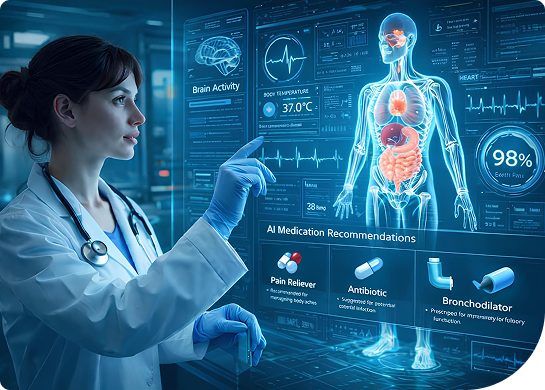
The trajectory of healthcare AI is moving from "experimental" to "infrastructural." AI-models like ChatGPT and Claude have launched specialized healthcare offerings. We are seeing a shift where AI is no longer a bolt-on feature but the very core of how health systems operate, driven by a global market projected to reach $505 billion by 2033 and 90+% adoption rates.
AI-Powered Precision Medicine
Precision medicine is evolving from a niche genomic research tool into a mainstream clinical reality. By 2026, AI is being used to synthesize "multi-omics" data (combining genomics, lifestyle, and environmental factors) to create hyper-individualized treatment pathways.
The Trend: Moving away from "one-size-fits-all" to "n-of-1" medicine where treatments are unique to a single patient’s biology.
The Data: The AI in Precision Medicine market is expected to grow at a CAGR of 34.33% through 2035, with AI in oncology leading the charge with a 31% market share.
Autonomous AI Agents in Hospitals
The era of simple chatbots is over; 2026 marks the rise of "Agentic AI"—autonomous digital entities that don't just answer questions but execute complex workflows. These agents act as "clinical wingmen," managing everything from patient intake and real-time triaging to automated billing and follow-up care without human intervention.
The Trend: Autonomous agents performing multi-step tasks like predicting sepsis and immediately triggering diagnostic protocols.
The Data: By the end of 2025, 94% of healthcare leaders already expected AI agents to be essential across their operations to combat a clinician burnout rate that currently affects over 50% of providers.
Real-Time Clinical Intelligence
Clinical intelligence is shifting from retrospective reporting to live, bedside decision support. In 2026, "Ambient AI" is the standard in exam rooms, listening to patient-doctor conversations and auto-generating structured clinical notes with higher accuracy than human-written reports.
The Trend: Live integration of AI into the EHR (Electronic Health Record) to provide instant "alternative point of view" second opinions for complex diagnoses.
The Data: AI-generated surgical notes currently show an accuracy of 71%, significantly outperforming the 53% accuracy found in traditional surgeon-written documentation.
AI-Driven Population Health Management
Health systems are now using AI to manage the health of entire communities rather than just the patients inside their walls. By analyzing social determinants of health (SDOH) and data from the Internet of Medical Things (IoMT), AI predicts which populations are at risk for chronic outbreaks or rising readmission rates.
The Trend: Predictive analytics enabling a "proactive" rather than reactive healthcare model, focusing on wellness and early intervention.
The Data: AI-driven predictive models have demonstrated the potential to reduce hospital readmission rates by up to ~15% and lower mortality rates by 30%.
Generative AI in Drug Discovery
By 2026, Generative AI has moved from text generation to "molecule generation." Pharmaceutical companies are using GenAI to simulate drug effects and run virtual clinical trials, which drastically slashes the traditional 10-year development cycle.
The Trend: Shortening drug development timelines from years to months and reducing R&D costs by repurposing existing drugs for new, off-label uses.
The Data: Experts predict that AI-driven drug repurposing will slash R&D costs by 25% by the end of 2026, making treatments for rare diseases more financially viable.
Read more about other latest healthcare technology trends here.
Radixweb’s Specialized AI Healthcare Portfolio
At Radixweb, we don’t believe in "plug-and-play" AI. We engineer bespoke, medical-grade intelligence that integrates deeply with your existing clinical and operational DNA.
AI-Driven Clinical Decision Support Systems
We build cognitive co-pilots that combine patient history, real-time vitals, and clinical research to provide evidence-based guidance at the point of care. These systems help physicians make faster, more accurate decisions while maintaining transparency through explainable AI.
- Real-time clinical decision intelligence
- Evidence-based treatment recommendations
- Reduced diagnostic variability across teams
- Transparent and explainable AI insights
- Faster decision-making at point-of-care
Predictive Patient Outcome Analytics
Our predictive AI and ML models transform healthcare data engineering by helping healthcare providers identify high-risk patients before conditions escalate. By analyzing historical and real-time health data, these systems enable proactive care interventions that improve outcomes and reduce emergency treatment costs.
- Predicts readmissions and disease escalation
- Identifies high-risk patient populations
- Enables proactive clinical intervention
- Improves long-term patient outcomes
- Reduces emergency care costs
Medical Imaging & Diagnostic Intelligence
We use advanced computer vision to automate and accelerate medical imaging analysis. These systems help detect anomalies earlier and prioritize critical scans for faster specialist review.
- AI-powered medical image analysis
- Detects subtle diagnostic anomalies
- Prioritizes high-risk imaging cases
- Improves diagnostic consistency and speed
- Reduces radiologist workload significantly
Intelligent Hospital Workflow Automation
Our AI solutions streamline hospital operations by automating administrative workflows and optimizing resource allocation. This ensures smoother patient flow and improved operational efficiency across healthcare facilities.
- Optimizes hospital resource allocation
- Predicts peak patient arrival patterns
- Automates staffing and scheduling workflows
- Reduces administrative operational friction
- Improves patient flow across departments
Healthcare Fraud Detection & Revenue Cycle AI
We build AI models that safeguard healthcare revenue cycles by detecting billing anomalies and fraudulent claims. These systems also improve billing accuracy and minimize costly claim denials.
- Detects billing anomalies and fraud
- Flags duplicate and uncoded claims
- Predicts claim denial risks
- Improves billing efficiency and accuracy
- Protects healthcare revenue integrity
AI-Powered Patient Engagement & Virtual Assistants
Our AI-powered virtual assistants help healthcare providers deliver continuous patient support through automated triage, scheduling, and care guidance.
- 24/7 AI patient assistance
- Automated triage and appointment scheduling
- Personalized patient health guidance
- Improves medication adherence rates
- Reduces front-desk operational workload
What Makes Radixweb a Trusted AI Healthcare Software Development Company?
With 26+ years of engineering excellence, Radixweb bridges the gap between complex AI innovation and the rigorous demands of the medical industry. We don't just build healthcare software solutions we build compliant, life-saving digital ecosystems.
Deep Domain & Compliance Expertise
We navigate the complexities of HIPAA, GDPR, and FDA regulations as a core part of our development DNA. Our ISO 27001:2022 certification ensures that every AI model we deploy meets the highest global standards for data security and patient privacy.
Interoperability-First Approach
We specialize in breaking down medical data silos. By utilizing FHIR/HL7 standards and secure API layers, we ensure your AI solutions communicate seamlessly with legacy EHRs, imaging systems (PACS), and lab databases for a unified "single source of truth."
Proven Clinical Value Delivery
Our focus is on "Actionable Intelligence" rather than just data. From reducing clinician burnout with ambient AI to improving patient outcomes through predictive analytics, our solutions are benchmarked against real-world clinical KPIs and ROI.
Real-World Impact: Our Success Stories
Frequently Asked Questions
What is AI in Healthcare?
What is the cost of AI healthcare software development?
What is the timeline for AI healthcare software development?
How do you handle security and compliance for AI in healthcare?
What is the AI healthcare software development process?
Schedule A 1-on-1 AI Strategy Session
Speak to our experts and find out
Step 1: Fill in the form & share your requirements
Step 2: Sign an NDA, if needed to ensure 100% privacy
Step 3: Get on a call with our AI experts and get a practical understanding of cost, timeline, and ROI.



Business Inquiry
Tell Us About Your Project for Tailored Guidance
By submitting this form, you agree to our Privacy Policy