Read More


Recognized for AI Excellence at 2026 Globee® Awards - Read More

Dhaval Dave

What This Article Covers: This article explains how healthcare data governance works in practice. It covers ownership, regulatory alignment, data quality, interoperability, and AI readiness, with a clear 90-day roadmap and real-world examples to help healthcare leaders implement data governance with working operational capability.
Healthcare data governance is the systematic management of healthcare data assets, including clinical, patient, and operational data, to ensure accuracy, security, compliance, and usability for clinical, regulatory, and analytical use.
In 2026, regulatory pressures like HIPAA Security Rule updates, state AI laws, and EU AI Act requirements demand governance beyond basic compliance. At the same time, FHIR/HL7 interoperability and exploding unstructured data volumes (80% of healthcare data) create quality and access risks that derail AI initiatives and population health analytics.
Poor governance costs hospitals $12.9M annually in data quality issues alone; however, strong governance cuts these by 15-22% and accelerates AI deployment from years to months.
In this guide, you will find a practical overview of data governance in healthcare. It breaks down the core components, connects governance to real regulatory and interoperability demands, and walks you through an implementation roadmap, measurable success indicators, and real-world examples you can apply within your own organization.
Healthcare data governance is the process of implementing policies, processes, and controls to manage data throughout its full lifecycle. It's one of the most innovative healthcare tech trends, designed to ensure that the data supporting care delivery, billing, compliance, analytics, and AI are accurate, secure, and traceable and meet regulatory mandates like HIPAA and FHIR standards.
Unlike general enterprise data governance that focuses primarily on reporting and analytics, healthcare data governance operates under tighter constraints and higher stakes. Healthcare organizations face life-critical consequences like wrong medication or delayed diagnoses from a single data quality failure.
Data in healthcare is also structurally more complex. As mentioned before, 80% is unstructured (clinical notes, PDFs, X-rays, audio dictations), which needs specialized extraction. Structured data also fragments across multiple source systems with inconsistent formats.
This complexity demands governance that turns raw data volume into reliable assets for value-based care delivery and AI initiatives.
Data governance matters in healthcare because data decisions directly affect clinical outcomes, regulatory exposure, financial stability, and day-to-day operations.
It's a core part of digital transformation in healthcare that organizations must approach to stay relevant in this age. When governance is weak or inconsistent, the impact shows up quickly, often in costly ways.
Some of the benefits of data governance in healthcare are reduced clinical errors caused by incomplete or outdated data, more reliable patient records at the point of care, fewer compliance gaps, faster audit response, and operational and reporting efficiency.
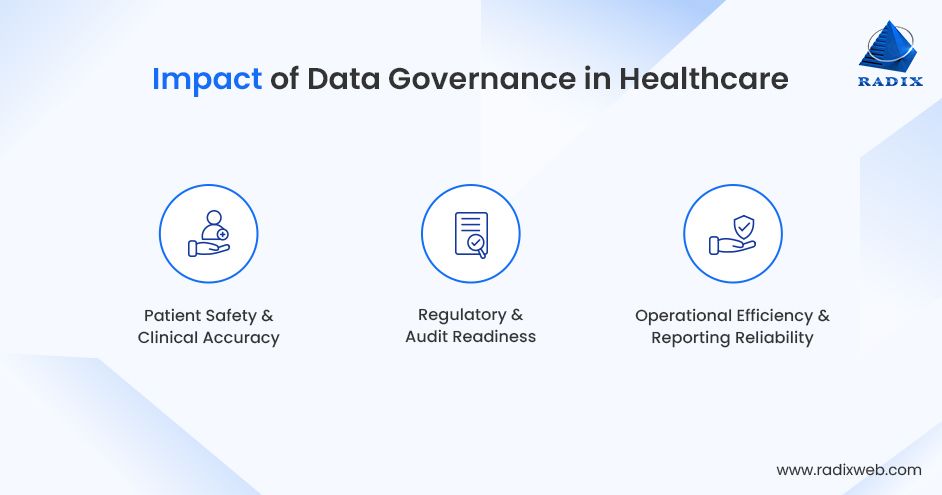
Patient lives could be at risk from inaccurate clinical decisions stemming from poor data governance. For example, duplicate patient records cause wrong medications, or inconsistent lab result formats can delay critical diagnoses.
A single data quality failure in an EHR can cascade through order sets and trigger adverse events that increase readmissions and expose organizations to malpractice liability. With effective data governance consulting solutions, however, enterprises can reduce these risks by making clinical data more reliable at the point of care.
Regulatory violations in the healthcare industry carry immediate financial damage. Without data governance, organizations struggle to prove HIPAA compliance during audits and could face average fines of $2+ million per major breach plus remediation costs.
On top of this, missing audit trails for PHI access or incomplete FHIR data lineage can hinder accreditation and federal reimbursements. As strong governance maintains continuous healthcare data security and compliance evidence, teams can avoid payment suspensions that cripple cash flow.
Ungoverned data inflates operational costs through rework and delays; there’s no exception. For instance, billing teams chase denied claims caused by inconsistent coding between EHRs and practice management systems and population health reports built on messy data mislead contract negotiations and cost millions.
A data governance system can only standardize data for finance, operations, and analytics teams. It reduces rework, optimizes reporting cycles, and delivers operational data that healthcare teams can trust without validation.
Healthcare data governance rests on eight interconnected components that together create a trusted data foundation across EHRs, hospital management systems, analytics platforms, and AI systems.
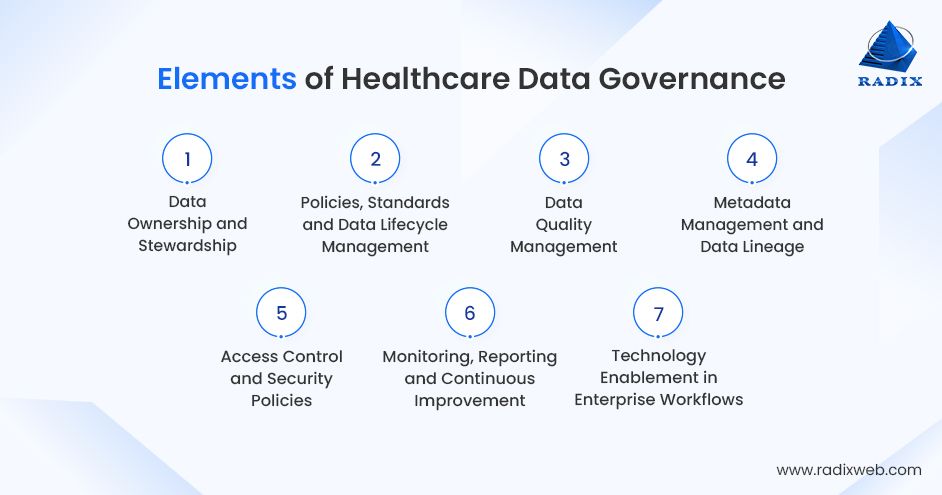
While data owners are responsible for clear decisions related to quality, access, and usage within their domains, data stewards manage definitions, resolve issues, and coordinate between clinical, IT, compliance, and analytics teams. Healthcare data governance is an ownership model.
Written policies define how data enters systems, transforms through workflows, and archives or deletes per retention rules. Standards mandate compliance, coding consistency, and metadata tagging. Lifecycle rules govern data from intake through active use to secure disposal and prevent duplicate records.
Quality rules ensure that information used for care, billing, and predictive analytics in healthcare meets defined thresholds for accuracy, completeness, consistency, and timeliness. Governance formalizes how quality issues are detected and resolved before they affect patient safety or operations.
Metadata provides visibility. By documenting data definitions, sources, transformations, and dependencies, governance allows teams to understand how data flows across systems and how changes impact downstream reporting and analytics.
Access controls enforce appropriate use as sensitive data gets categorized based on risk and regulatory requirements, with role-based access and privacy controls ensuring that only authorized users can view or modify it.
To keep governance effective over time, defined KPIs, audit trails, and regular reviews help organizations identify gaps and adapt controls as regulations, systems, and use cases evolve.
Data catalogs (Collibra, Alation), quality platforms (Informatica, Talend), and lineage tools (Manta, Octopai) embed and automate governance in everyday operation.
Data governance in healthcare succeeds or fails based on clear roles with defined decision authority. Here's the operating model with authority boundaries and conflict resolution:
Operational issues are resolved by data stewards within defined standards. Decisions that affect risk exposure, regulatory compliance, or data usage require approval from the relevant data owner. When clinical requirements conflict with security or compliance constraints, impacts are documented and escalated to the governance council for resolution.
This structure eliminates "everybody's responsible so nobody is" syndrome. Clear authority boundaries turn governance from meeting-heavy bureaucracy into an operational reality where clinicians trust data, auditors find evidence, and executives see ROI.
Healthcare data governance policy and regulations establish legal requirements for protecting patient data. Data governance provides the systems and processes that ensure compliance and generate audit-ready evidence.
HIPAA Privacy and Security Rules form the foundation for protecting patient health information (PHI). HITECH extends these requirements to business partners and mandates breach notifications. FHIR and HL7 standards ensure data can move between systems reliably.
Recent 2026 updates increased scrutiny. HHS finalized HIPAA Privacy Rule updates (effective Feb 16, 2026) for reproductive health data protection. State laws add requirements for AI fairness and genomic data protection. Global rules like GDPR and the EU AI Act create additional compliance layers for international operations.
Regulations state what organizations must achieve. Governance defines how to achieve it through policies, assigned roles, and automated monitoring.
For example,
As auditors need proof of compliance, governance automatically generates access logs, data lineage reports, and quality metrics. Compliance teams pull these reports during audits instead of scrambling through manual records.
Predefined audit packages map governance controls to specific regulatory requirements. This turns weeks of preparation into hours of response time.
Regulatory demands continue growing. Cybersecurity rules target ransomware threats that disrupted hundreds of hospitals last year. AI transparency requirements affect clinical decision support tools. New data types like genomics and wearable device information require updated protections.
Organizations with mature governance can adapt easily to these changes. They scale existing controls, update policies, and maintain compliance while others struggle with reactive fixes and penalties.
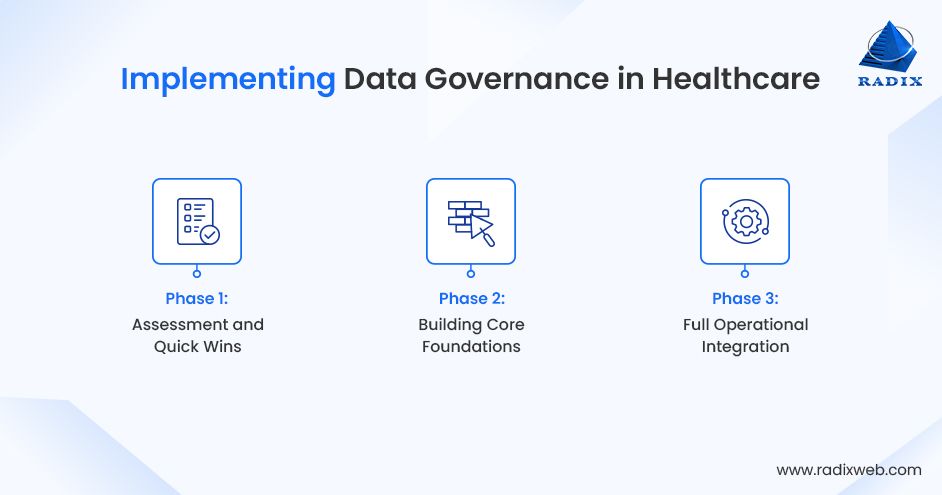
The end-to-end data governance and compliance process in healthcare has to be implemented in a phased cycle. Healthcare organizations should start small and gradually scale in clinical, operational, and analytics workflows.
When you implement governance step by step, with clear ownership, you start seeing tangible improvements every month. You’ll notice fewer data-related errors in patient care, less audit pressure, and more reliable reports and analytics techniques.
Over a single quarter, governance stops feeling like a compliance burden and starts to become a clear advantage for your organization.
Focus on simple fixes that show results fast - basic quality checks in your EHR system and standardized terms for the most-used data fields. These early successes build executive support and reduce errors right away.
Healthcare firms must set up automated reports for quality and access patterns. Achieve coverage of your top-priority datasets and establish initial performance targets, such as 95% data completeness.
As a result, clinical staff can see quality alerts during patient care. Finance teams track billing issues tied to data problems and analytics users access trusted datasets for reports and AI projects.
The issues below appear consistently in hospitals, payers, and health tech platforms.
| Common Issue | What Happens | Operational Impact |
|---|---|---|
| Unclear ownership | No final authority for shared data | Delayed decisions, inconsistent reports |
| Governance without authority | Roles lack mandate or time | Policies ignored in practice |
| Tool-first mindset | Technology deployed without rules | Low adoption, no behavior change |
| Overly broad scope | Too many domains governed at once | Program stalls early |
| Clinical misalignment | Governance seen as restrictive | Workarounds and resistance |
Start simple. You can begin with what you already have like basic EHR configuration and spreadsheets to track key data issues and responsibilities. As your governance efforts mature, you can layer in more specialized tools like data catalogs and quality platforms. Later, when you have clearer processes and priorities, it makes sense to introduce more advanced capabilities such as data lineage tracking and access management solutions.
The real investment, though, should be in your people. Prioritize budget for training clinicians, analysts, and operations teams so they understand their roles, know how to use the data correctly, and can spot issues early.
A workable healthcare data governance program can be established in 90 days if the focus stays on ownership, enforceable controls, and visible outcomes rather than broad frameworks or enterprise-wide rollouts.
Deliverable: RACI matrix, dataset inventory, first quality report.
Deliverable: Approved policies, 80% critical datasets cataloged, first access reports.
Deliverable: Live KPI dashboard, audit package, phase 2 plan.

Healthcare data governance for AI extends traditional data governance to handle dynamic model training, traceable predictions, and bias control for safe clinical outcomes and regulatory compliance.
Traditional governance manages static reports. AI requires:
Training datasets must meet strict criteria before model development:
Data stewards approve datasets, preventing biased models that misdiagnose underrepresented patients.
Complete traceability proves clinical reliability:
Patient vitals → Feature engineering → Model inference → Clinical alert
Metadata captures every transformation. Clinicians trace why AI flagged sepsis risk and logs record inputs/outputs per encounter.
Regulatory alignment: EU AI Act mandates traceability; FDA requires audit trails for approved algorithms.
Bias controls operate at three levels:
Explainability tools show clinicians: "Model prioritized abnormal vitals (65%) over demographics (12%)."
Clear accountability:
Here's why traditional data governance approaches starkly differ from AI governance needs:
| Traditional Governance | AI Governance Needs |
|---|---|
| Static schemas | Dynamic feature engineering |
| Role-based access | Synthetic data generation |
| Periodic reports | Real-time drift monitoring |
| Manual quality checks | Automated bias detection |
Scale overwhelms: AI consumes petabytes daily vs. governance handling terabytes.
AI-driven healthcare data governance is a four-layered framework, with each layer having its own roles:
Outcomes: 6-12 months faster model deployment, ~40% fewer bias incidents, clinician trust, regulatory compliance.
These two healthcare data governance examples we’ve mentioned here show how organizations facing typical healthcare tech challenges and data issues can achieve clinical, financial, and regulatory gains through targeted governance interventions.
Problem
Fragmented biomedical data across patient care, research, and operations hindered clinical decisions and compliance. No unified view of patient data across 3 campuses.
Governance Intervention
Outcome
Problem
Siloed systems across trusts blocked national data sharing for care coordination, public health, and research. Inconsistent standards caused interoperability failures.
Governance Intervention
Outcome
Problem
Variable clinical practices and data quality issues prevented reliable outcomes measurement. Clinicians distrusted analytics for decision support.
Governance Intervention
Outcome
The most common challenges that healthcare organizations often face in data governance and compliance are cultural resistance, unclear ownership, and overlapping tools.
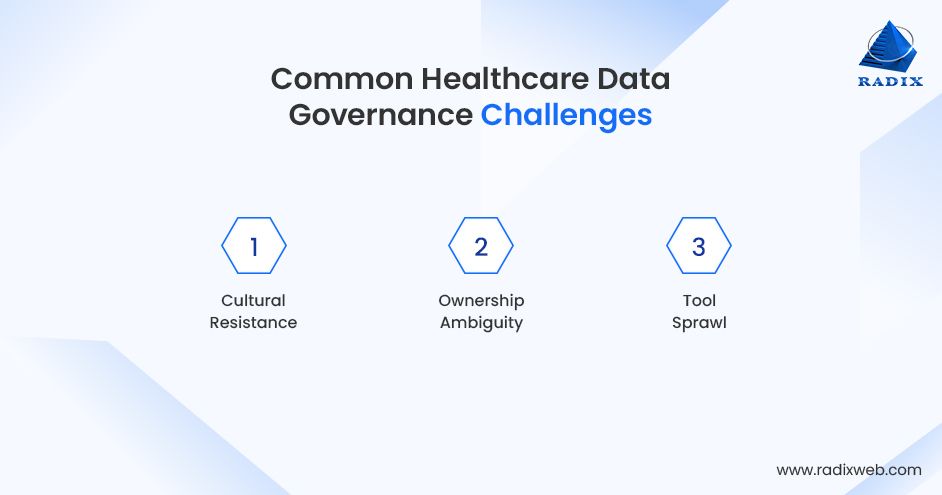
Clinicians view governance as an administrative burden that slows patient care. "Why document data definitions when I'm treating patients?" mentality blocks participation.
How to Mitigate
No one knows who "owns" patient matching rules or lab result standards. IT claims technical responsibility, while clinical teams claim usage authority. Nothing gets decided.
How to Mitigate
Teams deploy overlapping solutions like EHR plugins, standalone catalogs, Excel trackers, quality platforms that create integration gaps and training nightmares.
How to Mitigate

Closing Perspective for Healthcare Leaders
Data governance becomes a clinical and business enabler for healthcare leaders. It reduces friction in care delivery, shortens reporting cycles, strengthens audit readiness, and creates the data foundation required for analytics and AI to deliver real value.The difference is execution. As policies alone do not change outcomes, clear ownership, enforceable standards, and governance embedded into everyday workflows hold the key. Hence, organizations that treat governance as operating infrastructure, not a side initiative, move faster with less risk and greater confidence in their data.The next step is practical action. Start by focusing on the data domains that matter most, assign real decision authority, and measure progress in operational terms.If you need support designing or implementing a healthcare-ready data governance model, our healthcare software engineering team can help. We’ve assisted organizations in aligning governance with clinical realities, regulatory demands, and modern analytics initiatives. Get on a quick discovery session with us to know more.
Ready to brush up on something new? We've got more to read right this way.